 Calc
Wavelength Solver Calculator – Solve v = fλ for Speed, Frequency or Wavelength
 Created by David Okafor · Physics Writer · Waves & Light · Last updated: November 2026
Use this free Wavelength Solver Calculator to rearrange the wave equation v = fλ and find whichever value is missing — wave speed, frequency or wavelength — for sound, light, water waves or any other wave.
Most wave calculations hand you two of the three quantities and ask for the third, and students lose marks not on the physics but on the algebra — dividing when they should multiply, or solving for the wrong letter. This solver removes that friction: you choose which quantity is missing, type in the two you know, and the rearrangement is done for you, correctly, every time. Underneath sits the single most important equation in wave physics, v = fλ, the relation that ties together how fast a wave travels, how often it oscillates and how long each oscillation is.
The three quantities play very different roles. The speed v belongs to the medium: it is fixed by what the wave is travelling through — the temperature of the air, the tension in a string, the material of a solid — and the source cannot change it. The frequency f belongs to the source: it is set by whatever is vibrating, and it stubbornly refuses to change even when the wave crosses into a different medium. The wavelength λ belongs to neither; it is the compromise the other two negotiate, the distance the wave manages to travel during one complete oscillation of its source. Because λ is the dependent quantity, it is the one that stretches and shrinks as conditions change — and the one most often asked for.
The ranges involved are humbling. One equation covers the 1,500-metre waves of long-wave radio and the trillionths of a metre of gamma rays; the seven-metre swell of a concert hall's deepest organ note and the half-millimetre ripple of a medical ultrasound pulse. Nothing about the mathematics changes across those twenty powers of ten — only the numbers do. That universality is exactly why the rearrangement skill matters: learn to solve v = fλ in all three directions here, with sound and light and water waves, and you have quietly learned the working core of acoustics, optics, radio engineering and seismology.
Formula
v = f × λ • rearranged: λ = v / f • f = v / λ • and since the period T = 1/f, also v = λ / T
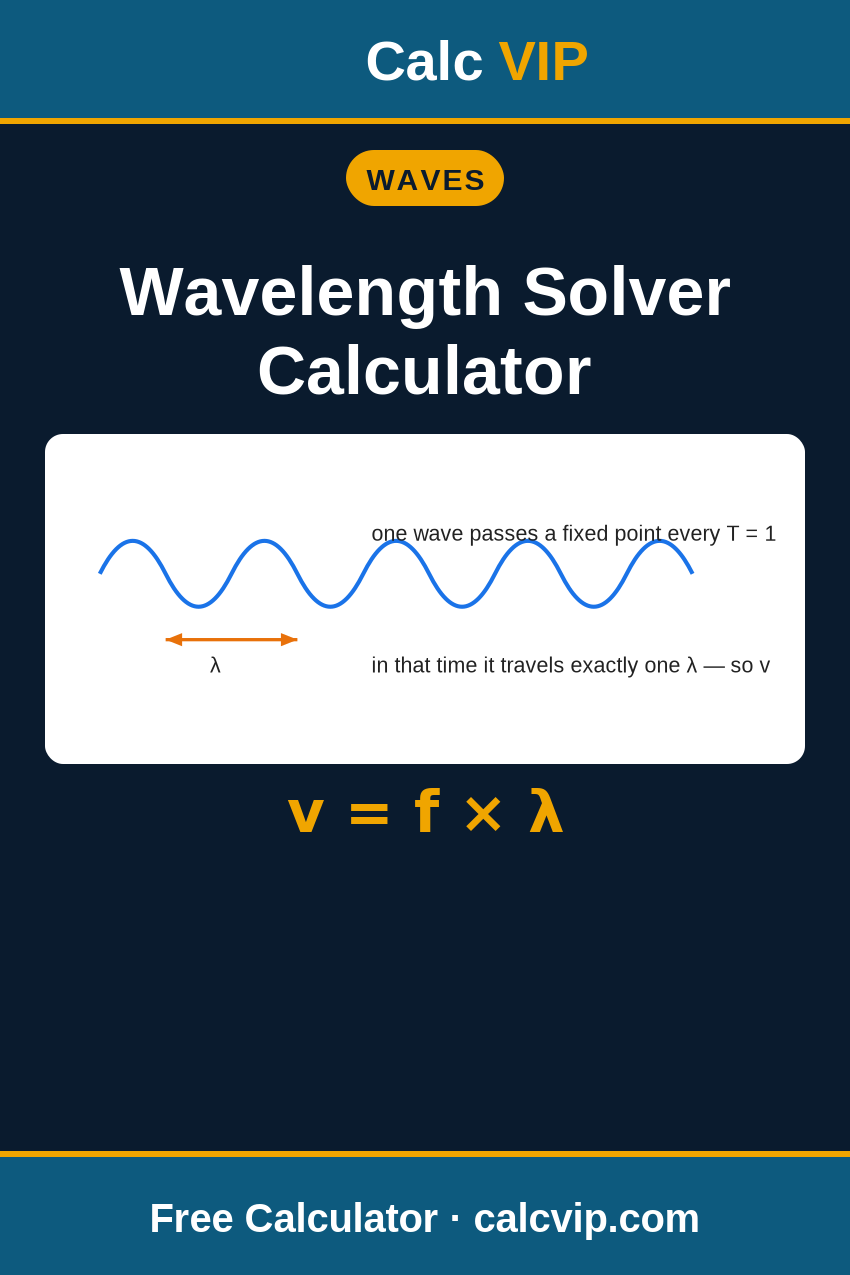
All three forms are the same statement wearing different clothes: in one second, f waves pass a point, each λ long, so the wave front advances f × λ metres — which is the speed. To find wavelength, divide the speed by the frequency. To find frequency, divide the speed by the wavelength. To find speed, multiply frequency by wavelength. The units police the algebra for you: m/s divided by Hz (1/s) leaves metres; m/s divided by metres leaves 1/s, i.e. hertz; Hz multiplied by metres leaves m/s. If your units do not cancel into the quantity you wanted, you have picked the wrong rearrangement — a built-in error check that costs nothing to use. Keep everything in SI base units while calculating — hertz, not kilohertz; metres, not centimetres or nanometres — and convert only the final answer.
| Symbol | Meaning | Units |
|---|---|---|
| v | wave speed — set by the medium | m/s |
| f | frequency — set by the source | hertz (Hz) |
| λ | wavelength — distance per cycle | m |
| T | period — time per cycle, T = 1/f | seconds (s) |
Why the wavelength is always the one that adjusts
Run a thought experiment. A loudspeaker plays a steady 440 Hz tone into a room. The air fixes the speed at 343 m/s, the speaker fixes the frequency at 440 Hz, and the wavelength has no freedom left: it must be 343 ÷ 440 = 0.78 m. Now carry the speaker underwater — conceptually — and play the same tone. The speaker still vibrates 440 times a second, but water carries sound at 1,480 m/s, so the wavelength stretches to 1,480 ÷ 440 = 3.36 m. Neither the source nor the medium "decided" the wavelength; it fell out of the division. This is why λ is the adjustable quantity in every wave phenomenon: refraction bends light because the wavelength changes at a boundary while the frequency cannot; a guitar string's pitch rises when you shorten it because the wavelength is halved while the wave speed on the string stays put.
The inverse relationship deserves its own moment, because it runs the whole show. At fixed speed, frequency and wavelength sit on a seesaw: double f and λ halves; halve f and λ doubles. Everything from the layout of the electromagnetic spectrum to the size of concert halls is this seesaw at work. Bass notes have wavelengths of metres, which is why they leak through walls and doorways; ultrasound has wavelengths of millimetres, which is why it can image a kidney stone. Whenever a question asks "what happens to the wavelength if…", first ask what happened to the speed and the frequency — the seesaw does the rest.
How to use
- Decide which quantity is missing — wavelength, frequency or speed — and select it in the "What do you want to find?" menu; the input labels change to match.
- Enter the two values you know, in SI units: speed in m/s, frequency in plain hertz (convert kHz, MHz and GHz first), wavelength in metres (convert cm, mm and nm first).
- Click "Calculate" to see the missing value with the rearrangement used, so you can follow the working.
- Sanity-check the answer against the seesaw: a higher frequency than your reference should give a shorter wavelength, and light should come out near 3 × 10⁸ m/s. If the size looks wrong, a prefix conversion is the usual culprit.
Worked examples
Example 1 — finding wavelength (sound). A sound wave travels through air at 343 m/s with a frequency of 440 Hz.
λ = v / f = 343 ÷ 440 = 0.78 m. Each wave is about 78 cm long — roughly the width of a doorway, which is why this pitch bends through doorways so readily.
Example 2 — finding frequency (light). Green light has a wavelength of 550 nm = 5.5 × 10⁻⁷ m and travels at 3 × 10⁸ m/s.
f = v / λ = 3 × 10⁸ ÷ (5.5 × 10⁻⁷) = 5.45 × 10¹⁴ Hz. The electric field of green light oscillates more than five hundred trillion times per second — no mechanical source comes within ten orders of magnitude of it.
Example 3 — finding speed (water waves). Ocean swell arrives with a frequency of 0.5 Hz (one wave every two seconds) and a wavelength of 6 m.
v = f × λ = 0.5 × 6 = 3 m/s — a brisk walking pace, which is why swimmers can watch a wave approach and brace for it.
Example 4 — finding wavelength (radio). An FM station broadcasts at 100 MHz = 1 × 10⁸ Hz, and radio waves travel at light speed, 3 × 10⁸ m/s.
λ = 3 × 10⁸ ÷ 1 × 10⁸ = 3 m. A good FM aerial is a quarter of this — about 75 cm — which is exactly the length of the telescopic aerials on older radios.
Example 5 — finding wavelength (ultrasound). A medical scanner sends 5 MHz ultrasound through soft tissue, where the speed is 1,540 m/s.
λ = 1,540 ÷ 5,000,000 = 3.08 × 10⁻⁴ m = 0.31 mm. Structures a few wavelengths across — a millimetre or so — are the smallest the image can resolve, which is why scanner frequencies live in the megahertz.
Example 6 — finding frequency (microwaves). A microwave oven's waves are 12.24 cm = 0.1224 m long and travel at 3 × 10⁸ m/s.
f = 3 × 10⁸ ÷ 0.1224 = 2.45 × 10⁹ Hz = 2.45 GHz — the frequency printed on the oven's rating plate, recovered from a ruler measurement of the wave.
The wave equation in real life
Antenna design. An efficient aerial is a fixed fraction of a wavelength — a quarter-wave whip for 100 MHz FM is 75 cm, while a phone's Wi-Fi antenna at 2.4 GHz (λ = 12.5 cm) needs only about 3 cm and hides inside the case. Every antenna ever built started life as a v = fλ calculation.
Musical acoustics. A string or pipe of length L sounds a fundamental whose wavelength is fixed by the geometry (2L for a string), so the pitch follows from f = v/λ. Instrument makers solve this equation in reverse all day: choose the note, and the equation dictates the length.
Earthquake location. Seismic waves cross the Earth at several km/s with periods of seconds to minutes — wavelengths of kilometres. Comparing arrival times and wavelengths at different stations lets seismologists triangulate an epicentre and probe the planet's interior layers.
Sonar and radar ranging. Both technologies time echoes, but interpreting them — and choosing frequencies that will reflect off a submarine hull or a rain cloud rather than pass around it — depends on comparing the target's size with the wavelength from this equation.
Optical instruments. A microscope cannot resolve detail much finer than the wavelength of its light (about 0.5 µm for visible light), and a telescope's sharpness scales with λ too. The equation sets the hard limits that lens quality can only approach, never beat.
Room and hall design. A 50 Hz bass note has a wavelength of 6.86 m — longer than most rooms. Architects use λ = v/f to predict which frequencies will resonate in a space, boom in corners or vanish in dead spots, long before the building exists.
The period form: v = λ / T
Frequency and period are two views of the same rhythm: f counts cycles per second, T measures seconds per cycle, and T = 1/f. Substituting gives v = λ/T — the wave travels one wavelength in one period. This form is the practical one whenever the raw data is a time rather than a rate: an oscilloscope trace showing a wave repeating every 0.0025 s (T) with λ = 0.86 m gives v = 0.86 ÷ 0.0025 = 344 m/s, recognisably sound in air. Oceanographers live in this form — swell is reported by period (say 10 s) because that is what a buoy clock measures — and seismologists likewise quote periods of tens of seconds for waves whose frequencies, thousandths of a hertz, look awkward. The solver's frequency mode handles it with one extra step: convert T to f = 1/T first.
Quick reference: the same equation across physics
| Wave | Speed v | Frequency f | Wavelength λ |
|---|---|---|---|
| long-wave radio | 3 × 10⁸ m/s | 200 kHz | 1,500 m |
| FM radio | 3 × 10⁸ m/s | 100 MHz | 3 m |
| Wi-Fi | 3 × 10⁸ m/s | 2.4 GHz | 12.5 cm |
| middle C (sound) | 343 m/s | 262 Hz | 1.31 m |
| bat ultrasound | 343 m/s | 40 kHz | 8.6 mm |
| red light | 3 × 10⁸ m/s | 4.29 × 10¹⁴ Hz | 700 nm |
Read any row in any direction and it is a solved example of this calculator. Read the whole table top to bottom and it is the seesaw made visible: as frequency climbs by twenty powers of ten, wavelength falls by the same twenty, with the speed never budging.
Dispersion: when one medium offers several speeds
The solver assumes the medium names a single speed, and for sound in air that is essentially true. But some media are dispersive — the speed depends on the frequency itself. Deep-water ocean waves are the friendliest example: their speed is v = √(gλ/2π), so long waves outrun short ones — a 100 m swell travels at √(9.81 × 100/6.283) = 12.5 m/s, while a 25 m chop manages only √(9.81 × 25/6.283) = 6.25 m/s. That is why storm waves sort themselves into smooth, ordered swell as they cross an ocean: the long ones arrive first, each wavelength travelling at its own speed, every one of them still obeying v = fλ. Glass does the same to light, more subtly: the refractive index is slightly larger for violet than for red, so the speeds differ by about a percent — and a prism fans white light into a spectrum. In dispersive company, use the solver one frequency at a time, with that frequency's own speed.
Common mistakes
- Leaving prefixes unconverted. Entering 2.45 for a 2.45 GHz wave gives a wavelength out by a factor of a billion. Convert kHz, MHz, GHz, cm, mm and nm into plain Hz and metres before calculating, every time.
- Multiplying when you should divide. λ = v/f, not v × f. The units check catches this instantly: m/s × Hz gives m/s², not metres — if the units are wrong, the rearrangement is wrong.
- Using the speed of light for sound (or vice versa). The equation is universal but the speed is not: 343 m/s for sound in air, 3 × 10⁸ m/s for light in vacuum, 1,480 m/s for sound in water. Picking the wrong medium's speed is the commonest source of absurd answers.
- Assuming the frequency changes in a new medium. It does not — the source sets it. When a wave crosses a boundary, the speed changes and the wavelength absorbs the entire difference.
- Confusing wavelength with amplitude. λ is measured along the direction of travel, between matching points on neighbouring waves. The wave's height — its loudness or brightness — is amplitude, and it appears nowhere in v = fλ.
FAQ
Does this work for light as well as sound?
Yes. The equation v = fλ applies to every wave. For light in a vacuum use v = 3 × 10⁸ m/s.
What happens to wavelength if frequency doubles?
At the same speed, doubling the frequency halves the wavelength — the waves are packed twice as tightly.
Why does the speed stay the same when a wave changes frequency?
The speed is set by the medium (for example, the temperature of the air), not by the source. When the source vibrates faster, the wavelength simply shortens so that v = fλ still holds.
What is the difference between this solver and a wavelength calculator?
An ordinary wavelength calculator only does λ = v/f. This solver does all three rearrangements — it will also find the frequency from speed and wavelength, or the speed from frequency and wavelength — which is what most real problems actually ask.
Can I use this for waves on a string?
Yes. The speed is the wave speed along the string (set by its tension and mass per unit length), the frequency is the vibration frequency, and the wavelength is the length of one full wave along the string. For the fundamental of a string fixed at both ends, λ = 2L.
How do I handle a period instead of a frequency?
Convert first: f = 1/T. A wave with a period of 0.002 s has a frequency of 500 Hz. Then use the solver as normal. Equivalently, v = λ/T directly.
Why does my light calculation give a wavelength in metres like 0.0000007?
Because that is correct — visible light's wavelength really is about 7 × 10⁻⁷ m. Multiply by 10⁹ to express it in nanometres (700 nm), the unit light is usually quoted in.
Does the equation work for earthquake waves?
Yes. Seismic waves travel at several kilometres per second with periods of seconds to minutes, giving wavelengths of kilometres to hundreds of kilometres — which is why they are felt over whole regions rather than at a point.
What speed should I use for light in glass or water?
Light slows in a material of refractive index n to v = c/n — about 2.26 × 10⁸ m/s in water (n = 1.33) and 2 × 10⁸ m/s in glass (n = 1.5). The frequency stays the vacuum value; the wavelength shrinks by the factor n.
Is there a wave for which v = fλ fails?
The equation itself is a definition-level truth for any periodic wave. What can fail is assuming a single speed: in dispersive media (a prism, deep water) the speed depends slightly on frequency, so each frequency component has its own v and its own λ — but each still obeys v = fλ individually.