 Calc
Closed Pipe Harmonics Calculator – Odd Harmonics of a Stopped Pipe
 Created by David Okafor · Physics Writer · Waves & Light · Last updated: November 2026
Use this free Closed Pipe Harmonics Calculator to list the resonant frequencies of a pipe that is open at one end and closed at the other — like a clarinet or a stopped organ pipe. A closed pipe only resonates at odd harmonics, so enter the pipe length and the speed of sound to see the first four of them, with their wavelengths.
The reason is a boundary condition, and it is absolute. Air at the closed end cannot move — the cap is in the way — so the standing wave must have a displacement node there. Air at the open end is free to rush in and out, so the wave must have an antinode there. A standing wave that is pinned to zero at one end and maximal at the other can only fit an odd number of quarter-wavelengths into the pipe: one quarter for the fundamental, three quarters for the next, then five, seven, and so on. The even multiples simply cannot satisfy both ends at once, and no amount of blowing will persuade them to exist.
That one missing family of harmonics shapes whole instruments. A closed pipe's fundamental, f₁ = v/(4L), is an octave below an open pipe of the same length — which is why the clarinet, a closed pipe driven by a reed, reaches surprisingly low notes for its size, and why its tone is hollow and woody: the even harmonics that give the flute its brightness are absent, leaving a spectrum dominated by the odd series 1, 3, 5, 7… A sound built from odd harmonics alone is an approximation of a square wave, and the ear reads it as mellow, dark and a little hollow.
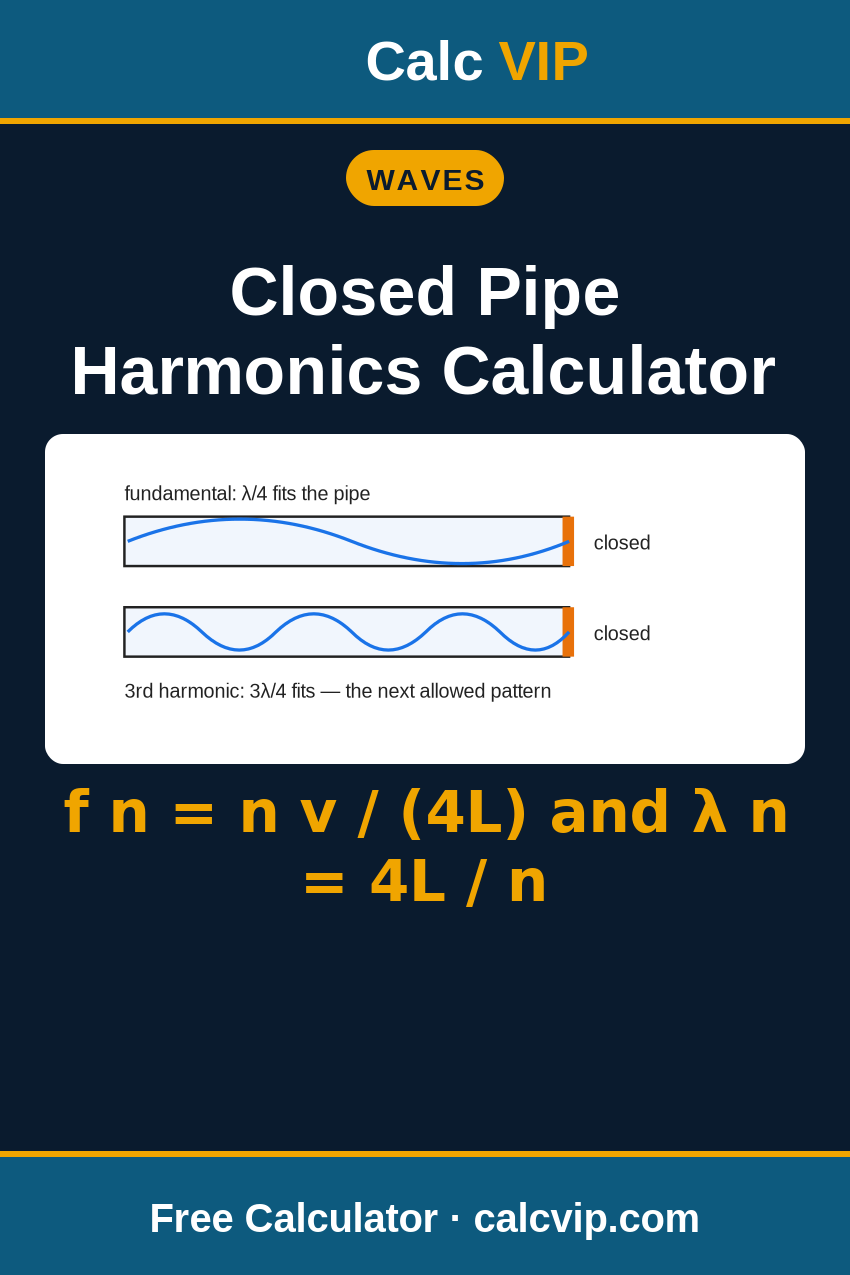
This calculator lists the first four allowed resonances — the 1st, 3rd, 5th and 7th harmonics — with their wavelengths, from just the pipe length and the speed of sound. Two practical notes: measure the air column, not the tube (in a bottle, that means down to the water surface), and remember that real pipes sound a shade flatter than the ideal numbers because the antinode forms slightly beyond the open end — the end correction, covered in the depth section below.
Formula
For a pipe closed at one end, only odd harmonics fit: fn = n v / (4L) and λn = 4L / n, for n = 1, 3, 5, 7, … The fundamental is f₁ = v / (4L).
The formula rearranges for design work: to build a pipe for a target fundamental, L = v / (4f₁); to find what harmonic a given frequency represents, n = 4Lf / v — and if that n is not an odd whole number, the frequency is not a resonance of the pipe at all. The wavelengths follow λn = 4L/n, so the fundamental's wavelength is always four times the pipe's length: a stopped pipe is a quarter-wave resonator, the acoustic twin of the quarter-wave aerial. Units: L in metres, v in metres per second (about 343 m/s in air at 20 °C, rising roughly 0.6 m/s per degree), f in hertz.
| Symbol | Meaning | Units |
|---|---|---|
| fn | frequency of the n-th harmonic (n odd only) | hertz (Hz) |
| L | length of the air column | metres (m) |
| v | speed of sound in the gas inside | m/s |
| λn | wavelength of the n-th harmonic | metres (m) |
Nodes, antinodes and the quarter-wave rule
It helps to picture the air's motion rather than its pressure. In the fundamental, air at the closed end is perfectly still while air at the mouth swings in and out at full amplitude; between them the motion grades smoothly, tracing a quarter of a sine wave along the pipe. Add the next allowed pattern and the pipe holds three quarters of a wave: an extra node and antinode appear along its length, and the frequency triples — not doubles, because the pattern that would double it (a half-wave, needing an antinode where the second node falls) contradicts the closed end. Every allowed mode is the fundamental's shape with extra odd quarter-waves inserted, which is why the series runs 1, 3, 5, 7 with ratios exactly like the odd numbers themselves.
Pressure tells the complementary story: where displacement has a node, pressure has an antinode. The closed end of a sounding pipe experiences the full pressure swing of the wave — which is why a microphone placed at the closed end of a resonance tube picks up the resonance so strongly, and why the capped end of an organ pipe must be sealed well. A leak at the closed end spoils the node, and the pipe's pitch and response wander with it.
How to use
- Measure the length of the air column in metres — for a bottle or resonance tube, measure from the opening down to the water surface, not the full container.
- Enter the speed of sound for the air temperature: about 343 m/s at 20 °C (331 m/s at 0 °C, 349 m/s at 30 °C).
- Click "Show Harmonics" to see the first four allowed harmonics — the 1st, 3rd, 5th and 7th — with their frequencies and wavelengths.
- To design for a target note instead, use L = v/(4f₁) from the Formula section, then check the resulting harmonic series here.
Worked examples
Example 1 — the reference pipe. A closed pipe of length L = 0.85 m with v = 340 m/s:
Fundamental f₁ = 340 / (4 × 0.85) = 100 Hz, λ₁ = 4 × 0.85 = 3.40 m.
3rd harmonic: 300 Hz, λ = 1.13 m • 5th: 500 Hz, λ = 0.68 m • 7th: 700 Hz, λ = 0.49 m.
There is no 2nd, 4th or 6th harmonic — they cannot fit a node at the closed end and an antinode at the open end.
Example 2 — the clarinet's low register. A clarinet's air column for its lowest notes is about L = 0.60 m; with v = 343 m/s, f₁ = 343 / (4 × 0.60) = 142.92 Hz, and the series continues 428.75, 714.58 and 1000.42 Hz. An open pipe of the same length would start at 285.83 Hz — a full octave higher — which is the entire secret of the clarinet's compact low register.
Example 3 — a stopped organ rank. A stopped flue pipe L = 2.44 m long (an "8-foot" stop whose pipes are actually half the length of the equivalent open rank) gives f₁ = 343 / (4 × 2.44) = 35.14 Hz, with harmonics at 105.43, 175.72 and 246.00 Hz. Organ builders exploit exactly this: stopped pipes deliver deep bass from half the metal and half the church height.
Example 4 — the resonance-tube experiment. In the classic school experiment a 512 Hz fork is held over a tube whose water level can be lowered. The first resonance sounds when the air column is L = v/(4f) = 343 / (4 × 512) = 0.1675 m ≈ 16.75 cm; lowering the water to three times that length, 50.24 cm, brings the 3rd harmonic of the same tube to the fork's frequency. The ratio of the two lengths, 1:3, is the odd-harmonic rule measured with a ruler.
Example 5 — a test tube as an instrument. Blowing across a test tube with an air column of L = 0.17 m gives f₁ = 343 / (4 × 0.17) = 504.41 Hz — a note near B5 — with the next resonance at 3 × 504.41 = 1513.24 Hz. Adding water shortens the column and raises the pitch, which is why a row of tubes or bottles at different fill levels makes a playable scale.
Example 6 — the shortest panpipe tube. A stopped panpipe tube of L = 0.10 m sounds f₁ = 343 / (4 × 0.10) = 857.5 Hz. Panpipes and bottle organs are built from the rearranged formula: each tube's length is chosen as L = v/(4f) for its note, so the lowest note of the set needs a tube a full quarter-wavelength long — the quarter-wave rule, cut in bamboo.
Closed pipes in real life
The clarinet family. Clarinets, and the stopped registers they inspire, are the textbook closed pipe: cylindrical bore, reed acting as the closed end, first register built on the fundamental, second register reached not by the octave but by the 3rd harmonic — a twelfth higher — which is why the clarinet's fingering system needs its extra register key logic.
Stopped organ pipes. Half the length, same pitch: stopped ranks fill the bass of organs where a full-length open pipe would not fit under the ceiling. Their softer, flutier tone — the odd-harmonic spectrum again — is chosen deliberately for quiet accompaniment stops.
Bottle instruments and Helmholtz-ish toys. Blowing across bottles, jugs and ocarina-like vessels gives the familiar low hoot. (A bottle's resonance is strictly a Helmholtz resonance of the neck and volume rather than a pipe mode, but the quarter-wave pipe is the right first model for tubes and the reason long-necked vessels sing low.)
Exhaust and intake tuning. A car's exhaust tailpipe and intake runners behave partly as closed-open resonators; engineers place their quarter-wave resonances to cancel boom frequencies or to scavenge cylinders. The side-branch "quarter-wave resonator" fitted to intake systems is this calculator's formula cast in plastic — a blind tube whose length is v/(4f) for the drone frequency it must kill.
Architectural acoustics. A corridor, stairwell or bottle-shaped alcove open at one end resonates at its quarter-wave frequency and odd multiples, colouring speech and amplifying particular low notes. Room-mode calculations for studios use the same boundary-condition logic with walls playing the closed end.
Wind instruments you blow across. The pan flute, the quena's stopped cousin tubes, and the humble blown test tube all follow the rule: pitch set by air-column length, overblowing (where possible) jumping a twelfth rather than an octave — the unmistakable fingerprint of the odd-only series.
The end correction: why real pipes sound flatter
The standing wave does not stop dead at the rim of the pipe. The air just outside the open end is dragged into the oscillation, so the antinode sits a little beyond the physical end — by about 0.6 times the pipe's radius for an unflanged opening. The pipe therefore behaves as if it were longer by that amount, and every resonance drops. For the Example 1 pipe fitted with a radius of 2 cm, the correction is 0.6 × 0.02 = 0.012 m, the effective length becomes 0.862 m, and the fundamental falls from 100 Hz to 340 / (4 × 0.862) = 98.61 Hz — flat by about a quarter of a semitone. Wide pipes suffer most, which is why organ builders voice and trim each pipe by ear, and why the resonance-tube experiment of Example 4 actually uses the difference between two resonance lengths: the correction cancels out of the subtraction.
Quick reference: fundamental frequency by pipe length (v = 343 m/s)
| Air column L | Closed pipe f₁ = v/4L | 3rd harmonic | Nearest note |
|---|---|---|---|
| 0.10 m | 857.5 Hz | 2572.5 Hz | ≈ A6 |
| 0.25 m | 343.0 Hz | 1029.0 Hz | ≈ F4 |
| 0.50 m | 171.5 Hz | 514.5 Hz | ≈ F3 |
| 0.85 m | 100.88 Hz | 302.65 Hz | ≈ G2 |
| 1.00 m | 85.75 Hz | 257.25 Hz | ≈ F2 |
| 2.00 m | 42.88 Hz | 128.63 Hz | ≈ E1 |
Halving the length doubles the fundamental — the same octave rule as every other resonator — but the closed pipe always starts an octave below its open twin of equal length. That single fact, plus the odd-only spectrum, is enough to identify a closed pipe from a recording: find the fundamental, then check whether the first strong overtone sits at 2f (open) or 3f (closed).
Temperature works through the same table from the other side: the pipe's length is fixed, but v is not. On a hot afternoon at 30 °C the speed of sound rises to about 349 m/s, and the 0.85 m pipe's fundamental climbs to 349 / (4 × 0.85) = 102.65 Hz — nearly 2% sharp of its 100.88 Hz value at 343 m/s, about a third of a semitone. Wind players live with this daily: a cold instrument plays flat, and as the player's breath warms the bore the pitch creeps up, which is why orchestras tune after warming up and why organ builders specify the temperature at which a rank was voiced. The calculator's v input is where that whole story enters.
Common mistakes
- Using the open-pipe formula. f = v/(2L) belongs to pipes open at both ends. For a closed pipe the denominator is 4L — using 2L predicts a fundamental an octave too high.
- Expecting a 2nd harmonic. There is none, ever, in the ideal closed pipe. If a measurement seems to show one, you are hearing the source's own harmonics leaking through, not a pipe resonance.
- Measuring the container instead of the air column. In a bottle or resonance tube the column ends at the water surface. Including the water-filled part of the tube understates the frequency badly.
- Forgetting the temperature. v rises about 0.6 m/s per °C. A pipe calculated at 343 m/s but played in a 0 °C hall (v ≈ 331 m/s) sounds about 3.5% flat — most of a semitone — with no change in length at all.
- Ignoring the end correction on wide tubes. For narrow tubes the correction is a detail; for a tube whose radius is a tenth of its length it shifts the fundamental by several percent (Example: 100 → 98.61 Hz for r = 2 cm). Laboratory measurements should use two resonance lengths and subtract.
FAQ
Why are the even harmonics missing?
The closed end must be a node (air cannot move there) and the open end an antinode. Only an odd number of quarter-wavelengths can satisfy both conditions at once, so only odd multiples of the fundamental appear.
Why does a clarinet sound lower than a flute of the same length?
The clarinet behaves like a closed pipe, so its fundamental is v/(4L) — one octave below the flute, an open pipe whose fundamental is v/(2L). The missing even harmonics also give the clarinet its hollow, woody tone.
What is the end correction?
The antinode at the open end actually sits slightly outside the pipe, by about 0.6 times the pipe's radius. Real pipes therefore sound a touch flatter than this ideal calculation; the wider the pipe, the bigger the effect.
Is the clarinet really a closed pipe?
To a good approximation, yes: the reed end behaves as a closed end for the air column, and the bore is cylindrical, so the odd-harmonic model fits well. The saxophone, despite its reed, is conical — and a cone behaves like an open pipe with all harmonics, which is why saxophones overblow the octave and clarinets the twelfth.
What is the wavelength of the fundamental compared with the pipe?
Always four times the pipe length: λ₁ = 4L. Only a quarter of the wave lives inside the pipe; the rest is a convenient fiction extending beyond the open end.
Does the pipe's diameter change the pitch?
Only through the end correction: wider pipe, larger correction, slightly lower pitch. The ideal formula ignores diameter entirely — two pipes of equal length but different widths have the same nominal series, the wider one sounding marginally flatter.
Can a closed pipe resonate at its 2nd harmonic if I blow harder?
No. Blowing harder excites the higher allowed modes more strongly — the 3rd, then the 5th — which is the clarinet's register jump to the twelfth. The forbidden modes stay forbidden at any pressure, because the boundary conditions do not care how hard you blow.
Why do stopped organ pipes sound softer and flutier than open ones?
Two reasons: the missing even harmonics remove the brightness the ear associates with open flue pipes, and the cap reflects energy back into the pipe rather than radiating it, so less power escapes per cycle. Builders use both effects deliberately for quiet stops.
What happens if I close both ends?
Then both ends are nodes, and the pipe supports the same series as a string or an open pipe — all harmonics of v/(2L) — but with no opening, the sound can barely escape, so you mostly hear it through the walls of the tube.
How accurate is this calculator for a real bottle?
For tubes and pipes, very good — within the end correction. For bottles with narrow necks and fat bodies, the true resonance is a Helmholtz resonance governed by neck area and volume, and the pipe formula can be off by a large factor; treat bottle numbers here as a rough guide only.