 Calc
Decibel Ratio Calculator – Intensity, Power & Amplitude Ratios from dB
 Created by David Okafor · Physics Writer · Waves & Light · Last updated: November 2026
Use this free Decibel Ratio Calculator to turn a difference in decibels into real-world ratios. Enter a dB difference to find out how many times more intense, more powerful, or larger in amplitude one signal is than another.
Decibels are a way of talking about ratios without drowning in zeros. The quietest sound a young ear can detect carries an intensity of about 10⁻¹² W/m²; a jet engine at close range delivers about 10² — fourteen powers of ten apart. No linear scale survives that range gracefully, so acoustics compresses it with a logarithm: every 10 dB multiplies the intensity by ten. The price of that convenience is that decibel statements are meaningless until they are converted back into ratios — and converting them back is exactly what this calculator does. Type in a difference and it tells you the honest multipliers hiding inside it: how many times the intensity, how many times the power, and how many times the amplitude.
The subtlety that trips up nearly everyone is that the decibel wears two conversion factors. For intensity and power — the energy-carrying quantities — the ratio is 10 raised to (dB/10). For amplitude-like quantities — pressure, voltage, displacement — the ratio is 10 raised to (dB/20), because intensity goes as the square of amplitude and the square doubles the logarithm's coefficient. Twenty decibels is therefore a hundredfold intensity but only a tenfold amplitude, and confusing the two is the single most common decibel error in textbooks, product brochures and exam answers alike.
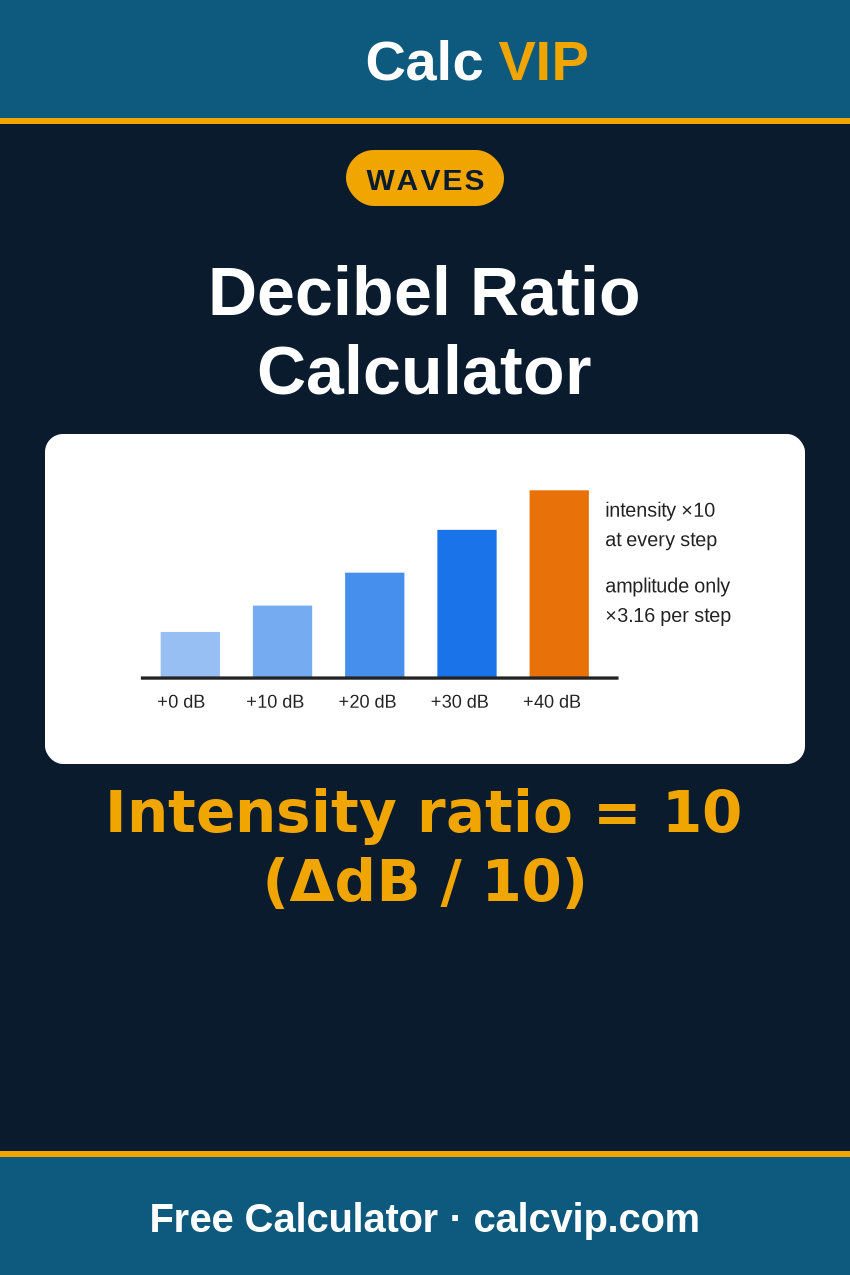
Keep in mind, too, what a decibel difference is not: it is not an amount of anything. "20 dB louder" compares two sounds but says nothing about either one's absolute level — a whisper raised by 20 dB is still quiet, and a siren lowered by 20 dB is still loud. Absolute levels need a reference (for sound in air, the 10⁻¹² W/m² threshold), while differences are pure ratios, portable between any pair of signals. This page deals in differences; the worked examples show how to chain them onto real levels when you need to.
Formula
Intensity ratio = 10(ΔdB / 10) • Power ratio = 10(ΔdB / 10) • Amplitude ratio = 10(ΔdB / 20)
Both formulas descend from the definition of a level difference: ΔdB = 10 × log₁₀(I₂/I₁). Solve for the ratio and the first formula appears. Amplitude enters through the physics of waves: intensity is proportional to amplitude squared, I ∝ A², so I₂/I₁ = (A₂/A₁)²; take the same 10 × log₁₀ of that and the square steps outside the logarithm, doubling the coefficient to 20 — hence ΔdB = 20 × log₁₀(A₂/A₁), and the second formula. Run either backwards to convert a ratio into decibels: a power ratio of 200 is 10 × log₁₀(200) = 23.01 dB, and an amplitude ratio of 200 is 20 × log₁₀(200) = 46.02 dB. Negative differences are welcome throughout: they simply produce ratios below 1, describing the smaller signal as a fraction of the larger.
| Symbol | Meaning | Units |
|---|---|---|
| ΔdB | difference between two levels (louder minus quieter) | decibels (dB) |
| I₂/I₁ | intensity ratio — energy per second per square metre | — (a multiplier) |
| P₂/P₁ | power ratio — same conversion as intensity | — (a multiplier) |
| A₂/A₁ | amplitude ratio — pressure, voltage or displacement | — (a multiplier) |
Why logarithms? Because your ears use them too
The decibel was not invented to torment students; it mirrors the senses. Human hearing responds to ratios, not differences: a sound must grow by a roughly constant percentage to seem one step louder, whether the starting point is a whisper or a shout. A scale built on logarithms has exactly that property — equal steps anywhere on it mean equal ratios — so a 10 dB rise feels like a comparable event at any level, even though at 40 dB it multiplies the intensity by ten from almost nothing and at 100 dB by ten from a great deal. Engineers adopted the bel (and its tenth, the decibel) for telephone lines in the 1920s, and the unit escaped into every field where ratios span many powers of ten: acoustics, radio, electronics, optics, seismology's cousins, even photography's exposure stops, which are the same idea in base 2.
The logarithmic bargain has one sharp edge: decibels from separate sources do not add like ordinary numbers. Two identical 90 dB machines running together do not make 180 dB; their intensities add, doubling the power, which is +3.01 dB — a total of 93.01 dB. Adding sources means converting to ratios, adding those, and converting back — precisely the round trip this calculator performs. Keep that discipline and decibels become a sharp tool; skip it and they produce confident nonsense, usually in marketing copy.
How to use
- Enter the difference between the two sound levels in decibels — for example, 90 dB minus 70 dB is a 20 dB difference.
- Click "Calculate Ratios" to see how many times greater the intensity, power and amplitude of the louder sound are.
- A negative difference works too: −20 dB means the second sound is 100 times less intense.
- To go the other way — from a ratio to decibels — use ΔdB = 10 × log₁₀(ratio) for power or intensity, and 20 × log₁₀(ratio) for amplitude.
Worked examples
Example 1 — twenty decibels. One sound is 20 dB louder than another.
Intensity ratio = 10(20/10) = 10² = 100 — the louder sound carries 100 times the intensity.
Power ratio = 100 as well, while the amplitude ratio = 10(20/20) = 10.
Example 2 — the famous 3 dB. For Δ = 3 dB: intensity ratio = 100.3 = 1.995 ≈ 2, and amplitude ratio = 100.15 = 1.41 (which is √2 — no coincidence, since doubling intensity means multiplying amplitude by √2). Three decibels is the doubling step of the energy world, and audio engineers budget whole careers in it.
Example 3 — ten decibels. For Δ = 10 dB: intensity ratio = 101 = 10, amplitude ratio = 100.5 = 3.16. Ten decibels is also roughly the step the ear judges as "twice as loud" — a doubling of sensation bought with a tenfold multiplication of physical intensity, the clearest illustration of the ear's logarithmic compression.
Example 4 — thirty decibels. For Δ = 30 dB: intensity ratio = 10³ = 1,000, amplitude ratio = 101.5 = 31.62. A 30 dB gap separates, for instance, a quiet bedroom (30 dB) from a busy office (60 dB): the office's air carries a thousand times the sound intensity, yet conversation there feels merely "much louder", not a thousand times anything.
Example 5 — going down: −6 dB. For Δ = −6 dB: intensity ratio = 10−0.6 = 0.251 — about a quarter — and amplitude ratio = 10−0.3 = 0.501 — about a half. This pair is the mirror of the distance law: moving twice as far from a source costs 6 dB, quartering the intensity and halving the pressure amplitude.
Example 6 — an amplifier's gain. A power amplifier is rated at 23 dB of gain. Its power ratio is 102.3 = 199.5 ≈ 200: feed it 0.5 W of signal and it delivers about 100 W to the speakers. The amplitude (voltage) gain is 1023/20 = 14.13 — the same box, described in the two dialects this page translates between.
Decibel ratios in real life
Hearing protection. Earplugs rated at −25 dB cut intensity by a factor of 102.5 ≈ 316 — the wearer receives about 0.32% of the sound energy. The modest-looking "25" on the packet is a three-hundredfold shield, which is why ratings should always be read as ratios.
Audio equipment. Amplifier gains, microphone sensitivities, signal-to-noise ratios and volume controls are all specified in decibels; converting them with this page's formulas is how engineers check that a chain of equipment neither whispers nor clips.
Radio and Wi-Fi link budgets. A phone receiving a signal 90 dB below the transmitted power is working with a power ratio of 10⁻⁹ — a billionth — and still decoding it. Antenna gains and cable losses, all in dB, are added and subtracted along the path like a bank account.
Soundproofing claims. A wall rated to reduce sound by 40 dB lets through 10⁻⁴ of the intensity — one part in ten thousand — but only half the benefit arrives in perceived terms, because the ear's "twice as quiet" needs only about 10 dB. Both numbers are true; they answer different questions.
Concerts versus conversation. The 60 dB gap between conversation (60 dB) and a loud concert (120 dB) is an intensity ratio of 10⁶ — a million. Hearing-damage guidance is written in such ratios, disguised as innocent-looking differences of level and time.
Photography and exposure. Photographers think in stops — doublings of light — which are decibels in base 2: one stop ≈ 3.01 dB of intensity. The same logarithmic instinct, wearing a different hat, in a different art.
Quick reference: decibel differences as ratios
| Difference ΔdB | Intensity / power ratio | Amplitude ratio |
|---|---|---|
| 1 dB | 1.26 | 1.12 |
| 3 dB | 2.00 | 1.41 |
| 6 dB | 3.98 | 2.00 |
| 10 dB | 10 | 3.16 |
| 20 dB | 100 | 10 |
| 30 dB | 1,000 | 31.62 |
| 40 dB | 10,000 | 100 |
| 60 dB | 1,000,000 | 1,000 |
Three rows deserve memory: 3 dB doubles the power, 6 dB doubles the amplitude, and 10 dB multiplies the power by ten. With those anchors and this table, most decibel claims in specifications and news stories can be audited on the spot.
References: when a difference becomes an absolute level
A difference in decibels needs no reference, but an absolute level is meaningless without one — so each field nails its decibel to a stated zero. Sound level in air uses the hearing threshold, 10⁻¹² W/m² (0 dB SPL). Radio and audio engineers use dBm, where 0 dBm is 1 milliwatt: a Wi-Fi signal of −70 dBm is 10⁻⁷ mW — ten million times weaker than the reference — yet perfectly usable. Electronics uses dBV (0 dBV = 1 volt) and dBu (0 dBu ≈ 0.775 V); digital audio uses dBFS, where 0 dBFS is the largest signal the system can represent and every real signal is a negative number of decibels below full scale. The suffix is not decoration — it is the reference, and dropping it turns a measurement into a rumour.
With references fixed, levels can be combined — but only through ratios. Two machines at 80 dB each give 10 × log₁₀(10⁸ + 10⁸) = 83.01 dB together, not 160 and not even 85. Add a third, quieter machine at 70 dB and the total becomes 10 × log₁₀(10⁸ + 10⁸ + 10⁷) = 83.22 dB: the quiet machine contributes barely a fifth of a decibel. This is why silencing the loudest source is the only noise-control strategy that pays — the logarithm ensures the biggest term dominates every sum, a rule this calculator's ratios make concrete.
The full span of hearing, in ratios
Stand back and admire what the ear handles. From the threshold of hearing to the threshold of pain is about 120 dB — an intensity ratio of 1012, a trillion, and an amplitude ratio of 106, a million. No single linear instrument could span that; the eye faces a similar range with starlight and sunlight and solves it the same way, with a roughly logarithmic response and an adjustable aperture. It is worth converting any dramatic decibel claim you meet — a "120 dB dynamic range" audio file, a "90 dB quieter" machine — into its ratio at least once, with this calculator, to feel what the numbers are really saying. Twelve orders of magnitude of physical range, folded into a scale you can count on your fingers: that folding is the decibel's entire purpose, and its entire danger when the folding is forgotten.
Common mistakes
- Dividing by 10 for amplitude. Amplitude ratios use dB/20. Using /10 for a pressure or voltage ratio squares the true answer — a "×100 amplitude" that should have been ×10 is a hundredfold error in the wave's actual size.
- Adding decibel levels directly. Two 90 dB sources make 93 dB, not 180 dB. Levels must be converted to intensities, added, and converted back. Any calculation that simply sums dB values from independent sources is wrong.
- Reading 0 dB as silence. Zero decibels of difference means "equal"; zero dB SPL means "at the reference intensity", the threshold of hearing — a real, faintly audible sound for sensitive ears, not the absence of sound. Negative levels exist and are heard in acoustic laboratories.
- Assuming "twice as loud" means twice the decibels, intensity or amplitude. Perceived doubling of loudness takes roughly +10 dB — ten times the intensity, 3.16 times the amplitude. All three scales disagree about "twice", and the question only makes sense once you say which scale you mean.
- Treating a dB difference as an absolute level. A 20 dB difference could be 30 vs 50 dB or 100 vs 120 dB — a factor of 100 in intensity either way, but wildly different sounds. Differences travel; levels need a stated reference point.
FAQ
Why do intensity and power use 10 but amplitude uses 20?
The decibel is defined for power-like quantities as 10 × log₁₀ of the ratio. Intensity is proportional to the square of the amplitude, and the square doubles the factor in the logarithm — giving 20 × log₁₀ for amplitudes, voltages and pressures.
What does a 3 dB difference mean?
About double (or half) the intensity and power, since 100.3 ≈ 2. A 10 dB difference means 10 times the intensity, and 30 dB means 1,000 times.
Does 20 dB louder sound twice as loud to my ears?
No — it is 100 times the intensity, but human hearing is roughly logarithmic too: most people judge a sound about 10 dB higher as "twice as loud", even though that is 10 times the intensity.
What ratio is 1 dB?
An intensity ratio of 100.1 = 1.26 — about 26% more energy — and an amplitude ratio of 1.12. One decibel is close to the smallest change a careful listener can detect, which is exactly why the unit was sized that way: the bel was too coarse, so its tenth became the working unit.
How many decibels is a doubling of amplitude?
20 × log₁₀(2) = 6.02 dB. Doubling amplitude quadruples intensity, and the two descriptions agree: 10 × log₁₀(4) = 6.02 dB as well. Whenever amplitude doubles, expect six decibels; whenever power doubles, expect three.
Two identical speakers play together — how much louder?
Their powers add, doubling the intensity: +3.01 dB. If the two speakers are driven coherently and you stand where their waves arrive in step, amplitudes can add instead, giving up to +6 dB at that spot — one reason speaker placement produces such uneven results around a room.
Can a decibel difference be negative, and what does it mean?
Yes. A negative difference means the second signal is the smaller one, and the formulas return fractions: −20 dB is an intensity ratio of 0.01 and an amplitude ratio of 0.1. Attenuators, faders and noise reductions are all specified with negative dB.
Is the decibel used outside sound?
Everywhere ratios sprawl. Radio engineers budget links in dB, electronics specifies amplifier gain and filter roll-off in dB, optics quotes losses in dB per kilometre of fibre, and the Richter and photographic-stop scales are logarithmic cousins. The 10-versus-20 rule follows the same power/amplitude distinction in every field.
What is the reference for decibels of sound level?
For sound in air, 0 dB SPL corresponds to an intensity of 10⁻¹² W/m² (equivalently a pressure of 20 micropascals) — approximately the threshold of human hearing at 1 kHz. This page's calculator needs no reference because it works with differences, in which the reference cancels.
How do I convert a ratio I already know into decibels?
Take the logarithm: for a power or intensity ratio r, ΔdB = 10 × log₁₀(r); for an amplitude ratio, ΔdB = 20 × log₁₀(r). A power ratio of 200 is 23.01 dB; an amplitude ratio of 200 is 46.02 dB. The calculator's formulas read backwards are all you need.