 Calc
Banked Curve Calculator – Ideal Speed v = √(rg tanθ)
 Created by James Carter · Physics Writer · Forces & Motion · Last updated: November 2026
Use this free Banked Curve Calculator to find the ideal speed for a banked bend — the speed at which a vehicle rounds the curve with no friction at all. Enter the curve's radius and banking angle, and the calculator returns the ideal speed in m/s and km/h.
On a flat road, a turning car survives on friction alone: the tyres' grip must supply the entire centripetal force, and when the bill exceeds the grip, the car slides. Banking changes who pays. Tilt the road into the turn and the surface's normal force — the road's own push, normally vertical — tilts with it, so a sideways share of that push now points towards the centre of the bend. The road itself starts steering the car. At one particular speed, the ideal speed, that share pays the centripetal bill exactly, and friction can take the day off entirely.
That speed is set by a formula of striking fairness: v = √(rg tan θ). Radius, gravity and angle — and nothing about the vehicle. The mass cancels, as it does throughout circular motion, so the lorry and the motorcycle, the cyclist and the bus, all share the same ideal speed for the same curve. It is the speed the curve was designed around, and the closer traffic flows to it, the less any tyre is asked to do.
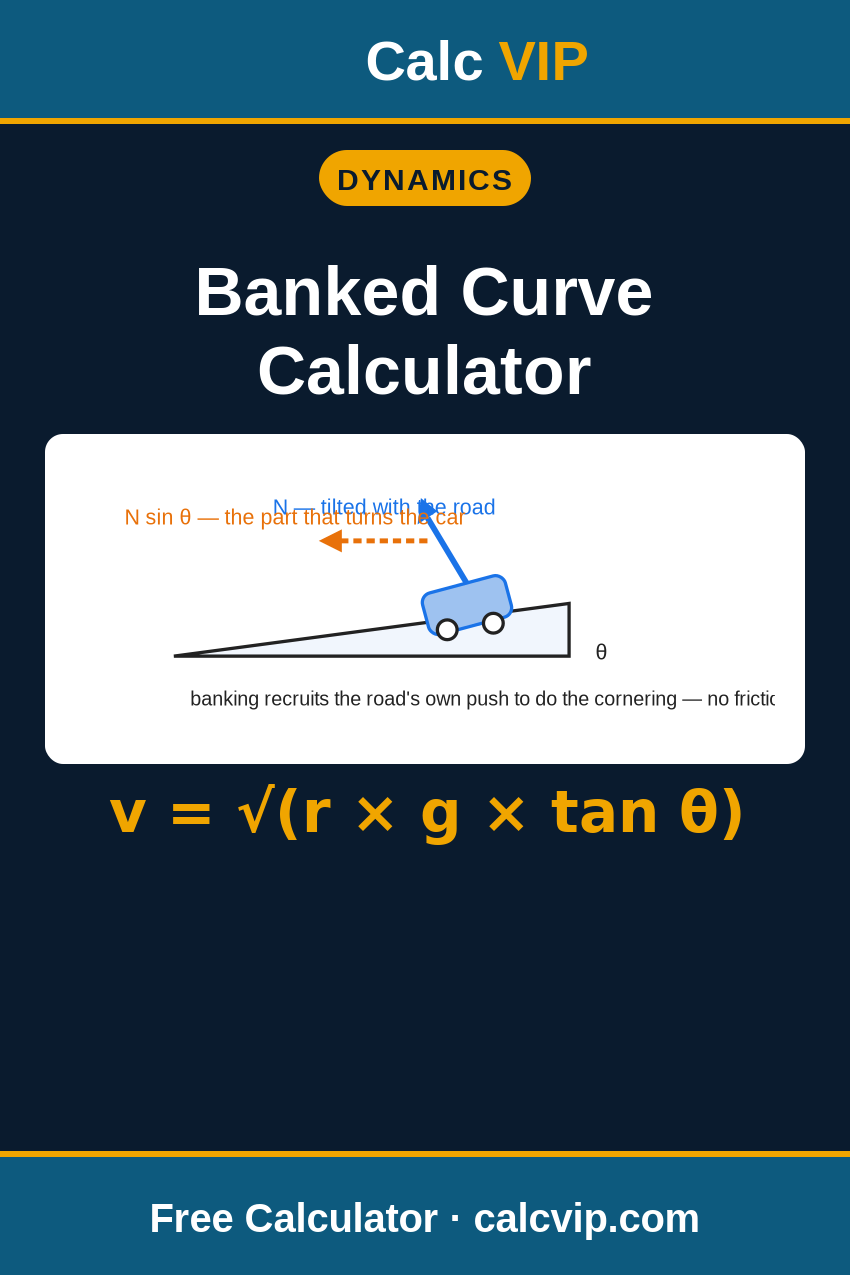
Enter the radius and banking angle (and g, if your curve is not on Earth) and this calculator returns the ideal speed in both m/s and km/h. The sections below explain where the formula comes from, what friction does above and below the ideal speed, and how the same tan θ law quietly runs velodromes, railways and turning aircraft.
Formula
Ideal speed: v = √(r × g × tan θ) • v in m/s, r in metres, g in m/s², θ = banking angle
The derivation is two lines of Newton. The tilted normal force N has a vertical share N cos θ, which must carry the car's weight: N cos θ = mg. Its horizontal share N sin θ is the only inward force available, so it must equal the centripetal demand: N sin θ = mv²/r. Dividing the second equation by the first eliminates both N and m, leaving tan θ = v²/(rg) — the formula, with the mass cancellation visible in the algebra. Rearranged, it also gives the angle a curve needs for a chosen design speed, θ = arctan(v²/(rg)) — the version road engineers actually use — and the radius a speed and angle imply, r = v²/(g tan θ). Note what is absent: no μ anywhere. Friction widens the workable range around the ideal speed (the depth section quantifies it), but the ideal itself is friction-free by definition.
| Symbol | Meaning | Units |
|---|---|---|
| v | ideal (friction-free) speed for the curve | m/s (calculator also gives km/h) |
| r | radius of the curve | metres (m) |
| θ | banking angle of the surface | degrees (°) |
| g | gravitational field strength (Earth ≈ 9.81) | m/s² |
What friction does above and below the ideal speed
The ideal speed is a point, and traffic refuses to live on points. Fortunately friction — the force banking was meant to rest — stands ready on both sides, pointing whichever way the situation requires. Drive slower than ideal and the car tends to slide down the bank, towards the inside of the bend; friction answers by acting up the slope, holding the car in place, and at very low speeds the car is essentially parked on a slope, held by the same static friction as on any hill. Drive faster than ideal and the car tends to run up the bank, towards the outside edge; friction reverses, acting down the slope, adding its grip to the normal force's inward share. The curve thus works over a whole range of speeds, with the ideal speed as the friction-free centre of the range.
That range is finite, and its top end is where accidents live. The fastest survivable speed comes when friction is fully spent pointing down-slope: vmax = √(rg (tan θ + μ) ÷ (1 − μ tan θ)). Banking and friction cooperate in that formula — which is why a steeply banked, high-grip track tolerates speeds a flat road cannot approach, and why the same bend that felt generous at noon becomes treacherous on ice, when μ collapses and the range shrinks towards the bare ideal speed from both sides.
There is a design moral here that engineers take seriously: a well-banked curve is forgiving. At the ideal speed it asks nothing of the tyres, so a patch of oil, a worn tread or a wet leaf — the everyday assassins of flat corners — merely spend a little of the friction reserve instead of the whole budget. Banking is safety margin built into geometry.
There is a comfort signature at the ideal speed, and your body knows it. At exactly v = √(rg tan θ), the road's push and gravity combine into a resultant that points squarely into the seat — straight through the floor of the car, perpendicular to the road surface. Passengers feel pressed down into their seats, slightly harder than usual, but not sideways at all: no sliding towards the door, no bracing against the dashboard. It is the same alignment a pilot aims for in a coordinated turn, and its absence — the sideways shove of a flat corner — is what makes unbanked bends feel violent even at modest speeds. Design a curve well and, at the design speed, the human cargo cannot tell it is turning, except by watching the world rotate.
How to use
- Enter the radius of the curve in metres — the distance from the centre of the turn to the vehicle's path.
- Enter the banking angle θ in degrees (typical roads: 4–10°; velodromes up to 42°; bobsled walls far steeper).
- Leave g at 9.81 for Earth, or change it for another world.
- Click "Calculate" to get the ideal speed in m/s and km/h — the speed at which no friction is needed.
Worked examples
Example 1 — the reference curve. A bend of radius 50 m banked at 15°: v = √(50 × 9.81 × tan 15°) = √(490.5 × 0.2679) = √131.42 = 11.46 m/s = 41.27 km/h. At about 41 km/h a car rounds this bend as if on rails, tyres unstressed; the design speed and the comfortable speed coincide because the engineer made them.
Example 2 — a velodrome. Track cyclists race on banking up to 42° with a turn radius near 25 m: v = √(25 × 9.81 × tan 42°) = √(245.25 × 0.9004) = √220.82 = 14.86 m/s = 53.5 km/h. Racing speeds sit near this value, which is no accident — the banking was chosen so sprinters at full pace need almost no grip from their narrow tyres, and can even ride slowly high on the wall during tactical pauses, friction holding them below the ideal.
Example 3 — a gentle highway ramp. A ramp of radius 80 m banked at just 6°: v = √(80 × 9.81 × tan 6°) = √(784.8 × 0.1051) = √82.48 = 9.08 m/s = 32.7 km/h. Real ramps carry traffic faster than that — the difference is supplied by friction, deliberately. Road banking (called superelevation) is kept modest so that slow or stopped vehicles do not slide inwards, and friction covers the gap to real traffic speeds.
Example 4 — a bobsled turn. A bobsled wall of radius 30 m banked at 35°: v = √(30 × 9.81 × tan 35°) = √(294.3 × 0.7002) = √206.07 = 14.36 m/s = 51.7 km/h. Bobsleds run far faster — 35 m/s and beyond — which is possible because the "bank" in the high turns approaches a wall: at extreme angles tan θ soars, and the ideal speed with it. The track is a banked curve that gradually stands on end.
Example 5 — designing a bend. A road designer wants traffic to flow friction-free at 68 km/h = 18.9 m/s on a radius of 100 m. Running the calculator's formula backwards, the needed angle satisfies tan θ = v² ÷ (rg) = 357 ÷ 981 = 0.364, so θ = 20° — and indeed √(100 × 9.81 × tan 20°) = 18.90 m/s = 68.03 km/h. Twenty degrees is steep for a public road, which is why real designs enlarge the radius instead: geometry offers three dials, and angle is the one with the tightest practical limits.
Example 6 — the same curve on the Moon. Take Example 1's bend (r = 50 m, θ = 15°) to the Moon, g = 1.62: v = √(50 × 1.62 × 0.2679) = √21.70 = 4.66 m/s = 16.77 km/h. Weaker gravity needs a slower ideal speed, because the normal force itself is weaker — there is less push to tilt. A lunar rover's test track, if anyone banks one, will be a slow place.
Banked curves in real life
Motorways and interchanges. Superelevation — banking — is standard on every high-speed bend, typically 4–8% of cross-slope (a few degrees). It is invisible to drivers, which is the point: the road does part of the steering, and the margin shows up only in the accidents that do not happen.
Velodromes and NASCAR. Purpose-built speed ovals push banking to extremes — 33° at Bristol, up to 42° on velodromes — because their traffic lives near one speed. The ideal-speed formula is their founding equation: choose the racing speed and radius, and the angle is decided.
Railway cant. Trains cannot lean on friction sideways (steel flanges protest), so railways bank the track itself: the outer rail is raised, called cant or superelevation, by an amount computed from the same tan θ relation. Mixed fast and slow traffic forces a compromise cant — and slow freight on a fast line's banking leans inwards, wearing the low rail, exactly as the friction discussion predicts.
Aircraft turns. A plane banks its wings to turn: the lift force, normally vertical, tilts, and its horizontal share becomes the centripetal force. The relation tan θ = v²/(rg) is identical — an airliner at 70 m/s on a 1,000 m radius banks at arctan(0.5) = 26.5°, which passengers feel as a gentle, coordinated lean with no sideways slide in their seats.
The wall of death. Fairground riders circle a vertical wall — θ = 90°, where tan θ is infinite and the "ideal speed" formula hands over to friction entirely: the wall's normal force is the centripetal force, and friction against it must carry the rider's weight, requiring v ≥ √(rg/μ). For r = 6 m and μ = 0.4 that is 12.13 m/s — about 44 km/h of commitment, below which the show slides down the wall.
Bobsled, luge and water slides. Ice tracks and flumes are banked curves tuned so the vehicle at racing speed presses squarely into the surface — the rider's "down" stays aligned with the track's normal, sparing both the vehicle and the spine the sideways shear that flat corners impose.
With friction: the full speed range
For the reference curve of Example 1 (r = 50 m, θ = 15°) with a healthy μ = 0.3, the top of the range is vmax = √(50 × 9.81 × (0.2679 + 0.3) ÷ (1 − 0.3 × 0.2679)) = √(490.5 × 0.6176) = √302.9 = 17.40 m/s = 62.7 km/h — half as fast again as the ideal 41 km/h. At the bottom of the range, the would-be minimum speed is zero or less: tan θ (0.268) is smaller than μ (0.3), so friction can hold a stationary car on this bank indefinitely, and the range runs from a standstill to 62.7 km/h. That asymmetry is the fingerprint of modest banking with good grip. Steepen the bank beyond arctan μ and a minimum speed appears — park too slowly on a velodrome's 42° wall and you slide to the apron, a rite of passage every track cyclist performs exactly once.
Quick reference: ideal speeds on a 50 m curve
| Banking angle θ | Ideal speed (m/s) | Ideal speed (km/h) |
|---|---|---|
| 5° | 6.55 | 23.6 |
| 10° | 9.30 | 33.5 |
| 15° | 11.46 | 41.3 |
| 20° | 13.36 | 48.1 |
| 30° | 16.83 | 60.6 |
| 45° | 22.15 | 79.7 |
Because v grows with √tan θ, the gains flatten: tripling the angle from 15° to 45° does not even double the ideal speed. Designers chasing speed reach for radius first.
Common mistakes
- Treating the ideal speed as a speed limit. It is the friction-free point, not a maximum. Vehicles safely exceed it using friction (up to v_max) and safely crawl below it. The danger is not crossing the ideal speed but exhausting friction.
- Using the diameter, or the road's outer edge, as r. r is the radius of the vehicle's path — roughly the centreline of its lane. On wide bends the inner and outer lanes genuinely have different ideal speeds.
- Putting the angle in radians, or tan in the wrong place. v = √(rg tan θ): tan θ multiplies, and θ is the banking from horizontal. A "10% superelevation" is a slope ratio (tan θ = 0.10, θ ≈ 5.7°), not 10°.
- Expecting heavier vehicles to need a different speed. Mass cancels. A lorry's lower safe speed on bends comes from its high centre of mass (rollover risk) and longer brakes — different physics, not this formula.
- Forgetting the range collapses on ice. Banking still provides its geometric share, but with μ near 0.05 the friction reserve nearly vanishes; speeds must cluster close to the ideal, and stopping on the bank may become impossible.
FAQ
Why bank a curve at all?
On a flat road, friction alone must supply the centripetal force. Banking tilts the normal force so part of it points towards the centre of the turn, helping the car round the bend — vital on icy roads and race tracks.
What happens above or below the ideal speed?
Faster than ideal, the car tends to slide up the bank and friction must act down the slope; slower, it tends to slip down and friction acts up the slope. The ideal speed is the one needing zero friction.
Does the ideal speed depend on the car's mass?
No — the mass cancels out in the derivation, so a truck and a motorcycle share the same ideal speed for a given curve.
What does "superelevation" mean in road signs and drawings?
It is the engineer's name for banking, usually quoted as a percentage: the cross-slope rise divided by the width. 7% superelevation means tan θ = 0.07, about 4°. The physics and the formula are this page's, unchanged.
Why not bank every curve steeply?
Because traffic is mixed. Steep banking makes slow vehicles, stopped vehicles and high-sided trucks slide or lean inwards uncomfortably, and complicates drainage and construction. Public roads compromise at a few degrees; single-purpose tracks go steep.
Do motorcycles use the same ideal speed?
Yes — the formula is vehicle-blind. A motorcycle additionally leans its own body into the turn, aligning itself with the tilted resultant force, which is why a rider on a banked velodrome-style corner looks doubly tilted: road banking plus body lean.
What provides the centripetal force at exactly the ideal speed?
The horizontal component of the normal force alone: N sin θ, with N = mg ÷ cos θ. Friction's contribution is zero — it exists, ready, but the geometry is already paying the whole bill.
How does banking help on ice?
By replacing friction-dependence with geometry. At the ideal speed an icy banked curve needs no grip at all, while an icy flat curve is nearly impossible at any speed. This is why mountain passes and northern highways are carefully superelevated.
Can a curve be over-banked for its traffic?
Yes — if the banking suits 80 km/h but traffic crawls at 20, vehicles spend friction holding themselves up the slope and heavy trucks lean alarmingly inwards. The velodrome's slow-rider slide is the extreme case of the same mismatch.
Is the formula different for a pendulum or a conical swing?
It is the same tan θ law. A conical pendulum — a ball on a string sweeping a cone — settles at the angle where tan θ = v²/(rg), and fairground chair swings fly out to exactly the angle their speed dictates. The road, the aircraft and the swing are one equation.