 Calc
Absolute Magnitude Calculator – Convert Apparent to Absolute Magnitude
 Created by Yuki Tanaka · Physics Editor · Modern Physics · Last updated: November 2026
Use this free Absolute Magnitude Calculator to convert a star's apparent magnitude (how bright it looks from Earth) into its absolute magnitude — how bright it would look from a standard distance of 10 parsecs. Absolute magnitude reveals a star's true luminosity.
The magnitude system is astronomy's oldest measurement scale, and its most perverse. It runs backwards — smaller numbers mean brighter objects — it is logarithmic, so equal steps mean equal ratios of brightness, and its zero point was fixed by the impressions of ancient Greek eyes. Hipparchus ranked stars from 1 (brightest) to 6 (faintest visible) around 150 BC; in 1856 Norman Pogson formalised the folk scale by decreeing that 5 magnitudes should equal exactly a factor of 100 in brightness, making each single step a factor of 2.512. Every magnitude you will ever meet, including the two in this calculator, lives on Pogson's scale.
Apparent magnitude m is the raw observation: how bright the object looks from Earth, contaminated by distance. Absolute magnitude M is the cleaned-up quantity: the apparent magnitude the object would have if it were placed at the standard distance of 10 parsecs (32.6 light-years), close enough to compare fairly but far enough that the comparison is uniform. Moving every star to the same distance removes distance from the comparison entirely, so differences in M are pure differences in luminosity. The Sun, overwhelming from Earth at m = −26.74, shrinks at 10 pc to M = +4.83 — a dim, ordinary star you would need a dark sky to notice. Sirius, the night sky's champion, has M = +1.43: genuinely more powerful, but only modestly. And the great supergiants, unspectacular to the eye across thousands of light-years, carry absolute magnitudes near −8, outshining the Sun ten thousand times over.
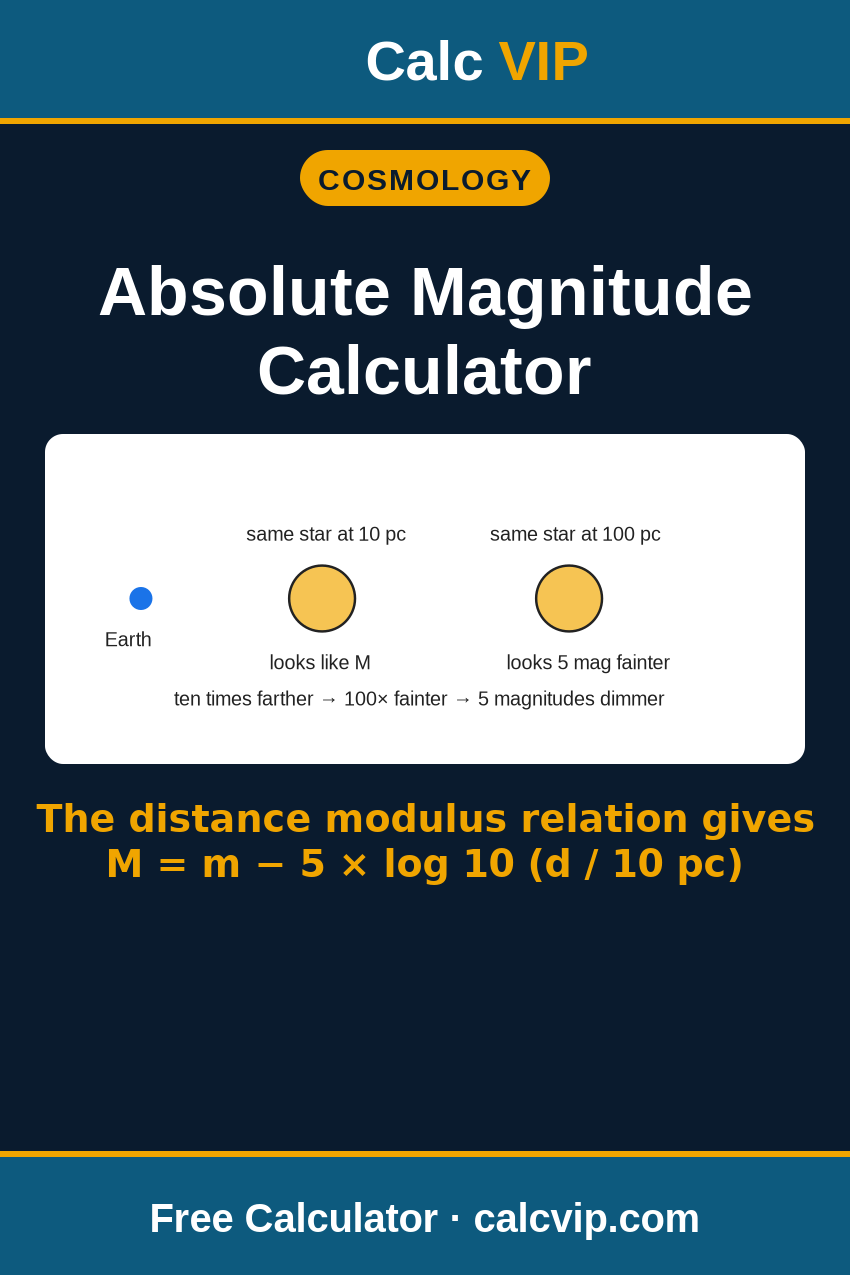
The conversion itself is just the inverse-square law wearing logarithmic clothing. Flux falls as d², magnitudes count factors of 2.512, and the algebra of those two facts produces the tidy relation M = m − 5 log10(d/10 pc). The quantity m − M is called the distance modulus, and it is a distance in disguise — which is why this calculator and the Distance Modulus calculator are two doors into the same room. Give either tool two of the three quantities (m, M, d) and it returns the third.
Formula
The distance modulus relation gives M = m − 5 × log10(d / 10 pc), where m is the apparent magnitude and d is the distance in parsecs. At exactly 10 pc, M = m. The relation rearranges to give the apparent magnitude an object of known M would show at distance d, m = M + 5 × log10(d / 10 pc), and to give the distance itself, d = 10 × 10(m − M)/5 parsecs. Underneath sits the brightness ratio law: a difference of Δm magnitudes means a brightness ratio of 2.512Δm — so an absolute-magnitude gap of 3.4 between two stars is a luminosity ratio of about 23.
| Symbol | Meaning | Units |
|---|---|---|
| M | absolute magnitude — apparent magnitude at 10 pc | magnitudes |
| m | apparent magnitude — as seen from Earth | magnitudes |
| d | distance to the object | parsecs (pc) |
| μ = m − M | distance modulus — the distance encoded as a magnitude gap | magnitudes |
Why 10 parsecs? And why the scale runs backwards
The standard distance is a historical compromise that turned out well. Ten parsecs is close to the neighbourhood scale of the stars whose distances were first measured by parallax, and it makes the modulus zero for a fair number of familiar stars, keeping the arithmetic gentle. Nothing physical picks it out — had astronomy standardised on 1 pc or 100 pc, every M would shift by a fixed constant and nothing else would change. What matters is only that everyone uses the same reference, so absolute magnitudes from different catalogues can be compared directly.
The backwards direction of the scale — bright objects, small numbers — is likewise an accident of history that astronomers are stuck with: Hipparchus called the brightest stars "first magnitude" the way we say "first class". Pogson's formalisation preserved the ranking and extended it past both ends, which is how the Sun earns −26.74 and telescope targets earn +25 and beyond. The logarithmic character, though, is a feature: stellar brightness spans more than twenty orders of magnitude, and a scale where 5 steps always means a factor of 100 compresses that immensity into numbers you can hold in your head. Absolute magnitude is where that compression pays off most, because it lets the entire zoo of stars be ranked on a single line from about −10 to +20.
How to use
- Enter the star's apparent magnitude m (smaller — even negative — means brighter).
- Enter its distance in parsecs (1 pc ≈ 3.26 light-years).
- Click "Calculate Absolute Magnitude" to get M and a plain-English brightness note.
- Interpret the sign of the change: if the star lies beyond 10 pc, M comes out smaller (brighter) than m, because at the standard distance it would be closer and brighter. Inside 10 pc the reverse holds.
Worked examples
Example 1 — the reference case. A star has apparent magnitude m = 5 and lies 100 pc away.
M = 5 − 5 × log10(100 / 10) = 5 − 5 × log10(10) = 5 − 5 = 0
So from the standard 10 pc distance it would shine at magnitude 0 — about as bright as Vega appears to us.
Example 2 — humbling the Sun. The Sun's apparent magnitude is −26.74 and its distance is 1 AU = 4.85 × 10⁻⁶ pc.
M = −26.74 − 5 × log10(4.85 × 10⁻⁷) = −26.74 + 31.57 = +4.83. The furnace that dominates our sky would be a forgettable fifth-magnitude star from 10 pc — the single best illustration of what absolute magnitude is for.
Example 3 — Sirius, honestly assessed. Sirius has m = −1.46 at a distance of 2.64 pc — inside the standard distance.
M = −1.46 − 5 × log10(0.264) = −1.46 + 2.89 = +1.43. Because Sirius is closer than 10 pc, its absolute magnitude is fainter than its apparent one: part of its brilliance is proximity. Even so, M = 1.43 against the Sun's 4.83 is a gap of 3.4 magnitudes, a luminosity ratio of 2.5123.4 ≈ 23 — matching its measured ≈ 25 L☉.
Example 4 — a supergiant unmasked. Betelgeuse shows a modest m ≈ 0.5 (it varies) but lies about 170 pc away.
M = 0.5 − 5 × log10(17) = 0.5 − 6.15 = −5.65. An unremarkable-looking point of light is intrinsically some ten thousand times the Sun's luminosity — distance was hiding almost everything about it.
Example 5 — the feeble majority. A red dwarf with m = 15 sits just 5 pc away.
M = 15 − 5 × log10(0.5) = 15 + 1.51 = +16.51. Most stars in the galaxy are like this: absolute magnitudes in the teens, luminosities thousands of times below the Sun's, invisible beyond a few parsecs. Absolute magnitude is how we know the galaxy's typical star is nothing like the ones we can see.
Example 6 — Deneb, the distant beacon. Deneb shines at m = 1.25 from roughly 800 pc.
M = 1.25 − 5 × log10(80) = 1.25 − 9.52 = −8.27 — among the most luminous stars known, on the order of 200,000 L☉. Only such monsters remain prominent across hundreds of parsecs, which is why the bright-star sky is a heavily biased sample of stellar power.
Absolute magnitude in real life
Building the Hertzsprung–Russell diagram. The HR diagram plots absolute magnitude against temperature or colour. It is astronomy's master chart — main sequence, giant branch, white-dwarf corner — and every star's position on it starts with an M from this formula.
Estimating distances (spectroscopic parallax). Read a star's spectral type, look up the M that type carries on the HR diagram, measure m, and the modulus hands you the distance. Despite the name it uses no parallax at all — it is this calculator run backwards.
Standard candles. Classes of objects with predictable M — Cepheids, RR Lyrae stars, Type Ia supernovae — turn apparent magnitudes into distances across the Universe. Their calibrations are absolute magnitudes, laboriously pinned down on nearby examples.
Judging exoplanet hosts. A star's M, with its colour, fixes its luminosity and radius well enough to size the habitable zone and interpret a transiting planet's true diameter — the planet's size is measured relative to the star's.
Galaxies by the same token. Whole galaxies have absolute magnitudes too: the Milky Way sits near M ≈ −20.5, dwarf galaxies down at −10 or fainter. Galaxy M values feed directly into counts of the Universe's total light.
Calibrating survey catalogues. Billion-star surveys like Gaia publish apparent magnitudes and parallaxes; converting them to absolute magnitudes at scale is how the modern HR diagram — and the discovery of new stellar families within it — was made.
From absolute magnitude to luminosity
Absolute magnitude and luminosity are the same information in two notations, joined by Mbol = 4.74 − 2.5 × log10(L/L☉) for the bolometric (all-wavelength) magnitude. The anchor is the Sun: Mbol = +4.74 means L = 1 L☉ by definition of the scale's modern calibration — the Sun's visual MV of +4.83, used elsewhere on this page, differs only by its small bolometric correction. Each magnitude brighter subtracts 2.5 log10 of the ratio, so Sirius at M = 1.43 sits 3.40 magnitudes above the Sun and 103.40/2.5 ≈ 23 times its luminosity. This is why astronomers swap between the two so casually — and why a reported M can be turned into the watts of the Luminosity calculator whenever a physical power is needed. One caution: magnitudes are usually measured in a specific colour band (V for visual), while luminosity properly means the bolometric total; the conversion above assumes the bolometric absolute magnitude, and band values differ by a bolometric correction.
The bias absolute magnitude exposes
Glance at the night sky and you might conclude the galaxy is populated by giants. Absolute magnitude corrects the illusion. A magnitude-limited survey — anything you can see — preferentially collects intrinsically bright objects, because they remain visible across enormous volumes, while the vastly more numerous dwarfs show up only in our immediate neighbourhood. Astronomers call this Malmquist bias, and correcting for it changed our picture of the galaxy: by number, roughly three quarters of all stars are red dwarfs with M above +10, and stars like the Sun are already in the brighter few percent. The honest census comes from volume-limited samples — every star within, say, 10 pc, converted to M — and it is dominated by objects no naked eye has ever seen.
Galaxies have absolute magnitudes too — and they measure the Universe
Nothing restricts M to single stars. A galaxy's absolute magnitude sums the light of its billions of stars into one number: the Milky Way measures about M ≈ −20.5, Andromeda about −21.2, and the feeblest dwarf galaxies fade to −10 or beyond — some ultra-faint dwarfs are, in total, dimmer than a single bright supergiant star. Galaxy absolute magnitudes power a whole branch of cosmology. Count galaxies by M and you get the luminosity function, the census that tracks how galaxies assemble their stars across cosmic time. Better still, a galaxy's M correlates with measurable properties — its rotation speed (the Tully–Fisher relation) or its stars' velocity dispersion (Faber–Jackson) — and those correlations turn galaxies themselves into standard candles: measure the rotation, infer M, compare with m, and the distance modulus machinery of this site takes over. The humble conversion on this page, scaled up, is one of the ways the expansion of the Universe was mapped. For calibration, an absolute magnitude of M = 0 corresponds to about 85 L☉ — the brightness Vega would have at the standard distance — which makes the galaxy figures above (twenty magnitudes brighter) a factor of 100 million in luminosity.
Quick reference: absolute magnitudes of familiar stars
| Star | Apparent m | Distance | Absolute M |
|---|---|---|---|
| Deneb | 1.25 | ≈ 800 pc | −8.27 |
| Betelgeuse | ≈ 0.5 | ≈ 170 pc | −5.65 |
| Vega | 0.03 | 7.68 pc | +0.60 |
| Sirius | −1.46 | 2.64 pc | +1.43 |
| the Sun | −26.74 | 1 AU | +4.83 |
| Proxima Centauri | 11.13 | 1.30 pc | +15.55 |
Proxima's row is worth computing yourself: m = 11.13 at 1.30 pc gives M = 11.13 − 5 log10(0.130) = 11.13 + 4.43 ≈ +15.55 — the nearest star to the Sun is one of the faintest in the table.
Common mistakes
- Entering the distance in light-years. The formula wants parsecs. A distance typed in light-years overstates d by 3.26 and shifts M by 5 log10(3.26) ≈ 2.57 magnitudes — enough to turn a dwarf into a giant. Convert first (divide light-years by 3.2618).
- Reading the scale the wrong way. A "bigger" magnitude is a fainter object. M = −5 is enormously brighter than M = +5 — ten magnitudes is a factor of 10,000, in the direction opposite to intuition.
- Forgetting dust. Interstellar extinction inflates the measured m, so the computed M comes out too faint (too large) unless the extinction in magnitudes is subtracted from m first. For distant or galactic-plane stars this is often the dominant error.
- Mixing magnitude bands. Absolute magnitudes are band-specific: MV (visual) and Mbol (total) differ by the bolometric correction, which for very hot or cool stars exceeds a magnitude. Compare like with like.
- Expecting M to change with distance. It does not — that is the point. M is a property of the star; only m responds to where the star sits. If your M changes when you move the star, a sign has flipped somewhere.
FAQ
What is the Sun's absolute magnitude?
About +4.83. From 10 pc away the Sun would look like an unremarkable faint star, even though from Earth its apparent magnitude is −26.74.
Why can magnitude be negative?
The scale is historical and open-ended: very bright objects (the Sun, Moon, Venus, Sirius) have negative apparent magnitudes.
How much brighter is one magnitude?
Each step of 1 magnitude is a factor of about 2.512 in brightness; 5 magnitudes is exactly a factor of 100.
Can absolute magnitude be negative?
Yes, for anything more luminous than about 85 L☉. Giants and supergiants run from M ≈ −3 to −10, and the most luminous galaxies reach about −23. The scale has no floor.
Why is the standard distance 10 pc and not 1 pc?
Historical convenience: early parallax work centred on stars a few parsecs away, and 10 pc makes the modulus of many familiar stars small and positive. Any fixed reference would work; the value of M shifts by a constant if the reference changes.
How accurate is an absolute magnitude?
Exactly as accurate as the distance. A 10% distance error shifts M by about 0.2 magnitudes; Gaia-era parallaxes have cut typical errors for nearby stars to a few hundredths of a magnitude.
Do planets have absolute magnitudes?
The concept is used differently for solar-system bodies: their "absolute magnitude" H is defined at 1 AU from both Sun and observer, and it encodes the body's size and reflectivity rather than any light of its own.
What is the faintest absolute magnitude a star can have?
The dimmest red and brown dwarfs reach M ≈ +20 and beyond — hundreds of thousands of times fainter than the Sun. At the hydrogen-burning limit a star's MV is around +19 to +20.
How does M relate to the distance modulus?
μ = m − M is the distance modulus, and it is a pure distance measure: μ = 0 at 10 pc, 5 at 100 pc, 10 at 1,000 pc. The Distance Modulus calculator starts from μ and returns the distance directly.
What absolute magnitude is the faintest a normal eye could see at 10 pc?
The naked-eye limit is about m = 6, so at the standard distance an object needs M ≈ 6 or brighter to be visible unaided. The Sun, at M = 4.83, would just qualify — a sobering thought: most of the galaxy's stars, placed at the reference distance, would be invisible to the eye that defined the scale.