 Calc
Astronomy Distance Converter – Parsecs, Light-Years, AU & Kilometres
 Created by Yuki Tanaka · Physics Editor · Modern Physics · Last updated: November 2026
Use this free Astronomy Distance Converter to switch between the units astronomers actually use: parsecs (pc), light-years (ly), astronomical units (AU) and kilometres (km). Enter a value in any one unit and see all the others at once.
Each of these units exists because a particular measurement made it natural. The astronomical unit is the Earth–Sun distance, the ruler of the solar system, measured first by transits of Venus and now by radar to centimetre precision. The light-year is the distance light covers in a year — a unit of distance despite the time in its name, and the public's favourite because it doubles as a lookback time: see something 100 light-years away and you see it as it was 100 years ago. The parsec is the professional's unit, born directly from the parallax method of measuring stellar distances. And the kilometre is the honest SI workhorse, hopeless for interstellar work — the nearest star is 40 trillion of them — but indispensable for planets, moons and spacecraft.
The parsec deserves its definition, because it is the cleverest of the four. Hold a ruler so that the Earth–Sun distance (1 AU) spans an angle of one arcsecond — one 3,600th of a degree — and the distance at which that happens is one parsec: "parallax of one arcsecond". A star whose position shifts by one arcsecond as Earth crosses its orbit is exactly 1 pc away, and its distance in parsecs is simply 1 divided by its parallax in arcseconds. Gaia, the European space astrometry mission, measures parallaxes to millionths of an arcsecond, which is why modern catalogues think natively in parsecs and why this converter keeps the pc at the head of its list.
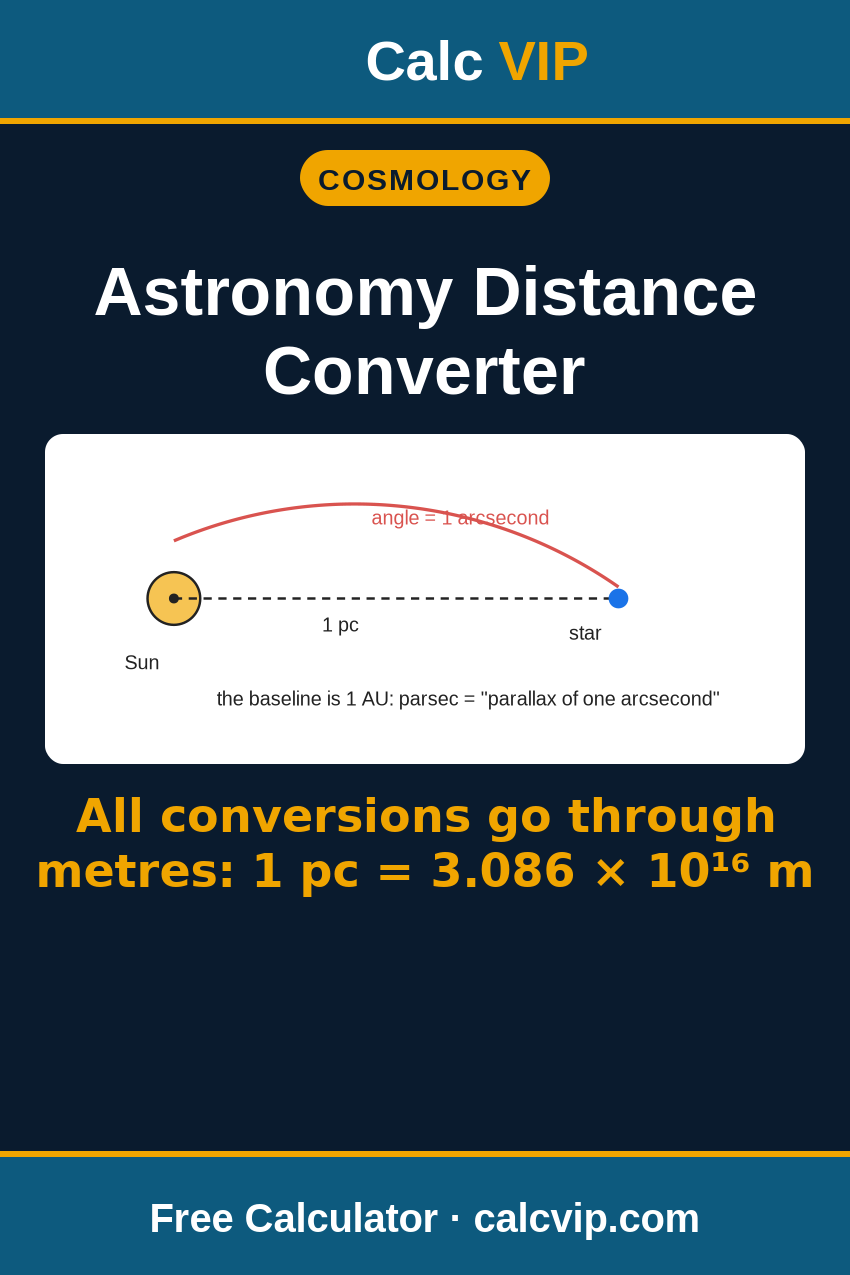
All conversions on this page run through exact, defined ratios. The AU is now a defined constant, exactly 149,597,870,700 m, though the calculator uses the rounded 1.496 × 10¹¹ m shared by this batch of tools. The light-year follows from the defined speed of light over a Julian year, and the parsec from geometry: 1 pc = 206,265 AU almost exactly, the number of arcseconds in a radian. Because the ratios are fixed, conversion itself never introduces error — every inaccuracy in a converted distance was present in the original measurement.
Formula
All conversions go through metres: 1 pc = 3.086 × 10¹⁶ m, 1 ly = 9.461 × 10¹⁵ m and 1 AU = 1.496 × 10¹¹ m. It follows that 1 pc = 3.2618 ly = 206,283 AU. The working ratios worth memorising are few: 1 pc = 3.2618 ly, 1 ly = 63,243 AU, 1 AU = 1.496 × 10⁸ km, and light needs 499 seconds — about 8.3 minutes — to cross 1 AU. With those four, nearly any astronomy distance in print can be re-expressed in any unit you prefer, and this calculator simply does the arithmetic without the slip risk.
| Unit | Definition | In metres |
|---|---|---|
| AU | mean Earth–Sun distance | 1.496 × 10¹¹ m |
| light-year (ly) | distance light travels in one Julian year | 9.461 × 10¹⁵ m |
| parsec (pc) | distance at which 1 AU subtends 1 arcsecond | 3.086 × 10¹⁶ m |
| kiloparsec / megaparsec | 1,000 pc / 1,000,000 pc — galactic and cosmic scales | 3.086 × 10¹⁹ / 10²² m |
Distances are also times: the lookback built into every unit
Because light travels at a finite speed, every astronomical distance is simultaneously a delay. The Moon's 384,400 km is 1.28 light-seconds — Apollo conversations carried that pause. The Sun is 8.3 light-minutes away; we always see it as it was 8.3 minutes ago. Proxima Centauri's 4.246 light-years means its light left in the year a current primary-school child was born. Andromeda's 2.5 million light-years means the photons hitting your retina tonight departed before humans existed. The light-year is the only unit that wears this openly, but the equivalence holds in all of them: 1 pc is 3.26 years of lookback, 1 Mpc is 3.26 million. Converting a distance is therefore also converting a "how long ago am I seeing?" — the deeper the conversion, the older the view.
The lookback reading also disciplines the imagination in a useful way: there is no "now" visible anywhere beyond the solar system. Even the nearest star is seen by candlelight four years old; the galactic centre is seen as it was when mammoths still walked; and the most distant galaxies are seen before the Earth existed. Astronomy is the only science whose instruments are also time machines, and the exchange rate between distance and time is printed on this page.
This is why cosmologists often skip distance units entirely and quote redshift, and why deep-field images are described as "seeing the Universe when it was 500 million years old". At the largest scales the simple units strain: expansion stretched the space the light crossed, so a galaxy whose light travelled 13 billion years can today sit much farther than 13 billion light-years away. For everything within a few hundred million light-years — every example on this page — the units interconvert cleanly and the lookback reading is exact.
How to use
- Enter the distance value.
- Choose the unit you are converting from.
- Click "Convert" to see the same distance in parsecs, light-years, AU and kilometres.
- For very large or small results the calculator switches to scientific notation (like 2.40 × 10¹⁹ km); read the exponent as "that many powers of ten", and compare exponents first when judging which of two distances is larger.
Worked examples
Example 1 — one parsec, fully translated. Convert 1 parsec:
1 pc = 3.26 light-years = 206,283.42 AU = 3.09 × 10¹³ km
The nearest star, Proxima Centauri, is about 1.30 pc away — that is 4.24 light-years.
Example 2 — Proxima in every unit. Proxima's measured distance is 4.246 ly.
In parsecs: 4.246 ÷ 3.2618 = 1.30 pc. In AU: 4.246 × 63,243 ≈ 268,525 AU. The same star, three dialects — and the parsec figure is the one straight from its parallax of about 0.769 arcseconds (1 ÷ 0.769 = 1.30).
Example 3 — Andromeda, the deep neighbour. The Andromeda Galaxy is 2.537 million light-years away.
That is 2.537 × 10⁶ ÷ 3.2618 ≈ 777,789 pc ≈ 0.78 Mpc, or in kilometres 2.537 × 10⁶ × 9.461 × 10¹² ≈ 2.40 × 10¹⁹ km — a number so unwieldy it demonstrates, by itself, why the megaparsec was invented.
Example 4 — Voyager 1, the farthest human object. Voyager 1 is roughly 162 AU from the Sun.
In kilometres: 162 × 1.496 × 10⁸ ≈ 2.42 × 10¹⁰ km. Its radio signals, at light speed, need 162 × 499 s ≈ 22.5 hours to reach us — the AU converts directly into a communications delay, which is how mission control actually feels this distance.
Example 5 — the Moon, for scale. The Moon orbits 384,400 km away.
That is 384,400 ÷ 1.496 × 10⁸ ≈ 0.00257 AU, or 4.06 × 10⁻⁸ light-years — a humbling reminder that everything humans have physically visited occupies the first sliver of the first unit on this page.
Example 6 — Neptune in light-time. Neptune orbits about 30.1 AU from the Sun.
In kilometres: 30.1 × 1.496 × 10⁸ ≈ 4.50 × 10⁹ km. In light-time: 30.1 × 499 s ≈ 15,020 s ≈ 4.2 hours — when Voyager 2 flew past Neptune in 1989, its pictures took over four hours to come home, a delay mission control felt in every command.
Unit conversion in real life
Reading research papers versus news stories. Journals quote parsecs; press releases quote light-years. Converting between them — divide or multiply by 3.2618 — is the daily bread of anyone who follows astronomy in both dialects.
Mission planning. Deep-space teams live in AU and light-time: a probe's distance in AU sets both its signal delay (499 s per AU) and its sunlight (falling as 1/AU²), which together size the radio and the power system.
Checking "nearest exoplanet" claims. Headlines alternate between light-years and parsecs for the same planet. Proxima b is "4.24 light-years" and "1.30 pc" in the same week; the converter keeps the claims comparable.
Star atlases and planetarium software. Catalogues store parsecs (from parallax), displays often show light-years. Knowing the ratio lets you sanity-check an app's numbers instead of trusting a misplaced decimal.
Scale models. Building a walkable solar system or galaxy model is pure unit conversion: at 1 AU = 10 m, the nearest star lands 2.7 km away and the Moon a marble 2.6 cm from its Earth — the fastest way to feel the emptiness.
Estimating lookback times. Converting a galaxy's distance from Mpc to light-years immediately gives the lookback in years — the number every "ancient light" headline is really reporting.
Where the parsec comes from: parallax in practice
Parallax is the apparent wobble of a nearby star against distant background stars as Earth orbits the Sun — the same shift you see in a finger held up and viewed with alternate eyes. The geometry is a very long, thin triangle: the baseline is 2 AU (Earth on opposite sides of its orbit), the measured angle is tiny, and the distance follows. Friedrich Bessel won the race to measure the first one in 1838: 61 Cygni, parallax 0.314 arcseconds, distance 1 ÷ 0.314 ≈ 3.18 pc ≈ 10.4 light-years — triumphantly close to the modern value. The method's precision has since improved by five orders of magnitude: ground telescopes reached milliarcseconds, Hipparcos reached a thousandth of an arcsecond from space, and Gaia now catalogues over a billion stars with parallaxes good to tens of microarcseconds, pushing direct geometric distances out to thousands of parsecs. Every one of those distances is natively a parsec figure, because the parsec was defined to make the parallax arithmetic trivial.
Kiloparsecs, megaparsecs and the expanding Universe
Astronomers stack prefixes on the parsec the way physicists stack them on the metre: kiloparsecs (kpc) for the architecture of galaxies — the Milky Way's disc spans about 30 kpc — and megaparsecs (Mpc) for the spaces between galaxies, where Hubble's law operates. At these scales a second subtlety creeps in: the Universe expanded while the light travelled, so "distance" splits into several inequivalent notions. The light-travel distance (lookback time × c), the comoving distance (expansion factored out), and the luminosity distance (from the inverse-square dimming) agree for nearby objects and diverge for remote ones. The converter on this page uses the simple, static-space ratios — exactly right for stars and nearby galaxies, and the necessary first step before the cosmological refinements of the Hubble's Law page.
A short history of the astronomical unit
The AU was the first of these units to be measured, and for centuries it was the worst known. Aristarchus estimated the Sun's distance in the third century BC and was short by a factor of twenty. Kepler's laws gave the solar system's relative layout precisely — every planet's distance in AU — while the AU itself, the scale of the whole diagram, remained uncertain by percent-level amounts that embarrassed astronomers. The 1761 and 1769 transits of Venus triggered the first great international science campaigns, with expeditions sailing worldwide to time Venus's silhouette crossing the Sun; the combined data pinned the AU to within a few percent. Radar echoes from Venus in the 1960s replaced triangulation with timing and nailed it to kilometres, and in 2012 the value was simply defined — exactly 149,597,870,700 m — retiring the measurement problem by decree. The parsec's history is the mirror image: defined by geometry, it waited on instruments, from Bessel's 1838 triumph to Gaia's microarcsecond flood. Every unit on this page carries a story of the measurement that created it.
One more unit occasionally appears in older books: the Siriometer, a million AU (about 15.8 light-years), proposed when Sirius was thought to be a standard distance marker. It died of uselessness — a reminder that units survive only while the measurements that motivate them do. The four units in this converter have each survived centuries because each is welded to a living measurement practice: radar and spacecraft for the AU, parallax for the parsec, the defined speed of light for the light-year, and everything for the kilometre. Smaller light-travel units survive too, at the solar system's edge: one light-day is 2.59 × 10¹⁰ km ≈ 173 AU, and Voyager 1, at about 162 AU, sits roughly 0.94 light-days out — its signals have been travelling for nearly a full day, which is why "light-time" replaces distance in deep-space operations.
Quick reference: famous distances in every unit
| Object | pc | Light-years | AU |
|---|---|---|---|
| the Moon | 1.25 × 10⁻⁸ | 4.06 × 10⁻⁸ | 0.00257 |
| the Sun | 4.85 × 10⁻⁶ | 1.58 × 10⁻⁵ | 1 |
| Proxima Centauri | 1.30 | 4.246 | 268,525 |
| Sirius | 2.64 | 8.60 | 544,588 |
| galactic centre | 7,971 | 26,000 | 1.64 × 10⁹ |
| Andromeda Galaxy | 777,789 | 2,537,000 | 1.60 × 10¹¹ |
Sirius's AU figure is worth a check with the calculator: 8.60 ly × 63,243 AU/ly ≈ 543,890 AU — the table rounds through the parsec route (2.64 pc × 206,283), and the small disagreement is a lesson in how rounding chains drift; the underlying ratios are exact.
Common mistakes
- Calling a light-year a time. It is a distance — the length light covers in a year. "The star is 10 light-years away" and "we see it as it was 10 years ago" are both true, but the unit itself measures space, not time.
- Using 3 or 3.3 for the pc–ly ratio in precise work. 1 pc = 3.2618 ly. The rough 3.26 is fine for conversation; chained conversions amplify sloppy ratios, as the Sirius check above shows.
- Confusing parallax with distance. Distance in parsecs is 1 ÷ parallax in arcseconds. A star with parallax 0.1″ is 10 pc away, not 0.1 pc — the reciprocal is the entire point of the parsec's definition.
- Mixing AU and light-years for solar-system objects. Neptune is 30 AU but only 0.0005 ly. Press stories occasionally swap the units and inflate the solar system by five orders of magnitude; a quick conversion exposes it.
- Assuming converted distances keep all their digits. Conversion is exact, measurement is not. "2.537 million light-years" is really "about 2.5 million", and writing 777,789 pc pretends to a precision the underlying measurement never had.
FAQ
Why do astronomers prefer parsecs?
The parsec comes directly from parallax measurements: it is the distance at which 1 AU subtends one arcsecond. Survey catalogues (like Gaia's) naturally produce distances in parsecs.
Is a light-year a distance or a time?
A distance — the distance light travels in one year, about 9.46 trillion km.
What is a megaparsec?
One million parsecs (3.26 million light-years). Galaxy distances and Hubble's law are usually quoted in Mpc.
How many kilometres are in a light-year?
About 9.461 × 10¹² km — nine and a half trillion. Even at a million kilometres per day, a spacecraft would need 26,000 years to cross one; the unit exists precisely because kilometres collapse at interstellar scales.
What is a kiloparsec?
One thousand parsecs (3,262 light-years), the working unit for galactic structure: the Sun sits about 8 kpc from the Milky Way's centre, and the galaxy's disc spans roughly 30 kpc.
Why is the AU defined so precisely now?
Since 2012 the AU is a defined constant — exactly 149,597,870,700 m — rather than a measured property of Earth's orbit, which actually varies slightly. Definitions beat measurements for a unit everyone builds on.
How far is a light-minute or light-hour?
One light-minute is 1.80 × 10⁷ km (about 0.12 AU); one light-hour is 1.08 × 10⁹ km (about 7.2 AU). Mission teams quote probe distances in light-time because it is the delay they must plan around.
Which unit do professionals actually publish in?
Parsecs and their multiples, almost universally, because distances arrive from parallax in parsecs and from Hubble's law in megaparsecs. Light-years dominate outreach; AU dominate solar-system work.
Is the parsec bigger than a light-year?
Yes, by a factor of 3.2618. A distance quoted in parsecs is always the smaller number for the same journey — a common source of "the star moved closer" confusion when a source switches units.
How big is the observable Universe in these units?
Its radius is about 46.5 billion light-years — roughly 14.3 billion parsecs, or 14,300 Mpc — larger than 13.8 billion light-years of lookback because space expanded while the light was travelling.