 Calc
Luminosity Calculator – Total Power of a Star from Flux & Distance
 Created by Yuki Tanaka · Physics Editor · Modern Physics · Last updated: November 2026
Use this free Luminosity Calculator to find the total power radiated by a star or galaxy from the flux (brightness) we measure and its distance. Luminosity is a star's true brightness, unlike the apparent brightness we see from Earth.
The distinction this calculator bridges — between how bright something looks and how much light it truly emits — is the single most important idea in observational astronomy. A nearby candle and a distant lighthouse can pour exactly the same number of photons into your eye, and the sky is full of such impostors: faint-looking stars that are monsters of power, and brilliant-looking ones that are feeble neighbours. Flux is what we measure, with telescopes and detectors; luminosity is what we want to know, because it reveals the object's size, temperature and stage of life. The inverse-square law is the bridge between them, and the distance is the toll: without a distance, flux alone tells you almost nothing.
The geometry behind the formula is beautifully simple. A star radiates in all directions at once, and by the time its light has travelled a distance d it has been smeared evenly over the surface of a sphere of radius d — a surface of area 4πd². Your detector samples a tiny patch of that sphere, one square metre of it, and the flux F is simply the total power divided by the sphere's area: F = L / 4πd². Turned around, L = 4πd²F. The squaring is what makes the law so ruthless: move twice as far away and the same luminosity spreads over four times the area, delivering a quarter of the flux. It is also what makes the measurement so sensitive — errors in the distance are squared along with everything else.
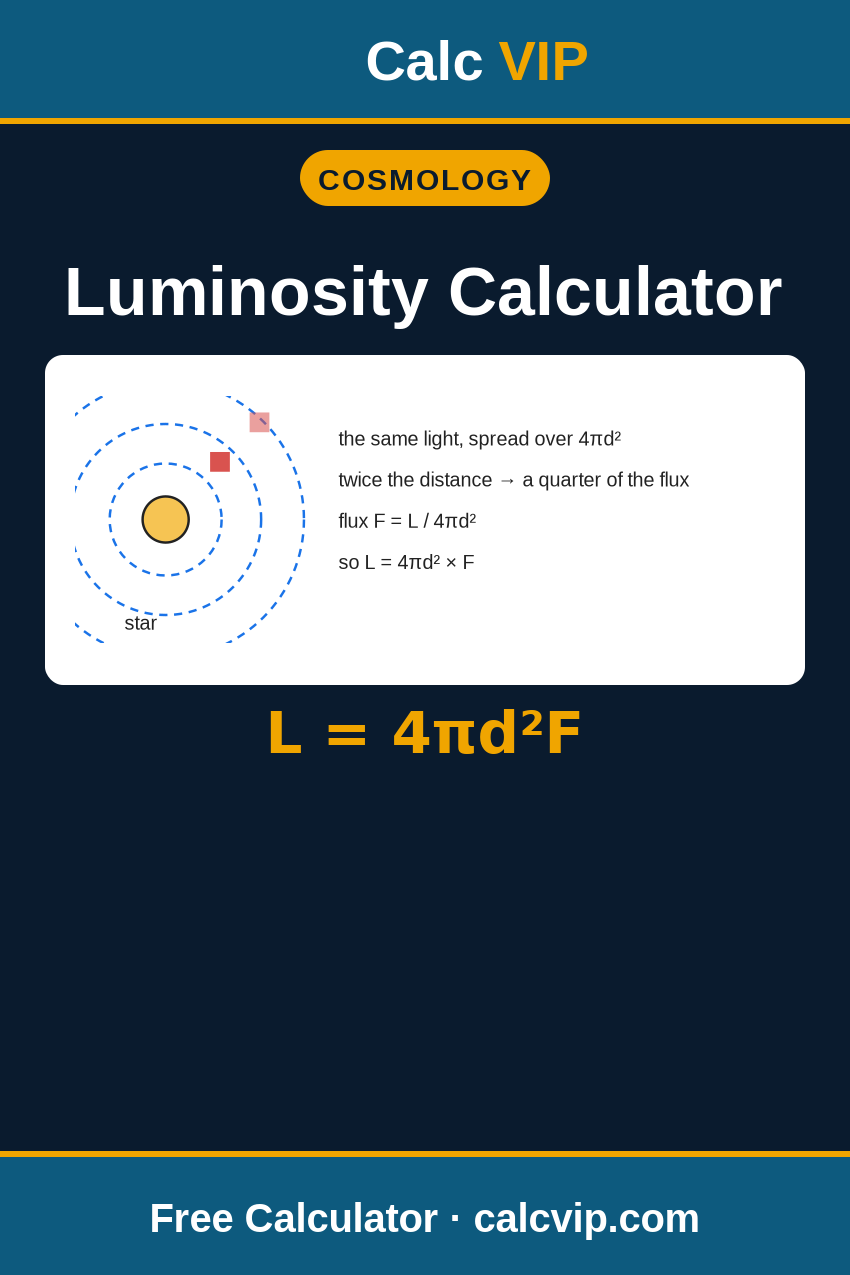
Luminosities are quoted in watts and, more conveniently, in units of the Sun's output, L☉ = 3.828 × 1026 W. The range nature uses is staggering: the dimmest red dwarfs smoulder at a ten-thousandth of a solar luminosity, the Sun sits in the modest middle, and the most extreme supergiants blaze at over a million L☉, while whole galaxies sum to tens of billions. Nearly every statement astronomers make about a star — its mass, its lifetime, whether it will end as a white dwarf or a supernova — traces back to a luminosity that was computed, at some point, by exactly the calculation on this page.
Formula
Light spreads out over the surface of a sphere of radius d, so the luminosity is L = 4πd²F, where F is the flux measured at distance d. Results are also given in solar luminosities, with L☉ = 3.828 × 10²⁶ W. The same law rearranged answers the forward question — how bright will a known source look from a given distance: F = L / 4πd² — and it can be solved for the distance instead, d = √(L / 4πF), which is how "luminosity distances" to standard candles are found. All three forms are the one geometric fact — area grows as d² — read in three directions.
| Symbol | Meaning | Units |
|---|---|---|
| L | luminosity — total power radiated in all directions | W (or L☉) |
| F | flux — power arriving per square metre at the observer | W/m² |
| d | distance to the object | m (entered as AU, ly, pc or km) |
| L☉ | one solar luminosity = 3.828 × 10²⁶ W | W |
Why the distance does all the damage
Look again at the d² in L = 4πd²F and consider what it does to uncertainty. Flux can be measured superbly — modern detectors count photons to fractions of a percent. Distances cannot. A parallax good to 10% is a triumph of measurement, yet squared inside this formula it becomes a luminosity uncertain by 21%: 1.1² = 1.21. A 25% distance error becomes a 56% luminosity error. This asymmetry explains a century of astronomical history: the great observing programmes, from Hipparcos to Gaia, have poured their effort into distances precisely because every luminosity, and everything deduced from it, inherits the distance error doubled. When you use this calculator, the number you should distrust most is not the flux — it is the distance you typed.
It is worth pausing on how recently the distance half of this equation became trustworthy. For most of history, fluxes were all astronomy had — brightnesses without distances, a sky of unknown powers. The Gaia mission has now measured parallaxes for nearly two billion stars, converting their long-catalogued fluxes into luminosities wholesale. The result is the first luminosity census of an entire galaxy: we can finally say, from measurement rather than theory, how the Milky Way's light is distributed among its stars — and the answer is that a small minority of bright stars outshines the dwarf majority combined.
The inverse-square dilution itself is pure geometry, and it assumes the source radiates equally in all directions (astronomers say isotropically) and that nothing absorbs light along the way. Both assumptions can fail informatively. Interstellar dust dims and reddens starlight, so the measured flux understates the true one and the raw luminosity comes out too low unless an extinction correction is applied — the same dust that haunts the distance-modulus method. And some sources beam: a pulsar's lighthouse sweep or a quasar's jet concentrates power into a narrow cone, so the naive 4πd²F wildly overstates the total output for observers inside the beam. The formula is exact; knowing when its assumptions hold is the astronomer's craft.
How to use
- Enter the measured flux in watts per square metre.
- Enter the distance and pick its unit (AU, light-years, parsecs, km or m).
- Click "Calculate Luminosity" to get the total power in watts and in solar luminosities.
- Sanity-check the answer against the scale of known objects: ordinary stars land between about 0.0001 and 100 L☉. A result far outside that range usually means a unit slip in the distance — parsecs entered as light-years is the classic.
Worked examples
Example 1 — measuring the Sun. Sunlight reaching Earth has a flux of 1,361 W/m² and the Sun is 1 AU away (1.496 × 10¹¹ m).
L = 4π × (1.496 × 10¹¹)² × 1,361 ≈ 3.83 × 10²⁶ W
That is exactly 1.00 solar luminosity — as expected, because this is how the Sun's own luminosity is measured.
Example 2 — Sirius, the brightest star in our sky. Sirius pours a flux of about 1.17 × 10⁻⁷ W/m² onto Earth from 8.6 light-years away.
L = 4π × (8.6 × 9.461 × 10¹⁵)² × 1.17 × 10⁻⁷ ≈ 9.7 × 10²⁷ W ≈ 25.4 L☉. The apparently brilliant Sirius really is intrinsically powerful — twenty-five Suns' worth — not merely close. (It is also close; both effects conspire.)
Example 3 — an anonymous survey star. A telescope measures a flux of 1.0 × 10⁻⁸ W/m² from a star whose parallax places it at 10 pc.
L = 4π × (3.086 × 10¹⁷)² × 1.0 × 10⁻⁸ ≈ 1.20 × 10²⁸ W = 31.3 L☉ — a hot, massive star, despite looking utterly unremarkable through the eyepiece. This is the calculator's daily bread: turning catalogue fluxes and parallaxes into a census of stellar power.
Example 4 — the faintest neighbour. Proxima Centauri, our nearest star at 4.246 light-years, manages a luminosity of only 0.0017 L☉. Run the law forwards: F = L / 4πd² = (0.0017 × 3.828 × 10²⁶) ÷ (4π × (4.246 × 9.461 × 10¹⁵)²) ≈ 3.2 × 10⁻¹¹ W/m² — some forty million times feebler than the flux of Sirius, which is why the closest star of all is invisible to the naked eye.
Example 5 — it works for a light bulb. Nothing in the formula is specific to stars. A 100 W bulb radiating isotropically, measured from 10 m away, delivers F = 100 ÷ (4π × 10²) = 0.0796 W/m². Feed that flux and distance back into the calculator and it returns the bulb's 100 W — a useful way to convince yourself the tool is honest before trusting it with a galaxy.
Example 6 — a whole galaxy. The Milky Way's combined output is roughly 2 × 10¹⁰ L☉, i.e. 2 × 10¹⁰ × 3.828 × 10²⁶ ≈ 7.7 × 10³⁶ W — the summed light of a few hundred billion stars, most of them dwarfs far dimmer than the Sun. Galaxy luminosities like this one are the currency of cosmology: divide by a typical star's output and you have estimated a galaxy's stellar population from a single flux measurement.
Luminosity in real life
Placing stars on the HR diagram. Plot luminosity against temperature and stars fall into families — main sequence, giants, white dwarfs — whose positions diagnose age and fate. Every point on that diagram began as a flux, a distance and this formula.
Finding habitable zones. A planet receives a flux set by its star's luminosity and its orbital distance. Knowing L locates the zone where liquid water can persist — the first filter applied to every exoplanet discovered.
Weighing stars without touching them. On the main sequence, luminosity tracks mass steeply (roughly L ∝ M3.5). A measured luminosity therefore estimates a star's mass, and with it the star's entire life expectancy.
Supernova distances. Type Ia supernovae peak at a near-standard luminosity. Measure the peak flux, apply L = 4πd²F solved for d, and you have a distance across billions of light-years — the measurement that revealed the accelerating Universe.
Spacecraft and solar power. Engineers use the same law with the Sun's known luminosity to predict the flux at any planet: at Mars (1.52 AU) sunlight is 1/1.52² ≈ 43% of Earth's, which sizes the solar panels of every Mars mission.
Light-pollution and exposure planning. Photographers and astronomers invert the law constantly: knowing a source's power and the flux their sensor needs tells them the working distance, whether the source is a studio lamp or the Moon.
Bolometric luminosity: the honest total
There is a catch hidden in the word "flux". A detector never sees all of a star's light: a hot star pours much of its output into the ultraviolet, a cool one into the infrared, and the atmosphere blocks bands entirely. The flux in any single band understates the whole. Astronomers therefore define the bolometric luminosity — the total over all wavelengths — and repair band measurements with a bolometric correction estimated from the star's temperature. For the Sun the correction is small; for a 30,000 K giant, most of the energy is invisible ultraviolet and the correction is enormous. When precision matters, the L from this calculator is only as bolometric as the flux you fed it. The Stefan–Boltzmann route on the Star Luminosity page reaches the same total from the other side — radius and temperature — and the agreement of the two methods is one of stellar astronomy's quiet triumphs.
From luminosity to a star's whole biography
Luminosity is the input to almost everything else known about a star. Combined with temperature it gives the radius through the Stefan–Boltzmann law. Plotted against temperature it gives the evolutionary state. Compared with the Eddington luminosity — the ceiling, about 30,000 L☉ per solar mass, at which radiation pressure blows the star apart — it tells you how close a star lives to its own destruction; the great supergiants of a million L☉ are near that edge and visibly unstable. And integrated over a star's lifetime, luminosity is the rate at which the star spends its nuclear fuel: a 100 L☉ star burns out in a small fraction of the Sun's ten-billion-year span, which is why the brilliant blue stars in any photograph of a nebula are, without exception, young.
From magnitudes to watts: what a measured flux really is
Observers rarely record flux in W/m² directly; they record magnitudes, and the conversion between the two is where luminosities are truly born. The magnitude scale is anchored so that Vega delivers a known flux — bolometrically, about 2.2 × 10⁻⁶ W/m² at Earth — and every 5 magnitudes fainter divides that flux by 100. A 10th-magnitude star therefore delivers about 2.2 × 10⁻¹⁰ W/m², and the faintest galaxies in deep Hubble images, near 30th magnitude, about 2 × 10⁻¹⁸ W/m²: a handful of photons per square metre per second, counted one by one. Feed any of those fluxes, with a distance, into this calculator and the machinery is identical — only the exponents change. It is worth developing a feel for the smallness of these numbers: the entire science of extragalactic astronomy is built on fluxes that would not warm a thermometer by any measurable amount, which is why telescopes are light buckets first and everything else second.
Quick reference: luminosities of familiar objects
| Object | Luminosity (L☉) | Luminosity (W) |
|---|---|---|
| Proxima Centauri | 0.0017 | 6.5 × 10²³ |
| the Sun | 1 | 3.83 × 10²⁶ |
| Sirius | 25.4 | 9.7 × 10²⁷ |
| Vega | ≈ 40 | 1.5 × 10²⁸ |
| Betelgeuse | ≈ 90,000 | 3.4 × 10³¹ |
| the Milky Way | ≈ 2 × 10¹⁰ | 7.7 × 10³⁶ |
Notice the pattern the table makes vivid: luminosity spans fourteen orders of magnitude from a dwarf star to a galaxy, yet one formula — and one distance — measures all of it.
Common mistakes
- Entering the distance in the wrong unit. The unit selector matters as much as the number: 8.6 entered as parsecs instead of light-years inflates d by 3.26 and L by more than ten. Always match the number to its unit.
- Forgetting that the error squares too. Quoting a luminosity to three significant figures from a distance known to 20% is false precision — the luminosity is uncertain by roughly 40%. Carry the distance uncertainty through, doubled.
- Using a single-band flux as the total. A visual-band flux misses ultraviolet and infrared power. For hot or cool stars the bolometric correction can exceed the measured part; the calculator totals only what you feed it.
- Ignoring dust extinction. Uncorrected interstellar dust steals flux, so the computed luminosity is a lower limit. Reddened, distant, or galactic-plane objects need an extinction correction first.
- Assuming every source radiates isotropically. Pulsars, jets and eclipsing systems do not spread their light over 4π steradians. For beamed sources this formula gives an "isotropic-equivalent" luminosity, not the true total.
FAQ
What is the difference between flux and luminosity?
Luminosity is the total power the object emits; flux is how much of that power lands on each square metre at our distance. Flux falls as 1/d², luminosity does not change with distance.
Why do I need the distance so accurately?
Because L depends on d², a 10% error in distance becomes about a 21% error in luminosity.
How luminous are other stars?
Dim red dwarfs emit as little as 0.0001 L☉, while the most luminous supergiants exceed 1,000,000 L☉.
What flux does the Sun deliver at Mars?
By the inverse-square law, 1,361 ÷ 1.52² ≈ 589 W/m² — about 43% of the terrestrial value. Solar-powered spacecraft at Mars need panels more than twice the area of Earth-orbiting equivalents for the same power.
Is luminosity the same as brightness?
No. Brightness in everyday speech usually means flux — how bright something appears from here. Luminosity is the intrinsic total power, independent of the observer. This calculator converts the first into the second.
How is flux actually measured?
By photometry: counting the energy a telescope collects per second over a known collecting area, calibrated against standard stars. Space telescopes measure the bolometric flux most completely, since no atmosphere intervenes.
Can luminosity be negative or zero?
Only trivially: a flux of zero gives L = 0, meaning no light was detected. A measured negative flux is noise in the detector, not a physical source — real luminosities are positive by definition.
What is the most luminous single star known?
The most extreme confirmed stars, in the Tarantula Nebula's R136 cluster, reach several million L☉ — near the Eddington ceiling where radiation pressure rivals gravity. Quasars, powered by accreting black holes, outshine even these by factors of thousands.
Why quote luminosities in solar units?
Because watts produce unreadable exponents. "25.4 L☉" for Sirius communicates instantly; "9.7 × 10²⁷ W" does not. The Sun is astronomy's standard candle of convenience.
How does luminosity relate to absolute magnitude?
They are two languages for the same quantity: absolute magnitude is a logarithmic rescaling of luminosity, with the bolometric value Mbol = 4.74 corresponding to 1 L☉ (the Sun's visual absolute magnitude is 4.83) and every 5 magnitudes a factor of 100 in L. The Absolute Magnitude calculator on this site converts between the two descriptions.