 Calc
Distance Modulus Calculator – Distance from Apparent & Absolute Magnitude
 Created by Yuki Tanaka · Physics Editor · Modern Physics · Last updated: November 2026
Use this free Distance Modulus Calculator to measure the distance to a star or galaxy from its apparent magnitude m and absolute magnitude M. This "spectroscopic parallax" method is a basic rung of the cosmic distance ladder.
Every distance in astronomy beyond the local neighbourhood is borrowed. Parallax — the gold standard, geometry pure and simple — fades within a few thousand light-years. Beyond that, astronomers climb a ladder of indirect methods, and the distance modulus is the ladder's central mechanism: if you know how luminous an object truly is (its absolute magnitude M) and you measure how bright it appears (its apparent magnitude m), the gap between the two numbers is a coded distance. This calculator decodes it. The method's traditional name, "spectroscopic parallax", is a misnomer worth unlearning early: no parallax is involved. The spectrum tells you what kind of object you are looking at, the kind tells you M, and the modulus does the rest.
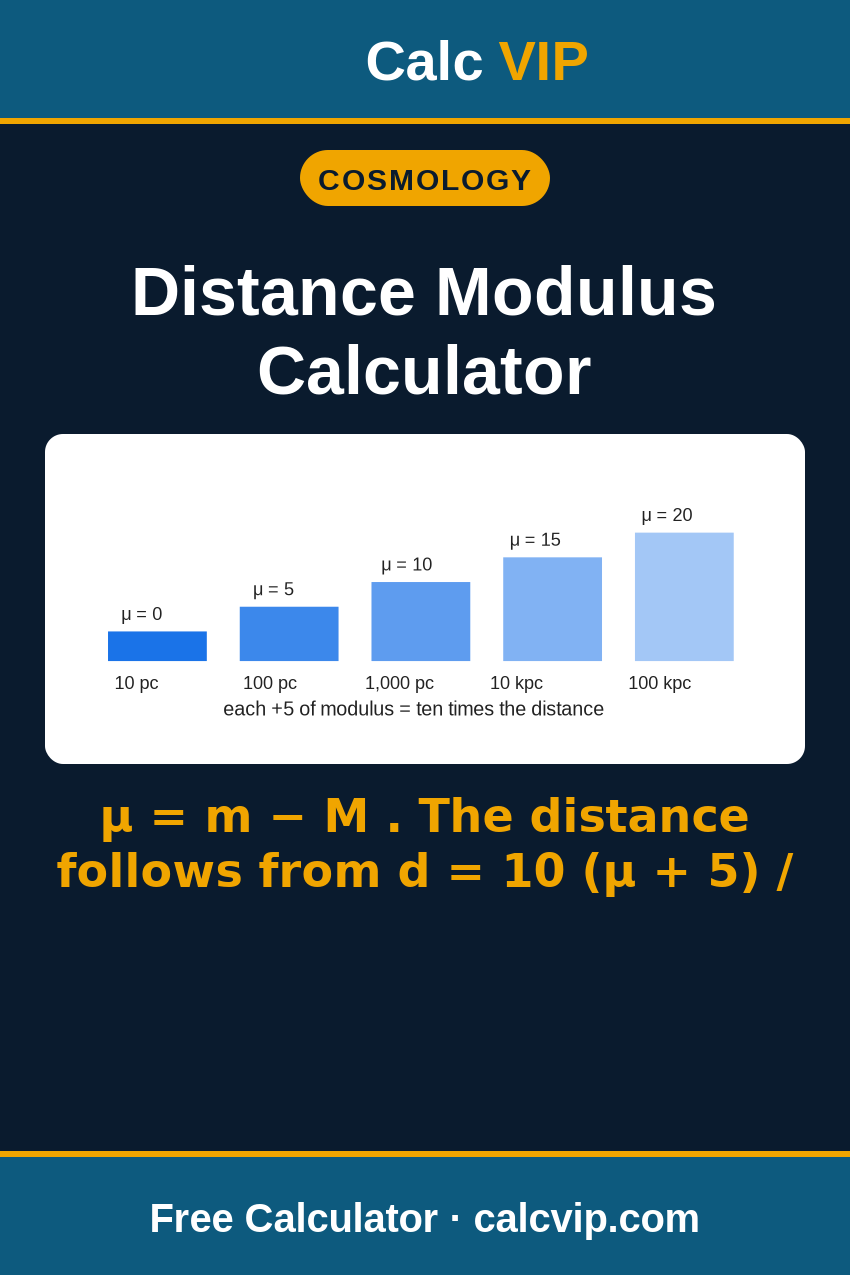
The code is compact. Each factor of 10 in distance dims an object by exactly 5 magnitudes, so the modulus grows by 5 for every tenfold step outward: μ = 0 at 10 pc, 5 at 100 pc, 10 at 1,000 pc, and so on up the powers of ten. Inverting that staircase gives the formula on this page, d = 10(μ+5)/5 parsecs. Because the scale is logarithmic, the method's reach is enormous: the same arithmetic that places a nearby star at 40 pc places a supernova's host galaxy at 400 million pc, with nothing changed but the inputs. No other single formula spans so much of the measurable Universe.
Everything hinges on the trustworthiness of M, and astronomy has spent a century identifying objects whose absolute magnitudes can be known without knowing their distances first — the "standard candles". Cepheid variables betray their luminosity through their pulsation period; Type Ia supernovae detonate at a near-uniform peak brightness; RR Lyrae stars, the tip of the red-giant branch, even the collective glow of galaxy clusters all serve at different ranges. Each candle lights a stretch of the ladder, overlapping with the next, and the modulus converts their apparent faintness into the distances that map the cosmos.
Formula
The distance modulus is μ = m − M. The distance follows from d = 10(μ + 5) / 5 parsecs. A modulus of 0 means 10 pc, 5 means 100 pc, and every extra 5 magnitudes multiplies the distance by 10. When dust extinction A (in magnitudes) is present, the honest form is μ = m − M − A: the observed modulus must be reduced by the dimming before it is converted, or the distance will come out too large. The inverse problem — predicting how bright an object of known M at known distance will appear — is m = M + 5 log10(d/10 pc), the Absolute Magnitude calculator's home ground.
| Symbol | Meaning | Units |
|---|---|---|
| μ | distance modulus, m − M | magnitudes |
| m | apparent magnitude measured from Earth | magnitudes |
| M | absolute magnitude — the candle's known brightness | magnitudes |
| d | distance | parsecs (pc), also shown in light-years |
The cosmic distance ladder, rung by rung
No single candle covers the Universe, so astronomers chain them, each rung calibrated by the one below. Radar ranging and parallax fix the local geometry — the AU, then the nearest stars. Main-sequence fitting and Cepheids, calibrated on those stars, reach across the Milky Way and out to nearby galaxies, tens of millions of light-years. There Cepheids fade from view, and Type Ia supernovae — visible across billions of light-years but rare — take over, themselves calibrated by the Cepheids in their host galaxies. At the top of the ladder, the supernova distances calibrate Hubble's law, which then measures everything else. The distance modulus is the joint at every connection: each rung is, mechanically, a set of m and M values fed through this formula.
The ladder's weakness is equally structural: errors compound upward. A 2% error in the parallax rung becomes a 2% error in Cepheid luminosities, then in supernova luminosities, then in the Hubble constant itself — which is one reason the modern "Hubble tension" between early- and late-Universe measurements is taken so seriously. It is also why independent cross-checks matter so much: gravitational-wave "standard sirens", maser distances and the tip of the red-giant branch each offer a route that bypasses parts of the chain. Whenever two independent ladders agree on a modulus, confidence in both rises; when they disagree, the disagreement itself is a discovery.
How to use
- Enter the apparent magnitude m measured from Earth.
- Enter the absolute magnitude M (from the object's known type, e.g. a Cepheid variable or Type Ia supernova).
- Click "Calculate Distance" to get μ and the distance in parsecs and light-years.
- If the object lies behind significant interstellar dust, subtract the extinction A from the modulus before trusting the distance — or equivalently, subtract A from m before you start.
Worked examples
Example 1 — the textbook case. A standard-candle object has m = 10 and M = 0.
μ = m − M = 10
d = 10(10 + 5)/5 = 10³ = 1,000 pc = 3,261.81 light-years
Example 2 — a Cepheid in a neighbouring galaxy. A Cepheid's period fixes its absolute magnitude at M = −4; it is observed at m = 20.
μ = 20 − (−4) = 24, so d = 1029/5 = 105.8 ≈ 630,957 pc ≈ 2.06 million light-years — Andromeda-class distances, measured with a variable star and this formula.
Example 3 — a Type Ia supernova. A supernova peaks at m = 16.7; Type Ia events peak at M ≈ −19.3.
μ = 16.7 − (−19.3) = 36, so d = 1041/5 = 108.2 ≈ 1.58 × 10⁸ pc ≈ 158 Mpc. This is the top of the ladder in action: one bright explosion, one modulus, a distance spanning a noticeable fraction of the observable Universe.
Example 4 — finding a Sun-like star's range. A star known to be Sun-like (M = +4.83) is catalogued at m = 15.
μ = 15 − 4.83 = 10.17, so d = 1015.17/5 ≈ 1,081 pc. A telescope reaching magnitude 15 sees Sun-like stars out to about a kiloparsec — a neat way to picture the volume any survey actually samples for ordinary stars.
Example 5 — an RR Lyrae in a globular cluster. RR Lyrae variables carry M ≈ +0.6; one in a cluster is measured at m = 15.6.
μ = 15.6 − 0.6 = 15, so d = 1020/5 = 10,000 pc exactly. Globular-cluster distances like this one anchored the first maps of the Milky Way's true size and the Sun's off-centre position in it.
Example 6 — the dust tax, quantified. Suppose the Cepheid of Example 2 sits behind dust with extinction A = 1 magnitude, uncorrected. Its m is inflated by 1, so μ reads 25 instead of 24, and the distance comes out 1030/5 = 1,000,000 pc — an overestimate by a factor of 101/5 ≈ 1.58, nearly 60% too far. One magnitude of dust is not a detail; it is the difference between two different galaxies' worth of distance.
Distance modulus in real life
Measuring galaxy distances for the Hubble diagram. Supernova moduli are the raw data of modern cosmology: plot distance (from μ) against recession velocity and you get the expansion history of the Universe, including its acceleration.
Sizing the Milky Way. Moduli to globular clusters and the galactic centre built the first accurate map of our own galaxy — its diameter, the Sun's distance from the centre, the halo's extent.
Target selection for telescopes. A galaxy's modulus immediately converts a telescope's limiting magnitude into the faintest stars it can resolve there: at μ = 30, a limit of m = 28 reaches only stars brighter than M = −2, which plans the observation.
Exoplanet host characterisation. For stars with poor parallaxes, a modulus from the star's spectral type (spectroscopic parallax) still supplies the distance that turns a transit's fractional dimming into a planet's true radius.
Calibrating Cepheids with Gaia. Gaia's parallaxes give direct distances to Milky Way Cepheids; their moduli then fix the Cepheid period–luminosity relation that the whole extragalactic ladder stands on.
Archaeology of nearby galaxies. The colour–magnitude diagrams of dwarf galaxies are interpreted by shifting them by a trial modulus until the stellar sequences align — the modulus is literally the dial astronomers turn to fit a galaxy's history.
Standard candles: how M is earned
A standard candle is not standard by magic; its M is earned by physics. A Cepheid pulsates because its atmosphere traps and releases radiation in a cycle, and the cycle's period is set by the star's density — which also sets its luminosity, hence the period–luminosity relation Henrietta Leavitt found in 1912: measure the period, read off M. A Type Ia supernova is a white dwarf pushed over a fixed mass threshold (the Chandrasekhar limit, about 1.4 solar masses), so the explosions share a fuel supply and a peak brightness, with small corrections from the light curve's shape. RR Lyrae stars burn helium in a core of nearly identical mass in every old star, so their luminosities cluster tightly. In each case the uniformity has a physical cause — and the astronomer's work is verifying that the cause holds in the new environment (different chemical composition, different galaxy) before the candle is trusted there.
When the modulus lies: extinction and other traps
The formula assumes the space between us and the candle is transparent. It often is not. Dust grains scatter blue light more than red, so a dust-dimmed object is both fainter and redder than it should be — the reddening is the saving grace, because it lets astronomers estimate A from the colour shift and correct the modulus. Without the correction the distance is always overestimated, never underestimated, by the factor 10A/5. Other traps are subtler: blending (two unresolved stars measured as one bright object, shrinking the apparent distance), misclassification (a Type II supernova mistaken for a Type Ia, with a very different M), and evolution (candles in the young Universe may not match their modern twins). Professional distance work is mostly the art of hunting these biases; the arithmetic on this page is the easy part. It is also why published moduli come with two error bars — statistical and systematic — and why the systematic one, dominated by exactly these traps, is the number that decides arguments.
The modulus in the Gaia era: a ladder being rebuilt from below
For a century the modulus method existed because parallax could not reach. That era is ending from the bottom up. Gaia's parallaxes now give direct, geometric distances — no candle, no M, no modulus — for stars out to several thousand parsecs, swallowing the first rungs of the ladder whole. The effect on this calculator's trade is not extinction but promotion: with nearby Cepheids' distances known geometrically, their period–luminosity relation is calibrated to about 1%, and that calibration propagates up every rung the modulus still serves. The remaining frontier is exactly where parallax will never reach — other galaxies — and there the modulus, fed by supernovae and the tip of the red-giant branch, remains the only game in town. Expect the pattern of the next decades: geometry below, modulus above, and the boundary between them marching steadily outward.
No single modulus carries more weight than the Large Magellanic Cloud's 18.477, now known to about ±0.03 magnitudes — a distance good to roughly 1%, thanks largely to eclipsing-binary measurements. It matters out of proportion to the LMC's size because that galaxy hosts the nearest rich population of Cepheids and other candles: calibrate them there, and the calibration transfers to every galaxy those candles can reach. A shift in the LMC modulus shifts, quite literally, the measured scale of the Universe.
There is a quieter lesson in the numbers themselves. A modulus is a logarithm, so equal errors in μ mean equal percentage errors in distance: an uncertainty of ±0.1 magnitudes is ±5% in distance whether the target is a star at 100 pc or a supernova at 100 Mpc. This is why astronomers budget their errors in hundredths of a magnitude and fight so hard over the last few hundredths — at the top of the ladder, 0.05 magnitudes of modulus is the difference between rival values of the Hubble constant, and between rival ages for the Universe.
Quick reference: modulus to distance
| Modulus μ | Distance (pc) | Distance (light-years) |
|---|---|---|
| 0 | 10 | 32.62 |
| 5 | 100 | 326.18 |
| 10 | 1,000 | 3,261.81 |
| 15 | 10,000 | 32,618 |
| 20 | 100,000 | 326,181 |
| 25 | 1,000,000 (1 Mpc) | 3,261,812 |
| 30 | 10 Mpc | 32,618,116 |
| 35 | 100 Mpc | 326,181,165 |
| 40 | 1,000 Mpc (1 Gpc) | 3,261,811,648 |
The Large Magellanic Cloud's modulus is 18.477 — the most consequential single value on the staircase, since the extragalactic ladder is calibrated there. The Andromeda Galaxy's modulus is about 24.4, the Virgo Cluster's about 31, and the most distant supernovae measured exceed 44 — all read off this same staircase.
Common mistakes
- Forgetting extinction. An uncorrected magnitude of dust adds directly to μ and inflates the distance by 10A/5. In the galactic plane A can reach several magnitudes — the single largest error source for in-galaxy distances.
- Subtracting the magnitudes the wrong way. μ = m − M, not M − m. A candle farther than 10 pc always has m > M and a positive modulus; a negative result for a distant object means the subtraction flipped.
- Using an M from the wrong candle class. A Cepheid's M and a supernova's M differ by 15 magnitudes — a factor of a thousand in distance. The method is only as good as the classification behind M.
- Reading the answer in the wrong unit. The formula returns parsecs. Reporting the parsec figure as light-years understates the distance by a factor of 3.26; the calculator shows both precisely to prevent this.
- Treating "spectroscopic parallax" as parallax. It is a modulus method with parallax-like output, and its errors (5–10% on a good day) are far larger than true parallax errors. Cite it as what it is.
FAQ
Where does M come from in practice?
From objects whose luminosity is known: Cepheid variables (from their pulsation period), RR Lyrae stars, and Type Ia supernovae are classic "standard candles".
What can spoil the measurement?
Interstellar dust dims and reddens the light, making the object look farther away unless the extinction is corrected for.
How far can this method reach?
With bright standard candles like Type Ia supernovae, distances of billions of light-years can be measured.
What modulus corresponds to the nearest stars?
Negative ones. Proxima Centauri at 1.30 pc has μ = 5 log10(0.130) ≈ −4.43: inside 10 pc, m is brighter than M and the modulus runs below zero. The scale handles it without complaint.
How accurate are modulus distances?
For a well-calibrated candle with good photometry, about 5% — set mostly by the scatter in the candle's own M and by extinction corrections. That is far better than any pre-20th-century method and far worse than parallax next door.
Why do astronomers quote μ instead of the distance?
Because μ is what is actually measured: m and M are both magnitudes, so their difference carries the measurement errors transparently, without a spurious conversion. Distances in parsecs are derived quantities; μ is the data.
Can the modulus be used for galaxies themselves?
Yes — a galaxy's total apparent magnitude minus its (statistically known) absolute magnitude gives its modulus. More powerfully, candles inside the galaxy — Cepheids, supernovae — give the galaxy's modulus star by star.
What is the largest modulus ever measured?
Distant Type Ia supernovae reach μ ≈ 44–46, corresponding to billions of parsecs. At those depths the simple formula needs cosmological corrections — expansion during the light's journey — and professionals quote a "luminosity distance" instead.
How does this relate to the Absolute Magnitude calculator?
They are the same equation in two directions. That tool takes m and d and returns M; this one takes m and M and returns d. Between them, any two of the three quantities yield the third.
Who invented the distance modulus method?
It grew out of early-1900s work on star magnitudes and spectra — Ejnar Hertzsprung and Henry Norris Russell's diagrams made spectral-type-to-M calibration possible, and the method matured alongside the Cepheid work of Leavitt and Hubble.