 Calc
Hubble's Law Calculator – Galaxy Recession Velocity & Distance
 Created by Yuki Tanaka · Physics Editor · Modern Physics · Last updated: November 2026
Use this free Hubble's Law Calculator to find how fast a galaxy is receding from us — or how far away it is from its recession velocity. Hubble's law is the key evidence that the Universe is expanding.
That one short equation, v = H0 × d, is arguably the most consequential formula in all of cosmology. Before it, the Universe could plausibly have been static and eternal, exactly as even Einstein first assumed. After Edwin Hubble published the relationship in 1929 — building on Vesto Slipher's galaxy redshifts and Georges Lemaître's earlier theoretical prediction — the cosmos had a history: everything was once closer together, and the Universe has been expanding ever since. Run the expansion backwards and you arrive at a beginning, the hot dense state we call the Big Bang. This calculator applies Hubble's law in both directions: give it a distance and it returns the recession velocity, or give it a velocity and it returns the distance.
The law's simplicity hides a subtlety worth grasping at the start. A galaxy's recession velocity is not really a velocity through space, the way a rocket moves. It is the growth of space itself between us and the galaxy. Every megaparsec of intervening space stretches by the same fraction each second, so the total recession speed is that fraction — the Hubble constant H0 — multiplied by how many megaparsecs of space lie in between. Double the distance and you double the amount of stretching space, hence double the velocity. That is why the law is linear, and why it holds in every direction and from every galaxy's point of view: there is no centre to the expansion.
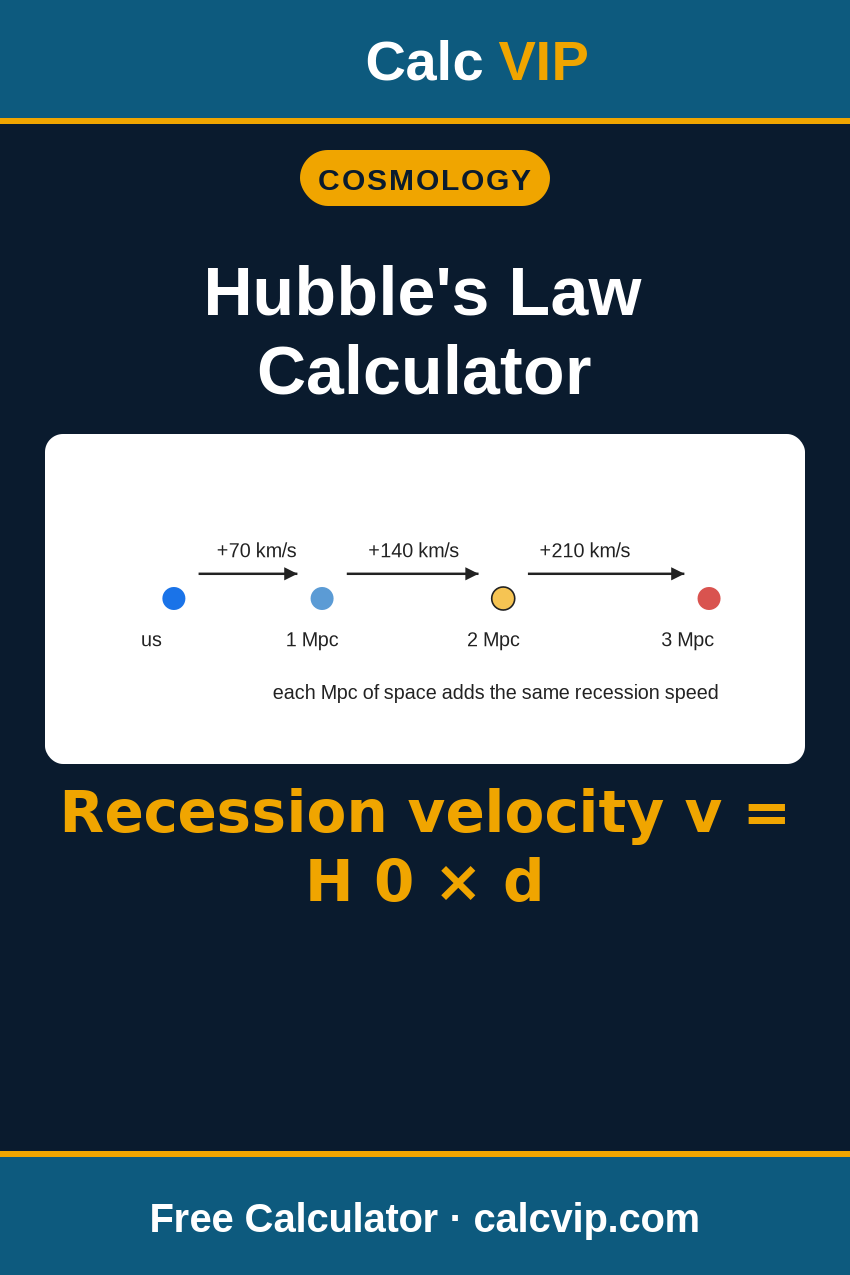
Because the relationship runs both ways, Hubble's law became astronomy's first true tape measure for the deep Universe. A galaxy's recession velocity is easy to measure from the redshift of its spectrum — how far its spectral lines have been stretched towards the red — and the law then converts that velocity straight into a distance, out to ranges where every other method fails. Most of the galaxy distances quoted in textbooks and news stories began life as a redshift fed through this exact calculation. The catch, explored below, is that the conversion is only as good as the value of H0 you feed in — and pinning that number down has become one of the great unresolved arguments of modern cosmology.
Formula
Recession velocity v = H0 × d • Distance d = v / H0
Hubble's law states v = H0 × d, where v is the recession velocity in km/s, d is the distance in megaparsecs (Mpc) and H0 is the Hubble constant in km/s per Mpc. Rearranged, the distance is d = v / H0. One megaparsec equals about 3.26 million light-years. Two companion quantities follow immediately: the Hubble time, 1/H0, is a rough age for the Universe (about 14 billion years for H0 = 70), and the Hubble distance, c/H0, is the distance at which the formal recession velocity reaches the speed of light — about 4,283 Mpc for H0 = 70. Neither marks a physical edge; both are scales, not walls.
| Symbol | Meaning | Units |
|---|---|---|
| v | recession velocity — rate at which space carries the galaxy away | km/s |
| d | distance to the galaxy | Mpc (megaparsecs) |
| H0 | Hubble constant — expansion rate of space today | km/s per Mpc |
| z | redshift — fractional stretching of the galaxy's light | dimensionless |
It is space that expands, not galaxies that fly
The most persistent misunderstanding of Hubble's law is the picture it first suggests: galaxies as shrapnel from an explosion, hurtling outward through pre-existing space from a central blast. Every part of that picture is wrong. There was no centre and no surrounding void. Instead, space itself is stretching uniformly, like the surface of an inflating balloon or the dough of a rising loaf, carrying the galaxies along the way raisins are carried apart by expanding dough. The galaxies themselves barely move through their local space at all; the distances between them simply grow. This is why the law looks the same from every galaxy — observers anywhere see all distant galaxies receding with speed proportional to distance, because the stretching is a property of space, not of any special viewpoint.
Two consequences follow that this calculator quietly encodes. First, recession velocities are not capped by the speed of light: beyond the Hubble distance of about 4,283 Mpc, space carries galaxies away faster than light can cross the growing gap, which relativity permits because nothing is moving through space faster than light. We can still see some of those galaxies, because the light they emitted long ago has been fighting its way through expanding space ever since. Second, nearby the law nearly vanishes. Within a few megaparsecs, ordinary gravitational tugs — galaxies falling towards each other and into clusters — are stronger than the gentle stretch of space, so local motions can point any way at all. Hubble's law is a statement about the Universe's large-scale average behaviour, and it only becomes trustworthy once you average over distances where those local motions are small corrections.
How to use
- Choose whether you want the velocity (from distance) or the distance (from velocity).
- Leave H0 at 70 km/s/Mpc or enter another published value (measurements range roughly from 67 to 74).
- Enter the distance in Mpc — or the velocity in km/s — and click "Calculate".
- Read the recession velocity as a percentage of light speed too: below a few percent, the simple law is reliable; as the fraction climbs towards a quarter or more, treat the result as a first estimate only, for the reasons in the depth section below.
Worked examples
Example 1 — the headline calculation. A galaxy is 100 Mpc away and H0 = 70 km/s/Mpc.
v = H0 × d = 70 × 100 = 7,000 km/s
That distance is also 100 × 3.2618 = 326.18 million light-years — and the galaxy is racing away at about 2.3% of the speed of light.
Example 2 — running the law backwards. A galaxy's spectrum shows a recession velocity of 21,000 km/s. How far away is it?
d = v / H0 = 21,000 ÷ 70 = 300 Mpc = 978.54 million light-years. This reverse direction is the everyday use of the law: velocities are measured from spectra, distances are what astronomers actually want.
Example 3 — the Virgo Cluster. The nearest large galaxy cluster lies about 16.5 Mpc away.
v = 70 × 16.5 = 1,155 km/s. The cluster's measured mean recession velocity is close to this, but individual member galaxies scatter by several hundred km/s around it — they are orbiting inside the cluster's gravity, a reminder that at small distances the law gives the average, not each galaxy.
Example 4 — the Hubble tension in one line. Take the same galaxy at 100 Mpc and feed in the two rival values of H0: the early-Universe value 67.4 gives v = 6,740 km/s, while the local distance-ladder value 73 gives v = 7,300 km/s. The 560 km/s gap between those answers — from nothing but the choice of constant — is the Hubble tension expressed as a velocity.
Example 5 — the deep field. A galaxy in a deep survey sits at 1,000 Mpc.
v = 70 × 1,000 = 70,000 km/s, which is 23.3% of the speed of light, and the distance is 3,261.8 million light-years. At this range the simple law is straining: the expansion rate was different when the light set out, so professional work replaces v = H0d with the full relativistic machinery of cosmology. The calculator's answer is the correct first approximation.
Example 6 — where the law fails: Andromeda. The Andromeda Galaxy is only 0.778 Mpc away, so the law predicts a recession of 70 × 0.778 = 54 km/s away from us. In reality Andromeda's light is blueshifted: it is approaching at about 110 km/s, because the mutual gravity of the Milky Way and Andromeda overwhelms the feeble expansion across such a small gap. Nearby, gravity wins; the law only takes over once distances reach tens of megaparsecs.
Hubble's law in real life
Distances to millions of galaxies. Large redshift surveys measure recession velocities for hundreds of thousands of galaxies; Hubble's law turns each one into a distance, building the three-dimensional maps of cosmic structure — filaments, walls and voids — that fill astronomy textbooks.
The age of the Universe. The Hubble time 1/H0 ≈ 14 billion years was the first quantitative estimate of the Universe's age, and it remains the yardstick against which precise ages (13.8 billion years) are compared.
Dark energy's discovery. In 1998, two teams plotted very distant supernovae on the Hubble diagram and found them slightly farther — hence fainter — than any decelerating expansion allowed. The expansion is accelerating, driven by what is now called dark energy; the Nobel Prize followed in 2011. The discovery was, at heart, a careful reading of this calculator's graph.
Planning telescope time. A galaxy's redshift immediately tells observers roughly how far away it is and therefore how long an exposure they need: a target at 300 Mpc demands far more telescope time than one at 30 Mpc for the same detail.
Testing gravity itself. Deviations from a perfectly smooth Hubble flow — galaxies streaming towards great attractors — map the invisible dark matter that causes the streaming, testing gravitational theory on the largest scales.
Calibrating every other distance. Galaxies whose distances are measured by independent methods (supernovae, Cepheids) are plotted against their recession velocities to fix H0; that single calibration then underwrites every Hubble-law distance in the catalogue.
The Hubble tension: one law, two constants
Hubble's law contains a single measured number, H0, and modern astronomy measures it two superbly precise ways that refuse to agree. The local route builds the distance ladder — parallax, Cepheid variables, Type Ia supernovae — and lands near 73 km/s/Mpc. The early-Universe route reads the cosmic microwave background, the afterglow of the Big Bang, and extrapolates forward with the standard cosmological model, landing near 67 km/s/Mpc. Each side claims errors under 2%, yet the values differ by nearly 9% — far more than the error bars allow. Either subtle systematics haunt one of the methods, or the standard model of cosmology is missing something real: new physics. Until it resolves, every distance from this calculator carries that same few-percent uncertainty, which is why the H0 box is left open for you to edit. Trying both values on the same galaxy, as in Example 4, is the fastest way to feel the size of the disagreement.
Where the simple law stops
Real Hubble diagrams also scatter: each galaxy has its own small peculiar velocity on top of the smooth flow, so points wobble around the straight line by a few hundred km/s. That scatter is itself useful — it maps the gravitational pull of nearby superclusters — but it is why no single galaxy's Hubble distance should ever be trusted to better than about ten percent.
The formula v = H0d is the first term of a richer story. At redshifts beyond about z ≈ 0.1 (a few hundred megaparsecs), three corrections matter. The expansion rate itself was larger in the past, so "the" Hubble constant is really a Hubble function that changes over cosmic time. The relationship between redshift and velocity turns relativistic — the naive v = zc overstates things and must be replaced by the relativistic Doppler formula and its cosmological refinements. And the very meaning of "distance" splits into several distinct quantities (light-travel, comoving, luminosity distance) that agree nearby but diverge far away. Professional cosmology handles all of this with the Friedmann equations; the simple law remains exact in the limit where the Universe is young-looking and nearby — which covers a surprising amount of everyday extragalactic astronomy, and everything this calculator is asked to do.
Quick reference: recession velocity by distance (H0 = 70)
| Distance | Recession velocity | In light-years |
|---|---|---|
| 10 Mpc | 700 km/s | 32.62 million ly |
| 50 Mpc | 3,500 km/s | 163.09 million ly |
| 100 Mpc | 7,000 km/s | 326.18 million ly |
| 200 Mpc | 14,000 km/s | 652.36 million ly |
| 500 Mpc | 35,000 km/s | 1,630.9 million ly |
| 1,000 Mpc | 70,000 km/s | 3,261.8 million ly |
Read the table as a scale of trust as well as of distance: the first rows are solid, everyday astronomy, while the last row is an extrapolation — right to first order, but refined by the corrections described above.
Common mistakes
- Applying the law to nearby galaxies. Inside a few megaparsecs, gravity-driven peculiar velocities swamp the expansion — Andromeda is approaching us despite the law "predicting" recession. Use the law for distant galaxies, where the flow dominates.
- Mixing parsecs and megaparsecs. H0 is per megaparsec. Feeding in a distance in plain parsecs inflates the velocity a million-fold; feeding Mpc into a per-parsec formula shrinks it the same way. Check the unit before the arithmetic.
- Treating the recession velocity as motion through space. A galaxy at 5,000 Mpc "recedes" faster than light without breaking relativity, because space itself is stretching. Do not plug Hubble velocities into ordinary Doppler or kinetic-energy formulas.
- Assuming H0 is settled. Values from 67 to 74 are all defensible today. Quote a Hubble-law distance together with the H0 you used, or the number is meaningless to anyone checking it.
- Confusing light-travel distance with the calculator's distance. The light-years figure shown is the distance converted at today's rate; the light from a 1,000 Mpc galaxy did not travel 3.26 billion years in the full cosmological accounting, because space expanded while it travelled.
FAQ
Why do distant galaxies move away faster?
Space itself is expanding. The farther a galaxy is, the more expanding space lies between us and it, so its recession velocity grows in proportion to distance.
What value of H₀ should I use?
70 km/s/Mpc is a good middle value. Measurements from the early Universe give about 67, while local distance-ladder measurements give about 73 — this small disagreement is called the "Hubble tension".
Does Hubble's law work for nearby objects?
Only roughly. For nearby galaxies, their own gravity-driven motions are comparable to the expansion velocity, so the law is reliable mainly for distant galaxies.
How was Hubble's law discovered?
Edwin Hubble combined his own distance measurements to galaxies (using Cepheid variables at Mount Wilson) with Vesto Slipher's redshift measurements, and in 1929 published the velocity–distance relation. Georges Lemaître had derived the same law theoretically two years earlier, and modern practice increasingly credits both.
What is redshift, exactly?
The fractional stretching of a galaxy's light towards longer, redder wavelengths, written z. For slow recessions v ≈ z × c, so a galaxy at z = 0.01 recedes near 3,000 km/s; at high z the simple conversion gives way to relativistic formulas.
Can anything recede faster than light?
Yes — galaxies beyond about 4,283 Mpc (for H0 = 70) recede superluminally. No relativity is broken: the galaxies are nearly stationary in their own space; it is the intervening space that grows faster than light can cross it.
Does the expansion stretch atoms, planets or galaxies too?
No. Bound systems — held together by electromagnetic or gravitational forces far stronger than the expansion's gentle pull — do not expand. Only the unbound spaces between galaxy clusters grow.
What is the Hubble time?
1/H0, the time the Universe would have existed if it had always expanded at today's rate: about 14.0 billion years for H0 = 70. The true age, 13.8 billion years, is close because the early deceleration and late acceleration roughly cancel.
Why is it called a "constant" if it changes?
H0 is constant in space — the same everywhere at this moment in cosmic history — but not in time. The subscript 0 means "today's value"; in the young Universe the expansion rate was far higher.
How far away is the most distant galaxy known?
The record holders sit at redshifts above 13, with light-travel times over 13.4 billion years. Feeding their redshifts into this simple calculator would give meaningless distances — at those depths only the full cosmological model, not v = H0d, applies.