 Calc
Interstellar Travel Time Calculator – Time Dilation at a Fraction of c
 Created by Yuki Tanaka · Physics Editor · Modern Physics · Last updated: November 2026
Use this free Interstellar Travel Time Calculator to find out how long a trip to another star would take at a sizeable fraction of the speed of light. Enter the distance in light-years and the speed as a fraction of c, and see both the time measured on Earth and the shorter time experienced by the travellers, thanks to time dilation.
Every other calculator of motion quietly assumes that time flows the same for everyone. This one does not. Einstein's special relativity says that a clock carried at a substantial fraction of the speed of light ticks slower than the clocks it left behind — not because of any mechanical fault, but because time itself runs at different rates along different paths through spacetime. Send a crew at half light-speed to the nearest star and they will age 1.14 years less than the people who waved them off. This calculator computes both sides of that bargain — the years that pass on Earth and the years the crew actually live through — for any distance and any fraction of c.
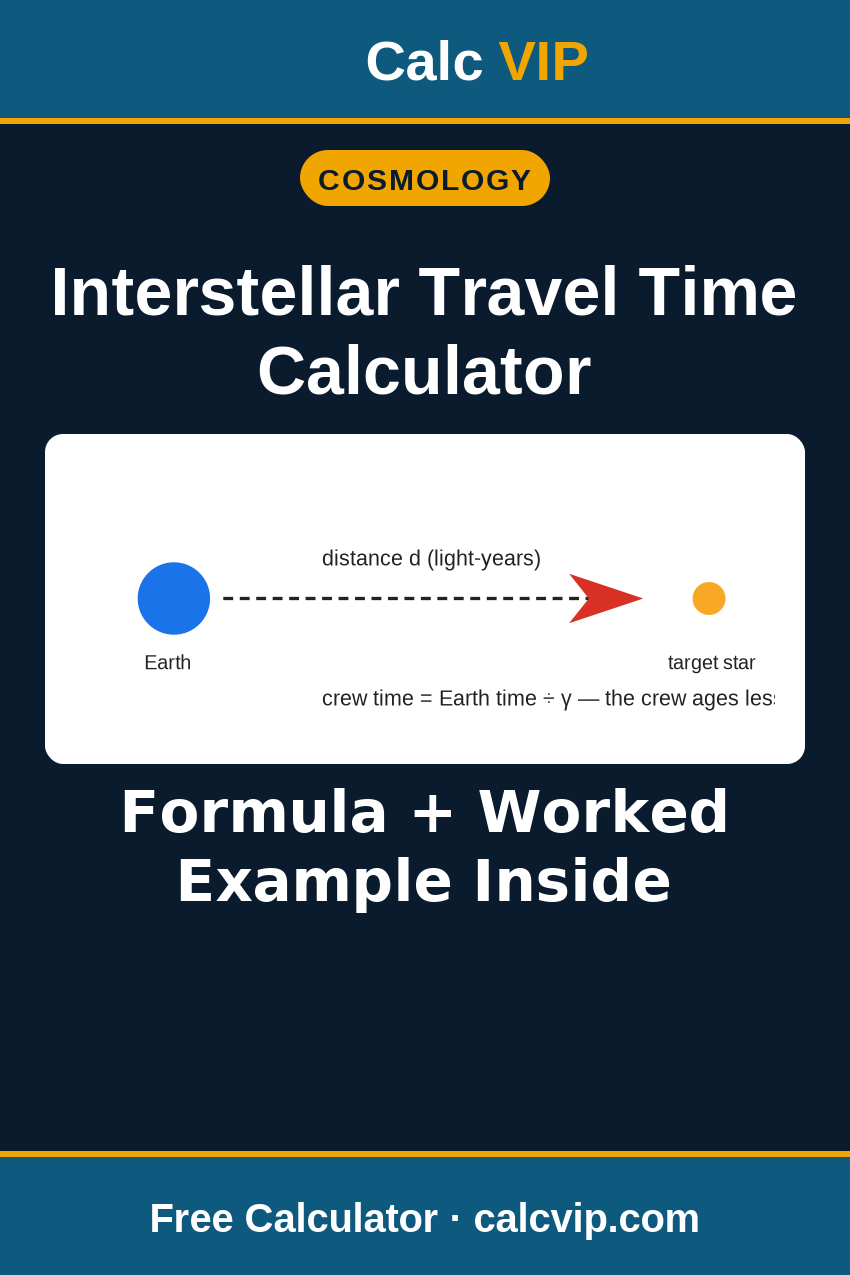
The effect is governed by a single quantity, the Lorentz factor γ, which depends only on speed: barely above 1 at a tenth of light-speed (γ = 1.005, a rounding error of an effect), 1.155 at half light-speed, 2.29 at 0.9c, 7.09 at 0.99c, and 22.4 at 0.999c — beyond which γ explodes towards infinity as speed approaches c, which no massive object can ever reach. Time dilation is γ applied to the crew's clock: their experienced time is the Earth-frame time divided by γ. The same γ also shrinks the distance ahead of the ship (length contraction), which is the crew's own explanation of the bargain: from their seats, the journey is shorter, so of course it takes less time.
Nothing here is science fiction except the engineering. Time dilation is measured daily: muons created in the upper atmosphere survive to reach the ground only because their clocks run slow; atomic clocks flown around the world in 1971 came home disagreeing with their stay-at-home twins by the predicted nanoseconds; and the GPS satellites overhead must have their clocks corrected for relativity every day, or navigation errors of kilometres would accumulate. The calculator simply scales those laboratory certainties up to interstellar distances, where the nanoseconds become years and the thought experiment becomes a one-way farewell.
Formula
For a journey of d light-years at a constant speed β (the speed as a fraction of c):
Earth time t = d ÷ β • Lorentz factor γ = 1 ÷ √(1 − β²) • Crew time t′ = t ÷ γ = (d ÷ β) × √(1 − β²)
The Earth time is almost Newtonian — distance over speed, with the light-year's definition doing quiet work: travelling d light-years at βc takes d/β years because light itself would take d years. All the relativity lives in γ. The ageing difference, t − t′, is the physical content of the twin paradox for the one-way trip: it is real, permanent, and (for the constant-speed idealisation) computable on the back of an envelope. Rearranged, the formulas answer the mission-design question — the speed needed for a crew to experience a chosen time t′ over distance d follows from t′ = (d/β)√(1−β²), solved numerically; the table below shows how brutally the required β crowds towards 1 as the demanded crew time shrinks.
| Symbol | Meaning | Units |
|---|---|---|
| d | distance to the target, in Earth's frame | light-years |
| β | speed as a fraction of light-speed c | — (0 to 1) |
| γ | Lorentz factor 1 ÷ √(1 − β²) | — |
| t, t′ | time elapsed on Earth; time experienced by the crew | years |
Two clocks, one journey: whose time is "real"?
Both — and that is the point that makes relativity relativity rather than illusion. Earth and crew disagree about the duration of the trip because duration is not a property of the trip alone; it is a property of the path taken through spacetime, and the two parties took different paths (one stayed, one went). Each clock faithfully records the time along its own path, the way two odometers faithfully record different distances along different roads between the same cities. The crew's slower ageing is not a trick of signal delay or perception: if the crew turns around and comes home, they return genuinely younger than their Earth twins, by twice the one-way difference. The turnaround matters — it is what breaks the symmetry between the twins — but for the one-way journeys this calculator describes, the accounting is exactly as shown: the traveller's elapsed proper time is t/γ, full stop.
The crew's own view is equally consistent and stranger. From the ship, the distance to the target is contracted by the same γ: at 0.99c the 2.54 million light-years to Andromeda shrink to about 358,000 light-years, which the ship — travelling at 0.99c through its own frame — crosses in about 361,500 years of ship time. Earth sees a 2.56-million-year voyage with a slowed clock; the crew sees a shortened road at full speed. Two descriptions, one physics, identical predictions for every clock and ruler. Whenever a result on this page feels paradoxical, translating it into the other frame is the reliable cure.
How to use
- Enter the distance to the target in light-years (Proxima Centauri: 4.24; the galactic centre: about 26,000; Andromeda: 2,537,000).
- Enter the cruise speed as a fraction of c — 0.5 for half light-speed, 0.99 for ninety-nine percent. It must lie between 0 and 1, exclusive.
- Click "Calculate Travel Time" to see the Earth-frame duration, the crew's experienced time, the Lorentz factor and the ageing difference.
- Remember the idealisation: the ship is assumed to cruise at full speed for the whole trip. Real acceleration and deceleration phases would add Earth time and slightly change the crew's total — the constant-speed answer is the clean benchmark they modify.
Worked examples
Example 1 — Proxima at half light-speed. d = 4.24 ly, β = 0.5.
Earth time t = 4.24 ÷ 0.5 = 8.48 years; γ = 1 ÷ √(1 − 0.25) = 1.1547; crew time = 8.48 ÷ 1.1547 = 7.34 years. The crew saves 1.14 years — real, but hardly a fountain of youth; at half light-speed, relativity is still a modest discount.
Example 2 — Proxima at a "realistic" 0.1c. d = 4.24 ly, β = 0.1 (far faster than any probe yet flown).
t = 4.24 ÷ 0.1 = 42.40 years; γ = 1.0050; crew time = 42.19 years; saving 0.21 years — about eleven weeks. Below a tenth of light-speed, time dilation is a curiosity for atomic clocks, not a strategy for crews.
Example 3 — ten light-years at 0.9c. d = 10 ly, β = 0.9.
t = 10 ÷ 0.9 = 11.11 years; γ = 2.2942; crew time = 4.84 years; saving 6.27 years. Past 0.9c the bargain transforms: the crew experiences less than half the Earth's wait.
Example 4 — TRAPPIST-1 at 0.8c. d = 39.46 ly, β = 0.8.
t = 39.46 ÷ 0.8 = 49.32 years; γ = 1.6667; crew time = 29.59 years; saving 19.73 years. A crew leaving at 25 arrives, by their own clocks, at 55 — while Earth has aged them to 74. One-way emigration at relativistic speed is also emigration in time.
Example 5 — a century at 0.999c. d = 100 ly, β = 0.999.
t = 100 ÷ 0.999 = 100.10 years; γ = 22.3663; crew time = 4.48 years; saving 95.62 years. The crew crosses a century of Earth history in a single working season of their own lives — and can never go back to the world they left.
Example 6 — Andromeda at 0.99c. d = 2,537,000 ly, β = 0.99.
t = 2,537,000 ÷ 0.99 = 2,562,626 years; γ = 7.0888; crew time = 361,503 years; saving 2,201,123 years. Even at ninety-nine percent of light-speed, another galaxy remains beyond any crew's lifetime by a factor of thousands — the honest scale of intergalactic ambition.
Relativistic travel in real life (and real physics)
GPS satellites. Orbiting clocks tick faster from weaker gravity and slower from their speed; the net relativistic correction is about +38 microseconds a day, without which GPS positions would drift by roughly 10 km daily. Relativity is not awaiting starships — it is holding your phone's map together.
Muon rain. Muons made by cosmic rays 10 km up should decay within about 660 m of travel, yet they flood the ground — because at 0.998c their γ ≈ 15 stretches their 2.2-microsecond lives, in Earth's frame, to cover the distance. Every second, this calculator's physics rains through you.
The Hafele–Keating experiment (1971). Atomic clocks flown around the world returned differing from ground clocks by the predicted tens-to-hundreds of nanoseconds — the twin paradox measured with airline tickets, including the gravitational contribution.
Breakthrough Starshot. The gram-scale probes proposed for Proxima would cruise near 0.2c: γ = 1.0206, so their clocks would lose about 2 percent — over a 21.2-year Earth-frame flight, roughly 0.43 years. Even uncrewed, a relativistic mission must decide whose calendar its telemetry uses.
Particle accelerators. The LHC's protons run at γ ≈ 7,000 — their internal clocks nearly frozen relative to the laboratory. Accelerator physics is applied time dilation, engineered to parts per billion.
Generation-ship planning. For the slower, realistic architectures (0.05–0.1c), this calculator's message is bracing: γ ≈ 1.005 buys the crew eleven weeks per half-century. Generation ships cannot cheat with relativity; they must simply endure — which is why the honest designs are worlds, not vehicles.
The energy bill: why 0.99c is not a plan
Time dilation's discount is paid in kinetic energy, and the price list is written by the same γ: a ship's kinetic energy is (γ − 1) × mc². At 0.5c that is 0.155 × mc² — for a modest 1,000-tonne ship, about 1.4 × 10²² joules — more than twenty years of humanity's current total energy consumption, for one launch, before deceleration (which, with rockets, must be paid again). At 0.99c the factor is 6.09 × mc² — forty times worse — and a rocket carrying its own fuel fares exponentially worse still, because the fuel must itself be accelerated. This is why serious interstellar proposals are beamed sails, fusion torches or world-ships at 0.05c, and why this calculator's most important output may be its most discouraging: the universe permits time travel into the future, at γ rates, and charges mc² rates for the ticket.
Talking home: the one-way conversation
Time dilation is not even the cruellest number on a relativistic mission — light-lag is. A crew arriving at Proxima after the 0.5c voyage of Example 1 radios the news home, and the signal, travelling at c, takes 4.24 years to arrive: Earth learns of the landing 8.48 + 4.24 = 12.72 years after launch, and any reply takes another 4.24. A question asked from Earth in year 13 is answered, at the earliest, in year 21. Mission control therefore cannot control; it can only advise, years late, a crew that has long since coped alone. As distances grow the lag swallows the dilation whole: at Andromeda the two effects differ by millions of years, but it is the humble speed of the radio signal — the same c that caps the ship — that truly isolates the travellers. Interstellar flight is not a voyage out and back; it is a correspondence with the future, conducted at one letter per decade.
Quick reference: the Lorentz factor
| Speed β | γ | Crew time per 10 Earth years |
|---|---|---|
| 0.1c | 1.0050 | 9.95 years |
| 0.5c | 1.1547 | 8.66 years |
| 0.8c | 1.6667 | 6.00 years |
| 0.9c | 2.2942 | 4.36 years |
| 0.99c | 7.0888 | 1.41 years |
| 0.999c | 22.3663 | 0.45 years |
Read the last column as the exchange rate between Earth's patience and the crew's lives — an exchange rate that improves seductively and costs catastrophically as β approaches 1.
Common mistakes
- Entering the speed as a percentage or a velocity. The input is β, the fraction of c: 0.5, not 50 and not 150,000 km/s. Values of 1 or more are rejected for the right reason — no massive ship can reach or exceed c.
- Multiplying by γ instead of dividing. The crew's time is t ÷ γ, always less than Earth's. If your crew time came out larger, the γ went the wrong way — moving clocks run slow, never fast, in this (special-relativistic) accounting.
- Believing the crew "feels" time slow down. Aboard the ship, everything — clocks, hearts, thoughts — runs at its normal rate; the crew notices nothing unusual locally. The difference appears only when the two parties compare clocks, at departure's end or by exchanged signals.
- Forgetting the trip home doubles the effect. This calculator prices one-way journeys. A return at the same speed doubles both times and doubles the ageing gap — the returning twin is younger by 2 × (t − t′).
- Ignoring acceleration entirely in real missions. The constant-speed model is the benchmark, not the itinerary. A ship that must accelerate gently (1g for comfort) spends years reaching cruise; its crew time then follows the relativistic rocket equations, which this simpler model approximates only for long, fast cruises.
FAQ
Why does the crew age less?
Moving clocks run slow — this is Einstein's time dilation, confirmed daily by atomic clocks on satellites and by short-lived particles in accelerators living longer at high speed. The effect is tiny at everyday speeds but grows fast as β approaches 1.
Can the speed be exactly c (β = 1)?
No massive object can reach c: γ becomes infinite, so the energy needed would be infinite too. The calculator therefore only accepts β below 1. Light itself makes the trip with zero proper time elapsed.
What about the return trip and messages home?
Double the one-way times for a round trip at the same speed (ignoring turnaround). Radio messages travel at c, so a reply from Proxima always takes at least 4.24 years each way no matter how fast the ship is.
Can the crew ever arrive before they left, or travel into the past?
No. Time dilation only ever moves travellers into the future faster than they would arrive by staying home — the ageing difference is always a saving, never a reversal. Special relativity permits no path that returns a clock to before its departure.
What speed makes the crew age half as fast as Earth?
γ = 2 requires β = √(1 − 1/4) = 0.866c. At that speed a 10-light-year trip takes Earth 11.55 years while the crew experiences 5.77 — the halfway bargain, at an energy cost of exactly one mc² per ship mass.
Why can't a ship simply keep accelerating to c?
Because its kinetic energy (γ − 1)mc² grows without bound as β → 1: each further increment of speed costs more energy than all the previous ones combined. Light-speed is not an engineering limit but an asymptote written into the structure of spacetime.
Does the crew see Earth's clocks run fast or slow?
During the constant-speed outbound leg, each side measures the other's clocks as running slow — symmetrically — because "at the same time" means different things in the two frames. The unambiguous, agreed difference appears when clocks are brought back together or compared at the destination by a traveller who changed frames.
How fast do today's fastest spacecraft go, in β?
The Parker Solar Probe, the fastest human-made object, peaks near 690,000 km/h — about 0.00064c. Its γ differs from 1 by roughly 2 parts in ten million: over a decade, its clocks would save about a minute. Interstellar β values remain, for now, entirely on paper and in this calculator.
What is a light-year in kilometres?
About 9.46 trillion km — the distance light covers in one year at 299,792 km/s. The light-year is what makes this page's arithmetic so clean: at βc, a d-light-year trip takes d ÷ β Earth years by definition.
Would a crew at 0.99c see the destination's history fast-forward?
In effect, yes: signals from ahead arrive Doppler-shifted to higher rates, and the crew watches the target system evolve rapidly as they approach — while the target, watching the ship's signals, sees the crew's time crawl. Both views are consistent bookkeeping of the same light-travel times and dilations.