 Calc
Escape Velocity Solver – Find a Planet's Mass or Radius
 Created by Yuki Tanaka · Physics Editor · Modern Physics · Last updated: November 2026
Use this free Escape Velocity Solver to work backwards from an escape velocity: find a planet's mass from its escape velocity and radius, or its radius from its escape velocity and mass. It is the reverse of the usual escape velocity calculation.
Escape velocity is usually taught forwards: given a planet's mass and radius, compute the speed needed to leave forever. But nature rarely hands us the mass and radius first. What telescopes actually deliver is often the escape velocity itself — inferred from the gases streaming off an exoplanet's atmosphere, or from the dynamics of moons and rings — or a radius from a transit, with the mass unknown. This solver runs the famous formula backwards: v = √(2GM/R) rearranged to give the mass from the velocity and radius, or the radius from the velocity and mass. It is, in effect, a way of weighing and measuring worlds with a speedometer.
The rearrangements deserve a look, because they expose the formula's anatomy. Solving for mass gives M = v²R/(2G): the mass grows with the square of the escape velocity, so a planet with twice Earth's escape speed at the same radius is four times as massive, not two. Solving for radius gives R = 2GM/v²: for a fixed mass, a higher escape velocity means a smaller, more compact world. Notice, too, what is absent: the escaping object's own mass cancels out of escape velocity entirely, which is why a molecule and a moon need the same speed to leave a planet, and why the result depends only on the planet's M and R.
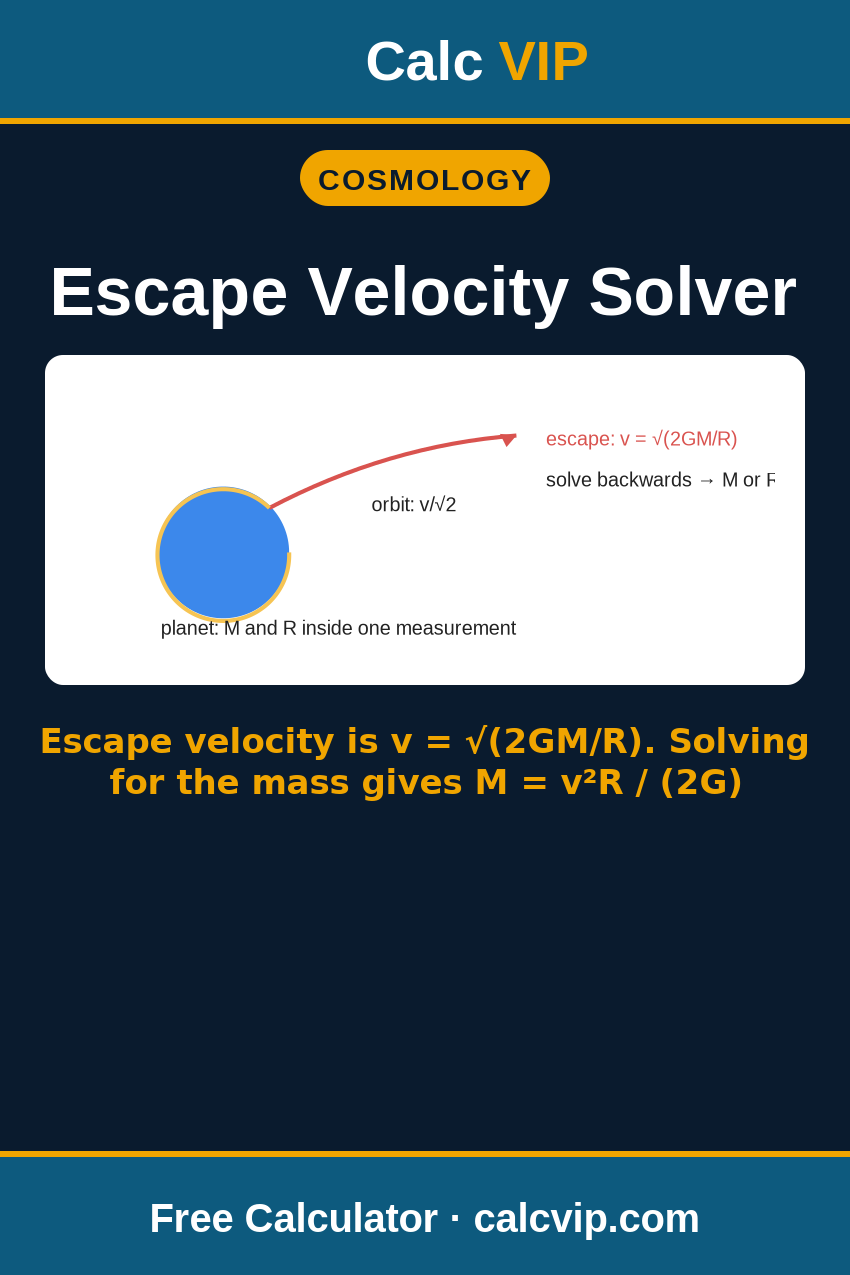
There is a beautiful consistency check built into the pair of modes. Escape velocity and circular-orbit velocity are cousins: the speed needed to orbit just above a planet's surface is vorbit = √(GM/R), and escape is exactly √2 times that. Earth's surface-skimming orbit speed is 7.9 km/s; multiply by 1.414 and you get 11.2 km/s — the escape velocity this solver starts from. Every low-orbit satellite is already travelling at 71% of the speed that would free it from Earth forever, a fact that shapes the energetics of every launch.
Formula
Escape velocity is v = √(2GM/R). Solving for the mass gives M = v²R / (2G), and solving for the radius gives R = 2GM / v², with G = 6.674 × 10⁻¹¹ N·m²/kg². A third rearrangement is worth having: combining escape velocity with the density form, a planet's mean density follows from v and R alone, ρ = 3v²/(8πGR²) — the basis of Example 6 below. All three are the single statement that kinetic energy ½mv² must repay the gravitational debt GMm/R, with the projectile's mass m cancelling, read in different directions.
| Symbol | Meaning | Units |
|---|---|---|
| v | escape velocity at the surface | km/s (entered) |
| M | planet's mass | kg |
| R | planet's radius | km (entered) |
| G | gravitational constant = 6.674 × 10⁻¹¹ | N·m²/kg² |
Weighing worlds: where the inputs really come from
A planet's mass is one of astronomy's hardest-won numbers, and this solver sits at the end of several very different supply chains. For solar-system bodies, mass usually comes from watching something orbit — a moon, a ring particle, a visiting spacecraft — and applying Kepler's third law. Radius comes from direct imaging, from occultation timings, or, for exoplanets, from the fraction of starlight blocked in transit. Escape velocity itself is measured for exoplanets by watching their upper atmospheres stream away during transit: the outflow's speed and composition betray the depth of the gravity well it climbed out of. When two of the three quantities are pinned by such observations, this solver's rearrangement delivers the third — and with mass and radius together comes density, the single most informative number about a world's composition: rock, ice, or gas.
The same inversion explains a classic result about our own planet. Earth's escape velocity and radius were both measurable long before anyone could weigh the Earth directly, and M = v²R/(2G) converts them into the mass — the modern version of Cavendish's 1798 experiment, which measured G in a laboratory and thereby "weighed the Earth" for the first time. The value of G remains the least precisely known of the fundamental constants, and its uncertainty (about 2 parts in 100,000) sets a floor under every mass this calculator reports — negligible for planets, but a real consideration for precision work.
How to use
- Choose whether to solve for the mass or the radius.
- Enter the escape velocity in km/s.
- Enter the radius in km (for mass mode) or the mass in kg — scientific notation like 5.972e24 works (for radius mode) — and click "Solve".
- Read mass answers against the Earth-mass scale the calculator provides: most rocky exoplanets of interest land between 0.1 and 10 Earth masses, and a result wildly outside that range deserves a unit check.
Worked examples
Example 1 — weighing the Earth. Earth's escape velocity is 11.19 km/s and its radius is 6,371 km. Solve for the mass:
M = v²R / (2G) = (11,190)² × 6.371 × 10⁶ / (2 × 6.674 × 10⁻¹¹) ≈ 5.98 × 10²⁴ kg
That recovers Earth's known mass (5.972 × 10²⁴ kg) from just two surface measurements.
Example 2 — the radius mode, checked on Earth. Enter v = 11.19 km/s and M = 5.972 × 10²⁴ kg.
R = 2GM/v² = 2 × 6.674 × 10⁻¹¹ × 5.972 × 10²⁴ ÷ (11,190)² ≈ 6,366 km — within 5 km of the true mean radius, the small deficit being the rounding of 11.19 itself. The two modes are consistent, as they must be.
Example 3 — weighing the Moon. The Moon's escape velocity is 2.38 km/s and its radius 1,737 km.
M = (2,380)² × 1.737 × 10⁶ ÷ (1.3348 × 10⁻¹⁰) ≈ 7.37 × 10²² kg — the Moon's accepted mass (7.35 × 10²² kg) to within rounding. A body with 1/81 of Earth's mass has an escape velocity less than a quarter of Earth's: the v² at work.
Example 4 — Mars's radius from its mass. Mars's mass is 6.417 × 10²³ kg and its escape velocity 5.03 km/s.
R = 2 × 6.674 × 10⁻¹¹ × 6.417 × 10²³ ÷ (5,030)² ≈ 3,385 km, against the measured 3,390 km. Mars rovers land on a world whose size this two-line calculation predicts to within a few kilometres.
Example 5 — a super-Earth exoplanet. A transiting planet has R = 10,000 km and an atmosphere whose escape implies v = 20 km/s.
M = (20,000)² × 10⁷ ÷ (1.3348 × 10⁻¹⁰) ≈ 3.00 × 10²⁵ kg ≈ 5.0 Earth masses. Mass and radius together give a mean density of about 7,150 kg/m³ — denser than Earth, hinting at a large iron core. This is precisely how the character of distant worlds is first sketched.
Example 6 — the Sun's radius from its escape velocity. The Sun's escape velocity is 617.7 km/s and its mass 1.989 × 10³⁰ kg.
R = 2 × 6.674 × 10⁻¹¹ × 1.989 × 10³⁰ ÷ (617,700)² ≈ 695,818 km — the solar radius (695,700 km) recovered to within a few parts in ten thousand, from a spectroscopically measured speed and a mass known from planetary orbits.
Escape velocity in real life
Why the Moon has no atmosphere. At 2.38 km/s, lunar escape velocity is only about five times the thermal speed of gas molecules at daytime temperatures, so gases leak away over geological time (Jeans escape). Earth's 11.19 km/s holds nitrogen and oxygen comfortably but still leaks hydrogen and helium — the rule of thumb is that a planet keeps a gas for eons if vesc exceeds about six times the gas's thermal speed.
Why rockets are staged. Reaching 11.19 km/s from Earth's surface in one stage demands a mass ratio that chemistry barely permits; staging discards empty tanks so the remaining fuel accelerates less dead weight. The number this solver uses is the reason launch vehicles look the way they do.
Reading exoplanet atmospheres. The outflow speed of a transiting exoplanet's escaping hydrogen, measured by telescopes, maps back through this formula to the planet's mass — sometimes the only mass estimate available for small, distant worlds.
Comets and the Oort cloud. At the Sun's escape velocity evaluated at Earth's orbit — 42.1 km/s — a comet nudged past that speed leaves the solar system forever. Interstellar visitors like 'Oumuamua arrived already exceeding the local escape speed, announcing their foreign origin kinematically.
Black holes, by extension. Set v = c in R = 2GM/c² and the solver's radius mode returns the Schwarzschild radius — the point at which escape velocity reaches light speed. The Newtonian formula lands on the exact relativistic answer by a famous coincidence of factors.
Planetary defence. An asteroid's own escape velocity — centimetres per second for a rubble pile — decides whether impact ejecta escapes or falls back, and whether a landed spacecraft can anchor or will bounce off, as Philae famously did on comet 67P.
Escape velocity is not a launch speed
A persistent confusion: rockets do not leave Earth at 11.19 km/s, and nothing needs to. Escape velocity is the speed a ballistic object — one given a single push and never powered again — needs at the surface to coast away forever. A continuously thrusting vehicle can leave at any speed, even walking pace, if it can sustain the climb; real rockets approach escape-class speeds only because chemical fuel economics favour burning fast and low. The figure also falls with altitude: escape velocity at the Moon's orbital distance from Earth is only about 1.4 km/s, which is why the Apollo lunar module, leaving the Moon (2.38 km/s) and then coasting home, never needed Earth-escape speed as a single burn. And direction is irrelevant to the energy bookkeeping — escape velocity is a speed, not a velocity with a required heading; aim anywhere that does not intersect the planet.
From escape velocity to density and composition
The deepest use of this solver is one step beyond it. Density is mass over volume, and with M from the solver and R known, a world's mean density falls out immediately: Earth 5,514 kg/m³, the Moon 3,344, the Example 5 super-Earth about 7,150. Density is a composition fingerprint. Pure water ice sits near 1,000 kg/m³, rock near 3,000–3,500, iron near 7,900; a measured density between landmarks implies a mixture, and interior models apportion the layers. This is how we know the Moon is mostly rock with a small core, that Ganymede hides an ocean's worth of ice, and that some exoplanets must be iron-rich remnants of much larger worlds. Two observables — a speed and a size — become a cross-section of a planet.
Escape velocity at altitude, and the vis-viva connection
Everything on this page is evaluated at the surface, but the formula's R is any distance from the centre, and the escape speed falls as 1/√R. At the altitude of the International Space Station (about 400 km, R = 6,771 km from the centre), Earth's escape velocity is 11.19 × √(6,371/6,771) ≈ 10.85 km/s — barely less, which surprises people until they remember the station is only 6% farther from the centre than the surface is. At the Moon's distance it is 1.44 km/s; at 1 AU from the Sun it is 42.1 km/s, as the FAQ notes. The generalisation that handles all of this — including objects already moving on elliptical orbits — is the vis-viva equation, v² = GM(2/r − 1/a), of which escape is the special case where the orbit's semi-major axis a stretches to infinity. Mission designers live inside vis-viva; this solver is its surface-boundary portrait.
The inverse problem has a twin in the history of physics worth knowing. In the 1780s John Michell, and later Laplace, asked what radius would make a star's escape velocity equal the speed of light — "dark stars", invisible because their light could not escape. Radius mode with v = c gives their answer, R = 2GM/c², two centuries before Einstein. The Newtonian reasoning is not relativistically correct — light's behaviour near such an object is subtler — yet the radius it predicts is exactly the Schwarzschild radius. Few formulas in physics have cast so long a shadow from so simple an energy balance.
Quick reference: escape velocities of solar-system bodies
| Body | Escape velocity (km/s) | Radius (km) |
|---|---|---|
| the Moon | 2.38 | 1,737 |
| Mercury | 4.25 | 2,440 |
| Mars | 5.03 | 3,390 |
| Venus | 10.36 | 6,052 |
| Earth | 11.19 | 6,371 |
| Neptune | 23.5 | 24,622 |
| Jupiter | 59.5 | 69,911 |
| the Sun | 617.7 | 695,700 |
Try the table against the solver: feed any row's velocity and radius into mass mode and you recover that body's mass — Jupiter's row, for instance, returns about 1.85 × 10²⁷ kg, the small shortfall against the true 1.90 × 10²⁷ kg being the rounding of 59.5 itself.
Common mistakes
- Entering the velocity in m/s. The box wants km/s. Typing 11,190 makes v a thousand times too large and the mass a million times too big (v is squared) — the commonest catastrophic slip with this tool.
- Confusing diameter with radius. Transit measurements sometimes quote diameters. Halve before entering: a diameter in the radius box doubles R and, in mass mode, doubles the mass.
- Expecting the object's mass to matter. It cancels. A heavier projectile needs proportionally more energy but not more speed; if your intuition says otherwise, it is smuggling in air resistance or rocket constraints.
- Using surface gravity instead of escape velocity. g and vesc are related (vesc = √(2gR)) but not interchangeable. Feeding 9.8 into the velocity box weighs a very strange planet indeed.
- Forgetting that escape velocity falls with altitude. The formula's R is the distance from the centre. For a launch from a mountain, a space station, or a planet's cloud tops, R is centre-to-launch-point, not the surface radius — the difference matters for gas giants with no surface at all.
FAQ
Can I check the radius mode with Earth too?
Yes: entering v = 11.19 km/s and M = 5.972 × 10²⁴ kg gives R ≈ 6,366 km, matching Earth's 6,371 km (the tiny difference is rounding in the escape velocity).
Why is this solver useful?
Astronomers often measure an exoplanet's escape velocity (from its atmosphere's behaviour) or its radius (from transits) first — this turns one known quantity into the missing one.
Does the escaping object's mass matter?
No. Escape velocity depends only on the planet's mass and radius, not on the mass of whatever is escaping.
What is the escape velocity at Earth's distance from the Sun?
Applying the formula to the Sun with R = 1 AU: √(2GM☉/1 AU) ≈ 42.1 km/s. Earth orbits at 29.8 km/s — exactly 42.1/√2, the circular-orbit relation again — so a comet needs a 12.3 km/s boost, in the right direction, to leave the solar system from here.
Why does the escaping object's mass cancel?
Both the kinetic energy needed (½mv²) and the gravitational debt (GMm/R) are proportional to m. Doubling the projectile doubles both sides of the bargain, leaving the required speed untouched.
Can this solver handle a black hole?
Formally, radius mode with v = c returns the Schwarzschild radius — for Earth's mass, about 8.9 mm. The physics there is Einstein's, not Newton's, and the agreement is a celebrated coincidence; treat stellar-mass results as estimates, not relativity.
How is an exoplanet's escape velocity measured?
During transit, starlight filtering through the planet's upper atmosphere carries absorption signatures of escaping gas; the line shapes and the cloud's extent reveal outflow speeds, which models convert into the escape velocity at the exobase — and then this solver converts that into mass.
What if I only know the density and radius?
Then mass follows from the volume, M = (4/3)πR³ρ, and the escape velocity from the standard formula. Density and radius are the transit-plus-timing observables for many exoplanets, making this the practical alternative route.
Does rotation help?
Slightly. A launch eastward from the equator inherits Earth's 0.46 km/s of rotational speed — about 4% of escape velocity, and a real saving in rocket energy, which is why spaceports hug coasts and low latitudes.
Why is Jupiter's escape velocity "only" 59.5 km/s despite its huge mass?
Because its radius is also huge, and v grows as √(M/R). Jupiter packs 318 Earth masses into 11 Earth radii; the ratio, under the root, yields a surface escape speed just 5.3 times Earth's. Compactness, not mass alone, makes deep gravity wells.