 Calc
Absolute Pressure Calculator – Gauge + Atmospheric Pressure
 Created by Elena Petrova · Physics Editor · Fluids & Rotation · Last updated: November 2026
Use this free Absolute Pressure Calculator to convert a gauge pressure reading into absolute pressure. Most gauges read zero at atmospheric pressure, so the absolute pressure is the gauge reading plus the pressure of the atmosphere itself.
Every pressure you have ever read off a dial is, quietly, a lie of omission. A tyre gauge, a boiler gauge, a blood-pressure cuff — all of them measure not the pressure itself but the difference between the pressure inside and the pressure of the atmosphere pressing on the outside of the instrument. That difference is called gauge pressure, and it is the right quantity for most workshop purposes. But nature does not compute with differences. Gas molecules collide with walls according to the total pressure, from true zero upward — the absolute pressure — and every formula of gas physics, from the ideal gas law to the boiling point of water on a mountain, is written in that total.
The gap between the two scales is the weight of the air above us: about 101.325 kPa, one atmosphere, pressing on every square metre of everything at sea level with a force equivalent to a mass of more than ten tonnes. We do not feel it because it presses equally in all directions, inside our bodies as much as outside. Gauges ignore it because it is (nearly) always there, a constant background both sides of the measurement can share. Absolute pressure puts it back. The conversion could not be simpler — add the atmosphere — yet forgetting it is one of the most reliable ways to wreck a gas calculation, because an error of one atmosphere is a 100% error at the pressures where much chemistry happens.
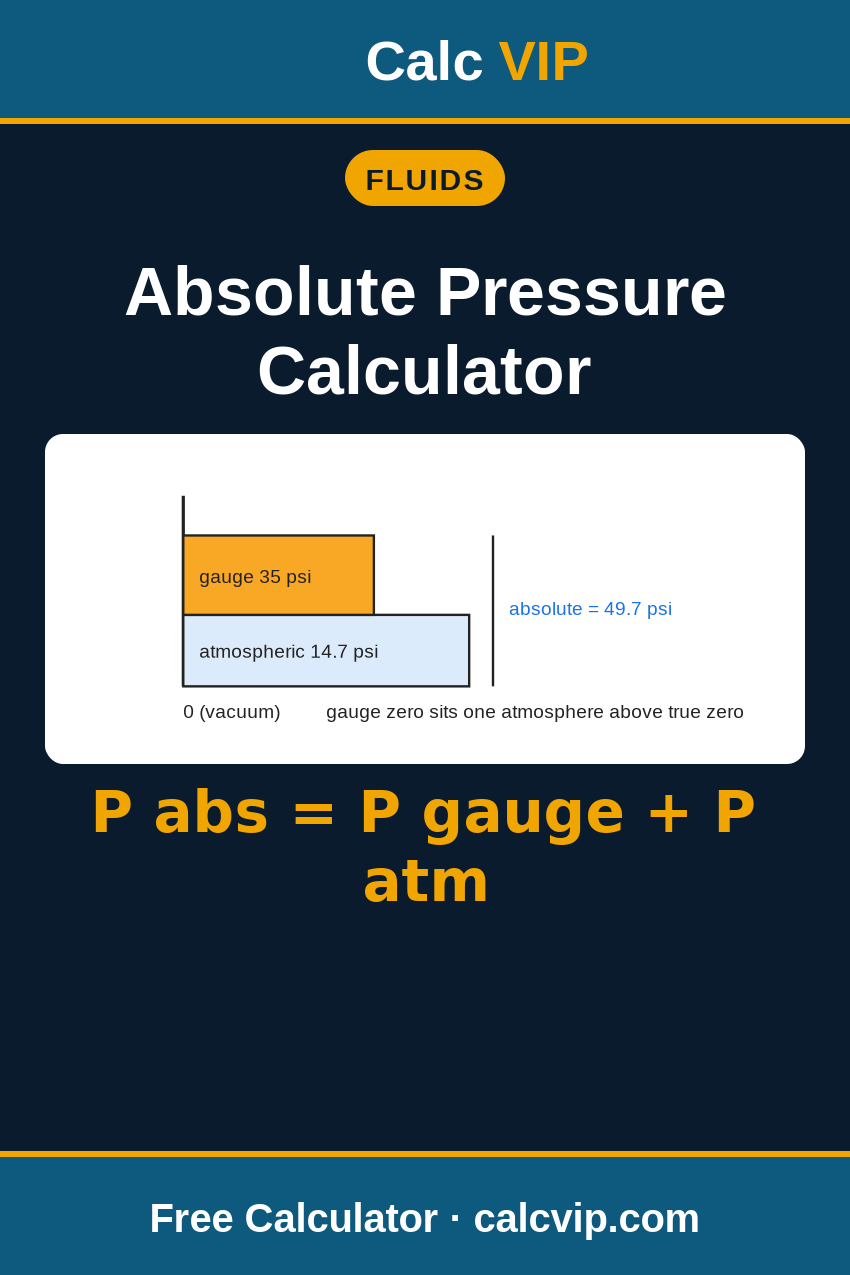
This calculator performs the addition in any mixture of the four everyday pressure units — kilopascals, atmospheres, pounds per square inch and bar — converting each term before adding, which is the step hurried hand calculations most often botch. Enter the gauge reading, confirm or adjust the atmospheric pressure (it falls with altitude and drifts a few percent with the weather), and the result comes back in all four units at once, ready for whichever formula is waiting for it.
Formula
Absolute pressure = Gauge pressure + Atmospheric pressure → Pabs = Pgauge + Patm
The rearrangements follow at once: Pgauge = Pabs − Patm (what a gauge will read when the absolute pressure is known) and, for a vacuum, Pabs = Patm − vacuum depth. Standard atmospheric pressure is 101.325 kPa = 1 atm = 14.696 psi = 1.01325 bar. The one absolute rule of the subject: the two terms must be in the same unit before they are added — 35 psi plus 101.325 kPa is not 136 of anything. This calculator converts each input to kilopascals first, adds, then reports the total in kPa, atm, psi and bar.
| Symbol | Meaning | Units |
|---|---|---|
| Pabs | absolute pressure — measured from perfect vacuum | kPa, atm, psi, bar |
| Pgauge | gauge pressure — measured from local atmospheric pressure | same — must match Patm |
| Patm | atmospheric pressure (standard: 101.325 kPa) | kPa, atm, psi, bar |
Two zeros: why gauge pressure exists at all
Gauge pressure survives because it answers the question engineers actually ask: how much more pressure is in here than out there? A tyre holds its shape because of the difference across its rubber, not the total; a boiler's steel feels the difference across its wall; a diver's regulator delivers air matched to the surrounding pressure, again a difference. Measuring from atmospheric zero throws away a constant that cancels in all these problems, and it makes instruments simpler: an open tube or a spring can compare inside against outside directly. The naming on datasheets is precise about it — pressures written psia are absolute, psig are gauge — and the 14.7 psi between the two has embarrassed more than one design review.
The trouble starts where the difference stops cancelling: in any law where pressure multiplies or divides something else. The ideal gas law PV = nRT, Boyle's law, Charles's law, partial-pressure sums, vapour-pressure tables, altitude formulas — all are statements about molecular bombardment, which knows nothing of our gauges. Feed Boyle's law a gauge pressure and it will happily predict that a "flat" tyre (0 psig) contains no air at all and can be compressed to nothing. Feed it the absolute pressure and it behaves. Rule of thumb: if the pressure came off a dial, convert it before it goes into a formula; if a formula produced it, convert it back before comparing with a dial.
Atmospheric pressure itself is not a constant of nature but a local, changeable quantity. It falls steadily with altitude — about 12 kPa per kilometre near sea level, as the Altitude Pressure Calculator shows — and at a fixed place it wanders by ±2–3 kPa with the weather systems that barometers track. For tyre and boiler work the standard 101.325 kPa is plenty; for precision gas work, and anywhere significantly above sea level, the local value belongs in this calculator's second field. A gauge in Denver (about 83 kPa atmospheric) and the same gauge at the coast differ by nearly a fifth of an atmosphere before either measures anything. The same reasoning explains a famous design choice: spacesuits are specified in absolute pressure — about 30 kPa of pure oxygen — because what the astronaut's lungs care about is the absolute oxygen pressure, while the lower total keeps the suit flexible enough to work in.
How to use
- Enter the gauge pressure reading and choose its unit (psi is pre-selected, as on most tyre and workshop gauges).
- Enter the local atmospheric pressure and its unit — 14.7 psi is pre-filled as the standard sea-level value; replace it if you are at altitude or need precision.
- Click "Calculate Absolute Pressure".
- Read the absolute pressure in whichever unit your next step needs: kPa, atm, psi or bar, all shown together. A negative result is impossible and means a value was entered with the wrong sign or unit.
Worked examples
Example 1 — the car tyre. A tyre gauge reads 35 psi and atmospheric pressure is 14.7 psi. Absolute pressure = 35 + 14.7 = 49.7 psi ≈ 342.67 kPa ≈ 3.38 atm (3.43 bar). The air inside the tyre is really at 49.7 psi absolute — the gauge simply ignores the 14.7 psi of air pressing on everything.
Example 2 — a boiler gauge in kilopascals. A steam boiler's gauge reads 200 kPa. Absolute pressure = 200 + 101.325 = 301.33 kPa ≈ 2.97 atm ≈ 43.70 psi. Steam tables are indexed by absolute pressure, so this is the number that determines the boiling temperature inside — about 134 °C at 3 atm absolute, not the 100 °C of an open pan.
Example 3 — a dive cylinder in bar. A scuba cylinder gauge reads 200 bar. Absolute = 200 + 1.013 = 201.01 bar. The correction is only half a percent here — at high pressures the atmosphere is a rounding error — which is why divers, unlike chemists, can safely think in gauge pressure. At the other end of the scale the same correction is everything: a "half-empty" vacuum chamber at 0.5 atm absolute reads just −0.5 atm on a gauge.
Example 4 — a partial vacuum. A vacuum gauge reads −70 kPa (70 kPa below atmospheric). Absolute pressure = 101.325 − 70 = 31.33 kPa ≈ 0.31 atm. This is the pressure a vacuum-packaging machine or a laboratory desiccator actually works at — and note that even the best workshop vacuum cannot go below zero absolute: −101.325 kPa gauge is the floor of the universe.
Example 5 — why Boyle's law demands absolute. A sealed 2-litre container of air sits at tyre pressure, 342.67 kPa absolute. Released to atmospheric pressure (101.325 kPa), the air expands to V = 2 × 342.67 ÷ 101.325 ≈ 6.76 litres. Run the same sum with the gauge reading (241.3 kPa) and you would predict 4.76 litres — wrong by nearly a third, from a single forgotten atmosphere.
Example 6 — at altitude. In Denver, atmospheric pressure is about 83.4 kPa. A tyre inflated there to 35 psi gauge is at 35 × 6.895 + 83.4 ≈ 324.7 kPa absolute, against 342.7 kPa for the same gauge reading at sea level. Drive down to the coast without touching the valve and the gauge climbs — the absolute pressure inside barely changed, but the atmosphere outside rose to meet it.
Absolute pressure in real life
Weather and barometers. A barometer is an absolute-pressure instrument: it measures the atmosphere against the vacuum sealed inside it. The "rising glass" and "falling glass" of weather lore are absolute pressure changes of a few kilopascals — small on this calculator's scale, enormous for the weather they announce.
Cooking and pressure cookers. A pressure cooker rated at 15 psi gauge cooks at 29.7 psi absolute — almost exactly 2 atm — which lifts water's boiling point to about 121 °C and cuts cooking times by a factor of three or four. At altitude the same cooker reaches a lower absolute pressure, which is why high-altitude recipes add time.
Aviation. Aircraft altimeters are absolute-pressure gauges calibrated in feet: they sense the falling pressure outside and report it as height, using the same barometric relationship as the Altitude Pressure Calculator. Cabin pressurisation is specified as a differential — a gauge pressure — of about 55 kPa between cabin and sky.
Medicine. Blood pressure is gauge pressure: "120 over 80" means 120 mmHg above atmospheric at the heartbeat's peak. Suction and vacuum therapy are quoted the other way, as depths below atmospheric, and ventilator pressures are gauge pressures measured in centimetres of water.
Vacuum technology. Vacuum packaging, freeze-drying, semiconductor fabrication and particle accelerators all specify absolute pressure, because what matters is how many molecules remain: from rough vacuum (10 kPa absolute) down to the 10⁻⁹ kPa of a research chamber, each factor of ten is another engineering world.
Diving. A diver's body responds to absolute pressure — at 30 m in the sea it is about 4 atm absolute (see the Water Depth Pressure Calculator) — while the cylinder gauge on their back reads gauge pressure. Dive computers quietly work in absolute; the distinction decides decompression.
Below one atmosphere: the vacuum scale
Everything beneath 101.325 kPa absolute is vacuum, and vacuum engineering divides the descent into regimes that behave like different worlds. Rough vacuum (down to about 0.1 kPa absolute) is the land of vacuum cleaners, packaging machines and workshop suction — ordinary pumps, ordinary gauges. Medium vacuum (to about 10⁻⁴ kPa) freeze-dries food and coats spectacle lenses; the air is thin enough that molecules rarely meet each other. High vacuum (to about 10⁻⁷ kPa) is where electron microscopes, particle accelerators and semiconductor lines live, reached by pumps that trap molecules one at a time. Beyond that, ultra-high vacuum approaches the conditions of orbit: the Large Hadron Collider's beam pipe sits near 10⁻⁸ kPa absolute, thinner than the space between stars in our galactic neighbourhood. At every step the quantity specified is absolute pressure, because what matters is the molecules remaining per cubic metre — a number that gauge pressure, with its shifting atmospheric zero, cannot even express. The conversion on this page is the doorway to that whole scale: atmospheric minus the vacuum depth, never below zero.
Quick reference: the standard atmosphere in every unit
| Unit | 1 atmosphere equals | Where you meet it |
|---|---|---|
| pascal (Pa) | 101,325 Pa | physics and engineering SI work |
| kilopascal (kPa) | 101.325 kPa | weather maps (in hPa, the same number) |
| bar | 1.01325 bar | diving, European gauges, espresso machines |
| psi | 14.696 psi | tyres and workshop gauges in the US/UK |
| mmHg (torr) | 760 mmHg | medicine and vacuum work |
| inches of mercury | 29.92 inHg | aviation altimeter settings |
| metres of water | ≈ 10.33 m | pumps and diving rules of thumb |
One atmosphere is the exchange rate of the whole subject: whatever the unit on the gauge in your hand, this is the amount that must be added — after conversion — before physics will accept the number.
Common mistakes
- Adding numbers in different units. 35 psi + 101.325 kPa is meaningless. Convert both terms to one unit first — the calculator does this for you; a hurried notebook often does not.
- Feeding gauge pressure into gas laws. PV = nRT, Boyle's and Charles's laws all require absolute pressure. At low pressures the error is not a detail — it can be 100%.
- Assuming atmospheric pressure is always 101.325 kPa. At 1600 m altitude it is about 83 kPa; in a storm it can dip several kPa at sea level. Precision work and mountain work need the local value.
- Confusing psia and psig on datasheets. They differ by 14.7 psi. A sensor specified in psia fitted where psig was assumed reads one atmosphere high everywhere — a classic commissioning bug.
- Trying to go below zero absolute. Absolute pressure cannot be negative. A result below zero means a sign or unit slipped; the deepest vacuum possible is 0, approached but never crossed.
FAQ
Why does a tyre gauge read zero when the tyre is flat?
A flat tyre still contains air at atmospheric pressure. The gauge measures only the extra pressure above atmospheric, so it reads zero even though the absolute pressure inside is about 14.7 psi.
What is a perfect vacuum in these terms?
A perfect vacuum has an absolute pressure of 0. Its gauge pressure would read −14.7 psi (or −101.325 kPa), which is why vacuum gauges use a negative scale.
When must I use absolute pressure?
Whenever pressure appears in a physics or chemistry formula — the ideal gas law, Boyle's law and altitude formulas all assume absolute pressure measured from a true zero.
What do psia and psig mean?
They are psi with the zero made explicit: psia is absolute (from vacuum), psig is gauge (from atmospheric). The difference is always the local atmospheric pressure — 14.696 psi at sea level. Datasheets for sensors, compressors and regulators use these labels, and mixing them up is a one-atmosphere error.
How do I convert absolute back to gauge?
Subtract the atmospheric pressure: gauge = absolute − atmospheric. A vessel at 250 kPa absolute at sea level reads 250 − 101.325 ≈ 148.7 kPa on a gauge. This calculator performs the forward direction; the reverse is the same two numbers with the sign flipped.
Does atmospheric pressure really change enough to matter?
For tyres, no — weather swings of ±3 kPa vanish beside a 240 kPa fill pressure. For weather forecasting, altitude work, precision gas metering and vacuum processes, absolutely: a 3 kPa fall is a storm approaching, and the 18 kPa drop between sea level and Denver changes boiling points, engine power and baking times.
Why is standard atmospheric pressure such an odd number — 101,325 Pa?
Because it was defined from a physical artefact of nature: the pressure that supports a 760 mm column of mercury at 0 °C under standard gravity. The pascal figure is what that column works out to in SI units. The bar (100,000 Pa exactly) was invented later, deliberately close to one atmosphere but rounder.
What is the highest absolute pressure in everyday life?
A full scuba cylinder at about 200 bar gauge is about 201 bar absolute; a pressure washer's jet reaches similar figures. Industrial hydraulics run at 300 bar and beyond, and the fuel injectors of a modern diesel engine exceed 2000 bar — twenty thousand times the pressure of the air around you.
Can a gauge pressure be greater than the absolute pressure?
No — absolute is always gauge plus a positive atmosphere, so absolute is the larger number wherever the gauge reads positive. Only in vacuum work, where gauge readings are negative, does the relationship surprise people: there the absolute pressure is what remains after the vacuum has eaten into the atmosphere's 101.325 kPa.
Is blood pressure absolute or gauge?
Gauge — it is measured relative to the atmosphere pressing on the arm, which is why the cuff works at any altitude without correction. "120/80 mmHg" means the arterial pressure rises 120 mmHg above atmospheric at its peak; in absolute terms the peak is 760 + 120 = 880 mmHg.