 Calc
Chase Calculator – Catch-Up Time for an Accelerating Pursuer
 Created by Sarah Mitchell · Physics Editor · Motion & Measurement · Last updated: November 2026
Use this free Chase (Pursuit) Calculator for the classic catch-up problem: a target moves ahead at a steady speed while a pursuer starts from rest and accelerates. The calculator solves the quadratic equation for the catch-up time, and also gives the distance covered and the pursuer's speed at the moment of the catch.
The chase is the oldest story in mechanics: something ahead, moving steadily; something behind, starting from rest and straining to catch it. The mathematics has a distinctive flavour, because the two motions grow differently — the target's distance accumulates in proportion to time, the pursuer's in proportion to time squared — and the catch, when it comes, is the moment a parabola overtakes a line. This calculator solves that moment exactly: the catch-up time, the distance from the pursuer's start, and the speed the pursuer has reached when the gap finally closes.
The setup is deliberately pure: the target never tires, speeds up or slows down; the pursuer accelerates uniformly from rest, without limit. Reality caps top speeds and adds reaction delays, and the depth sections below discuss what those caps change. But the pure problem is the skeleton every real pursuit hangs on — police intercept planning, a fielder running down a rolling ball, a second train departing after the first — and its quadratic heart is worth understanding on its own terms.
One feature of the answer deserves a preview, because it startles everyone: at the moment of the catch, the pursuer is always moving at more than twice the target's speed. Not roughly — provably, from the formula itself. Catching up is not a matter of matching the target's speed; it is a matter of first repaying the head start while still slower, then closing the remaining gap, and the bill for that history arrives as overshoot.
Formula
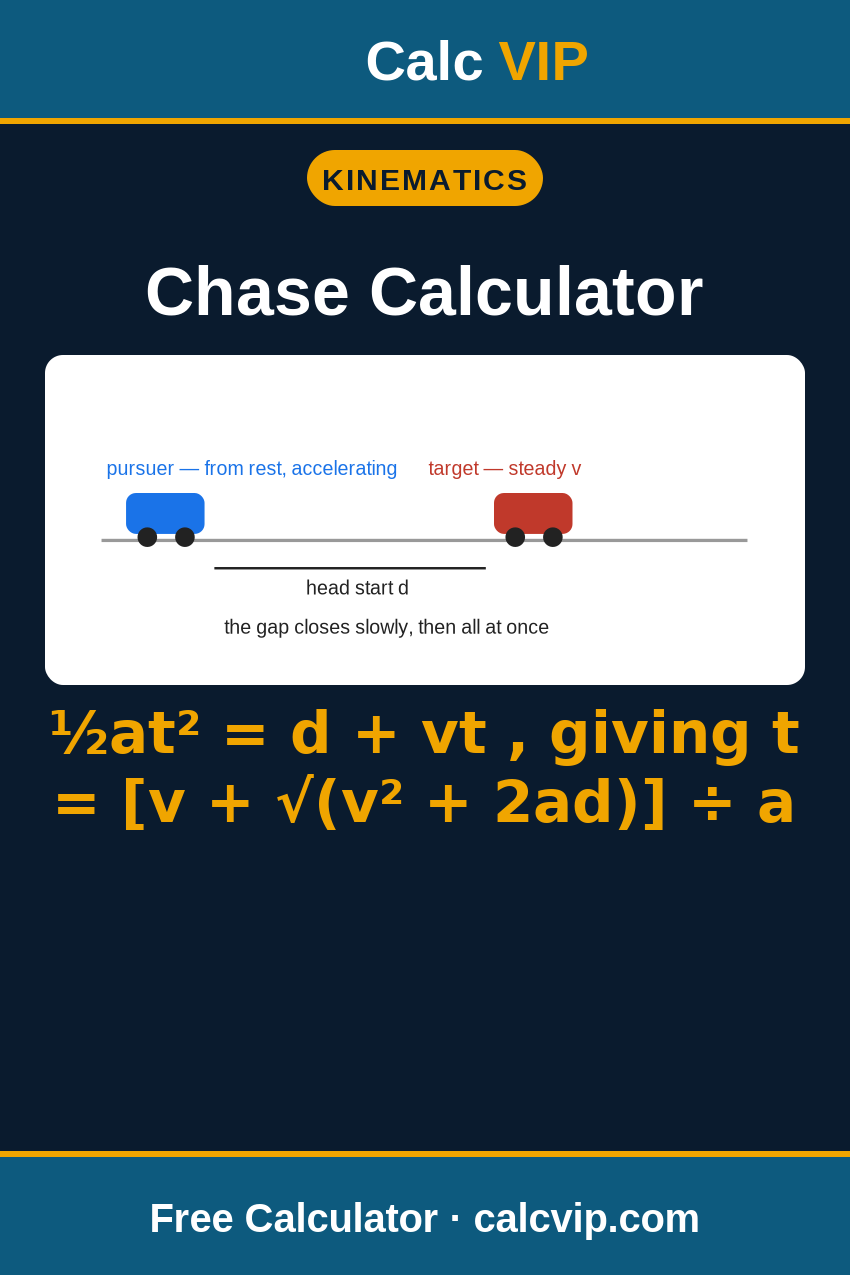
At the catch, distances are equal: ½at² = d + vt, giving t = [v + √(v² + 2ad)] ÷ a • Distance from pursuer's start = ½at² • Pursuer's speed at the catch = at
The catch condition says the pursuer's distance from its start (½at², the standard result for uniform acceleration from rest) must equal the target's head start plus what the target covers during the chase (d + vt). Rearranged, it is the quadratic ½at² − vt − d = 0, and the quadratic formula's positive root is the one this calculator reports; the negative root is a ghost — the moment in the mathematical past when the two would have met had the motions run backwards. Two elegant checks live inside the answer. First, the catch speed at = v + √(v² + 2ad), which exceeds 2v whenever d is positive. Second, if the head start were zero, the formula collapses to t = 2v ÷ a — the pursuer draws level exactly when its own speed reaches 2v, having averaged v over the chase, matching the target's distance stride for stride.
| Symbol | Meaning | Units |
|---|---|---|
| v | target's constant speed | m/s |
| d | target's head start when the pursuer starts | m |
| a | pursuer's acceleration, from rest | m/s² |
| t | catch-up time | s |
The shape of a chase: losing first, then winning suddenly
Plot the gap between target and pursuer and the chase tells a three-act story. In the first act the gap grows: the pursuer, starting from rest, is initially slower than the target, so every second adds distance between them even as the pursuer accelerates. The gap peaks at the moment the pursuer's speed draws level with the target's — at t = v ÷ a — and only then does the second act begin: the gap shrinks, slowly at first (the speeds are nearly equal), then faster and faster as the pursuer's speed advantage compounds. The third act is the catch, which arrives with a speed difference already large — which is why real catches so often end in an overshoot, a grab, or a collision rather than a gentle rendezvous. In Example 1 the gap grows from 100 m to a maximum of 125 m at t = 5 s (the target gains 50 m while the pursuer covers only 25 m) before the pursuer's acceleration reclaims it all by 16.18 s.
This shape explains a deep intuition athletes and animals share: early in a chase, the quarry seems to escape; late in a chase, the pursuer seems to teleport. Both impressions are the same parabola viewed from different ends, and both mislead anyone who extrapolates linearly — the gap's future is written in squares, not in straight lines.
It also explains why the head start d enters the formula under the square root, softened: doubling the head start does not double the catch time, because the pursuer is travelling ever faster while it repays the extra distance. In Example 1, doubling d to 200 m would raise the catch time only from 16.18 s to about 20 s (t = [10 + √900] ÷ 2). Distance is cheaper, bought late in a chase, than bought early — one more way the quadratic refuses to behave like the linear intuition it replaces.
How to use
- Enter the target's constant speed v in m/s (divide km/h by 3.6 if needed — 36 km/h is 10 m/s).
- Enter the head start d in metres — the gap at the instant the pursuer begins. If the head start is given as a time, multiply it by the target's speed to get metres first.
- Enter the pursuer's acceleration a in m/s². The model assumes the pursuer starts from rest at the same instant the clock starts.
- Click "Find Catch Time" to get the catch time, the distance from the pursuer's start, and the pursuer's speed at the catch.
- Check the catch speed for realism: if it exceeds the pursuer's actual top speed, the pure model has broken and the real chase is a constant-speed pursuit instead (see the depth section).
Worked examples
Example 1 — the reference chase. A target moves at a steady v = 10 m/s with a d = 100 m head start. The pursuer accelerates from rest at a = 2 m/s². Catch time t = [10 + √(100 + 2 × 2 × 100)] ÷ 2 = [10 + √500] ÷ 2 = [10 + 22.36] ÷ 2 = 16.18 s. Distance covered = ½ × 2 × 16.18² = 261.8 m — check: the target covers 100 + 10 × 16.18 = 261.8 m too. The pursuer is then moving at 2 × 16.18 = 32.36 m/s — more than three times the target's speed.
Example 2 — a playground chase. A runner at v = 5 m/s has d = 20 m on a chaser accelerating at a = 2.5 m/s²: t = [5 + √(25 + 100)] ÷ 2.5 = [5 + 11.18] ÷ 2.5 = 6.47 s, over a distance of ½ × 2.5 × 6.47² = 52.36 m, at a catch speed of 16.18 m/s. Even a modest chase ends with the chaser moving at sprint speeds — the overshoot theorem again.
Example 3 — Achilles and the tortoise, settled. Zeno's tortoise crawls at v = 1 m/s with d = 100 m; Achilles accelerates gently at a = 0.5 m/s²: t = [1 + √(1 + 100)] ÷ 0.5 = [1 + 10.05] ÷ 0.5 = 22.1 s, distance 122.1 m. Zeno's infinite regress dissolves the moment you sum it — the shrinking steps take shrinking times, and the total is a finite number this calculator just prints.
Example 4 — the departing train. A train pulls away at a steady 15 m/s, already 300 m down the line; a light locomotive accelerates after it at 1.2 m/s²: t = [15 + √(225 + 720)] ÷ 1.2 = [15 + 30.74] ÷ 1.2 = 38.12 s, distance 871.76 m, catch speed 45.74 m/s. Railway pursuits are long because railway accelerations are small — the quadratic needs time to grow its advantage.
Example 5 — double the acceleration. Repeat Example 1 with a = 4 m/s²: t = [10 + √(100 + 800)] ÷ 4 = [10 + 30] ÷ 4 = 10 s exactly, distance 200 m, catch speed 40 m/s. Doubling the acceleration did not halve the time (16.18 → 10 s) — the relationship runs through the square root, a useful calibration for intuition.
Example 6 — no head start. If d = 0 and the target passes the pursuer's start line at 10 m/s as the chase begins, t = 2v ÷ a = 10 s at a = 2 m/s², over 100 m, with the catch speed exactly 20 m/s = 2v. The pursuer's average speed over those 10 s is 10 m/s — the target's speed — which is precisely why the distances match: the zero-head-start chase is the average-speed theorem wearing a disguise.
Chases in real life
Police pursuit planning. Interceptors are positioned using exactly this arithmetic: given the target's speed and the patrol car's acceleration, where and when can a catch happen before the next junction, the county line, the school zone? The catch-speed overshoot is why trained drivers plan to arrive alongside under control, not merely to arrive.
Predator and prey. A cheetah's chase is the pure model with a top-speed cap: acceleration near 9 m/s²-class bursts, a target already at speed, and a catch window of seconds before overheating ends the attempt. Prey animals survive by breaking the model's assumptions — jinking sideways, which a one-dimensional quadratic cannot follow.
Air traffic and drone interception. An interceptor drone launched after a departing aircraft solves this problem in three dimensions, with the same t² growth deciding whether the geometry closes at all. The catch-speed theorem becomes a design requirement: the interceptor's top speed must exceed twice the target's cruise for a stern chase from rest.
Cricket and baseball fielding. A fielder sprinting after a ball rolling towards the boundary is a pursuer whose "target" decelerates — easier than the model — while a relay throw converts the chase into a projectile problem. Coaches time these runs with the same distance-matching logic.
Traffic merging. A car accelerating down an on-ramp after a gap in motorway traffic is solving a softened chase: match position and speed simultaneously, not just position. The extra condition — arrive at the target's speed, not at twice it — is what makes merging a skill rather than a collision.
Zeno's paradox in the classroom. The chase is where students meet the resolution of Zeno: infinitely many "and then he reaches where the tortoise was" steps, summing to a finite time. The quadratic formula is that sum, closed.
When the pursuer has a top speed
The pure model lets the pursuer accelerate forever, and its catch speed — always above 2v — is the tell that reality must intervene: vehicles and animals have ceilings. With a top speed V, the chase becomes two-phase: accelerate to V, then close at the constant relative speed (V − v). The catch then takes longer than the quadratic promises, and if V is only slightly above v, much longer — the closing phase crawls. The pure formula remains useful as the optimistic bound: if even the unlimited model cannot catch the target before some deadline or boundary, no real pursuer will. And the theorem reverses into a design rule — for a from-rest stern chase to end in a controlled rendezvous rather than a fly-past, the pursuer needs either a top speed comfortably above the target's and the discipline to stop accelerating, or a head start of its own. Every intercept course in aviation is this paragraph, flown.
Quick reference: catch time versus acceleration (v = 10 m/s, d = 100 m)
| Pursuer acceleration | Catch time | Distance | Catch speed |
|---|---|---|---|
| 1 m/s² | 27.32 s | 373.21 m | 27.32 m/s |
| 2 m/s² | 16.18 s | 261.8 m | 32.36 m/s |
| 3 m/s² | 12.15 s | 221.53 m | 36.46 m/s |
| 4 m/s² | 10 s | 200 m | 40 m/s |
| 5 m/s² | 8.63 s | 186.33 m | 43.17 m/s |
| 6 m/s² | 7.68 s | 176.76 m | 46.06 m/s |
Read the last column as the hidden cost: harder acceleration catches sooner, but arrives faster. The distance column shrinks towards a floor — even infinite acceleration cannot catch the target in less than the 100 m head start plus the target's travel during the (vanishing) chase.
Common mistakes
- Matching speeds instead of distances. The catch happens when positions coincide, not when speeds do. At the moment speeds match, the gap is at its maximum — the exact opposite of the catch.
- Forgetting the target keeps moving. Setting ½at² = d alone answers "when does the pursuer reach the target's starting point?" — Zeno's first step, not the catch. The target's vt must be on the other side of the equation.
- Taking the negative root seriously. The quadratic's other root is negative (or refers to a fictitious past meeting). Catch times are the positive root; a negative "answer" means the wrong branch was chosen.
- Feeding a head start in seconds directly. The formula wants metres. A 5-second head start at 10 m/s is d = 50 m; entering 5 shrinks the chase absurdly.
- Ignoring the catch speed's plausibility. If the computed catch speed exceeds anything the pursuer can do, the model's assumption has failed and the answer is fiction. Always read the third output line as a reality check.
FAQ
Why is there a quadratic equation?
The pursuer's distance grows with t² (because it accelerates) while the target's grows with t. Setting them equal gives ½at² − vt − d = 0, and the positive root is the catch time.
What if the target has a head start in time instead of distance?
Convert it to a distance first: head start distance = target speed × head-start time, then use this calculator.
Does the pursuer always catch the target?
With constant acceleration, yes — its speed keeps growing until it passes the target's speed, after which the gap closes. In real life top speed limits and reaction times also matter.
Why must the pursuer end up faster than twice the target's speed?
Because it spends the first part of the chase slower than the target, losing ground it must later regain. Averaged over the whole chase the pursuer's speed must equal the target's (they cover matched distances in the same time, apart from the head start) — and since its speed grows linearly from zero, its final speed must overshoot symmetrically: at = v + √(v² + 2ad), strictly more than 2v for any positive head start.
What if the pursuer starts with some speed already?
Then the equation becomes ½at² + u₀t = d + vt, still a quadratic, with the pursuer's initial speed u₀ helping on the left. This calculator assumes u₀ = 0; a rolling start always shortens the catch, and the formula's structure — distance matching — is unchanged.
What if the target accelerates too?
Then both sides carry t² terms and the problem reduces to a chase with the difference of accelerations. If the target's acceleration equals or exceeds the pursuer's, the quadratic may have no positive root — the algebraic form of "never catches".
When is the gap between them largest?
At t = v ÷ a, when the pursuer's speed first equals the target's. In Example 1 that is t = 5 s, with the gap swollen to 125 m — a quarter more than the head start. Judging a chase before that moment is judging it at its most misleading.
Does the target's size matter?
In this point-model, no. For extended vehicles, "catching" usually means drawing level front-to-rear, which adds the lengths to the head start — the train-crossing trick of adding lengths applies here too.
How does this relate to relative velocity?
In the target's frame, the pursuer starts at speed −v (approaching backwards, in effect) and accelerates at a; the catch is when its relative displacement reaches d. The quadratic is the same — relative motion repackages the problem but never changes its answer.
Can the catch time be found without the quadratic formula?
Yes, graphically or numerically: plot ½at² and d + vt and read the crossing, or iterate — guess t, compare distances, adjust. The formula is simply that search done once, exactly, in advance. For understanding, the graph is better; for answers, the formula wins.