 Calc
Deceleration Calculator – From Speed Change or Stopping Distance
 Created by Sarah Mitchell · Physics Editor · Motion & Measurement · Last updated: November 2026
Use this free Deceleration Calculator to find how quickly a moving object slows down. You can work it out two ways: from the change in speed over a time interval, or from the distance it takes to stop completely (the braking distance).
Deceleration is the physics of stopping — and stopping is where motion gets dangerous. Anyone can make a vehicle go; bringing it safely back to rest, in the space available, is the harder engineering problem, and it is governed by one unforgiving feature of the maths: the stopping distance grows with the square of the speed. This calculator works with the two situations drivers and engineers actually face: a known speed change over a known time, and the full emergency stop, where the distance available decides how hard the brakes must work.
The two modes are two faces of one idea. Deceleration is the rate at which velocity is surrendered, measured in metres per second, per second. Given the start speed, end speed and the time between them, the rate is a simple division. Given instead a complete stop over a measured distance, the rate comes from the energy-style relation v² = u² + 2as with v = 0, which rearranges to a = u² ÷ (2s). Both describe the same steady slowing; the calculator simply asks for whichever pair of facts you happen to know.
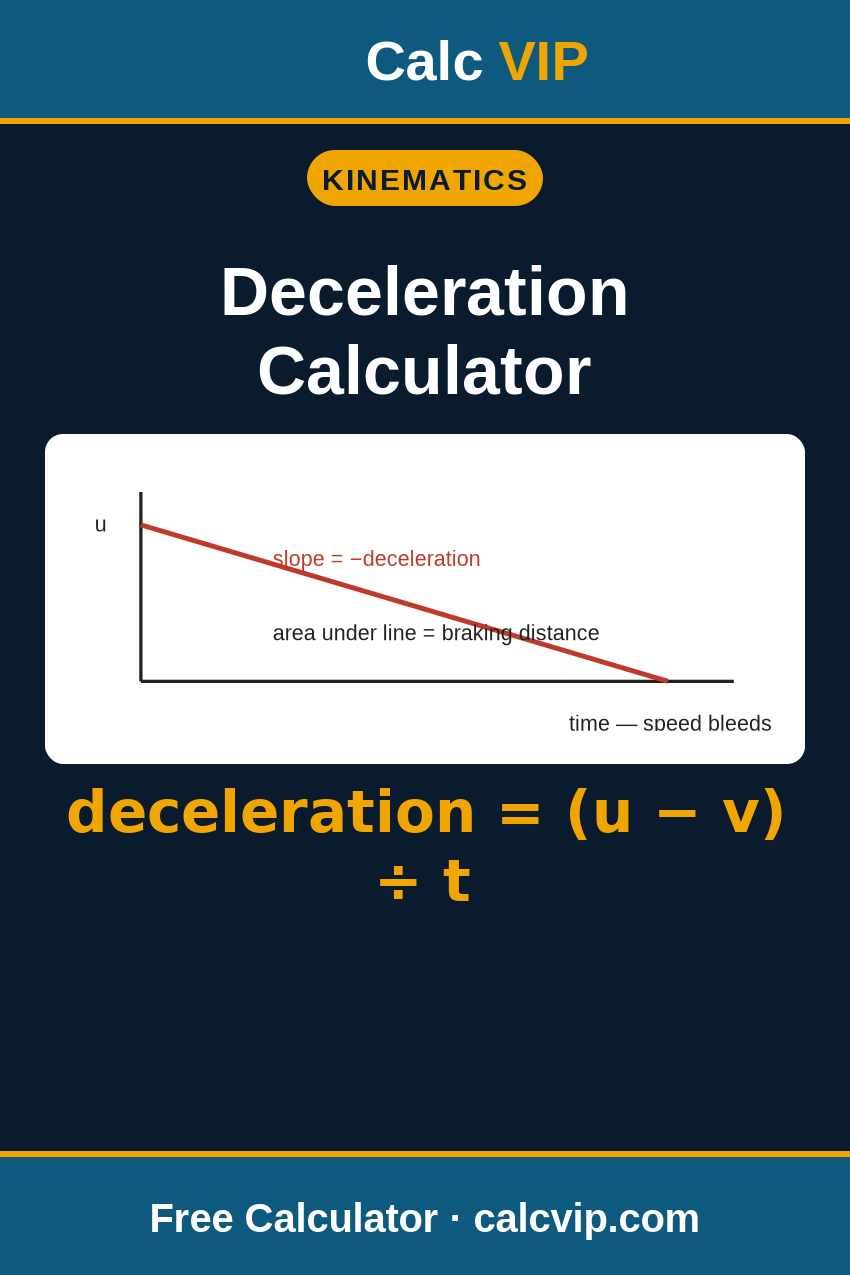
It is worth pausing on the word itself. Physicists mostly avoid "deceleration" as a technical term — they speak of acceleration with a sign, negative when it opposes the velocity — but the word survives because it names something real in human experience: the push forward in your seat when the brakes bite, the dive of a landing aircraft's nose wheel, the controlled violence of a crash-test sled. Behind each of those sensations sits a number, in m/s², and that number is what this page computes.
Formula
From speed change: deceleration = (u − v) ÷ t • From a full stop: deceleration = u² ÷ (2s), with stopping time t = u ÷ deceleration
The two formulas are the same physics wearing different clothes. The first is the definition — acceleration is change of velocity divided by time taken — with the subtraction reversed so the answer comes out positive for a slowing object. The second comes from the equation v² = u² + 2as: set the final velocity v to zero (a complete stop), move terms around, and the deceleration is the square of the starting speed divided by twice the distance. That square is the single most important letter on this page: it is why speed is so unforgiving. Rearrangements worth knowing: s = u² ÷ (2a) predicts the stopping distance for a known deceleration, and u = √(2as) works backwards from skid marks — a form traffic police use daily.
| Symbol | Meaning | Units |
|---|---|---|
| u | initial velocity — speed when braking starts | m/s |
| v | final velocity (0 for a complete stop) | m/s |
| t | time taken to slow down | s |
| s | distance covered while slowing (braking distance) | m |
| a | deceleration — reported as a positive size | m/s² |
The square law: why speed punishes twice
Double your speed and two things happen at once: you have twice as much velocity to shed, and you shed it while covering ground twice as fast. The two effects multiply, which is why stopping distance scales with u². A car that stops from 10 m/s in 10 m needs a deceleration of 5 m/s²; the same car from 20 m/s at the same 5 m/s² needs 40 m — four times the road. This is not a subtle correction; it is the dominant fact of road safety, the reason speed limits bite hardest exactly where speeds are highest, and the reason a "small" excess — 120 km/h instead of 100 — buys a disproportionately long stopping distance (at 6 m/s², 92.59 m against 64.3 m, an extra 28 metres of helplessness).
The square law is also an energy statement. Kinetic energy is ½mv², and braking is the business of converting that energy into heat in the discs and pads. Double the speed and the energy to be dumped quadruples — while the car is also covering the ground faster, giving the brakes less time in which to dump it. On a long mountain descent that heat has nowhere to go, the pads fade, the deceleration on offer falls, and the stopping distance stretches accordingly — the mechanism behind the runaway-truck ramps posted on steep grades.
How to use
- Choose the mode that matches your data: "Speed change over time" if you know both speeds and the time, or "Stopping distance" if the object brakes to rest over a known distance.
- Enter speeds in metres per second (divide km/h by 3.6 — 90 km/h is 25 m/s), times in seconds and distances in metres.
- Click "Calculate Deceleration". In stopping-distance mode you also get the stopping time.
- Sanity-check the answer against the real world: comfortable braking is around 2–3 m/s², firm braking 4–6, and anything above about 8 m/s² on an ordinary road should make you suspicious of the inputs.
Worked examples
Example 1 — the bus and the car. A bus slows from u = 25 m/s to v = 5 m/s in t = 4 s: deceleration = (25 − 5) ÷ 4 = 5 m/s². The distance mode agrees in spirit: a car at u = 20 m/s stopping in s = 40 m has deceleration = 20² ÷ (2 × 40) = 400 ÷ 80 = 5 m/s², and its stopping time is 20 ÷ 5 = 4 s.
Example 2 — a motorway stop. A car at 30 m/s (108 km/h) must stop within 75 m of clear road. Deceleration = 30² ÷ (2 × 75) = 900 ÷ 150 = 6 m/s², taking t = 30 ÷ 6 = 5 s. Firm, dry-road braking — possible, but with nothing to spare, which is why motorway gaps are measured in seconds, not metres.
Example 3 — a cyclist. A cyclist eases from 12 m/s to 3 m/s in 3 s: deceleration = (12 − 3) ÷ 3 = 3 m/s², and the distance covered while slowing is the trapezium ½ × (12 + 3) × 3 = 22.5 m — a reminder that slowing down is not the same as stopping, and the road used is the average speed times the time.
Example 4 — a train's patience. A train at 40 m/s (144 km/h) brakes to rest over 800 m: deceleration = 40² ÷ (2 × 800) = 1600 ÷ 1600 = 1 m/s², and the stop takes 40 ÷ 1 = 40 s. Steel wheels on steel rails grip weakly, so trains trade deceleration for distance — the physics behind signals placed hundreds of metres ahead of stations.
Example 5 — the square law in one line. At a deceleration of 5 m/s², a car from 10 m/s stops in s = 10² ÷ (2 × 5) = 10 m. From 20 m/s — merely double — it needs 20² ÷ 10 = 40 m. Twice the speed, four times the road, identical brakes.
Example 6 — a wet road. Rain roughly halves the grip: say the deceleration falls from 7 to 3.5 m/s². From 25 m/s, the dry stop takes 25² ÷ 14 = 44.64 m; the wet stop takes 25² ÷ 7 = 89.29 m and lasts 25 ÷ 3.5 ≈ 7.14 s. Same car, same speed, double the distance — the arithmetic behind every "slow down when it rains" sign ever posted.
Deceleration in real life
Skid-mark forensics. Police measure the dark lines a locked or ABS-modulated tyre leaves and work backwards with u = √(2as), using a deceleration measured by test skids on the same surface. The length of the mark is a speedometer reading written on the road.
Highway Code stopping distances. The published tables are this calculator plus a thinking distance: at 30 m/s a one-second reaction adds 30 m travelled before the brakes even bite (21 m at a brisk 0.7 s reaction). Total stopping distance is always reaction distance plus braking distance — the first part linear in speed, the second quadratic, which is why the totals grow so brutally.
Arrestor beds and runaway ramps. Airport runway overruns and mountain escape lanes use deep gravel to impose a large, reliable deceleration on vehicles whose own brakes have failed — engineered stopping distance, bought with crushed stone instead of brake pads.
Elevator comfort. Lifts decelerate at only about 1–1.5 m/s²: from a brisk 8 m/s that means roughly 5.33 s and 21.33 m of gentle slowdown, planned into the shaft. Passengers judge a lift's quality almost entirely by how its deceleration is shaped.
Roller coasters and crash sleds. Ride designers cap braking deceleration to keep necks safe, while crash-test facilities do the opposite: sleds are slammed at precisely programmed decelerations — tens of g — so dummies and sensors can grade how a cabin protects its occupants.
Regenerative braking. Electric vehicles decelerate by running their motors as generators, typically offering 2–3 m/s² of smooth "one-pedal" slowing and feeding the energy back to the battery. The friction brakes remain for the hard stops, where the square law demands decelerations regeneration alone cannot reach.
Thinking distance: the stop before the stop
The calculator's clock starts when the brakes bite, but a real stop starts earlier — when the hazard appears. Between the two lies the reaction time, typically 0.7–1.5 s, during which the vehicle sails on at full speed. That thinking distance is simply u × reaction time: 21 m at 30 m/s with a sharp 0.7 s reaction, 30 m with a one-second one, and proportionally worse for a tired or distracted driver. It grows only linearly with speed, yet at motorway pace it can exceed the entire braking distance of a city stop. Every honest stopping-distance figure is therefore a sum: a linear part you owe to your brain and a quadratic part you owe to physics, and this calculator handles the second while your habits control the first.
What limits deceleration?
Ultimately, friction. The tyres can only push backwards on the car as hard as the road pushes forwards on the tyres, and that grip caps the deceleration near μg, where μ is the friction coefficient: around 0.7–0.8 on dry asphalt (hence the familiar 5–8 m/s²), half that in the wet, and a miserable 0.1–0.2 on ice, where even 10 m/s needs some 250–500 m to stop. Brake hardware rarely sets the limit on a modern car — the tyre–road interface does, which is why ABS exists: a rolling tyre grips harder than a sliding one, so the system stutters the brakes to keep the wheels at the edge of grip, harvesting the maximum deceleration the surface can give. Aircraft push the same battle further with spoilers, reverse thrust and carbon brakes, because a runway is a stopping-distance problem with a fence at the end.
Deceleration without brakes
Brakes are only one way to shed speed. Air drag decelerates anything moving fast through air, growing with the square of speed until a falling body reaches terminal velocity and the deceleration fades to zero. A parachute weaponises that drag, swapping a lethal fall for a survivable one in a few violent seconds. Spacecraft use the same trick at orbital scale: a capsule returning at nearly 8,000 m/s lets the atmosphere do the braking, enduring decelerations of several g and converting the energy to a plasma-hot heat shield rather than brake discs. Rockets, having no atmosphere to borrow at the Moon, must carry their deceleration as fuel — the tyranny that makes landing there so expensive. In every case the bookkeeping is identical to this page's: a speed to lose, a rate of losing it, and a distance over which the loss must be completed.
Quick reference: stopping from road speeds at 6 m/s²
| Speed | In m/s | Braking distance | Stopping time |
|---|---|---|---|
| 50 km/h | 13.89 | 16.08 m | 2.31 s |
| 80 km/h | 22.22 | 41.15 m | 3.7 s |
| 100 km/h | 27.78 | 64.3 m | 4.63 s |
| 120 km/h | 33.33 | 92.59 m | 5.56 s |
Read down the distance column and watch the square law at work: the speed rises by a factor of 2.4 from top to bottom, but the braking distance grows by a factor of nearly six. Add a second of thinking distance — 14 to 33 more metres — to every row.
Common mistakes
- Feeding km/h into an m/s formula. 90 km/h is 25 m/s. Using 90 directly inflates the stopping-distance deceleration by a factor of 3.6² ≈ 13 — the commonest and most dangerous slip on this page.
- Using the distance formula for a partial slowdown. Deceleration = u² ÷ (2s) assumes the object stops (v = 0). For a slowdown to a nonzero v, the correct form is (u² − v²) ÷ (2s), or simply use the speed-change mode with the time.
- Expecting stopping distance to scale with speed. It scales with speed squared. "I was only going a bit faster" translates, in metres, to a lot more road — see Example 5.
- Forgetting the thinking distance. The calculator gives the braking part only. A real stop adds u × reaction time before the brakes bite, which at motorway speed is tens of metres.
- Quoting deceleration with the wrong sign story. As a signed acceleration, slowing down is negative; as a deceleration, report the positive size and say "deceleration". Mixing the two mid-solution flips signs and breaks equations downstream.
FAQ
Is deceleration just negative acceleration?
Yes. Deceleration means the acceleration acts against the motion, so as a signed value it is negative; this calculator reports its size (a positive number).
Why does doubling the speed quadruple the stopping distance?
Because the distance formula contains u². Double the speed and the braking distance becomes four times longer at the same deceleration — a key road-safety fact.
What deceleration can a car achieve?
A typical car braking hard on a dry road manages about 5–8 m/s². Values near 9.81 m/s² (1 g) are about the limit for ordinary tyres.
What is a comfortable deceleration for passengers?
About 1–2 m/s² feels gentle, 2–3 m/s² is normal service braking, and above 4 m/s² passengers brace themselves. Public transport standards design around these numbers so standing passengers stay standing.
How does deceleration relate to g-force?
Divide by 9.81. A deceleration of 5 m/s² is about 0.51 g; the 49.05 m/s² (5 g) a racing car achieves under braking would stop it from 27.78 m/s in under 8 m — about 7.87 m of travel — which is why racing brakes and tyres are exotic.
Why do heavier vehicles not always stop longer?
Because braking force and inertia both scale with mass: in the ideal friction model the mass cancels, exactly as it does on an incline. In practice heavy vehicles are limited by brake heating and tyre load sensitivity, so trucks do stop longer — an engineering limit, not a formula limit.
Can deceleration be too high for the vehicle itself?
Yes. Beyond tyre grip, loads shift, unsecured cargo slides, and in extreme cases the structure objects. That is why freight is lashed assuming specific decelerations and why crash pulses are engineered rather than simply maximised.
Does ABS shorten stopping distance?
On most surfaces, yes or equal: it keeps tyres near peak grip instead of sliding past it, and preserves steering. On loose gravel or deep snow a locked wheel can dig in and stop shorter — the famous exception that proves the grip rule.
How do I find the distance for a slowdown that does not stop?
Use s = (u² − v²) ÷ (2a) once you know the deceleration, or find the time from the speed-change mode and multiply by the average speed ½(u + v). Example 3 above does exactly this for a cyclist.
What deceleration does a parachutist or a landing plane experience?
A parachute opening spikes several g briefly, then settles to a descent whose flare at landing is a gentle ~1–2 m/s² problem. Airliners brake on the runway at a modest 2–3 m/s² by choice — autobrake settings literally dial a target deceleration — reserving maximum braking for emergencies.