 Calc
Center of Mass Velocity Calculator – Vcm = (m1v1 + m2v2)/(m1 + m2)
 Created by James Carter · Physics Writer · Forces & Motion · Last updated: November 2026
Use this free Center of Mass Velocity Calculator to find how fast the centre of mass of a two-object system moves. Enter both masses and velocities — with signs for direction — and get Vcm instantly. This is the velocity the system would keep after a sticking collision.
Every system of moving objects has a ghost: a single imaginary point that moves as if all the system's mass were concentrated in it and all its momentum belonged to it. That point is the centre of mass, and its velocity — Vcm — is the one motion of the system that no internal event can alter. Collisions may rearrange the objects violently, springs may snap, things may explode into fragments, but if no outside force intervenes, the centre of mass sails on at exactly the same velocity throughout, indifferent to the drama around it. This calculator finds that velocity for a two-object system from the masses and signed velocities of its parts.
The formula's meaning is bookkeeping: total momentum divided by total mass. The whole system, however complicated internally, behaves — as far as its overall drift is concerned — like one lump of mass (m1 + m2) carrying the momentum (m1v1 + m2v2). That is why Vcm appears in disguise all over mechanics. It is the final velocity of a sticking collision, the drift of a recoiling system's heart, the reference motion subtracted away when physicists analyse collisions in the "centre-of-mass frame". Learn to compute it here and a dozen apparently separate topics turn out to be one topic.
Signs do heavy lifting in this formula, because velocity is a vector. Two objects moving towards each other contribute momenta that partly cancel, so the centre of mass of two colliding trolleys can be creeping — or perfectly still — while both trolleys move briskly. The examples below include exactly that paradox, and it is not a trick: stand in the frame moving at Vcm and the total momentum is zero, the fairest possible viewpoint from which to watch a collision.
Formula
Centre of mass velocity Vcm = (m1v1 + m2v2) ÷ (m1 + m2) • equivalently Vcm = Ptotal ÷ Mtotal
The numerator is the system's total momentum; the denominator is its total mass. The formula is the velocity-analogue of the centre-of-mass position, xcm = (m1x1 + m2x2) ÷ (m1 + m2): in both, each contribution is weighted by its mass, so heavy objects dominate the average and light ones merely nudge it. Signs follow the velocities: choose a positive direction once, and every velocity pointing the other way enters negative — the answer's sign then reports the direction of the system's overall drift. The calculator also returns the total momentum and total mass, so the division can be audited at a glance. Nothing else is needed: no forces, no times, no collision details — Vcm is a property of the system's state at any instant, computable from a single snapshot.
| Symbol | Meaning | Units |
|---|---|---|
| Vcm | velocity of the centre of mass | m/s |
| m1, m2 | masses of the two objects | kg |
| v1, v2 | their velocities (signed) | m/s |
| Ptotal | total momentum, m1v1 + m2v2 | kg·m/s |
Why nothing inside the system can change Vcm
The constancy of Vcm is Newton's third law wearing a disguise. Every internal force comes in an equal-and-opposite pair: object 1 pushes object 2 exactly as hard as object 2 pushes back. Their impulses therefore cancel in the total momentum, second by second, whatever the interaction — spring, collision, explosion, gravitational embrace. With total momentum and total mass both fixed, their ratio Vcm is fixed. Only an external force — friction from the ground, a push from outside, gravity acting over time — can rewrite the total, and it rewrites it at exactly the rate Fexternal = Mtotal × (acceleration of the centre of mass), as if the whole system were one particle.
The consequences are quietly spectacular. A firework shell bursting at the top of its arc sprays fragments in every direction, yet the centre of mass of all the fragments continues along the original parabola as if nothing happened (until fragments start landing). Two skaters who push off each other glide apart, but their shared centre of mass stays exactly where it was. A diver somersaults wildly while her centre of mass traces one clean, untouchable parabola into the pool. In each case this calculator, fed a snapshot from any moment, reports the same Vcm — before, during and after the event.
How to use
- Enter the mass of object 1 in kilograms and its velocity in metres per second.
- Enter the mass and velocity of object 2, using a minus sign for any velocity pointing opposite to object 1's positive direction.
- Click "Calculate Vcm" to see the centre of mass velocity, together with the system's total momentum and total mass.
- Interpret the sign: positive means the system's heart drifts in the chosen positive direction; zero means the momenta exactly cancel and the centre of mass is stationary, however busy the objects themselves may be.
Worked examples
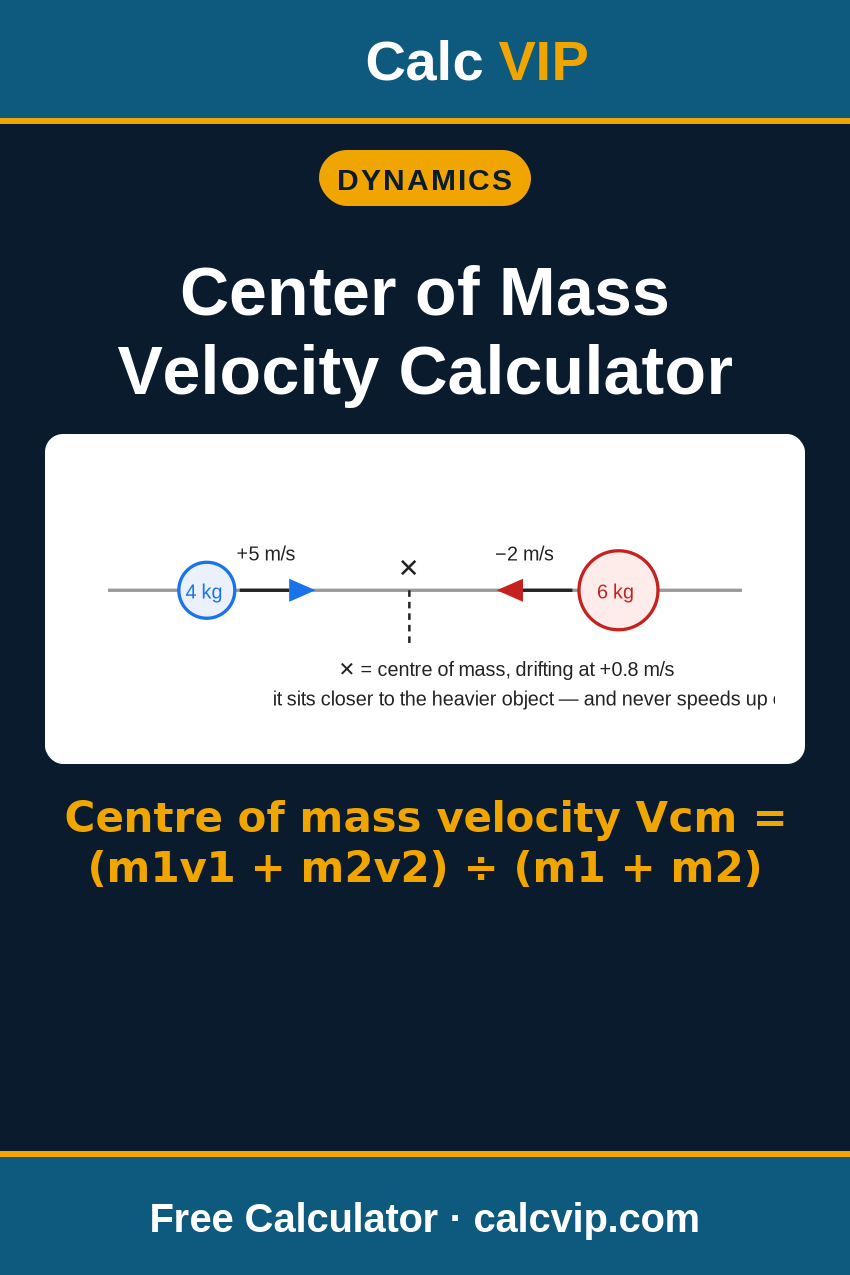
Example 1 — opposing trolleys. A 4 kg object at +5 m/s and a 6 kg object at −2 m/s: Vcm = (4 × 5 + 6 × (−2)) ÷ (4 + 6) = (20 − 12) ÷ 10 = 0.8 m/s. The system carries 8 kg·m/s of total momentum spread over 10 kg, so its heart creeps positive even though one member moves briskly backwards.
Example 2 — the perfect cancellation. Two 2 kg pucks approach symmetrically at +3 m/s and −3 m/s: Vcm = (6 − 6) ÷ 4 = 0 m/s. Their centre of mass sits motionless between them while they collide — if they stick, the joined pair simply stops dead, exactly as the collision solver confirms.
Example 3 — the explosion. A stationary firework (treat it as 3 kg + 1 kg of fragments-to-be) bursts: one fragment flies at +4 m/s, the other recoils at −12 m/s. Vcm = (3 × 4 + 1 × (−12)) ÷ 4 = (12 − 12) ÷ 4 = 0 m/s — unchanged, as it must be: the explosion is an internal event and cannot give the system's centre any motion it did not already have. Note the trade: the light fragment leaves three times faster, momentum's price for its small mass.
Example 4 — the heavy anchor. A 10 kg block slides at 2 m/s while a 1 kg puck rests on the same ice: Vcm = (20 + 0) ÷ 11 = 1.82 m/s. If the puck is scooped up and sticks, the pair continues at exactly 1.82 m/s — Vcm computed before the event predicts the sticking collision's outcome after it.
Example 5 — skaters pushing off. A 50 kg skater glides at −3 m/s and a 75 kg partner at +2 m/s after their push: Vcm = (−150 + 150) ÷ 125 = 0 m/s. They started at rest together, so their centre of mass never acquired any velocity; it remains hovering over the spot where they parted, while each skater carries off equal and opposite momentum.
Example 6 — a gentle lab case. Dynamics carts of 1.5 kg at 0.6 m/s and 2.5 kg at −0.2 m/s: Vcm = (0.9 − 0.5) ÷ 4 = 0.1 m/s. Small numbers, same law — the centre of mass drifts at a tenth of a metre per second, a value students can verify with a stopwatch and a metre rule by tracking the balance point of the pair.
Centre of mass velocity in real life
Finding planets around other stars. A star and its planet orbit their common centre of mass; the star's Vcm-style wobble — often just a few metres per second — is measured by Doppler spectroscopy, and thousands of exoplanets have been discovered from nothing but this formula applied to starlight.
Walking in a boat. Walk towards the bow of a light dinghy and the boat slides backwards under you: with no external horizontal force, the person-plus-boat centre of mass stays put, so your forward step is paid for by the boat's retreat. Every canoeist learns Vcm the wet way.
Forensic explosion analysis. Investigators map fragment positions and speeds, compute where the centre of mass must have travelled, and run it backwards to locate the device — the fragments testify, but the average never lies.
Diving and gymnastics. Once airborne, an athlete's centre of mass is committed to a parabola no technique can alter; tucks and twists only rearrange mass around that point, changing rotation, never the path. Coaches choreograph around an invisible, unchangeable trajectory.
Rocket staging. A rocket and its exhaust are one system: the combined centre of mass continues on the original path while rocket and gas separate around it. Staging — dropping an empty tank — is analysed by tracking how the remaining system's centre of mass proceeds.
Particle physics. Collider experiments transform every measurement into the centre-of-mass frame, where total momentum is zero, because collision products then reveal their energies without the bookkeeping of the system's overall drift — Vcm is the frame's defining velocity.
The centre-of-mass frame: physics with the drift removed
Subtract Vcm from every velocity and you enter the centre-of-mass (zero-momentum) frame, the viewpoint riding along with the system's heart. In Example 1 that means watching from a trolley moving at 0.8 m/s: object 1 now approaches at 5 − 0.8 = 4.2 m/s, object 2 at −2 − 0.8 = −2.8 m/s, and their momenta — 4 × 4.2 = 16.8 and 6 × (−2.8) = −16.8 kg·m/s — cancel exactly. Every collision looks fairest from here: the objects approach their shared centre, interact, and recede from it, with no overall drift muddying the energy accounts. It is in this frame that the kinetic energy of a sticking collision shows its structure — the part tied to relative motion is entirely destroyed, the part tied to Vcm untouchable — and in this frame that collider physicists quote their energies. One subtraction, performed by this calculator, unlocks the cleanest description of any two-body event.
The frame also splits the kinetic energy into two honest piles. Example 1's objects carry ½ × 4 × 5² + ½ × 6 × 2² = 50 + 12 = 62 J between them. Of that, the centre-of-mass motion itself accounts for ½ × 10 × 0.8² = 3.2 J — untouchable, since Vcm cannot change without an outside force — while the remaining 58.8 J is relative motion, the only energy a collision can destroy, convert or rearrange. (Check it in the CM frame: ½ × 4 × 4.2² + ½ × 6 × 2.8² = 35.28 + 23.52 = 58.8 J exactly.) This is why a sticking collision between Example 1's trolleys would end with precisely 3.2 J still moving and 58.8 J spent: the split, computable from Vcm alone, predicts the energy ceiling of every interaction before it happens. Example 4 makes the same point at the gentle extreme: the block's 20 J of kinetic energy divides into ½ × 11 × 1.82² ≈ 18.18 J of untouchable centre-of-mass motion and a mere 1.82 J of relative motion — which is all the scooping-up of the little puck can possibly cost, and why heavy systems absorb light arrivals so cheaply.
Quick reference: Vcm for common pairings
| m1 | v1 | m2 | v2 | Vcm |
|---|---|---|---|---|
| 4 kg | +5 m/s | 6 kg | −2 m/s | +0.8 m/s |
| 5 kg | +8 m/s | 5 kg | +2 m/s | +5 m/s |
| 2 kg | −4 m/s | 8 kg | +1 m/s | 0 m/s |
| 12 kg | 0 | 3 kg | +9 m/s | +1.8 m/s |
Equal masses moving the same way (row 2) average plainly; unequal momenta in opposition (row 3) cancel outright. In every row the pattern is the same: momentum is the vote, mass is the weighting, and Vcm is the result the system as a whole cannot argue with.
Common mistakes
- Averaging the velocities without the masses. (5 + (−2)) ÷ 2 = 1.5 m/s is not Example 1's answer — the 6 kg object's vote counts half again as much as the 4 kg's, pulling the true Vcm down to 0.8. The mass weighting is the entire content of the formula.
- Sign slips. Velocities in opposite directions must enter with opposite signs. Entering both as positive in a head-on case fabricates momentum and can double or treble the reported Vcm.
- Believing a collision changes Vcm. It cannot — not sticking, not bouncing, not exploding. If your before-and-after Vcm values differ, an external force acted during the interval (or an arithmetic slip did); on a frictionless track, differing values are always an error signal.
- Confusing the centre of mass with the meeting point. Objects collide wherever they collide; the centre of mass is a mass-weighted average position that may lie inside neither object — for two separated trolleys it floats in the gap between them, closer to the heavier one.
- Forgetting the frame. Velocities are measured relative to something — usually the ground or the lab bench. Mixing one velocity measured from the ground with another measured from a moving cart corrupts the numerator beyond repair.
FAQ
Why do the signs matter?
Velocity is a vector. If two objects move towards each other, their momenta partly cancel, so the centre of mass moves slower than either object — or can even be at rest.
Does Vcm ever change?
Only if an outside force acts on the system. With no external force, the centre of mass keeps moving at the same velocity forever, even while the objects collide or explode.
How is this related to collisions?
If the two objects stick together, their final shared velocity is exactly Vcm — that is why this formula also solves sticking collisions.
Where exactly is the centre of mass of two objects?
On the line joining them, at the point that divides the distance in the inverse ratio of the masses: xcm = (m1x1 + m2x2) ÷ (m1 + m2). For Example 1's 4 kg and 6 kg objects it sits 60% of the way from the lighter to the heavier — always leaning towards the mass that dominates the average.
Can Vcm be zero while both objects are moving fast?
Yes — Examples 2, 3 and 5 all show it. Zero Vcm means the momenta cancel, not that the motion does. The system can be seething with kinetic energy while its centre of mass sits perfectly still; that is precisely the situation in a symmetric head-on collision.
What if there are three or more objects?
The formula simply extends: Vcm = (m1v1 + m2v2 + m3v3 + …) ÷ (m1 + m2 + m3 + …). Every fragment of an explosion, every wagon of a train, every star of a cluster joins the same weighted average. This calculator covers the two-object case, which is also the building block for chains of pairwise events.
Does gravity change Vcm?
Gravity is an external force on a thrown system, so yes — it accelerates the centre of mass at g, exactly as if the whole mass were one projectile. That is why a bursting shell's fragments keep the original parabola: gravity rewrites Vcm steadily and identically for every fragment, leaving their relative arrangement to the explosion.
How is Vcm different from the average velocity?
The plain average weights each object equally; Vcm weights by mass. They agree only when the masses are equal. A mosquito and a lorry approaching each other have an average velocity near the midpoint of their speeds — and a Vcm essentially equal to the lorry's velocity, because the lorry's mass outvotes the mosquito's by ten orders of magnitude.
Why do physicists bother with the centre-of-mass frame?
Because in that frame the total momentum is zero and collisions show their true structure: energies split cleanly into an untouchable "drift" part and an available "relative" part. Accelerators are even rated by their centre-of-mass energy — the portion of the collision energy actually available to create new particles.
Is the velocity after a sticking collision always Vcm?
Always. Once joined, the combined mass has a single velocity, and momentum conservation forces it to be total momentum over total mass — Vcm by definition. The collision solver on this site and this calculator are the same equation viewed from opposite ends of the event.