 Calc
Center of Mass Calculator – Balance Point of Masses on a Line
 Created by James Carter · Physics Writer · Forces & Motion · Last updated: November 2026
Use this free Center of Mass Calculator to find the balance point of up to three masses placed along a straight line. The centre of mass is the weighted average position — the whole system behaves as if all its mass were concentrated there.
Centre of Mass on a Line (up to 3 masses)
Every object and every system has one point that answers to the whole of its mass: the centre of mass. Push the system through that point and it glides without rotating; support it there and it balances; let it fly and that point — alone among all its points — traces the clean parabola of a projectile while the rest of the object tumbles around it. This calculator finds that point for the fundamental case of masses arranged along a line: enter each mass and its position, and it returns the mass-weighted average position and the total mass. Three masses cover a surprising share of real problems, from seesaws to spacecraft.
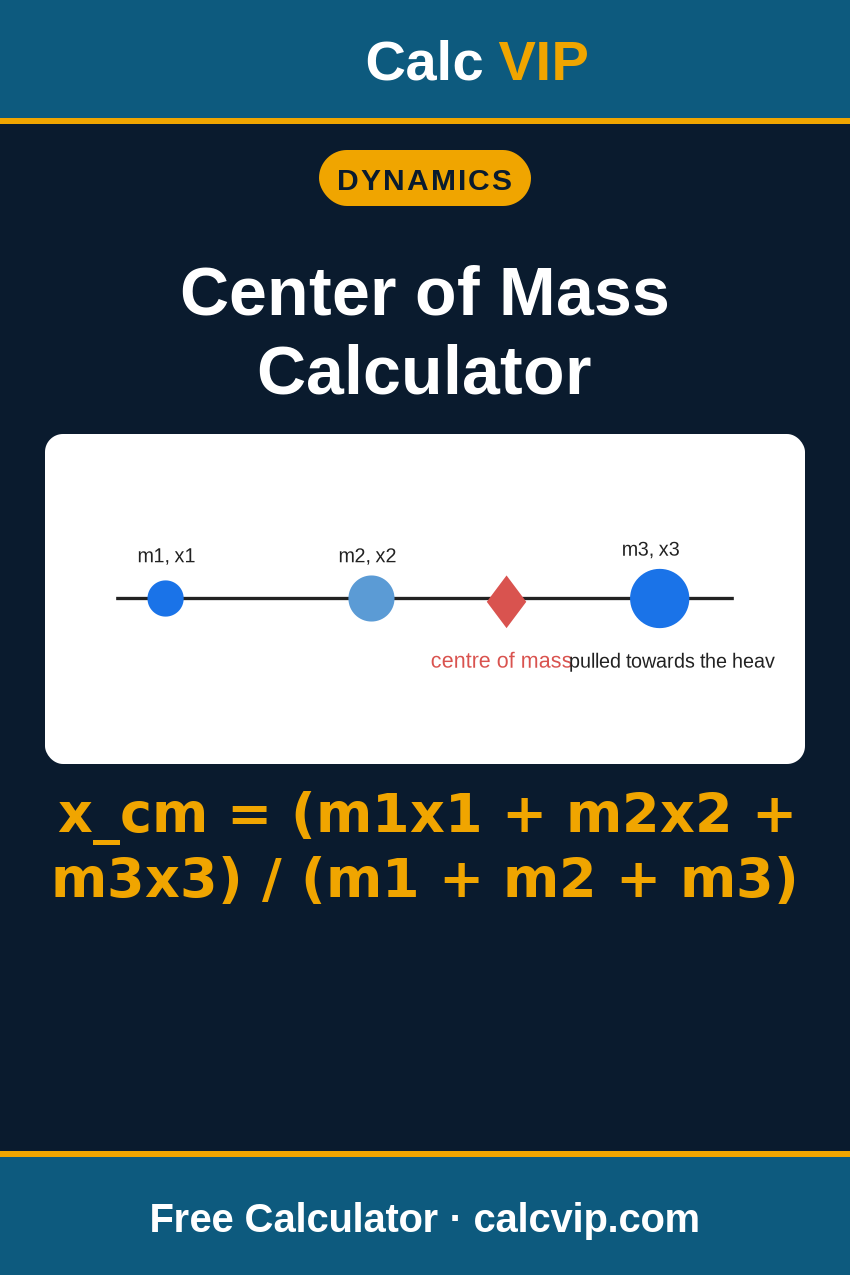
The formula's intuition is the seesaw's. A heavy mass pulls the balance point towards itself in exact proportion to its mass: twice the mass at the same distance earns twice the say. Positions are therefore not averaged but weighted — each position is multiplied by its mass before averaging, and the total mass divides. That is why the balance point in the worked example sits at 6.2 m rather than at the plain midpoint of the rod, and why a small mass far away can outvote a large mass nearby: weight in this election is mass × distance, the quantity physicists call the first moment.
Do not let the simplicity of the arithmetic undersell the concept. The centre of mass is the anchor of the deepest theorem in mechanics: in the absence of an external force, the centre of mass of any system moves at constant velocity — no matter what the parts do. Collide, stick, explode, wrestle, burn fuel: the parts may rearrange their motion violently, but the centre of mass glides on untouched, because internal forces cannot move it. Half the calculators on this site are, underneath, that theorem at work.
Formula
x_cm = (m1x1 + m2x2 + m3x3) / (m1 + m2 + m3) — each position is weighted by its mass, then divided by the total mass. Leave the third mass blank to use just two masses.
For two masses the formula has a memorable geometric reading: the centre of mass divides the line between them in the inverse ratio of the masses — it sits m2 / (m1 + m2) of the way from m1 towards m2, always closer to the heavier one. The same weighted average extends to any number of masses, Σ mᵢxᵢ / Σ mᵢ, and to two and three dimensions by applying it independently to each coordinate: y_cm from the y-positions, z_cm from the z-positions. It also extends to solid objects, where the sums become integrals over the body's density — which is how the centre of mass of a uniform rod lands at its midpoint, a cone's at a quarter of its height from the base, and a hollow ring's at its empty centre. Positions may be measured from any origin; shifting the origin shifts x_cm by the same amount, because the physical point does not care where the ruler starts.
| Symbol | Meaning | Units |
|---|---|---|
| x_cm | position of the centre of mass | m (same unit as the positions) |
| m1, m2, m3 | the masses on the line | kg |
| x1, x2, x3 | their positions, from one shared origin | m |
| M | total mass, m1 + m2 + m3 | kg |
The point that cannot be pushed around from inside
The centre-of-mass theorem deserves its reputation. Differentiate the defining formula with respect to time and it says M × v_cm = total momentum; differentiate again and it says M × a_cm = total external force. Internal forces — the pushes and pulls the parts exert on each other — cancel in pairs by Newton's third law and never appear. So when two skaters push off each other, their velocities change dramatically but their shared centre of mass does not move a millimetre. When a shell explodes mid-flight, the fragments scatter, yet their centre of mass continues along the original parabola as if nothing happened — a fact artillery instructors and film animators both rely on. And when a rocket burns fuel, the centre of mass of rocket-plus-exhaust stays fixed in space; the rocket moves forward precisely because the exhaust moves back, the two motions conspiring to keep the average exactly where it was.
This is also why the centre of mass, not any material point, is the honest answer to "where is the system?" The Earth and Moon do not orbit each other in the naive sense; both orbit their shared centre of mass, a point about 4,675 km from Earth's centre — inside the Earth, but off-centre enough that Earth visibly wobbles around it monthly. Astronomers hunting exoplanets watch for exactly that wobble in distant stars: the star's centre-of-mass dance with an unseen planet, measured by this page's formula run backwards.
How to use
- Measure all positions from the same zero point, in metres, along the line — mixing origins is the one error that ruins everything.
- Enter at least two masses with their positions; the third pair is optional — leave both of its boxes blank to run a two-mass calculation.
- Click "Calculate Centre of Mass" to get the balance-point position and the total mass.
- Sanity-check the answer: it must lie between the leftmost and rightmost masses, and closer to the heavier end. An answer outside the span means a sign or origin slip.
Worked examples
Example 1 — three masses on a rod. Three masses sit on a rod: 2 kg at 0 m, 3 kg at 4 m and 5 kg at 10 m.
x_cm = (2 × 0 + 3 × 4 + 5 × 10) / (2 + 3 + 5) = (0 + 12 + 50) / 10 = 62 / 10 = 6.2 m.
The balance point is at 6.2 m — pulled toward the heaviest mass, as expected. Note it is not the midpoint of the rod (5 m): the 5 kg mass outvoted the geometry.
Example 2 — two masses. A 4 kg mass at 1 m and a 6 kg mass at 6 m. x_cm = (4 × 1 + 6 × 6) / 10 = (4 + 36) / 10 = 4.0 m. Check with the inverse-ratio rule: the COM sits 6/10 of the way from the 4 kg mass towards the 6 kg one — 1 + 0.6 × 5 = 4.0 m. Two routes, one point.
Example 3 — the balanced seesaw. A 30 kg child sits 1.5 m to the left of the pivot (position −1.5 m) and a 75 kg adult sits 0.6 m to the right (+0.6 m). x_cm = (30 × (−1.5) + 75 × 0.6) / 105 = (−45 + 45) / 105 = 0 m — exactly at the pivot, which is why the seesaw balances. The adult's 2.5× mass is precisely cancelled by the child's 2.5× distance: mass × distance is the currency on both sides.
Example 4 — masses either side of the origin. Masses of 1 kg at −2 m, 2 kg at 1 m and 3 kg at 3 m. x_cm = (1 × (−2) + 2 × 1 + 3 × 3) / 6 = (−2 + 2 + 9) / 6 = 9 / 6 = 1.5 m. Negative positions are not a complication; they are how the formula hears about the left-hand side of the world.
Example 5 — the Earth and the Moon. Treat Earth (5.97 × 10²⁴ kg) as sitting at 0 and the Moon (7.35 × 10²² kg) at their separation of 384,400 km. x_cm = (7.35 × 10²² × 384,400) / (5.97 × 10²⁴ + 7.35 × 10²²) ≈ 4,675 km from Earth's centre. Earth's radius is 6,371 km, so the shared centre of mass lies inside the Earth, about 1,700 km beneath the surface on the Moon-facing side. Both bodies orbit this point — Earth wobbling in a monthly circle of radius 4,675 km, the Moon sweeping the grand circuit outside.
Example 6 — the dumbbell. Two 5 kg plates on a light bar, at 0 m and 2.2 m (bar mass neglected). x_cm = (5 × 0 + 5 × 2.2) / 10 = 1.1 m — the midpoint, as equal masses demand. This is why a balanced barbell feels neutral in the hands when gripped at its centre mark, and why the mark is printed there: the manufacturer solved this example so the lifter does not have to.
The centre of mass in real life
Aircraft weight and balance. Before every flight, pilots (or their software) compute the aircraft's centre of mass from the masses and positions of fuel, passengers and cargo — literally this formula with more rows. The result must fall inside a certified envelope: too far aft and the aircraft becomes unstable; too far forward and it cannot lift its nose. Few calculators on this site have a more literal safety case.
The Fosbury flop. A high jumper using the flop arches over the bar while their centre of mass passes underneath it — the body goes over in pieces, head and legs drooping either side, so the point that must be raised against gravity never has to clear the bar at all. World-class jumpers exploit the fact that the centre of mass need not be inside the body.
Vehicle stability. A car's rollover resistance is set by its centre-of-mass height against its track width — which is why battery-heavy electric cars, with their mass in the floor, corner flat, and why roof boxes and lifted suspensions genuinely change a vehicle's safety, not just its looks.
Carrying a ladder with a friend. When two people carry a long load, the person nearer the centre of mass bears the larger share of the weight — the inverse-ratio rule felt in the shoulders. Slide the grip towards the load's COM and the shares equalise; experienced movers shuffle loads for exactly this reason.
Tightrope walkers' poles. The long pole lowers and steadies the walker's centre of mass (and increases rotational inertia), moving the balance point closer to the wire and slowing any tip. The performer is carrying a centre-of-mass management device.
Cranes and forklifts. A forklift is safe only while the combined centre of mass of truck plus load stays inside the wheelbase triangle; raise a heavy load and drive, and the COM migrates forward and upward towards the tip-over edge. Load charts are this formula with legal force.
Finding the centre of mass of a real object
For irregular objects, experiment beats integration. Hang the object freely from one point and drop a plumb line from the support: the centre of mass lies somewhere on that line, because a hanging body settles with its COM directly below the pivot. Hang it from a second point and draw a second line; where the lines cross is the centre of mass — for flat objects, a two-minute job with string and a marker. The balancing version is quicker still: rest the object on a fingertip or a knife edge and shuffle it until it balances, and the COM is above the contact point. Mechanics use the same ideas at industrial scale, weighing axles to locate a vehicle's COM longitudinally, then tipping it on a tilt table to find the height. Notice what all these methods share: none of them needs to know the object's internal layout, because the centre of mass is a property of the whole, readable from the whole's behaviour.
Quick reference: two-mass centre of mass
| Masses (separation L) | COM position |
|---|---|
| equal masses | midway — L/2 from each |
| one twice the other (2 : 1) | L/3 from the heavier, 2L/3 from the lighter |
| one three times the other (3 : 1) | L/4 from the heavier |
| one nine times the other (9 : 1) | L/10 from the heavier |
| Earth and Moon (81 : 1) | about L/82 from Earth's centre — inside the Earth |
The pattern is the inverse-ratio rule in uniform: the COM divides the separation in the inverse proportion of the masses, hugging the heavy partner ever closer as the ratio grows. It is the fastest sanity check for any two-body problem, from dumbbells to binary stars.
Common mistakes
- Averaging the positions without the masses. (0 + 4 + 10) / 3 = 4.67 m is the answer to a different question — the centre of the positions. The centre of mass weights each position by its mass; skipping the weights is the single most common error with this formula.
- Measuring positions from different origins. Every x must be read off the same ruler. One mass measured from the left end and another from the right silently corrupts the weighted sum, and the result usually fails the between-the-extremes check.
- Half-filling the optional third mass. Entering a third mass without its position (or the reverse) either errors or, worse, is quietly ignored in hand calculations. Pairs travel together: both boxes or neither.
- Expecting the COM to sit on a mass. With several masses it usually falls in the gaps between them — and for rings, boomerangs and high jumpers it can fall outside the material entirely. An answer in empty space is not an error; it is often the point.
- Confusing centre of mass with centre of gravity in precision work. They coincide in uniform gravity, which covers nearly everything — but for very tall structures or precision orbital mechanics the variation of g across the body separates them slightly, and the distinction starts to matter.
FAQ
Is the centre of mass always inside the object?
No. For a ring or a boomerang it can lie in empty space. For masses on a line it always lies between the leftmost and rightmost masses, closer to the heavier end.
Why does the centre of mass matter for collisions?
The centre of mass of a system keeps moving at constant velocity unless an external force acts — even while the individual objects collide, explode or stick together.
Is centre of mass the same as centre of gravity?
In a uniform gravity field, yes — they coincide. They only differ where gravity varies noticeably across the object, such as very tall structures.
Why does the Earth–Moon centre of mass lie inside the Earth?
Because Earth is about 81 times as massive as the Moon, the inverse-ratio rule puts the balance point just 1/82 of the separation from Earth's centre — roughly 4,675 km out, well within Earth's 6,371 km radius. The Moon does not orbit Earth's centre; both bodies orbit that interior point.
Can internal forces move the centre of mass?
No. Internal forces cancel in pairs, so the centre of mass responds only to external forces. Passengers shifting in a boat move themselves relative to the boat, but the boat-plus-passengers centre of mass stays put (ignoring water resistance) — the boat slides back as they walk forward.
How do pilots use the centre of mass?
They compute it before flight from the masses and positions of everything aboard and confirm it lies within a certified range. A centre of mass too far back makes an aircraft unstable in pitch; too far forward makes it hard to rotate for takeoff. It is this calculator, flown.
Does the choice of origin change the centre of mass?
It changes the number, not the point. Measure from a new origin and x_cm shifts by exactly the origin's shift. The physical balance point is a property of the mass distribution alone.
Where is a standing person's centre of mass?
Roughly at 55% of their height, in front of the lower spine — and it moves: raise your arms and it rises; bend and it can move outside the body entirely, which is why a person touching their toes without bending their knees must lean their hips back to keep the point over their feet.
How is the centre of mass found for a 2D or 3D system?
By applying the same weighted average to each coordinate separately: x_cm from the x-positions, y_cm from the y-positions, z_cm from the z-positions. This calculator handles the one-dimensional case, which is also the building block — each coordinate of the full answer is a 1D calculation like this one.
Why does a thrown wrench tumble but its centre of mass flies straight?
Because gravity (the only external force) acts as if applied at the centre of mass, that point follows the perfect projectile parabola, while rotation about the point is unconstrained by it. Films and games animate exactly this: plot the COM's clean arc, then spin the object around it.