 Calc
Bulk Modulus Calculator – B = ΔP/(ΔV/V) & Volume Change
 Created by James Carter · Physics Writer · Forces & Motion · Last updated: November 2026
Use this free Bulk Modulus Calculator in two ways. In the first mode, enter a pressure increase and the resulting volume change to measure a material's bulk modulus B. In the second mode, enter B and a pressure change to predict how much a given volume will shrink (or expand).
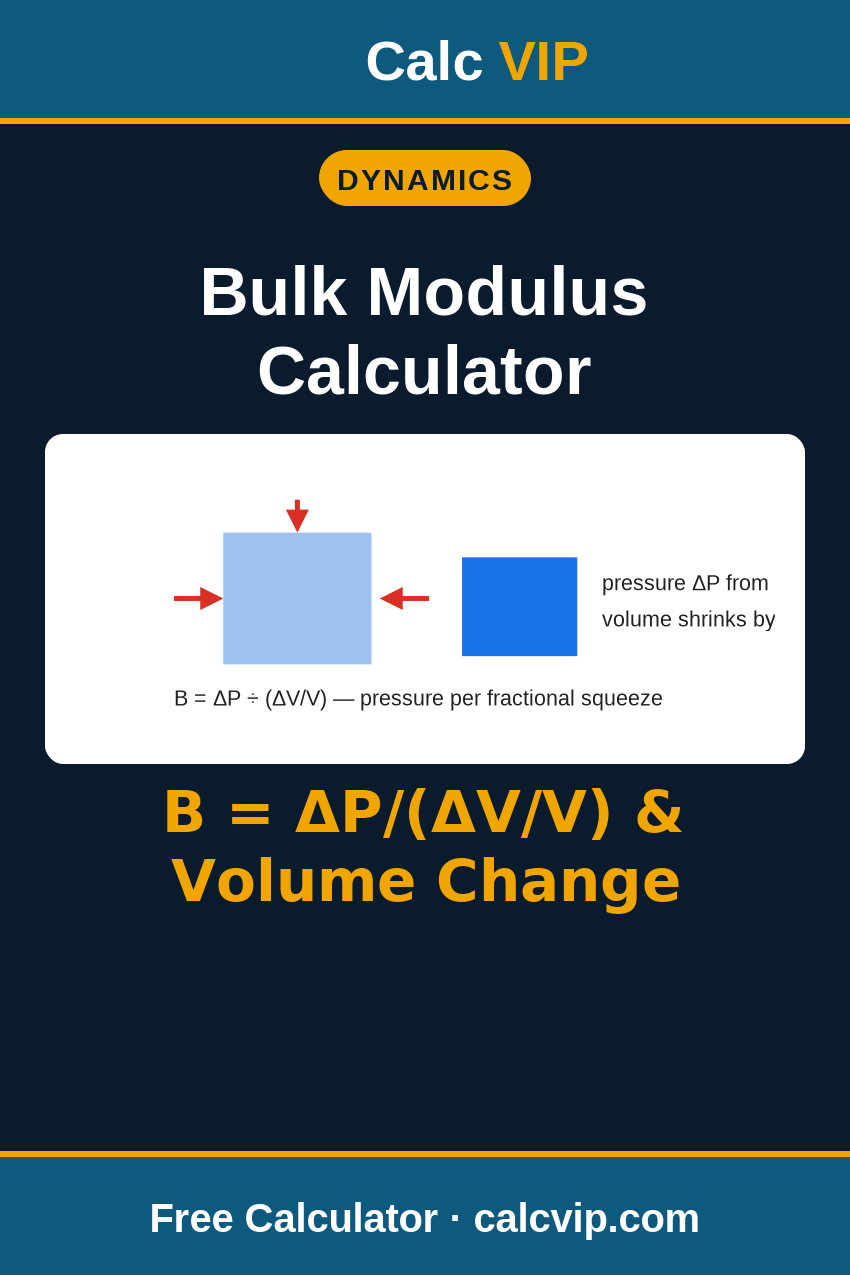
Squeeze a material from all sides at once and it shrinks — a little, if it is steel; a little more, if it is water; enormously, if it is air. The property that prices that shrinkage is the bulk modulus, B: the pressure you must apply, divided by the fractional change in volume it buys. It is Young's modulus's hydrostatic cousin — where E describes pulling a rod longer, B describes crushing a block smaller — and at 2.2 GPa for water, 160 GPa for steel and a mere 0.14 MPa for air at atmospheric pressure, it explains everything from why the deep ocean is denser than the surface to why hydraulic brakes feel solid and pneumatic ones feel spongy. This calculator works both directions: find B from a measured squeeze, or predict the volume change a known material will suffer under a given pressure.
The definition hides a pleasing asymmetry. Stretch a rod by 10 percent and you have done something dramatic; shrink a volume by 10 percent and, for any solid or liquid, you have applied pressures that wreck apparatus — water needs about 220 MPa (over two thousand atmospheres) to give up a tenth of its volume, and steel needs 16,000 MPa. Ordinary engineering lives in the parts-per-million corner of this property: the ocean's water at a kilometre down is compressed by less than half a percent, yet that "less" is enough to matter to submariners, oceanographers and the designers of deep-sea housings, whose walls answer to B at every metre of descent.
Its reciprocal has a name and a career of its own: compressibility, 1/B, the fractional shrinkage per unit pressure. Seismologists trade in B directly, because the speed of earthquake P-waves through rock is set by a combination of bulk and shear moduli; reservoir engineers live by the compressibility of oil and water, which decides how much fluid a pressurised formation will yield. One quantity, two dialects — this page reports both, so whichever your discipline speaks, the answer arrives translated.
Formula
The bulk modulus is pressure divided by the volumetric strain it produces:
B = ΔP ÷ (ΔV ÷ V) • rearranged: ΔV = V × ΔP ÷ B • compressibility = 1 ÷ B
B emerges in pascals and is usually quoted in GPa for solids and liquids. The strain ΔV/V is dimensionless — a pure fraction — which is why the same formula serves a thimble of oil and an ocean basin. Two honest approximations ride along: the formula treats B as constant over the pressure range (true within a few percent for liquids up to hundreds of MPa, less true for gases), and for gases B is not a material constant at all but tracks the pressure itself — isothermally B ≈ P, adiabatically B ≈ 1.4 × P — which is why air at one atmosphere shows the tiny 0.14 MPa of Example 5 while the same air at 300 atmospheres is three hundred times stiffer. The calculator's two modes mirror the two laboratory situations: characterising an unknown material from a measured squeeze, and designing with a known one.
| Symbol | Meaning | Units |
|---|---|---|
| B | bulk modulus — resistance to uniform compression | Pa (reported also in GPa) |
| ΔP | applied pressure increase | Pa |
| V, ΔV | original volume; volume decrease | cm³ (any consistent unit) |
| ΔV/V | volumetric strain — the fractional shrinkage | dimensionless |
| 1/B | compressibility | Pa⁻¹ |
B, E and the family of moduli
A material's elastic personality needs more than one number because it can be deformed in more than one way: stretched (Young's modulus E), twisted (shear modulus G), and squeezed uniformly (bulk modulus B). For an isotropic material the three are locked together through Poisson's ratio ν — B = E ÷ [3(1 − 2ν)] — so any two determine the third. The relation explains a classic surprise: rubber, with E of only ~0.05 GPa, has a bulk modulus near 2 GPa, like water's. Rubber is easy to distort (its shear modulus is tiny, so it changes shape freely) but nearly impossible to compress, because its molecules, like water's, resist being packed closer even while sliding past each other happily. A rubber ball squeezed in a vice bulges; it does not shrink. Distinguishing "soft to shape" from "soft to squeeze" is the entire content of having three moduli instead of one.
B also sets the speed of sound wherever a fluid carries it: v = √(B ÷ ρ). In water, √(2.2 × 10⁹ ÷ 1,000) ≈ 1,483 m/s — the measured speed of sound in water, from a modulus and a density. In rock, the P-wave speed uses B together with G, and seismologists invert earthquake arrival times into maps of B and G inside the Earth — effectively performing this page's measurement on the planet itself, with earthquakes as the pressure source. The bulk modulus is thus both a bench property and a planetary probe.
How to use
- Choose the mode: "Find bulk modulus" if you measured a squeeze, or "Find volume change" if you know the material's B and want to predict ΔV.
- Enter the pressure change ΔP in pascals (1 bar = 100,000 Pa; 1 MPa = 1,000,000 Pa; ocean pressure grows by roughly 1 MPa per 100 m of depth).
- For find-B mode, enter the original volume and the measured volume change (same units — cm³ here). For find-ΔV mode, enter B in pascals and the original volume.
- Click "Calculate" to see B in Pa and GPa with its compressibility, or the predicted ΔV and the fractional change.
- Sanity-check against the table: liquids live at 1–3 GPa, common solids at 30–200 GPa, gases near their own pressure. An answer far outside its family's range means a slipped unit, usually ΔP.
Worked examples
Example 1 — the reference squeeze. ΔP = 1 × 10⁸ Pa (1,000 bar), V = 500 cm³, ΔV = 2.5 cm³.
Fractional change = 2.5 ÷ 500 = 0.005. B = 1 × 10⁸ ÷ 0.005 = 2 × 10¹⁰ Pa = 20 GPa; compressibility 1/B = 5 × 10⁻¹¹ Pa⁻¹. Twenty GPa is a stiff liquid / soft solid figure — the territory of some polymers, ice and light alloys' softer cousins.
Example 2 — water a kilometre down. B = 2.2 × 10⁹ Pa; at 1,000 m the pressure has grown by ρgh ≈ 1 × 10⁷ Pa; V = 1,000 cm³.
ΔV = 1,000 × 1 × 10⁷ ÷ 2.2 × 10⁹ = 4.55 cm³ — a 0.455 percent shrinkage. Small, but it means deep seawater is measurably denser from compression alone, a term oceanographers may not omit: it affects buoyancy, sound speed and the depth readings of every instrument lowered into the trench.
Example 3 — a steel block under the same 1,000 bar. B = 1.6 × 10¹¹ Pa, ΔP = 1 × 10⁸ Pa, V = 100 cm³.
ΔV = 100 × 1 × 10⁸ ÷ 1.6 × 10¹¹ = 0.0625 cm³ — six hundredths of one percent of the volume (0.062%). Pressure vessels and hydraulic rams are designed in this regime: the steel yields almost nothing to pressure, which is exactly why it is trusted to contain it.
Example 4 — characterising an unknown solid. ΔP = 5 × 10⁷ Pa shrinks V = 200 cm³ by ΔV = 0.05 cm³.
Fractional change = 0.05 ÷ 200 = 2.5 × 10⁻⁴. B = 5 × 10⁷ ÷ 2.5 × 10−4 = 2 × 10¹¹ Pa = 200 GPa — up in the stiff metals' league, near steel's family and far above any polymer: the squeeze has testified about the material's bonds before any chemistry was done.
Example 5 — air, the compressible exception. B ≈ 1.013 × 10⁵ Pa (isothermal, at one atmosphere); ΔP = 1 × 10⁴ Pa (a tenth of an atmosphere); V = 1,000 cm³.
ΔV = 1,000 × 1 × 10⁴ ÷ 1.013 × 10⁵ = 98.72 cm³ — nearly ten percent, two hundred times water's fractional response to a pressure ten times larger. This single comparison is the felt difference between hydraulic and pneumatic machinery: one transmits force like a solid rod, the other like a spring.
Example 6 — the bottom of the ocean. At the Challenger Deep the pressure reaches ≈ 1.086 × 10⁸ Pa. For water (B = 2.2 × 10⁹ Pa), V = 1,000 cm³:
ΔV = 1,000 × 1.086 × 10⁸ ÷ 2.2 × 10⁹ = 49.36 cm³ — the water down there is squeezed 4.94 percent smaller, denser by the same fraction, before temperature and salinity have their say. A bathyscaphe's buoyancy calculations ignore that five percent at their peril.
Bulk modulus in real life
Hydraulics versus pneumatics. Brake pedals feel firm because brake fluid's B is ~2 GPa — the pedal's pressure reaches the calipers almost undiminished by fluid compression. Air systems, with B near the working pressure itself, store energy in compression — useful in air brakes' reservoirs, dangerous in a burst line.
Deep-sea engineering. Submersible housings, oil-filled cables and buoyancy foams are all specified against the ΔV arithmetic of Examples 2 and 6. Syntactic foam — glass microspheres in resin — is engineered to a target bulk modulus so a vehicle neither gains nor loses buoyancy catastrophically with depth.
Seismology. P-waves travel at √((B + 4G/3) ÷ ρ); their speeds through the Earth (up to ~13.7 km/s in the deep mantle) are inverted into the planet's internal B profile — the only "measurement" of bulk modulus ever performed at megabar pressures outside a diamond-anvil cell.
Oil and gas reservoirs. A reservoir's fluids yield partly by their own expansion as pressure falls: water's compressibility (~4.5 × 10⁻¹⁰ Pa⁻¹, the reciprocal of its B) and oil's larger one drive "fluid-expansion drive", a real production mechanism priced by this page's reciprocal.
Sound in fluids. Sonar ranges, ultrasound imaging and underwater acoustics all begin from v = √(B/ρ). Medical ultrasound's assumed 1,540 m/s in tissue is a bulk modulus wearing a stethoscope.
High-pressure science. Diamond-anvil cells squeeze samples to hundreds of GPa and read B from the shrinking lattice — the experiments that discovered how iron, ice and hydrogen behave at planetary-core conditions, and that keep finding new phases (ice VII, metallic hydrogen's precursors) in the squeeze.
When B itself changes: the honest limits
The formula treats B as a constant, and nature treats it as a first approximation. Squeeze water hard enough and its molecules pack into arrangements that resist further squeezing more strongly — B climbs measurably across hundreds of MPa, which is why precise oceanography uses a pressure-dependent equation of state (the international TEOS-10 standard) rather than one modulus. Solids do the same, and at megabar pressures the whole framework is replaced by equations of state fitted to shock-wave data. Phase changes break the model entirely: compress a material through a structural transition and the volume collapses discontinuously as the atoms rearrange — graphite's long squeeze towards diamond is the famous case. None of this diminishes the constant-B formula inside its jurisdiction — the everyday pressures of engineering and the upper ocean — but the jurisdiction has borders, and Examples 2 and 6 sit comfortably inside them while a diamond anvil does not.
Quick reference: bulk moduli of common materials
| Material | B (GPa) | Compressibility 1/B (Pa⁻¹) |
|---|---|---|
| air (1 atm, adiabatic) | 0.000142 | 7.05 × 10⁻⁶ |
| petrol / gasoline | ≈ 1.0 | 1.0 × 10⁻⁹ |
| water | 2.2 | 4.55 × 10⁻¹⁰ |
| rubber | ≈ 2 | ≈ 5 × 10⁻¹⁰ |
| glass | ≈ 35–55 | ≈ 2 × 10⁻¹¹ |
| aluminium | ≈ 76 | 1.32 × 10⁻¹¹ |
| steel | ≈ 160 | 6.25 × 10⁻¹² |
| diamond | ≈ 443 | 2.26 × 10⁻¹² |
The air row and the diamond row differ by a factor of three million — the widest spread of any property on this site — and both are the same quantity, measured the same way, by the formula on this page.
Common mistakes
- Using a pressure difference in bar or MPa as if it were pascals. B comes out in whatever pressure unit ΔP carried in. A ΔP of "100" meaning 100 bar, entered as 100 Pa, shrinks B by a factor of 100,000 — the commonest wreck in this calculation.
- Entering ΔV as a percentage. The formula wants the actual volume change in the same unit as V (or, equivalently, the fraction — but not the percent). A 0.5 percent shrinkage is ΔV/V = 0.005, not 0.5.
- Confusing bulk modulus with Young's modulus. Same material, different number, different experiment: steel's E ≈ 200 GPa is not its B ≈ 160 GPa. A pressure problem fed an E value is wrong by a quarter before it begins.
- Treating a gas's B as constant. For gases B tracks the pressure (isothermal B ≈ P, adiabatic B ≈ 1.4P). The find-ΔV mode with a fixed B is a small-excursion approximation for gases — fine for a tenth of an atmosphere, fiction for ten.
- Forgetting temperature. Liquids expand thermally while pressure squeezes them; a measurement that lets the sample warm during compression reads a ΔV polluted by expansion. Precision work thermostats the cell for exactly this reason.
FAQ
How is bulk modulus different from Young's modulus?
Young's modulus measures resistance to being stretched in one direction; bulk modulus measures resistance to being squeezed equally from all sides (hydrostatic pressure). A material needs both numbers (or B plus Poisson's ratio) to describe its elasticity fully.
Why is B so large for liquids and solids but tiny for gases?
The molecules in liquids and solids are already nearly touching, so squeezing them further meets strong repulsion — gigapascals of B. A gas at atmospheric pressure has B ≈ 1.4 × 10⁵ Pa (adiabatic), roughly 10,000 times smaller, which is why gases are so compressible.
What is compressibility?
Compressibility κ = 1/B, in Pa⁻¹. It appears in oceanography and geology: seawater's small compressibility (κ ≈ 4.5 × 10⁻¹⁰ Pa⁻¹) still matters, because the deep ocean's pressure shrinks water by a few percent.
Is water really compressible?
Yes — by about 0.0046 percent per atmosphere. Its compressibility is 4.55 × 10⁻¹⁰ Pa⁻¹, so each atmosphere (1.013 × 10⁵ Pa) shrinks it by a fraction of 4.6 × 10⁻⁵. Negligible in a kettle; decisive in an ocean, where a thousand atmospheres of depth accumulate it into the 4.94 percent of Example 6.
Why do hydraulic systems use oil instead of water?
Partly for lubrication and corrosion, but the physics qualifies both: oil's bulk modulus (~1.5 GPa) is the same order as water's (2.2 GPa), so oil transmits force almost as stiffly while protecting the machinery water would rust. Early hydraulics did use water — and very high-pressure water systems still do.
Can a material have a negative bulk modulus?
Not in stable equilibrium — a negative B would mean squeezing makes it expand, which makes it squeeze itself further: a runaway, not a material. Engineered metamaterials can show effectively negative compressibility over narrow ranges by internal geometry, one of the stranger frontiers of materials science, but no ordinary substance qualifies.
How is B measured in practice?
For liquids, by precision piston cells or from the speed of sound (v = √(B/ρ) inverted — the modern route, accurate to parts per million). For solids, by ultrasonic pulse timing, static compression in instrumented presses, or X-ray diffraction of the lattice under diamond-anvil pressure.
What happens to B at a phase change?
It misbehaves instructively: the volume jumps discontinuously at the transition pressure, so the effective compressibility spikes enormously at the boundary. Ice melting under pressure and graphite collapsing towards diamond both show the signature — the modulus is a property of a phase, not just of a chemistry.
Why does the deep ocean not compress itself into a solid?
Because 5 percent is all the squeeze 1,000 atmospheres buys, and water's phase diagram keeps it liquid far beyond that — pressure ice (ice VI, VII) needs over 600 MPa at room temperature, six times the Challenger Deep's pressure, and the cold deep ocean's path through the diagram stays liquid all the way down.
How does B relate to Poisson's ratio?
Through B = E ÷ [3(1 − 2ν)]. As ν approaches 0.5 (rubber, water-like incompressibility), the denominator approaches zero and B soars — the algebra's way of saying that a material which refuses to change volume at any cost has an enormous bulk modulus whatever its other softness.