 Calc
Roche Limit Calculator – How Close Can a Moon Orbit Before Breaking Up?
 Created by Yuki Tanaka · Physics Editor · Modern Physics · Last updated: November 2026
Use this free Roche Limit Calculator to find how close a moon can orbit its planet before the planet's tidal forces tear it apart. Inside the Roche limit, moons shatter into rings — this is why Saturn has its famous ring system.
The Roche limit is named for Édouard Roche, the French astronomer who in 1848 worked out why a moon cannot simply orbit as close as it pleases. The mechanism is the tide. A planet's gravity pulls harder on the near side of an orbiting moon than on its far side, and that difference — the tidal force — stretches the moon along the planet–moon line, trying to pull it apart. The moon's own gravity resists, holding it together. Far away, self-gravity wins easily. Close in, the tide grows (it strengthens as the cube of the distance shrinks) while the moon's cohesion stays fixed, and at one specific distance the two balance. Inside it, a moon held together only by gravity comes apart. That distance is the Roche limit.
Look at the formula's structure and the physics shows through. The limit depends on the planet's radius and on the cube root of the density ratio, (ρM/ρm)1/3 — densities, not masses, because what matters is how strongly each body grips itself versus how strongly it is stretched, and both scale with density. The cube root makes the limit forgiving: even a moon eight times less dense than its planet only doubles the Roche distance. And the whole expression is anchored to the planet's radius R, so Roche limits are naturally quoted in planet radii — Saturn's fluid limit for ice is about 2.15 R, Earth's for the Moon about 2.88 R — letting you compare systems of wildly different sizes at a glance.
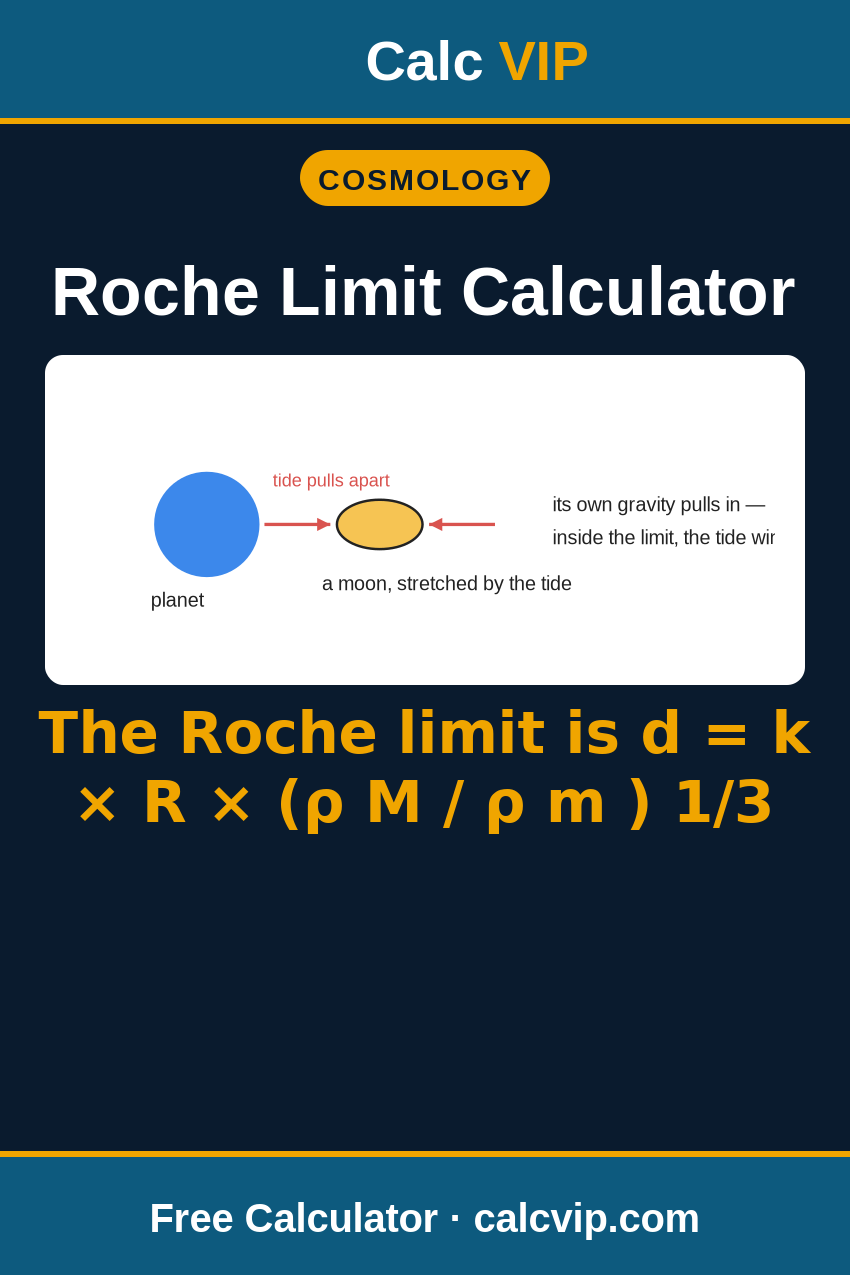
The two constants bracket the real behaviour of real moons. A perfectly fluid body — a rubble pile, a slushy iceball, anything that flows to equilibrium — disrupts at k = 2.44. A perfectly rigid body, held by material strength as well as gravity, survives to k = 1.26. Actual moons live between the lines: small ones are strength-dominated and can venture inside even the rigid limit (spacecraft and tiny moonlets do it routinely), while large icy and rubble bodies behave nearly as fluids. This calculator reports both limits, because the honest answer to "how close can it orbit?" is a band, not a line.
Formula
The Roche limit is d = k × R × (ρM / ρm)1/3, where R is the planet's radius and the densities are the planet's (ρM) and the moon's (ρm). The constant is k = 2.44 for a fluid (deformable, rubble-like) body and k = 1.26 for a rigid (solid) body. This calculator shows both. An equivalent form replaces the densities with masses and radii, d = R × (2M/m)1/3-style expressions for the rigid case, but the density form is the insightful one: it shows the limit cares about what the two bodies are made of, and only about the planet's size — never, directly, about the moon's size at all. A pebble and a planet-sized moon of the same density share the same Roche limit around the same planet.
| Symbol | Meaning | Units |
|---|---|---|
| d | Roche limit — distance from the planet's centre | km (also in planet radii) |
| R | planet's radius | km |
| ρM | planet's mean density | kg/m³ |
| ρm | moon's (satellite's) mean density | kg/m³ |
| k | 2.44 (fluid body) or 1.26 (rigid body) | dimensionless |
Rings: the fossils of moons that crossed the line
The most beautiful consequence of the Roche limit is written across Saturn. A ring system is what a moon becomes: material inside the limit cannot gather itself into a single body, because every incipient clump is sheared apart by the tide, so it remains a swarm of independent particles orbiting in a flat disc. Saturn's main rings span from about 1.28 to 2.35 Saturn radii — matching the fluid Roche limit for porous ice (about 2.3 R for particles near 800 kg/m³, 2.15 R for solid ice at 1,000 kg/m³). Whether the rings are the remains of a shredded icy moon or of a comet that wandered too close, their location is no coincidence; it is this calculator's output, drawn in ice. The other giant planets wear fainter rings inside their own limits, and the logic is universal: rings live inside Roche limits, moons live outside them.
The boundary is not a wall but a negotiation, and nature exploits the loopholes. Ring particles constantly collide and briefly stick, forming transient aggregates that the tide pulls apart again. Small solid moonlets — Saturn's Pan and Atlas, a few tens of kilometres across — orbit inside the fluid limit, held together by material strength their size makes sufficient: for a small body, chemical bonds beat gravity, and the "rigid" picture understates their toughness. At the other extreme, the comet Shoemaker–Levy 9, a loose rubble pile, passed within Jupiter's fluid limit in 1992 and was drawn out into the famous "string of pearls" — 21 fragments that, two years later, fired into Jupiter in the most watched impacts in history. The Roche limit predicted the breakup; telescopes watched it happen.
How to use
- Enter the planet's radius in kilometres.
- Enter both densities in kg/m³ (Earth 5,514; the Moon 3,344; Saturn 687; an icy moon ≈ 1,000).
- Click "Calculate Roche Limit" to get both the fluid and rigid limits, in km and in planet radii.
- Compare any real moon's orbital distance — measured from the planet's centre, not its surface — against the band between the two limits to judge how much margin the moon has, or how doomed it is.
Worked examples
Example 1 — Earth and the Moon. For Earth (R = 6,371 km, ρM = 5,514 kg/m³) and the Moon (ρm = 3,344 kg/m³):
(ρM/ρm)1/3 = (1.649)1/3 ≈ 1.1814
Fluid limit = 2.44 × 6,371 × 1.1814 ≈ 18,365.28 km (2.88 Earth radii)
Rigid limit = 1.26 × 6,371 × 1.1814 ≈ 9,483.71 km (1.49 Earth radii)
The real Moon orbits at 384,400 km — far outside both limits, so it is perfectly safe.
Example 2 — Saturn and an icy moon. Saturn: R = 58,232 km, ρM = 687 kg/m³; an icy body, ρm = 1,000 kg/m³.
(687/1,000)1/3 = 0.8824, so the fluid limit = 2.44 × 58,232 × 0.8824 ≈ 125,373 km = 2.15 Saturn radii, and the rigid limit ≈ 64,742 km = 1.11 R. Saturn's bright rings end near 136,775 km = 2.35 R — essentially at the fluid limit for porous ice of about 800 kg/m³ (≈ 135,000 km by this formula), exactly where ring theory says the transition from swarm to moonlets should occur.
Example 3 — Jupiter and Amalthea. Jupiter: R = 69,911 km, ρM = 1,326; Amalthea, ρm ≈ 857 kg/m³.
(1,326/857)1/3 = 1.1566, so the fluid limit ≈ 2.44 × 69,911 × 1.1566 ≈ 197,298 km = 2.82 Jupiter radii. Amalthea actually orbits at 181,400 km = 2.59 R — inside the fluid limit. It survives because at 83 km across it is a strength-held rubble pile, not a fluid: a living demonstration that the fluid line binds only bodies gravity alone holds together.
Example 4 — the comet that died at Jupiter. Model Shoemaker–Levy 9 as rubble of ρm ≈ 600 kg/m³ approaching Jupiter (ρM = 1,326).
(1,326/600)1/3 = 1.3026, so the fluid limit ≈ 222,194 km = 3.18 Jupiter radii. In July 1992 the comet passed about 1.6 R from Jupiter's centre — deep inside that limit — and emerged as a chain of 21 fragments. The calculator, given a comet's fluffiness, predicts its fate.
Example 5 — a rubble asteroid visiting Earth. Earth (5,514) and a porous asteroid (ρm = 2,000):
(5,514/2,000)1/3 = 1.4022, so the fluid limit ≈ 21,798 km = 3.42 Earth radii and the rigid limit ≈ 11,256 km = 1.77 R. Geostationary satellites orbit at 6.6 R, comfortably clear — but a loosely bound asteroid on a very close flyby inside ~22,000 km of Earth's centre could be tidally kneaded or disrupted, as happened to comet Shoemaker–Levy 9 at Jupiter.
Example 6 — Neptune and the doomed Triton. Neptune: R = 24,622 km, ρM = 1,638; Triton, ρm = 2,061.
(1,638/2,061)1/3 = 0.9263, so the fluid limit ≈ 55,649 km = 2.26 Neptune radii. Triton, orbiting retrograde, is slowly spiralling inward; in roughly 3.6 billion years it will cross this limit and shred into a ring system that will briefly make Neptune outshine Saturn.
Roche limits in real life
Explaining every ring system. Saturn, Jupiter, Uranus and Neptune all wear rings inside their Roche limits for their respective particle densities — the single fact that organises ring astronomy, and the first check applied to any newly discovered ring, including those around asteroids like Chariklo.
Phobos's appointment with destruction. Mars's moon Phobos orbits at 2.77 Mars radii — already inside the fluid limit for its density (about 3.12 R by this calculator) — and spirals closer by tidal drag. In 30–50 million years it will cross into genuine disruption and become a ring around Mars; its grooved surface may already record the strain.
Predicting comet breakups. Sungrazing and planet-grazing comets are rubble piles on suicide trajectories; comparing their perijove distance with the fluid limit forecasts fragmentation, as with Shoemaker–Levy 9 and the Kreutz sungrazers at the Sun.
Placing artificial satellites safely — or deliberately not. Spacecraft routinely orbit inside Roche limits because bolts and welds beat gravity at small scales; but planners of graveyard orbits and debris models use the limit to judge whether a dead satellite or a proposed megastructure held by gravity alone would survive.
Reading exoplanet systems. The innermost rocky exoplanets skirt their stars' Roche limits; a planet detected inside the fluid limit for its density must be dense, strong, or disintegrating — and at least one known planet (a disintegrating world with a comet-like dust tail) appears to be doing exactly that.
Forming moons in the first place. Earth's Moon accreted from a debris disc after the giant impact — but only the material outside the Roche limit could clump into a single moon; the material inside stayed a ring and eventually rained back or spiralled out. The limit is thus part of our own Moon's birth certificate.
The tide itself: why the cube root and the 1/d³
Underneath the Roche formula sits the tidal acceleration, which falls as 1/d³ — faster than gravity's 1/d² — because it is a difference of gravity across the moon's body. Differentiate GM/d² and the difference across a moon of radius r comes out proportional to GMr/d³. The moon's self-gravity, meanwhile, is proportional to Gρmr — it depends on the moon's density and size. Setting tide equal to self-gravity, the moon's radius r cancels (hence the limit's indifference to moon size), the planet's mass trades for its density and radius through M ∝ ρMR³, and what survives is d ∝ R(ρM/ρm)1/3 — the calculator's formula, with the constant k absorbing the geometry: 1.26 from the simple rigid balance, 2.44 from Roche's full treatment of a self-gravitating fluid that deforms as it disrupts. The same 1/d³ tide raises Earth's oceans, locks the Moon's rotation, heats Io into volcanoes and drives Triton towards its appointment in Example 6.
Beyond moons: Roche lobes and mass transfer
The Roche name attaches to a second, related idea in close binary stars. Each star in a tight pair has a teardrop-shaped region — its Roche lobe — within which its gravity dominates its own material. A star that expands to fill its lobe begins pouring gas onto its companion through the lobe's tip, and that mass transfer powers some of the sky's most violent phenomena: novae, Type Ia supernovae (a white dwarf fed to the Chandrasekhar limit by its companion's overflow), and X-ray binaries where the stream falls onto a neutron star or black hole. The planet–moon limit on this page and the binary-star lobes are cousins — both mark where one body's gravity stops being sovereign over its own substance — and between them they explain a remarkable fraction of everything in astronomy that breaks, spills or explodes.
Quick reference: Roche limits for real systems
| System | Fluid limit | Rigid limit | Actual orbit |
|---|---|---|---|
| Earth – Moon | 18,365 km (2.88 R) | 9,484 km (1.49 R) | 384,400 km |
| Saturn – icy body | 125,373 km (2.15 R) | 64,742 km (1.11 R) | rings end ≈ 136,775 km |
| Jupiter – Amalthea | 197,298 km (2.82 R) | 101,883 km (1.46 R) | 181,400 km (inside fluid!) |
| Mars – Phobos | 10,587 km (3.12 R) | 5,467 km (1.61 R) | 9,376 km (inside fluid!) |
| Neptune – Triton | 55,649 km (2.26 R) | 28,737 km (1.17 R) | 354,759 km (falling) |
| Sun – comet (ρ 600) | 2,255,774 km (3.24 R) | 1,164,867 km (1.67 R) | sungrazers cross it |
Two rows of the table carry the lesson: Amalthea and Phobos both orbit inside their fluid limits yet persist, because strength, not gravity, holds small bodies together. The fluid limit is a statement about rubble and fluids — apply it to a solid moonlet and you will predict a death that never comes.
Common mistakes
- Using the wrong constant for the body type. Quoting the rigid 1.26 limit for a rubble comet understates its danger zone by nearly a factor of two; quoting 2.44 for a small solid moon predicts a breakup that cannot happen. Match k to the body's nature — fluid/rubble 2.44, solid/rigid 1.26.
- Measuring the orbit from the surface. Roche limits are distances from the planet's centre. A moon "10,000 km up" above Earth is 16,371 km from the centre — compare centre-to-centre on both sides or the verdict flips.
- Swapping the densities. The planet's density goes on top. Inverting the ratio shrinks the limit instead of growing it; a denser planet has the larger Roche limit, because its tide is fiercer.
- Expecting the moon's size to matter. In the gravity-only theory it cancels. A mountain-sized and a continent-sized body of the same density share a limit; only when material strength enters (small bodies) does size begin to protect.
- Treating the limit as instant destruction. Crossing the fluid limit starts a process — deformation, shedding, breakup over one to several orbits — not an explosion at a line. Shoemaker–Levy 9 took a full passage to become a pearl-string.
FAQ
Why are Saturn's rings inside the Roche limit?
Exactly because of this effect: icy material that drifted (or was torn) inside Saturn's Roche limit could never clump together into a moon, so it remains a ring of separate particles.
Which limit should I use, fluid or rigid?
Real moons are somewhere in between. Small solid moons behave almost rigidly; large icy or rubble-pile bodies behave more like fluids. The fluid value (2.44) is the one most often quoted.
Is Earth's Moon in any danger?
No — the Moon is actually receding from Earth by about 3.8 cm per year, moving away from the Roche limit, not towards it.
What is the Roche limit for the Sun and a comet?
For a fluffy comet of density 600 kg/m³ against the Sun's 1,408: (1,408/600)1/3 = 1.329, giving a fluid limit of about 2,255,774 km ≈ 3.24 solar radii from the Sun's centre. Sungrazing comets that pass inside it are routinely observed to fragment and evaporate.
Could Earth's Moon ever have been inside the limit?
Yes — it formed there. After the giant impact, debris inside about 2.9 Earth radii stayed a ring; the Moon assembled just outside the limit from the rest and has been spiralling outward ever since, which is why it is now twenty times farther than its birthplace.
Do artificial satellites violate the Roche limit?
Constantly and safely. The limit governs bodies held together by gravity alone; a bolted, welded spacecraft is held by chemical bonds many orders of magnitude stronger. The ISS orbits at 1.06 Earth radii — deep inside even the rigid limit — without noticing.
What happens to the debris after a breakup?
It spreads along the orbit into a ring, sorted by collisions into a flat, thin disc. Given time and a location outside the limit, ring material can re-accrete into a new moon — Saturn's smaller moons may be exactly such second-generation bodies.
Is there a Roche limit for black holes?
Yes — stars wandering within a black hole's tidal disruption radius are shredded into accretion streams, producing bright flares astronomers now observe routinely in distant galaxies. The physics is Roche's, with relativistic corrections near the event horizon.
Why is the fluid constant so much larger than the rigid one?
A fluid body deforms into an elongated ellipsoid aligned with the planet, and the elongation itself increases the tidal lever arm — a runaway that lets disruption begin much farther out. Roche's 2.44 comes from solving that self-consistent deformation; 1.26 assumes the body keeps its shape.
How close is Phobos to destruction, in time?
Phobos loses altitude steadily and will reach the genuine disruption zone in roughly 30–50 million years. Mars will then gain a ring, which will itself decay over the following tens of millions of years — a temporary Saturn impression, long after any observers on Mars have gone.