 Calc
Displacement Calculator – SUVAT Equations of Motion Solver
 Created by Sarah Mitchell · Physics Editor · Motion & Measurement · Last updated: November 2026
Use this free Displacement Calculator (equations of motion / SUVAT) to find how far an accelerating object travels. Enter the initial velocity, acceleration and time, and get the displacement plus the final velocity.
Some motion is simple: an object glides along at a steady velocity, and the distance it covers is just velocity × time. But much of the interesting motion in life involves speeding up or slowing down — a car pulling away, a ball falling, a train braking into a station. For that kind of motion, with acceleration that stays constant, physicists use a small family of equations called the SUVAT equations, named after the five quantities they connect.
The five quantities are s (displacement), u (initial velocity), v (final velocity), a (acceleration) and t (time). Every SUVAT equation links four of the five, so if you know any three values you can always find a fourth. This calculator uses the most direct pair: given u, a and t, it finds the displacement s and the final velocity v.
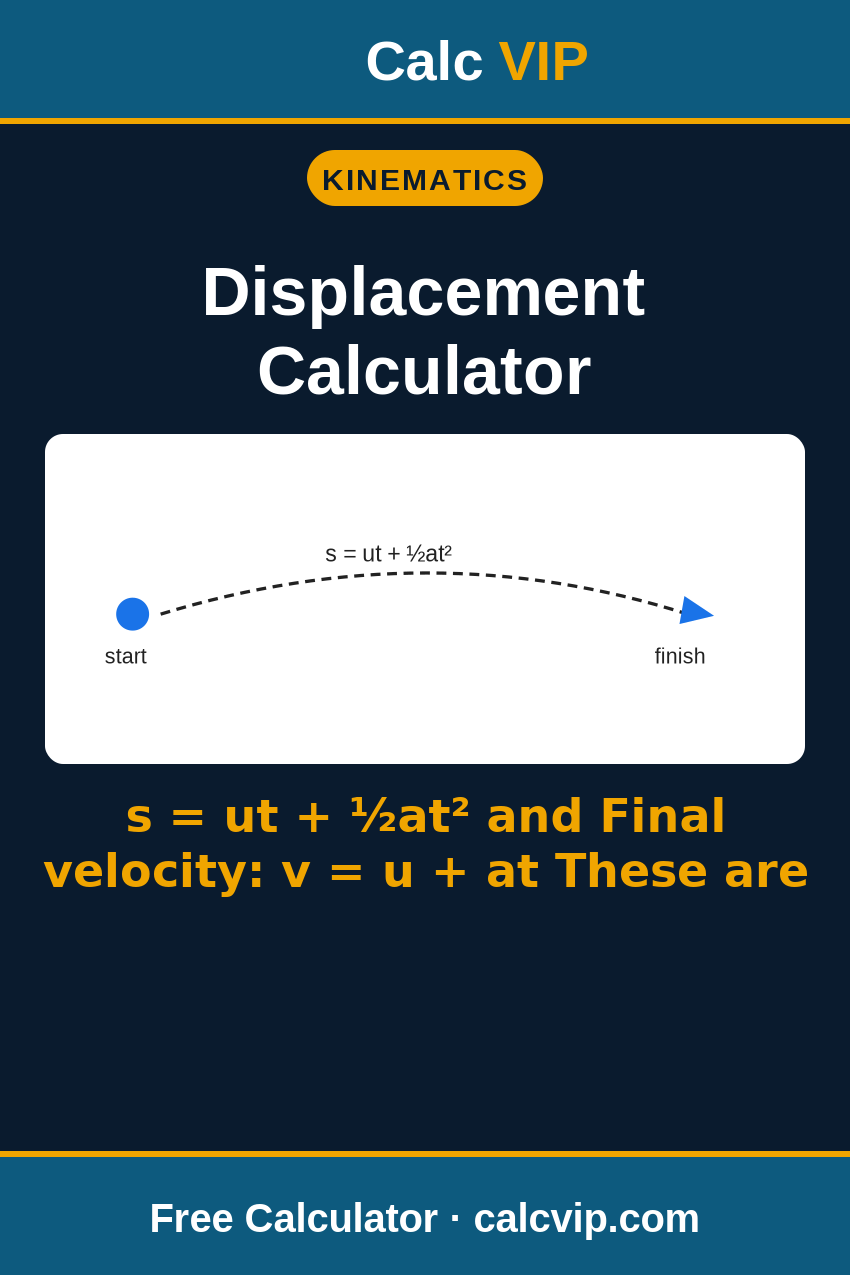
One word deserves care: displacement is not quite the same as distance. Displacement is the straight-line change of position, measured from the start, and it carries a direction — it can even be negative if the object ends up behind where it began. A runner who completes a full lap of a track has run 400 metres of distance but has a displacement of zero. For motion in a straight line without turning back, the two numbers coincide, which is the situation in most problems this calculator is used for.
Formula
Displacement: s = ut + ½at² and Final velocity: v = u + at
These are two of the SUVAT equations of motion, valid when acceleration is constant.
The displacement formula is really two distances added together. The first term, ut, is the distance the object would cover if it simply kept its initial velocity for the whole time. The second term, ½at², is the extra distance gained because it sped up (or lost, if a is negative, because it slowed down). A car starting at 5 m/s and accelerating gently gains a little extra; a dropped stone, starting at u = 0, has only the second term, which is why its distance is ½gt².
The full SUVAT family has five equations, each leaving out a different quantity: v = u + at (no s), s = ut + ½at² (no v), s = vt − ½at² (no u), v² = u² + 2as (no t) and s = ½(u + v)t (no a). Choosing the equation that leaves out the quantity you neither know nor want is the standard exam technique.
| Symbol | Meaning | Units |
|---|---|---|
| s | displacement — change of position | metres (m) |
| u | initial velocity | m/s |
| v | final velocity | m/s |
| a | acceleration (constant) | m/s² |
| t | time | seconds (s) |
Displacement as the area under a graph
There is a picture behind the algebra. On a velocity–time graph, the displacement is the area under the line. For the trolley in Example 1 (u = 5 m/s, a = 2 m/s², t = 3 s) the line climbs from 5 to 11 m/s. The area splits into a rectangle, 5 × 3 = 15 m (the ut term), and a triangle on top, ½ × 3 × 6 = 9 m (the ½at² term). Total: 24 m — the same answer the formula gives, seen geometrically.
How to use
- Enter the initial velocity u (use 0 for a start from rest).
- Enter the constant acceleration a and the time t.
- Click "Calculate Displacement" to see the distance travelled (s) and the final velocity (v).
- For braking, enter the acceleration as a negative number — for example a = −5 for a car slowing at 5 m/s².
Worked examples
Example 1 — the trolley. A trolley starts at u = 5 m/s, accelerates at a = 2 m/s² for t = 3 s. s = (5 × 3) + (½ × 2 × 3²) = 15 + 9 = 24 m, and v = 5 + (2 × 3) = 11 m/s.
Example 2 — a car leaving the lights. A car starts from rest (u = 0) and accelerates at 3 m/s² for 6 seconds. s = 0 + (½ × 3 × 6²) = ½ × 3 × 36 = 54 m, and v = 0 + (3 × 6) = 18 m/s — about 65 km/h, reached after covering barely more than the length of a football pitch's penalty area to halfway line.
Example 3 — braking to a stop. A car travelling at 25 m/s brakes with a steady deceleration of 5 m/s² (enter a = −5). It stops when v = 0, at t = 25 ÷ 5 = 5 s. The displacement is s = (25 × 5) − (½ × 5 × 5²) = 125 − 62.5 = 62.5 m. Check with v² = u² + 2as: 0 = 625 − 10s gives s = 62.5 m — the same stopping distance from a different equation.
Example 4 — a cyclist building speed. A cyclist already moving at 8 m/s accelerates at 1.5 m/s² for 4 s. s = (8 × 4) + (½ × 1.5 × 4²) = 32 + 12 = 44 m, and v = 8 + (1.5 × 4) = 14 m/s. Three-quarters of the distance came from the speed already owned; the acceleration contributed the rest — the ut term quietly dominating, as it usually does once things are moving.
Example 5 — a train pulling away. A train starts at 20 m/s, accelerates at 0.5 m/s² for 40 s. s = (20 × 40) + (½ × 0.5 × 40²) = 800 + 400 = 1200 m, and v = 20 + (0.5 × 40) = 40 m/s. Half the distance came from the speed it already had; the other half was bought by the acceleration — the two terms of the formula, visible separately.
Example 6 — a ball thrown straight up. A ball leaves the hand at 15 m/s with a = −9.81 m/s². After 1.5 s: s = (15 × 1.5) − (½ × 9.81 × 1.5²) = 22.5 − 11.04 = 11.46 m, and v = 15 − (9.81 × 1.5) = 0.29 m/s — the ball is a hand's breadth from its peak, essentially hovering, exactly as the small velocity says.
Displacement in real life
Stopping distances. Example 3 hides an alarming pattern. Because v² = u² + 2as, the braking distance grows with the square of the speed: at a deceleration of 5 m/s², stopping from 10 m/s takes 10 m, from 20 m/s takes 40 m, and from 30 m/s takes 90 m. Double the speed, quadruple the braking distance — and that is before adding the distance travelled during the driver's reaction time, which the same calculator covers: at 30 m/s, a 0.7 s reaction adds another 21 m before braking even begins.
Take-off rolls. A light aircraft that must reach 80 m/s to lift off, accelerating at a steady 2.5 m/s², needs t = 80 ÷ 2.5 = 32 s of runway time and a displacement of s = ½ × 2.5 × 32² = 1280 m. That is why runway length is a hard limit on which aircraft can use which airport.
Falling. Free fall is just this calculator with u = 0 and a = g = 9.81 m/s², giving s = ½gt². The displacement calculator and the free-fall calculator are the same physics wearing different clothes — SUVAT is the general tool, free fall its most famous special case.
Carrier catapults. A carrier catapult takes a jet from rest to about 75 m/s in 2 seconds. The acceleration is a = 75 ÷ 2 = 37.5 m/s², and the deck run is s = ½ × 37.5 × 2² = 75 m — the whole launch fitted into less than a football pitch, which is precisely why the catapult exists: no runway on Earth is shorter than the distance this equation demands.
The lift's first three seconds. A lift accelerating gently at 1 m/s² for its first 3 s covers s = ½ × 1 × 3² = 4.5 m and reaches 3 m/s before settling into its cruise. Building designers choreograph exactly this opening — too sharp and passengers' stomachs object; too slow and the tower's traffic jams.
The other equations earning their keep
Each SUVAT equation exists because some quantity is missing. Suppose a car's speed rises from u = 10 m/s to v = 20 m/s with acceleration a = 2 m/s², but nobody timed it. The no-time equation, v² = u² + 2as, answers directly: s = (v² − u²) ÷ 2a = (400 − 100) ÷ 4 = 75 m. Or suppose the time is known but the acceleration is not: a trolley with u = 5 m/s and v = 11 m/s after t = 3 s has s = ½(u + v)t = ½ × 16 × 3 = 24 m — the same trolley as Example 1, solved without ever mentioning its acceleration. Choosing the equation that omits your unknown is not a trick; it is the entire method.
Signs and directions
SUVAT quantities are vectors in disguise, and the equations only balance if you pick a positive direction and stick to it. Take "forwards" as positive: a braking car has positive u and negative a, as in Example 3. A ball thrown straight up at 12 m/s has u = +12 and a = −9.81; at t = 1 s the equations give v = 12 − 9.81 = 2.19 m/s (still rising, slowly) and s = 12 − 4.9 = 7.1 m above the hand. At t ≈ 2.45 s the ball is back at the hand with s = 0 and v = −12 m/s — same speed, opposite sign, direction reversed. Every sign in the answer is a direction statement, which is why displacement, unlike distance, is allowed to come out negative.
Where SUVAT comes from
The five equations are not five separate facts — they are one fact viewed five ways. The single underlying statement is that acceleration is the rate of change of velocity, applied steadily: v = u + at says the velocity grows by a every second. Everything else follows by counting the area under that growing velocity, which is where the ½ in ½at² comes from — the area of a triangle is half its base times its height. Students who meet calculus later discover that SUVAT is simply integration for the special case of constant acceleration, worked out two centuries before they were born. That is also the boundary of the method: the moment acceleration stops being constant, the tidy equations give way to calculus, and motion must be built up instant by instant instead.
When acceleration refuses to sit still
SUVAT's one demand — constant acceleration — fails more often than textbooks admit. A car's acceleration fades as it approaches top speed; a falling object's acceleration is eaten by air resistance; a rocket's grows as its tanks empty. The honest generalisation of s = ut + ½at² is graphical: displacement is the area under the velocity–time graph, whatever its shape, and velocity is the area under the acceleration–time graph. For constant acceleration those areas are a rectangle plus a triangle — which is literally the two terms ut and ½at² wearing graph clothes.
Engineers facing varying acceleration slice the motion into thin time steps, treat the acceleration as constant inside each slice, and add the slices up — SUVAT applied a thousand times a second. That is how flight simulators and crash-test software integrate motion, and it is the seed of the calculus Newton invented for exactly this problem. The five equations are not wrong outside their comfort zone; they are the first slice of the general method.
Quick reference: displacements worth remembering
These anchors let you smell-check any SUVAT answer. If a calculated stopping distance comes out shorter than a car length from motorway speed, or a take-off roll longer than the runway, the arithmetic — not the physics — is the first suspect.
| Motion | Displacement |
|---|---|
| stone dropped for 3 s (u = 0, a = g) | 44.1 m |
| car braking from 25 m/s at 5 m/s² (Ex. 3) | 62.5 m |
| dragster, a = 8 m/s² for 5 s | 100 m |
| train accelerating for 40 s (Ex. 5) | 1200 m |
| airliner take-off roll (typical) | ≈ 1280 m and up |
The fifth equation: displacement from average velocity
There is a quieter member of the SUVAT family worth meeting on its own: s = ½(u + v) × t. It says the displacement is the average of the starting and finishing velocities, multiplied by the time — true whenever acceleration is constant, because the velocity then grows in a straight line and its average is the midpoint. Check it against Example 1: ½ × (5 + 11) × 3 = ½ × 16 × 3 = 24 m, the same displacement the two-term formula produced, from a single multiplication.
This form is the fastest sanity check in kinematics. If a problem gives you u, v and t, it answers in one step; if it gives you a displacement that disagrees with ½(u + v)t, one of the other equations has been fed a wrong sign or a wrong time. Professional problem-solvers keep it in reserve precisely because it shares no algebra with the others — an independent witness, arriving at the same scene by a different road.
Common mistakes
- Using SUVAT when acceleration varies. These equations demand constant acceleration. A car whose driver presses the pedal harder and harder is not a SUVAT problem — the equations would only approximate its motion.
- Sign errors when braking. If u is positive, braking means a is negative. Entering a = +5 for a braking car makes it speed up in the calculation and can even give a "stopping distance" for a car that never stops.
- Confusing displacement with distance. If an object moves forwards then backwards, SUVAT gives the net displacement from the start, not the total path length. Both are useful, but they are different answers to different questions.
- Forgetting that u = 0 simplifies everything. From rest, s = ½at² and v = at. Many textbook problems are set from rest precisely so the first term vanishes.
- Reading t² as 2t. In ½at² the time is squared: for t = 5 s and a = 2 m/s² the term is ½ × 2 × 25 = 25 m, not ½ × 2 × 10 = 10 m. Squaring is where the large displacements of long motions come from.
FAQ
What does SUVAT mean?
SUVAT stands for the five motion variables: s (displacement), u (initial velocity), v (final velocity), a (acceleration) and t (time).
When can I use these equations?
Only when the acceleration stays constant during the motion, which is true for most textbook problems and for free fall near Earth.
Is displacement the same as distance?
Displacement is the straight-line change in position and can be negative if the object moves backwards. Distance is always positive.
How do I choose which SUVAT equation to use?
Pick the equation containing the three values you know and the one you want — each equation omits a different variable. This calculator uses s = ut + ½at² because it needs only u, a and t.
Can displacement be negative?
Yes. If an object moves in the direction chosen as negative — or brakes, reverses and ends up behind its start — its displacement is negative. The sign is information about direction, not an error.
Does the mass of the object matter?
No. None of the SUVAT equations contain mass. Mass decides how much force is needed to produce the acceleration, but once the acceleration is known, the motion is fully determined without it.
How is this related to free fall?
Free fall is SUVAT with u = 0 and a = g. Set those values and s = ut + ½at² becomes s = ½gt², the free-fall formula. Any SUVAT problem about falling objects can be checked with the free-fall calculator.
Can displacement be zero while the distance travelled is large?
Yes. Throw a ball straight up and catch it at the same height: it may travel 20 m of path, but its displacement is zero because it ends where it started. SUVAT tracks displacement — the net change — which is why the up-and-down journey needs care with signs.
What if u and a point in opposite directions?
Give one of them a minus sign and proceed exactly as normal — that is Example 3's braking car and Example 6's rising ball. The equations handle slowing down automatically; the displacement simply grows more slowly, stops growing, and may shrink.
Why do the SUVAT equations contain no mass or force?
Because they describe motion, not its cause. Mass and force decide what acceleration an object gets (through F = ma); once the acceleration is known, the motion unfolds identically for a feather and a freight train. Kinematics and dynamics are two floors of the same building, joined by a.