 Calc
Distance From Velocity Change Calculator – s = (v² − u²) / 2a
 Created by Sarah Mitchell · Physics Editor · Motion & Measurement · Last updated: November 2026
Use this free Distance From Velocity Change Calculator to find how far an object travels while its velocity changes from u to v with constant acceleration. It uses s = (v² − u²) / 2a, the distance form of the third equation of motion, and also shows how long the change takes.
Ask a driver how far a car travels while braking from motorway speed, or an engineer how long a runway a jet needs to reach rotation speed, and the question has the same shape: a velocity change, a known acceleration, and a distance to find — with the time usually unknown and unwanted. This calculator answers that shape directly with s = (v² − u²)/2a, and then, because the same inputs fix it for free, also tells you the time the change took, t = (v − u)/a. Two answers for one set of inputs: how much road the change consumes, and how many seconds it occupies.
The formula's behaviour is dominated by the squares, and internalising them changes how you judge speed. The distance does not care about the velocity change alone; it cares about the difference of the squares. Accelerating from 20 to 30 m/s covers far more ground than accelerating from 0 to 10 m/s, though both are "+10 m/s" — because 30² − 20² = 500 while 10² − 0² = 100. Speed bought at high speed is expensive in distance; speed shed at high speed is expensive in stopping room. This asymmetry, invisible in the time-based equations, is the first thing this calculator teaches.
Underneath, this is energy bookkeeping. The quantity ½(v² − u²) is the kinetic energy change per kilogram, and dividing by a — force per kilogram — converts energy-per-mass into the metres over which that energy was delivered or removed. When the calculator says a braking car needs 90 m, it is saying the brakes must absorb ½ × 30² = 450 joules per kilogram of car across those 90 m. Distance, velocity change and acceleration are three views of one transaction, and this page is the till receipt.
Formula
Distance s = (v² − u²) / 2a • velocities in m/s, a in m/s², s in metres (m)
The parent equation is v² = u² + 2as, and this page's formula is its distance rearrangement. It rearranges further: a = (v² − u²) / 2s finds the acceleration over a known distance, and the square-root forms v = √(u² + 2as) and u = √(v² − 2as) find either velocity. The companion time is t = (v − u) / a — note that it needs only the plain difference of velocities, no squares, because time responds to the velocity change itself while distance responds to the energy change. For a full stop, v = 0 and the formula becomes the stopping distance s = u² / 2|a|; from rest, u = 0 and it becomes s = v² / 2a. Consistent units are essential: m/s throughout, never km/h.
| Symbol | Meaning | Units |
|---|---|---|
| u | initial velocity — start of the change | m/s |
| v | final velocity — end of the change | m/s |
| a | constant acceleration (negative when slowing) | m/s² |
| s | distance covered during the change | m |
| t | time the change takes, (v − u)/a | seconds (s) |
Why the same "+10 m/s" costs five times the road at speed
Set a = 4 m/s² and compare two identical-looking accelerations. From rest to 10 m/s: s = (100 − 0)/8 = 12.5 m. From 20 to 30 m/s: s = (900 − 400)/8 = 62.5 m — five times the distance for the same velocity gain at the same acceleration (though, interestingly, the same 2.5 s of time). The distance formula exposes what the time formula hides: at higher speeds the object is simply covering ground faster while it accelerates, and each second of acceleration is purchased at the current, higher speed. The average velocity during the change — ½(u + v) — is the multiplier, which is why the identity s = ½(u + v) × t gives the same answers and serves as this calculator's built-in cross-check.
This is also the physics inside two everyday puzzles. It is why the last part of a car's 0–100 km/h run, from 80 to 100, eats so much more road than the launch — and why motorway braking distances feel disproportionate: shedding speed from 30 to 20 m/s at −5 m/s² takes (900 − 400)/10 = 50 m, while shedding the "same" 10 m/s from 10 down to 0 takes only 10 m. The first third of a stop, in speed terms, is over half of the stop — 50 of the 90 metres — in distance terms. Drivers who brake "halfway" by the speedometer have barely begun by the road's accounting.
How to use
- Enter the initial velocity u in metres per second (m/s) — the speed at which the change begins.
- Enter the final velocity v in m/s — the speed at which it ends (0 for a complete stop).
- Enter the constant acceleration a in m/s², negative if the object is slowing down.
- Click "Calculate Distance" to see the distance travelled during the change and the time it took.
- If the calculator objects that the values do not fit one-directional motion, check the sign of a: it must match the direction of the velocity change (positive a with v > u, negative a with v < u).
Worked examples
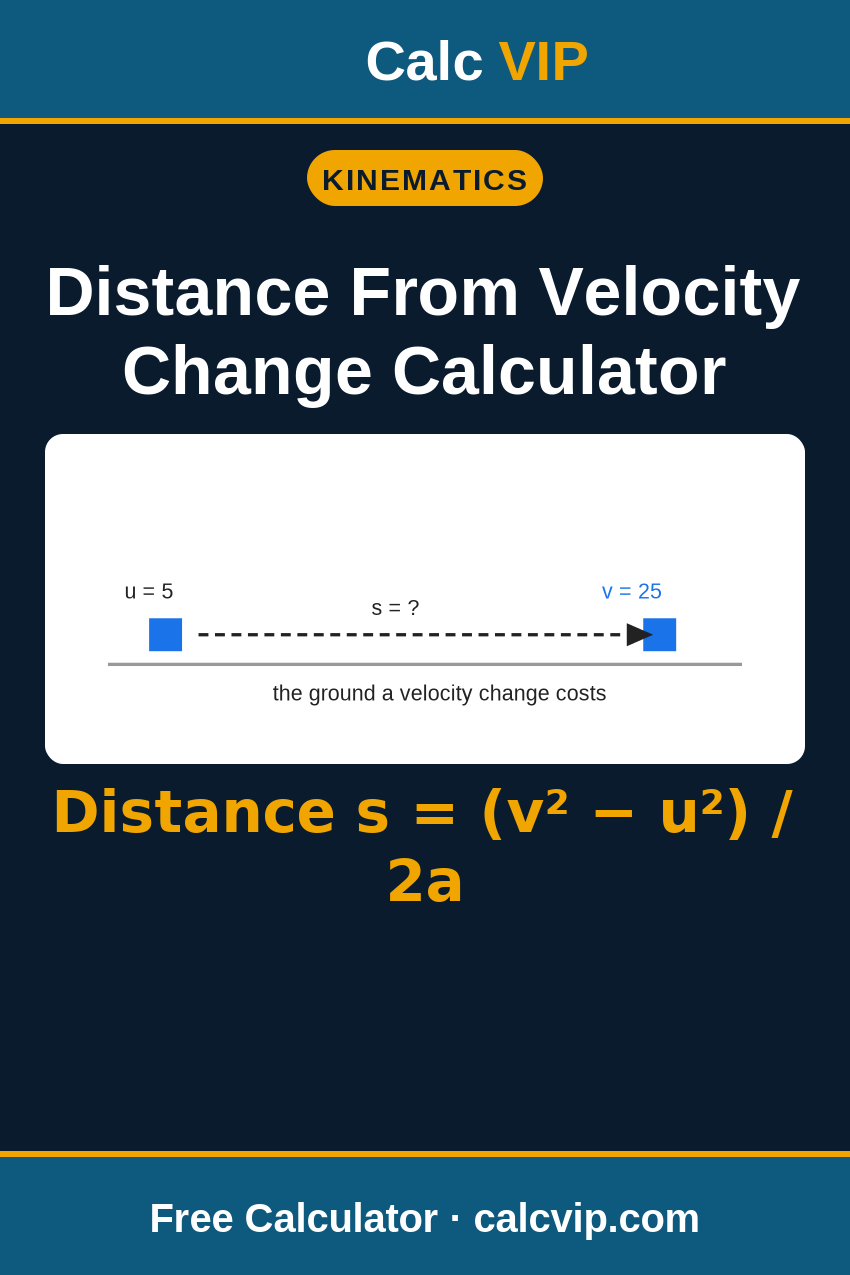
Example 1 — the accelerating car. A car accelerates from u = 5 m/s to v = 25 m/s at a = 4 m/s².
Distance s = (25² − 5²) ÷ (2 × 4) = 600 ÷ 8 = 75 m. Time taken t = (25 − 5) ÷ 4 = 5 s.
Example 2 — the full stop. A car brakes from 30 m/s (108 km/h) to rest at −5 m/s². s = (0 − 900) ÷ (−10) = 90 m, taking t = (0 − 30) ÷ (−5) = 6 s. Ninety metres of braking — before any thinking distance is added.
Example 3 — from rest at a junction. A motorcycle pulls away from rest to 20 m/s at 2.5 m/s². s = (400 − 0) ÷ 5 = 80 m, in t = 20 ÷ 2.5 = 8 s.
Example 4 — the motorway speed change. A car accelerates from 22 m/s to 33 m/s at a gentle 1.5 m/s² while overtaking. s = (33² − 22²) ÷ 3 = (1089 − 484) ÷ 3 = 605 ÷ 3 = 201.67 m, taking t = 11 ÷ 1.5 = 7.33 s — a quarter of a kilometre spent in the overtaking lane, which is why overtakes need so much clear road.
Example 5 — the cyclist. A cyclist speeds up from 2 m/s to 8 m/s at 0.8 m/s². s = (64 − 4) ÷ 1.6 = 37.5 m, in t = 6 ÷ 0.8 = 7.5 s.
Example 6 — the slowing train. A train eases from 40 m/s down to 10 m/s approaching a station, braking at −1 m/s². s = (100 − 1600) ÷ (−2) = 750 m of gentle braking, taking t = (10 − 40) ÷ (−1) = 30 s — trains plan their stops three-quarters of a kilometre out for exactly this reason.
Distance during a velocity change in real life
Highway code stopping distances. The braking-distance half of every stopping-distance chart is this formula with v = 0: the chart's steep growth with speed is the u² term, printed in metres.
Runway length planning. Given a jet's acceleration and its rotation speed, s = v²/2a sets the minimum runway; given the runway, the same formula caps the takeoff weight, because a heavier jet accelerates less.
Following-distance rules. The two-second gap is a time rule, but the distance it must contain is set by this calculator: your braking distance from the speed you share with the car ahead.
Amusement and stunt design. A stunt car that must hit a ramp at exactly v after accelerating from u over the available lot has its whole choreography in this one division.
Regenerative braking. An electric car's energy recovery is the kinetic energy difference ½m(v² − u²); the distance over which the motor can spread that recovery, at its maximum comfortable deceleration, comes from s = (v² − u²)/2a.
Railway signalling. Signal spacing is braking distance plus margin at line speed — computed block by block with this formula for the heaviest, worst-braking train allowed on the route.
Thinking distance + braking distance: the full stop
A real stop has two chapters. During the driver's reaction time — typically 0.7 s or so — the car continues at full speed u, covering the thinking distance u × treaction, which grows only linearly. Then the brakes bite and this calculator's chapter begins: u²/2|a|, growing with the square. At 30 m/s with 0.7 s reaction, the thinking distance is 21 m and Example 2's braking distance is 90 m — a 111 m total stop from motorway speed. The formula on this page deliberately excludes the thinking part (it assumes the acceleration acts from the first instant), so when you use it for road safety, add the reaction distance yourself; examiners, investigators and highway codes all do.
Quick reference: braking distance from speed (v = 0)
| Start u (m/s) | a = −4 m/s² | a = −5 m/s² | a = −8 m/s² |
|---|---|---|---|
| 10 | 12.5 m | 10 m | 6.25 m |
| 15 | 28.13 m | 22.5 m | 14.06 m |
| 20 | 50 m | 40 m | 25 m |
| 25 | 78.13 m | 62.5 m | 39.06 m |
| 30 | 112.5 m | 90 m | 56.25 m |
Read down any column and the square law stares back: each 5 m/s step costs more road than the last. Read across a row and stronger braking buys distance back — but only linearly, fighting a square.
Where a comes from: friction sets the ceiling
The acceleration in this formula is not a free choice — for braking, it is capped by the grip between tyre and road. The maximum deceleration is approximately μg, where μ is the coefficient of friction: about 0.7 on dry asphalt, 0.4 on wet, and as low as 0.15 on ice. Run the calculator's formula from 30 m/s at each ceiling and the weather becomes visible in metres. Dry (a = 6.87 m/s²): s = 900 ÷ 13.73 = 65.53 m, in 4.37 s. Wet (a = 3.92 m/s²): s = 114.68 m, in 7.65 s. Ice (a = 1.47 m/s²): s = 305.81 m, in 20.39 s — a third of a kilometre of sliding from a speed that felt ordinary. No brake hardware can beat these numbers, because the limit lives at the contact patch, not in the pedal; anti-lock systems exist to keep the tyre near the ceiling rather than skidding below it. When you use this calculator for road scenarios, choosing a is choosing a surface — and the honest range of answers across surfaces is the real result.
The anti-lock point deserves its own arithmetic, because a locked wheel does not merely fail to beat the ceiling — it falls through the floor. Sliding (kinetic) friction on dry asphalt is nearer μ = 0.5 than the static 0.7, so a locked-wheel stop from 30 m/s at a = 4.91 m/s² takes s = 900 ÷ 9.81 = 91.74 m, against 65.53 m for the rolling, threshold-braked stop. Twenty-six extra metres — the difference between a near miss and an impact — is what ABS buys by keeping the tyre at the static ceiling, and it is computed by exactly the formula on this page with a worse μ.
One transaction, two receipts: the s–t cross-check
This calculator hands you two answers, and they are not independent — they are the same event measured in metres and in seconds, chained together by the average velocity ½(u + v). That gives every result a built-in audit: s must equal ½(u + v) × t. Example 1: ½ × (5 + 25) × 5 = 75 m ✓. Example 4's overtake: ½ × (22 + 33) × 7.33 = 201.67 m ✓. Example 6's train: ½ × (40 + 10) × 30 = 750 m ✓. Run the audit whenever an answer surprises you; it separates the two kinds of surprise cleanly. If the audit fails, a number was mistyped — the physics is innocent. If the audit passes but the answer still looks wrong, the inputs themselves are describing a different event from the one you intended: a speed in km/h wearing m/s clothing, a deceleration entered positive. Audits check consistency; only you can check meaning.
Common mistakes
- Using the velocity difference instead of the difference of squares. (v − u)² is not v² − u². For u = 5, v = 25 the correct numerator is 600; (25 − 5)² = 400 would understate the distance by a third. Square first, then subtract.
- Mismatched signs. Slowing down requires negative a. Entering +5 for a braking car with v < u produces a negative distance — the calculator's refusal is the formula correctly reporting an impossible scenario.
- Forgetting the thinking distance. This tool times the stop from the instant braking starts. Real stops add the distance covered during reaction time, which at motorway speed is tens of metres.
- Entering km/h. Speeds must be m/s. A "30" that is really 30 km/h (8.33 m/s) inflates the distance by a factor of about 13, because the error is squared too.
- Assuming the same distance for the same speed change. +10 m/s from rest and +10 m/s at 20 m/s differ fivefold in distance at equal acceleration. Always compute from the actual u and v, never from the change alone.
FAQ
Is this the same as the stopping distance formula?
Yes — for a full stop, set v = 0 and enter the deceleration as a negative acceleration, and the same formula gives the stopping distance.
Why does velocity get squared?
Because kinetic energy grows with v², doubling the speed needs four times the distance at the same acceleration.
What if acceleration is zero?
Then the velocity never changes, so the formula cannot be used — distance is simply speed × time in that case.
Why does the calculator show the time as well?
Because t = (v − u)/a is fixed by the same three inputs, and it is often the follow-up question — how long the overtake, the braking, the launch actually lasts.
How is this different from the Acceleration From Distance calculator?
They are two modes of the same equation, v² = u² + 2as: that tool solves for a (or s), this one solves for s and adds the time. Use whichever matches the unknown you have.
Does the mass of the vehicle matter?
Not to the distance at a given acceleration — a is already the net effect of force and mass. Mass matters one step earlier, in deciding what acceleration the brakes or engine can achieve.
What deceleration can a normal car achieve?
Roughly 5–8 m/s² on dry asphalt with good tyres, 3–4 on wet roads, and far less on ice — which is why the same speed demands two to three times the distance in the rain.
Can this find the distance for a falling object?
Yes: set a = 9.81 m/s², u = 0 for a drop, and v to the impact speed — or run it the other way with the Free Fall Height calculator, which is this formula specialised for gravity.
Why is the numerator sometimes negative?
When v < u — any slowing motion — v² − u² is negative. Paired with the negative a of braking, the quotient is a positive distance. The signs are a matched pair; change one without the other and the result turns impossible, correctly.
What is the quickest sanity check on an answer?
Use s = ½(u + v) × t with the calculator's own t. The two routes to s must agree exactly, because they are the same equation — if they do not, a number was mistyped.