 Calc
Centripetal Force Calculator – F = mv²/r and F = mω²r
 Created by James Carter · Physics Writer · Forces & Motion · Last updated: November 2026
Use this free Centripetal Force Calculator to find the inward force needed to keep a mass moving in a circle. Enter the mass and radius with either the speed (F = mv²/r) or the angular speed (F = mω²r), and the calculator returns the centripetal force in newtons.
Anything that moves in a circle is being pulled off the straight line it would prefer to follow. A ball on a string, a car on a bend, the Moon around the Earth — all are continuously falling inwards, towards the centre of their circle, and the force making them fall is the centripetal force ("centre-seeking"). It is not a new species of force but a job description: whatever real force — tension, friction, gravity, a wall's push — happens to point at the centre and do the curving earns the title.
The size of the job follows a formula with a sting in it: F = mv²/r. The mass and the radius behave politely — double either and the force doubles or halves. The speed does not: it is squared, so doubling the speed quadruples the required force. That square is the reason fast corners are dangerous out of proportion to their speed, why spin cycles are hard on machinery, and why a modest increase in a roundabout's spin turns a gentle lean into a desperate grip. The twin formula F = mω²r serves rotating machinery, where the natural measure is angular speed ω in radians per second, linked to ordinary speed by v = ωr.
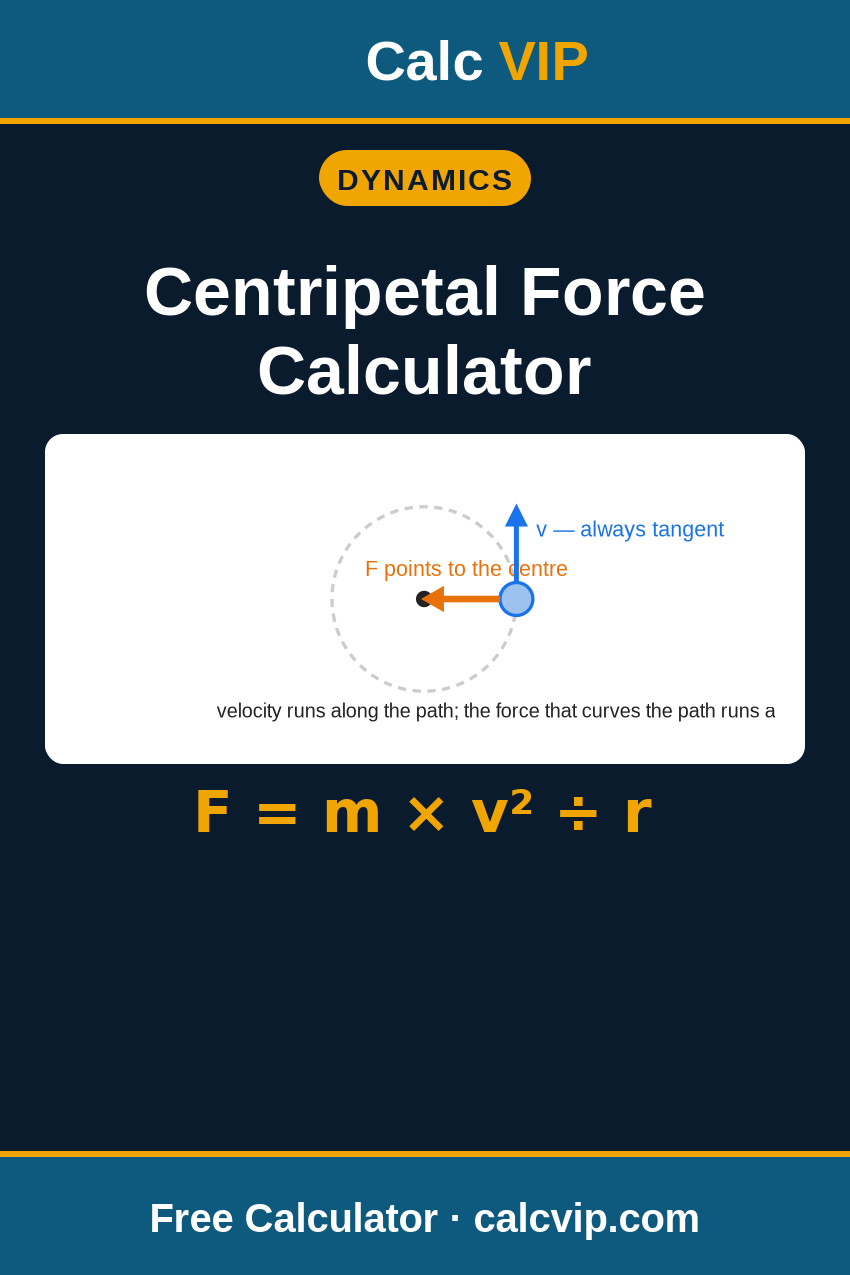
Choose whichever form matches your data, enter the numbers, and the calculator returns the inward force your string, road or orbit must supply. Compare it against what the supplier can actually provide — a rope's strength, a tyre's friction ceiling — and you know whether the circle holds or breaks.
Formula
From speed: F = m × v² ÷ r • From angular speed: F = m × ω² × r • Link: v = ω × r • F in newtons, m in kg, v in m/s, ω in rad/s, r in m
The two formulas are one formula wearing two coats: substitute v = ωr into mv²/r and mω²r appears. Beneath both sits the centripetal acceleration a = v²/r = ω²r — the inward acceleration of anything moving in a circle at steady speed — with F = ma doing the rest. Rearrangements solve the design problems: the radius a given force can hold at speed v is r = mv² ÷ F; the speed a given force permits on radius r is v = √(Fr ÷ m) — the formula behind every safe cornering speed and every "maximum speed" sign derived from physics rather than habit. Unit discipline: ω must be in radians per second (revolutions per minute × 2π ÷ 60), because degrees and rpm silently poison the ω² form.
| Symbol | Meaning | Units |
|---|---|---|
| F | centripetal force — the net inward force | newtons (N) |
| m | mass of the circling object | kilograms (kg) |
| v | speed along the circle (tangential speed) | m/s |
| ω | angular speed — angle swept per second | rad/s |
| r | radius of the circle | metres (m) |
Acceleration without speeding up
Circular motion hides a paradox that unlocks the whole topic: an object can accelerate continuously while its speed never changes. Acceleration is change of velocity, and velocity is speed with direction. Rounding a bend at a steady 50 km/h, the speedometer is frozen but the direction rotates every instant — so the velocity changes, so there is acceleration, so (Newton insists) there is a net force. That acceleration points inwards, perpendicular to the motion, which is exactly why it can steer without speeding: a force along the motion changes speed, a force across the motion changes direction, and the centripetal force is the pure across case.
It follows that the centripetal force is always a net force — the inward total of whatever real forces are acting. On the ball, tension alone qualifies. On the car, friction between tyre and road. On a banked track, a share of the normal force joins in. On the Moon, gravity, with nothing else present. When a problem asks "what provides the centripetal force?", it is asking you to audit the real forces and find which ones point at the centre. If the audit comes up short of mv²/r, the circle cannot be sustained at that speed: the object drifts wider, the string snaps, the satellite leaves — nature enforces the budget without exception.
The v² term deserves its reputation. Kinetic energy also carries a v², and for the same reason: velocity changes compound. Practically, it means safety margins evaporate with speed. A corner that needs 1,200 N of friction at 25 km/h needs 4,800 N at 50 km/h — beyond most wet-road budgets — which is why accident statistics bend so sharply upwards with speed, and why this calculator is worth running before trusting a fast, tight turn of any kind.
How to use
- Choose what you know: speed v and radius r, or angular speed ω and radius r.
- Enter the mass in kilograms.
- Enter the speed in m/s (km/h ÷ 3.6) or the angular speed in rad/s (rpm × 2π ÷ 60), plus the radius in metres.
- Click "Calculate" to get the centripetal force in newtons — the inward force that must be supplied by tension, friction, gravity or a surface.
Worked examples
Example 1 — both modes, one answer. A 2 kg mass circles at 6 m/s on a radius of 3 m: F = mv²/r = 2 × 36 ÷ 3 = 24 N. In angular terms the same motion has ω = v ÷ r = 2 rad/s, and F = mω²r = 2 × 4 × 3 = 24 N — the two modes agreeing, as they must. The string, the hand or the track must supply 24 N inwards, every instant, in whichever direction "inwards" currently is.
Example 2 — a car on a bend. A 1,000 kg car takes a bend of radius 40 m at 50 km/h = 13.89 m/s: F = 1,000 × 13.89² ÷ 40 = 1,000 × 192.93 ÷ 40 = 4,823 N. That force must come from tyre friction, whose ceiling on dry asphalt is about μN = 0.7 × 9,810 = 6,867 N — comfortable. On a wet road (μ ≈ 0.4, ceiling 3,924 N) the same bend at the same speed cannot be held: the physics, not the driver, declines.
Example 3 — a playground roundabout. A 30 kg child sits 2 m from the centre of a roundabout spinning at ω = 1.2 rad/s: F = mω²r = 30 × 1.44 × 2 = 86.4 N — the grip force the child's hands and the seat's friction must find. Double the spin to 2.4 rad/s and the demand quadruples to 345.6 N, beyond most grips: the ω² term is why roundabouts eject the unwary suddenly rather than gradually.
Example 4 — a satellite. A 1,000 kg satellite orbits at v = 7,660 m/s on a radius of 6,771,000 m (about 400 km above Earth): F = 1,000 × 7,660² ÷ 6,771,000 = 8,666 N. Gravity supplies it — the satellite's weight at that altitude — and the balance is exact and self-maintaining: that is what an orbit is. Slow the satellite and gravity over-delivers, pulling it into a lower, faster orbit; the bookkeeping never sleeps.
Example 5 — the washing machine. A 0.5 kg wet garment pressed against a drum of radius 0.25 m spinning at ω = 20 rad/s: F = mω²r = 0.5 × 400 × 0.25 = 50 N — the drum wall's inward push, one hundred times the garment's weight, squeezing water out through the drum's holes. The holes let water escape tangentially while the wall refuses the garment the same exit: a centrifuge is a circle with a sieve.
Example 6 — a ball on a string. A 0.2 kg ball whirls at 8 m/s on a 1.2 m string: F = 0.2 × 64 ÷ 1.2 = 10.67 N of tension. Modest — until the string is shortened mid-whirl to 0.6 m at the same speed, when the demand doubles to 21.3 N, or the speed rises to 12 m/s, when it reaches 24 N. Strings snap at the combination, never at the intention.
Centripetal force in real life
Road and rail design. Every bend is a negotiation between mv²/r and the friction (or banking) available. Designers choose radius, camber and speed limits together; the "advisory speed" plate on a sharp bend is this formula with a safety margin, printed in yellow.
Centrifuges. Laboratory and industrial centrifuges spin samples so that the required centripetal force — supplied by the tube walls — reaches thousands of times gravity, separating blood cells, isotopes and cream by density. The "× g" rating of a centrifuge is v²/r expressed in units of 9.81.
Fairground rides. Rotor drums, looping coasters and chair carousels are centripetal budgets with music. At the top of a loop, gravity itself contributes to the inward force, so the track's share can fall to near zero at the design speed — the delicious moment of lightness is an accounting identity.
Athletics throwing events. Hammer and discus throwers are human centripetal machines: the hammer's wire tension at release exceeds 2,000 N in elite throwing, and the athlete's whole technique is a strategy for supplying inward force without being pulled out of the circle.
Planets and moons. Every orbit in the solar system is gravity meeting an mv²/r bill. The Moon's bill is paid monthly and exactly; the same formula, run backwards from a moon's period and radius, weighs its planet — astronomy's scale for everything it cannot touch.
Spin drying and salad spinners. The humble salad spinner and the washing machine share Example 5: rotation pins the contents to the wall with an inward force many times their weight, and the water, unpinned at the holes, leaves. Domestic appliances are applied circular motion.
The v² law and other sensitivities
Before trusting any circular-motion number, run the sensitivity check the formula demands. Speed is the dangerous variable: +10% speed means +21% force (1.1² = 1.21); double speed, quadruple force. Radius is the forgiving one: a wider circle at the same speed needs proportionally less force, which is why motorway bends are sweeping and parking-lot corners are slow. Mass is the honest one: strictly proportional. And in the ω form, note that at fixed ω a larger radius needs more force (F = mω²r) — the opposite of the fixed-v behaviour — because holding the same angular speed on a bigger circle means travelling faster. Confusing those two regimes is the subtlest error in the topic; the table below keeps them straight.
Vertical circles: when gravity joins and leaves
Everything so far assumed a horizontal circle, where gravity is a bystander. Swing the circle vertical — a ball on a string, a looping coaster, a bucket of water — and gravity takes sides: at the top it points inwards, helping; at the bottom it points outwards, opposing. The required tension therefore breathes around the loop. For the 0.2 kg ball of Example 6 (mv²/r = 10.67 N, weight 1.96 N): at the top, tension plus gravity together must equal 10.67 N, so T = 10.67 − 1.96 = 8.71 N; at the bottom, tension must beat gravity and supply the 10.67 N, so T = 10.67 + 1.96 = 12.63 N. Strings and tracks are sized for the bottom figure; the famous bucket trick works because at the top, a fast enough swing needs no help from the bucket at all — gravity alone covers the mv²/r bill and the water has no say in leaving.
Quick reference: what doubling does
| Change | Effect on F |
|---|---|
| mass × 2 | F × 2 |
| speed v × 2 (same r) | F × 4 |
| radius × 2 (same v) | F ÷ 2 |
| angular speed ω × 2 (same r) | F × 4 |
| radius × 2 (same ω) | F × 2 (because v = ωr grew) |
| speed × 3 (same r) | F × 9 |
Pin the second row to memory: it explains more road accidents, snapped strings and ejected roundabout riders than every other row combined.
Common mistakes
- Inventing an extra "centripetal force" in the force list. Centripetal is the name of the inward total, not an additional force. Listing tension and centripetal force side by side double-counts the same pull.
- Feeding rpm or degrees into the ω formula. ω must be in rad/s. A machine at 600 rpm has ω = 62.8 rad/s; using 600 makes the force nearly a hundred times too big.
- Using diameter instead of radius. r is the distance to the centre. A drum "600 mm across" has r = 0.3 m; the error halves or doubles answers depending on direction.
- Assuming faster always needs proportionally more force. The square punishes that assumption: 40 km/h needs four times the friction of 20 km/h on the same bend, not twice.
- Believing something flings you outwards. What you feel in a turning car is your body trying to continue straight (Newton's First Law) while the car turns under you. The only horizontal force on you points inwards — that is what presses you against the door.
FAQ
What provides the centripetal force?
Something real must supply it: tension in a string, friction between tyres and road, gravity for a satellite, or the normal force on a banked track. "Centripetal" describes the direction, not a new kind of force.
What happens if the speed doubles?
The force goes up four times, because F depends on v². That is why fast corners need so much more grip.
Is centripetal force the same as centrifugal force?
No. Centripetal force is the real inward force. "Centrifugal force" is the apparent outward push you feel in a rotating frame — it is not a real force on the object.
What is centripetal acceleration?
The inward acceleration of circular motion, a = v²/r (equivalently ω²r). It exists even at constant speed because the velocity's direction changes. Multiply by mass and you have the centripetal force.
How fast can a car take a flat bend?
Set friction's ceiling equal to the demand: μmg = mv²/r, so v = √(μgr). For μ = 0.7 and r = 40 m that is √(0.7 × 9.81 × 40) = 16.6 m/s ≈ 60 km/h — mass cancels, so a lorry and a hatchback share the same physical limit on the same tyres.
Why do cyclists lean into a turn?
Leaning tilts the combined force of gravity and the road's push so it passes through the bike's line, and the road's friction supplies the inward force without a toppling torque. The lean angle satisfies tan θ = v²/(gr) — the same equation as the banked curve's ideal angle.
What happens if the string breaks?
The inward force vanishes, so the object obeys Newton: it flies off along the tangent — the direction of its velocity at that instant — not radially outwards. Hammer throws and sling shots are timed to exploit exactly that tangent.
Is the centripetal force the same all the way around?
In magnitude, yes, for steady circular motion — mv²/r never changes. In direction it rotates continuously, always aimed at the centre. A force of constant size and rotating direction is precisely what steady circling requires.
Can gravity alone keep something in orbit at any speed?
No — each radius has its orbital speed, v = √(GM/r). Slower, and the object falls into a lower (elliptical) path; faster, and it climbs or escapes. The formula is this page's rearrangement v = √(Fr/m) with gravity's F substituted.
Why do centrifuges quote "× g" instead of newtons?
Because the useful comparison is with gravity's separating effect. A centrifuge at 3,000 × g settles particles 3,000 times faster than standing gravity would — the force per kilogram, v²/r ÷ 9.81, is the number biologists actually design protocols around.