 Calc
Battery Energy Calculator – Wh = Ah × V & Runtime
 Created by Priya Sharma · Physics Editor · Energy & Gravity · Last updated: November 2026
Use this free Battery Energy Calculator to find how much energy a battery stores from its amp-hour (Ah) rating and voltage. Enter the capacity and voltage, and optionally the power of the device it runs, to see the stored energy in watt-hours and the expected runtime.
Batteries are sold by a number that does not, by itself, tell you how much energy they hold. The amp-hour rating measures charge — how much electric current the battery can deliver for how long — and charge only becomes energy when you know the voltage it is delivered at. Multiply the two and you get watt-hours, the true currency of stored energy: Wh = Ah × V. This calculator performs that conversion and, when you add a load in watts, divides energy by power to give the runtime — the two numbers every battery purchase, backup plan and off-grid design actually turns on.
The distinction is not pedantry; it is where battery comparisons go wrong. A 100 Ah battery sounds identical wherever it appears, yet at 12 V it stores 1,200 Wh while at 24 V it stores 2,400 Wh — twice the energy wearing the same label. Electric vehicles quote kilowatt-hours for exactly this reason, and phone makers' milliamp-hours only compare fairly between phones of the same voltage. Watt-hours are the level playing field: once every battery is translated into Wh, the biggest number wins, honestly.
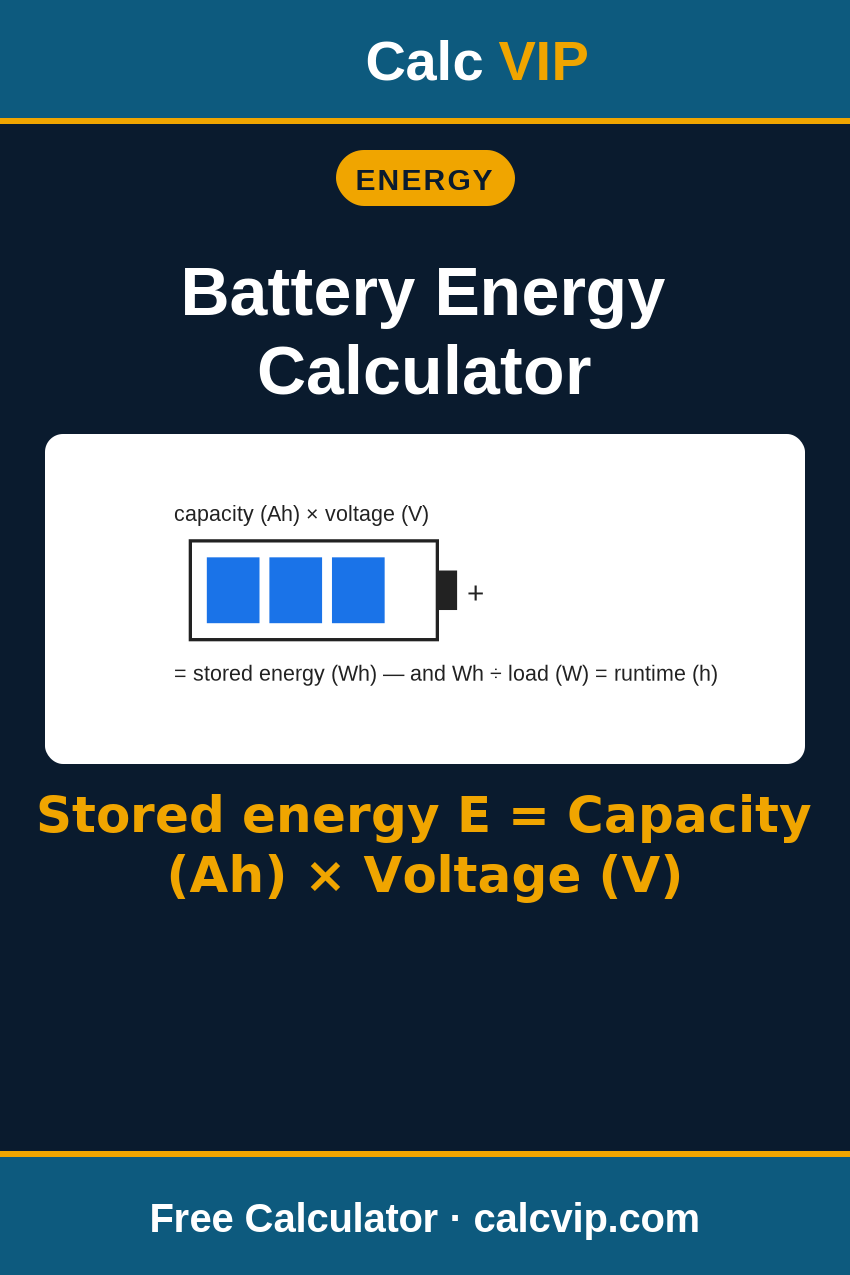
Runtime is the second translation, from storage into time. Runtime = energy ÷ load, and it inherits all the drama of that division: halve the load and the hours double; connect something hungry and a mighty battery becomes an afternoon's supply. The calculator gives the ideal figure — full capacity, perfectly used. Real batteries keep reserves, age, and object to being emptied completely, and the depth sections below explain how far reality typically discounts the ideal, and why.
Formula
Stored energy E = Capacity (Ah) × Voltage (V) • Runtime = E (Wh) ÷ Load (W) • 1 kWh = 1,000 Wh
The energy formula is a unit conversion in disguise: an amp-hour is a unit of charge (an amp sustained for an hour), and a volt is a joule per unit charge, so Ah × V lands exactly on energy — watt-hours, with 3,600 joules in each one. The runtime formula is the power equation rearranged, t = E ÷ P: stored energy divided by the rate of spending it. Both formulas are linear, which makes mental scaling easy: double the capacity, double the energy; double the voltage, double the energy; double the load, halve the runtime. Small batteries quote milliamp-hours — divide by 1,000 to get Ah before entering (5,000 mAh = 5 Ah). The calculator reports energy in Wh and kWh, and runtime in hours, rounded to two decimal places.
| Symbol | Meaning | Units |
|---|---|---|
| E | stored energy | watt-hours (Wh); 1 Wh = 3,600 J |
| Ah | capacity — charge the battery can deliver | amp-hours (Ah); 1,000 mAh = 1 Ah |
| V | battery voltage (nominal) | volts (V) |
| P | load — power of the device being run | watts (W) |
| t | runtime = E ÷ P | hours (h) |
Usable energy: why the label is a ceiling, not a promise
The calculator's energy is the battery's nameplate store — what it holds when new, full and treated kindly. How much of that store you may actually spend depends on chemistry. Lead-acid batteries are damaged by deep discharge: cycle them below about 50% and their lifespan collapses, so a 1,200 Wh lead-acid battery offers only about 600 Wh of routine usable energy — 6 hours at a 100 W load, not the ideal 12. Lithium batteries tolerate far deeper use, typically 80–90% of nameplate, which is a large part of why they displaced lead-acid in vehicles and home storage despite higher prices. Age taxes both: a battery at 80% health has simply become a smaller battery, and every figure on this page shrinks in proportion.
Temperature is the third silent discount. Cold batteries are smaller batteries: a lead-acid battery at freezing may offer only about 80% of its warm capacity, and a lithium pack in deep winter protects itself by withholding charge its chemistry cannot safely give or take. The EV whose range sags every January is demonstrating this page's arithmetic with a seasonal multiplier — the Ah on the label was measured in a mild laboratory, and the road in February is not one. Warm the battery, and the missing watt-hours return; they were never destroyed, only made temporarily unavailable by sluggish chemistry.
Two more discounts apply in real systems. Inverters — needed whenever a battery must run mains appliances — waste about 10–15% of the energy in conversion. And heavy loads themselves shrink the effective capacity of lead-acid batteries (the Peukert effect): drain a lead-acid battery at high current and it delivers noticeably fewer amp-hours than its gentle-discharge rating promises. None of this makes the calculator's figure wrong; it makes it the gross figure, from which the honest net is found by applying your chemistry's depth-of-discharge, your inverter's efficiency and your battery's age — in that order.
How to use
- Enter the capacity in amp-hours from the battery label. If the label says mAh, divide by 1,000 first (5,000 mAh = 5 Ah).
- Enter the nominal voltage: 12 V for a car or leisure battery, 3.7 V for a phone cell, 36 or 48 V for many e-bikes, 400 V-class for an EV pack (use its rated figure).
- Optionally enter the load in watts — the device's power draw — to get the runtime.
- Click "Calculate Battery Energy". Read the Wh as the gross store; for lead-acid planning, halve it before trusting the runtime, and for lithium, take about 85%.
Worked examples
Example 1 — the manifest check: a leisure battery. Capacity 100 Ah at 12 V, running a 100 W load.
E = 100 × 12 = 1,200 Wh (1.2 kWh). Runtime = 1,200 ÷ 100 = 12 hours — the ideal figure; as a lead-acid battery, its honest planning figure is nearer 6 hours at the 50% depth rule.
Example 2 — a phone battery. Capacity 5,000 mAh = 5 Ah at 3.7 V, phone drawing an average of 2 W.
E = 5 × 3.7 = 18.5 Wh. Runtime = 18.5 ÷ 2 = 9.25 hours of active use — matching the lived experience that a phone's "5,000" headline and its day of screen time are the same fact in different units.
Example 3 — an electric car. A pack rated 150 Ah at 400 V.
E = 150 × 400 = 60,000 Wh = 60 kWh. At an average motor draw of 20 kW on the move, runtime = 60,000 ÷ 20,000 = 3 hours of driving — which at motorway speeds is a few hundred kilometres, the range figure on the brochure by another route.
Example 4 — a single AA cell. Capacity 2.5 Ah at 1.5 V, running a 0.5 W torch.
E = 2.5 × 1.5 = 3.75 Wh; runtime = 3.75 ÷ 0.5 = 7.5 hours. The humblest battery in the drawer obeys the same two formulas as the EV pack — the family resemblance spans five orders of magnitude.
Example 5 — a UPS battery. Capacity 7 Ah at 12 V, keeping a 42 W router and modem alive.
E = 7 × 12 = 84 Wh; runtime = 84 ÷ 42 = 2 hours of outage coverage — enough for most power cuts, which is precisely the calculation that sizes a UPS.
Example 6 — an e-bike. Capacity 14 Ah at 36 V, motor drawing 250 W.
E = 14 × 36 = 504 Wh; runtime = 504 ÷ 250 = 2.02 hours at full assistance. Rider effort stretches it further in practice — the motor's share of the work is what the battery pays for.
Battery energy in real life
Off-grid and solar storage. A home battery is specified in kWh because loads are in watts and nights are in hours: this page's two formulas, run for every appliance, size the bank. The solar calculator elsewhere on this site computes the harvest; this one computes the store.
EV range comparisons. Kilowatt-hours per 100 km is the EV's fuel economy, and pack kWh is its tank. Translating any pack's Ah and V into kWh (Example 3) lets you compare vehicles whose makers quote different figures.
Power banks and travel rules. Airlines limit spare batteries by watt-hours (commonly 100 Wh without approval) — a rule written in this page's units. A "20,000 mAh" power bank at 3.7 V is 74 Wh: legal, and only legible once converted.
UPS and backup planning. Runtime promises on backup units are Example 5 with different numbers. Knowing your load in watts and the battery's Wh tells you whether the promise survives contact with your equipment.
Caravans, boats and cabins. Leisure batteries (Example 1) run lights, pumps and fridges far from the mains. The 50% lead-acid rule and this calculator together are the whole art of not going dark on the third evening.
Medical and emergency devices. For a CPAP machine, a powered wheelchair or a fridge holding medicine, runtime is not convenience but safety. The calculation is identical; the margin you add for depth of discharge and ageing is what changes.
Series and parallel: same energy, different shape
Batteries are combined to reach the voltage or capacity a job needs, and the energy arithmetic exposes a satisfying truth: wiring changes the shape, never the total. This is also the fastest audit of a suspicious specification. A bank advertised with a heroic Ah figure at a heroic voltage, whose implied Wh exceeds the sum of its cells' energies, is advertising arithmetic that physics will not honour — the watt-hour total of any bank is exactly the sum of the watt-hours inside it, no matter how the marketing arranges the multiplication. Take two of Example 1's 12 V, 100 Ah batteries. In series they make 24 V at 100 Ah: E = 24 × 100 = 2,400 Wh. In parallel they make 12 V at 200 Ah: E = 12 × 200 = 2,400 Wh. Identical energy, because there are simply two batteries' worth of chemistry either way — series trades for voltage (which motors and inverters may demand), parallel trades for capacity and current. When a battery bank's specification confuses you, convert the whole bank to Wh with this page's formula; the watt-hour total is the one number that cannot be dressed up by wiring.
C-rate: how fast you may spend the store
There is a gentler cousin of the same idea worth knowing: self-discharge. A battery on a shelf is a battery slowly spending itself — lithium cells lose a percent or two a month, lead-acid several times that, and old nickel chemistries far more. The Wh you calculate is the store on the day it was charged; a battery pulled from a drawer after a season holds measurably less, which is why stored batteries are kept cool, kept partly charged, and topped up before critical use. Energy arithmetic always has a date stamp, even when the label does not.
Capacity is rated at a gentle discharge. The C-rate expresses how fast a battery is being emptied relative to its size: 1C means discharged in one hour, 0.5C in two, 2C in thirty minutes. A 100 Ah battery at 1C delivers 100 A. The connection to this page is the load: a 1,200 Wh battery feeding a 1,200 W load is running at 1C and will indeed last about an hour — less, for lead-acid, whose capacity shrinks under fast discharge (Peukert again). High loads are therefore a double cost: they divide the runtime arithmetically and shrink the store they divide into. Gentle loads are repaid twice, which is why efficient appliances and modest draws are the twin pillars of every successful off-grid design.
Quick reference: familiar batteries in watt-hours
| Battery | Capacity | Voltage | Energy |
|---|---|---|---|
| AA cell | 2.5 Ah | 1.5 V | 3.75 Wh |
| phone battery | 5 Ah | 3.7 V | 18.5 Wh |
| power bank | 20 Ah | 3.7 V | 74 Wh |
| UPS battery | 7 Ah | 12 V | 84 Wh |
| car battery | 60 Ah | 12 V | 720 Wh |
| e-bike pack | 14 Ah | 36 V | 504 Wh |
| EV pack | 150 Ah | 400 V | 60,000 Wh |
Read down the energy column and the pattern of modern life appears: the devices we carry live in tens of watt-hours, while the ones that move us live in tens of thousands of them. Every single row in the table is one multiplication — this page's formula — away from its printed label.
Common mistakes
- Comparing batteries by Ah alone. Amp-hours ignore voltage. A 100 Ah battery at 24 V stores twice the energy of a 100 Ah battery at 12 V. Always convert to Wh before declaring one battery "bigger" than another.
- Entering mAh as Ah. A 5,000 mAh phone battery is 5 Ah. Entering "5000" inflates its energy a thousandfold — to a fictional 18,500 Wh, more than some home batteries. Divide mAh by 1,000 first.
- Trusting the ideal runtime for lead-acid. The calculator assumes the full capacity is spendable. Lead-acid should be cycled to about 50% only; plan on half the nameplate Wh, or buy twice the battery you calculated.
- Forgetting the inverter. Running mains devices from a battery costs 10–15% in conversion. A runtime that ignores the inverter is a runtime that ends early, usually mid-evening.
- Using the load's peak watts as its average. Many devices cycle — fridges, tools, heaters on thermostats. Runtime divides by the average draw; using the peak understates the hours, sometimes several-fold.
FAQ
How do I convert mAh to Ah?
Divide by 1000. A phone battery rated 5000 mAh is 5 Ah, and at 3.7 V it stores 5 × 3.7 = 18.5 Wh.
Why does my battery not last as long as the runtime shown?
The calculation assumes the full capacity is usable. In practice, inverters waste about 10–15% of the energy, and lead-acid batteries should only be discharged to about 50% to avoid damage — so real runtime is often shorter.
What is the difference between Ah and Wh?
Ah measures charge; Wh measures energy. Wh is the fair way to compare batteries of different voltages, because it includes the voltage.
How many watt-hours is 1 kWh?
Exactly 1,000. The leisure battery of Example 1 (1,200 Wh) holds 1.2 kWh — the same unit your electricity bill uses, which makes home-storage comparisons with grid energy immediate.
What voltage should I use for a lithium battery labelled 36 V?
Use the nominal 36 V — that is the rating the Ah figure was measured against. (A "36 V" pack actually swings between about 42 V full and 30 V empty; the nominal value is the honest middle the energy calculation assumes.)
Does a bigger load just shorten runtime proportionally?
Almost — runtime = Wh ÷ W is exactly proportional in the ideal formula. In reality, heavy loads also shrink a lead-acid battery's effective capacity (the Peukert effect), so very heavy loads cost a little more time than the division suggests.
How long will a 720 Wh car battery run a 60 W load?
Ideally 720 ÷ 60 = 12 hours. As a lead-acid battery cycled kindly, plan on about half that — 6 hours — and remember a car battery is built for short engine-start bursts, not deep cycling at all.
Why do airlines ask for watt-hours?
Because fire risk scales with stored energy, and Wh measures it directly. The common cabin limit is 100 Wh per spare battery — a 20 Ah power bank at 3.7 V (74 Wh) passes; the same 20 Ah at 12 V (240 Wh) would not.
Can I add the Wh of different batteries together?
Yes — energy adds regardless of voltage, which is the whole point of converting. Two 84 Wh UPS batteries store 168 Wh between them, whether wired in series, parallel, or sitting in separate cupboards.
How does battery ageing change these numbers?
A battery at 80% state of health has 80% of its original Ah, so every result on this page scales by 0.8: the 1,200 Wh leisure battery becomes 960 Wh, and its ideal 100 W runtime falls from 12 hours to 9.6. Re-run the calculator with the aged capacity when planning around old batteries.