 Calc
Conservation of Energy Calculator – Speed from Height & Height from Speed
 Created by Priya Sharma · Physics Editor · Energy & Gravity · Last updated: November 2026
Use this free Conservation of Energy Calculator to swap between height and speed. When an object falls, its gravitational potential energy (mgh) turns into kinetic energy (½mv²) — find the speed it gains dropping from a height, or the height it must have fallen from to reach a speed.
Few ideas in physics are as sweeping as this one: energy is never created or destroyed, only converted from one form to another. This calculator uses the cleanest version of that law — the trade between height and speed. An object held high above the ground stores gravitational potential energy, mgh. Let it fall and that store empties exactly as fast as kinetic energy, ½mv², fills up. At every moment of the fall the two add to the same total, so if you know how far the object has dropped, you know its speed — and if you know its speed, you know how far it must have dropped.
The result surprises almost everyone the first time: the mass cancels. A falling anvil and a falling apple, dropped from the same height, pass every floor at the same speed, because doubling the mass doubles both the potential energy available and the kinetic energy needed to reach a given speed. Galileo argued this from thought experiments four centuries ago; Apollo 15's commander demonstrated it on the Moon in 1971, dropping a hammer and a feather together and watching them land side by side. On Earth air resistance muddies the picture for light, fluffy objects, but for anything reasonably dense the rule is exact.
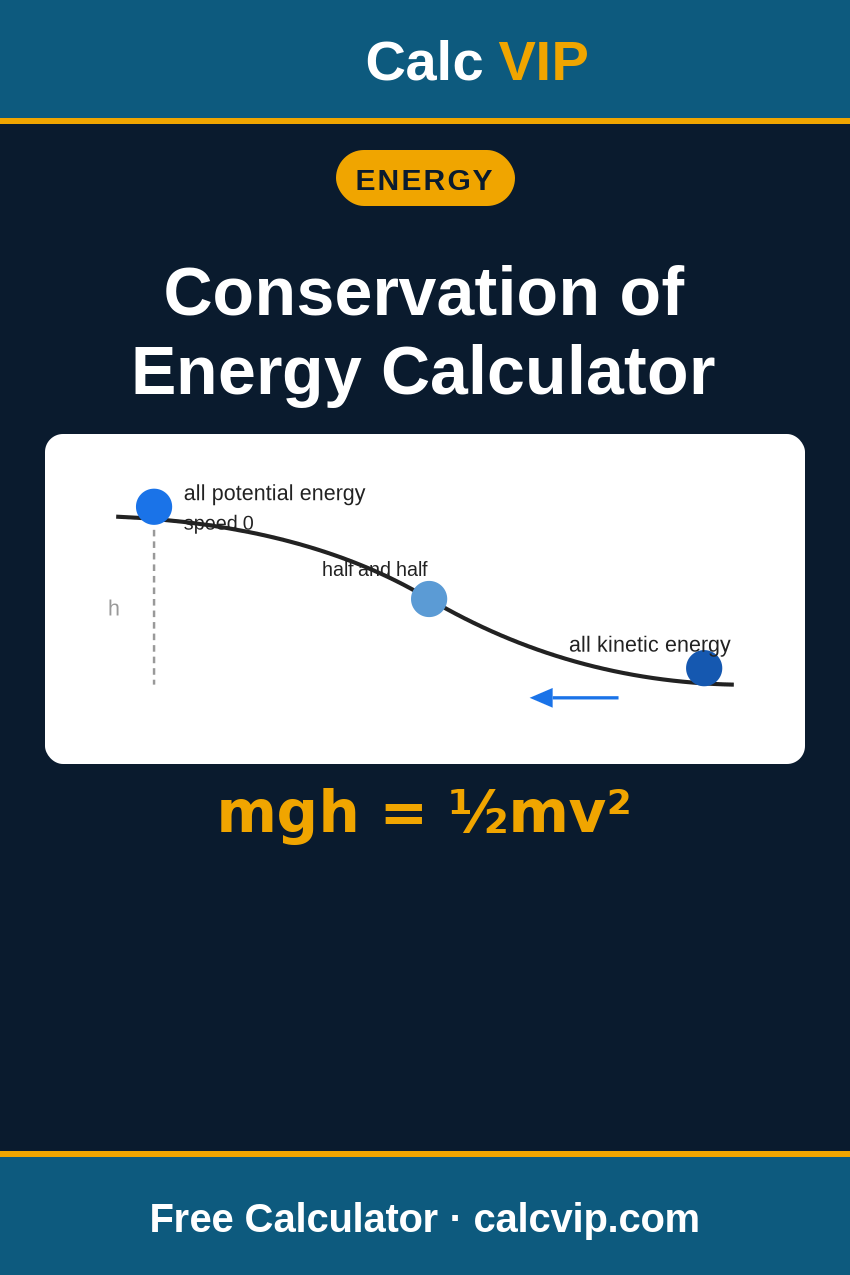
Just as remarkable is what else does not matter: the route. Slide down a near-vertical chute or a long gentle ramp, swing down on a rope or drop straight — the speed gained depends only on the vertical height lost, never on the shape of the journey. That single fact powers this whole page: two modes, one for finding speed from height and one for finding height from speed, both resting on nothing more than energy refusing to go missing.
Formula
Potential Energy = Kinetic Energy → mgh = ½mv²
The mass cancels out, giving v = √(2gh) and h = v² / (2g), with g = 9.81 m/s². Read the first as "speed from height": double the drop and the speed grows by √2 ≈ 1.41, not by 2, because kinetic energy follows the square of speed. Read the second as "height from speed": the height an object must have fallen from (or could climb to) grows with the square of its speed — a object at 20 m/s carries the energy of a 20.4 m fall, not a 10 m one. The general form, needed when the object is already moving or does not fall all the way to the ground, is mgh₁ + ½mv₁² = mgh₂ + ½mv₂²: total energy at the start equals total energy at the end. This assumes no energy is lost to friction or air resistance, so treat the answers as the ideal ceiling — real objects arrive a little slower.
| Symbol | Meaning | Units |
|---|---|---|
| m | mass of the object (cancels out of the final answer) | kilograms (kg) |
| g | gravitational field strength — 9.81 on Earth | m/s² |
| h | vertical height dropped | metres (m) |
| v | speed after dropping h | m/s |
| mgh | gravitational potential energy | joules (J) |
| ½mv² | kinetic energy | joules (J) |
Energy changes costume, never disappears
The falling object is best pictured as carrying two bank accounts with a standing order between them. The potential account starts full and the kinetic account starts empty. As the object descends, money flows steadily from one to the other — never appearing, never vanishing, just moving. Halfway down, the split is exactly even: half the height gone means half the energy converted. At the ground the potential account (measured from ground level) is empty and the kinetic account holds everything. The total never changed at any point, which is the entire content of the word "conservation".
Notice that height is measured relative to wherever you choose to call zero — usually the ground or the lowest point of the motion. Only the change in height enters the physics, which is why this calculator asks for the height dropped, not the height above sea level. A diver falling 3 m from a boat deck into the sea gains exactly the speed of a diver falling 3 m from a low board into a pool, even though one started hundreds of metres higher above the Earth's centre. Potential energy is a difference, not an address.
Real falls are never perfectly clean, and the exceptions teach as much as the rule. A skydiver reaches terminal velocity — a constant speed — even though she keeps losing height. Her potential energy is still being spent at the same rate, but instead of buying speed it is being paid straight to the air as heat, sound and turbulent motion. Conservation is not violated; the money is simply going to a third account. Whenever a real speed falls short of √(2gh), the difference is a receipt for energy that went somewhere else, and hunting for where it went is one of the most productive habits in physics.
How to use
- Choose whether you want the speed at the bottom or the height.
- For speed: enter the height the object drops, in metres (m) — the vertical distance it falls, not its height above sea level.
- For height: enter the speed in metres per second (m/s) — divide km/h by 3.6 to convert.
- Click "Calculate" to see the result.
- Remember the answer is the ideal value with no friction or air resistance; expect a real object to be a few percent slower, and much slower if it is light and bulky like a falling leaf or a parachute.
Worked examples
Example 1 — the headline case, both ways. An object drops from a height of 5 m. Its speed at the bottom is v = √(2 × 9.81 × 5) = √98.1 = 9.90 m/s — about 36 km/h, from a fall of barely two storeys. Going the other way, an object moving at 14 m/s must have dropped h = 14² ÷ (2 × 9.81) = 9.99 m, essentially 10 m. The two directions of the calculator are the same equation wearing different clothes.
Example 2 — the 10-metre diving board. A diver steps off the top board, 10 m above the water, and falls freely: v = √(2 × 9.81 × 10) = √196.2 = 14.01 m/s, which is 50.4 km/h. Olympic divers really do hit the water at about 50 km/h — which is why entries are judged on a knife-clean vertical line, and why a belly flop from that board is a medical event.
Example 3 — the skateboard half-pipe. A skateboarder drops in from the lip of a half-pipe 3.2 m above the flat bottom: v = √(2 × 9.81 × 3.2) = √62.78 = 7.92 m/s at the bottom — fast enough, carrying that speed up the far wall, to climb right back to 3.2 m on the other side, which is exactly the rhythm you see: down one wall, up the other, height traded for speed and back again.
Example 4 — a child's swing. A swing rises until the seat is 0.8 m above its lowest point, then falls back: v = √(2 × 9.81 × 0.8) = √15.70 = 3.96 m/s through the bottom of the arc. Modest — but notice that even this gentle playground motion converts height to speed at exactly the rate the formula predicts, and pumping the swing is just a way of topping up the height account each cycle.
Example 5 — why crash speeds are so destructive. A car travelling at 25 m/s (90 km/h) carries kinetic energy equal to the potential energy of a fall from h = 25² ÷ (2 × 9.81) = 31.86 m — roughly a ten-storey building. Crash engineers think in exactly these terms: stopping a car at 90 km/h means safely absorbing the energy of driving it off a ten-storey roof, which is why crumple zones, barriers and airbags are engineered like landing systems.
Example 6 — the same fall on the Moon. On the Moon g is only 1.62 m/s². An astronaut's dropped tool falling the same 5 m reaches v = √(2 × 1.62 × 5) = √16.2 = 4.02 m/s — less than half its Earth speed, and taking noticeably longer to get there. The formula never mentions Earth; swap in the local g and it describes falls anywhere, from Mercury to a neutron star's unimaginable surface gravity.
Conservation of energy in real life
Hydroelectric power. A dam is this calculator scaled to a landscape. Water stored high in a reservoir holds potential energy; falling through the penstock it converts that energy to kinetic energy, and the turbine converts it again to electrical energy. The speed the water gains from the reservoir's height — the "head" — is √(2gh), and it sets how hard the water can drive the turbines.
Pole vault. The vaulter is a chain of conversions: chemical energy to the kinetic energy of the sprint, kinetic energy into the bend of the pole, the pole's elastic energy back into motion, and finally motion into the potential energy of a body six metres up. The world record above 6.2 m is, at heart, an energy audit that balances.
Bungee jumping. The jumper's potential energy becomes kinetic energy during the free fall, then stretches the cord, which stores it as elastic potential energy and spends it hauling the jumper back up. Each bounce is lower than the last because some energy leaks to heat and air resistance on every cycle — conservation with a small tax.
Pumped-storage reservoirs. Grid operators run this page backwards: when electricity is cheap, they pump water uphill, banking it as potential energy; when demand peaks, they let it fall and sell the energy back. It is the largest form of battery humanity operates, and its entire economics is mgh.
Water slides and ski slopes. Designers of slides and slopes think in height budgets. A slide that drops 12 m can deliver at most √(2 × 9.81 × 12) ≈ 15.3 m/s at the bottom, whatever its twists — and ski instructors know that a slope's vertical drop, not its length, decides how fast a beginner can possibly end up going.
Escape velocity thinking. Ask how fast an object must move so that its kinetic energy can pay for climbing forever against gravity, and you get the escape velocity — 11.2 km/s for Earth. Rockets, meteor impacts and the atmospheres planets manage to keep are all settled by this same exchange rate between speed and height.
When the object is already moving
The clean mgh = ½mv² swap assumes the object starts from rest and ends at your zero level. Real problems are often one step richer: a roller-coaster car crests a hill already moving, or you want the speed halfway down rather than at the bottom. The fix is to conserve the total rather than swapping one form for the other: mgh₁ + ½mv₁² = mgh₂ + ½mv₂². Mass still cancels, leaving v₂ = √(v₁² + 2g(h₁ − h₂)). Every term is a familiar one — starting speed squared, plus twice g times the height lost — and the simple calculator on this page is just the special case where v₁ = 0 and h₂ = 0. If the "final height" is above the start, the same formula reports whether the object can get there at all: if v₁² is smaller than 2g(h₂ − h₁), it cannot, and it will stop and come back first.
Quick reference: speed gained in a free fall
| Height dropped | Speed at the bottom | In everyday terms |
|---|---|---|
| 1 m | 4.43 m/s | a brisk running pace |
| 2 m | 6.26 m/s | a fast sprint |
| 5 m | 9.90 m/s | 36 km/h — a car in town |
| 10 m | 14.01 m/s | 50 km/h — a diving entry |
| 20 m | 19.81 m/s | 71 km/h — motorway speed |
| 45 m | 29.71 m/s | 107 km/h — a tall coaster drop |
The pattern to carry away is the square root's mercy and its menace: the first metres of a fall buy speed quickly, and each further doubling of height adds only about 41% more speed. Falls are most dangerous not because speed grows without limit, but because even a two-storey fall already reaches town-traffic speed.
Common mistakes
- Using height above the ground instead of height dropped. Only the vertical distance fallen matters. An object on a 100 m cliff that falls 5 m to a ledge gains the speed of a 5 m fall, not a 100 m one.
- Expecting the mass to change the answer. Mass cancels exactly. If your calculation gives a heavier object a different falling speed (in a vacuum), an algebra slip has crept in.
- Doubling the height and expecting double the speed. Speed grows with √h: four times the height gives twice the speed. Twenty metres of fall is not twice as fast as ten — it is 1.41 times as fast.
- Forgetting that real falls lose energy. Friction and air resistance divert some potential energy into heat, so measured speeds come in below √(2gh) — dramatically so for light, high-drag objects like feathers, leaves and parachutes, which this ideal formula does not describe.
- Mixing g values mid-problem. Pick 9.81 m/s² (or 10 for a rough estimate) and use it in both directions of the calculation. Converting a speed to a height with a different g than you used going down breaks the round trip — 5 m should give 9.90 m/s and 9.90 m/s should give the same 5 m back.
FAQ
Why doesn't the mass matter?
Mass appears on both sides of mgh = ½mv², so it cancels. A heavy object and a light object dropped from the same height reach the same speed (ignoring air resistance).
Does the path matter — straight down or down a slope?
No. Only the vertical height change matters, because gravity depends on height, not on the route taken.
What if there is friction?
Then some potential energy turns into heat instead of kinetic energy, so the real speed is a bit less than this ideal value.
Does the object have to start from rest?
For the simple swap mgh = ½mv², yes. If it is already moving, use the total-energy form: mgh₁ + ½mv₁² = mgh₂ + ½mv₂², which simplifies to v₂ = √(v₁² + 2g(h₁ − h₂)). The calculator covers the starting-from-rest case, which is the one most falling, sliding and swinging problems need.
Where does the energy go when the object lands and stops?
It does not vanish — it changes form again. A landing object spends its kinetic energy on deformation (a dent, a splash, a crumple zone), on sound, and on heat. A bouncing ball keeps some as elastic energy and returns it, which is why it bounces at all; the height of each bounce is an audit of how much was kept.
How fast do I fall from just 1 metre?
v = √(2 × 9.81 × 1) = 4.43 m/s — about 16 km/h, the speed of a quick run. It is a useful calibration: even stepping off a chair-height drop, you meet the ground at running speed, which is why short falls still twist ankles.
Does this work on other planets?
Completely — just replace g. On the Moon (g = 1.62 m/s²) a 5 m fall gives only 4.02 m/s; on Jupiter (g = 24.79 m/s²) the same fall gives √(2 × 24.79 × 5) = 15.74 m/s. The calculator is set to Earth's 9.81 m/s², but the physics is universal.
Why does a skydiver stop accelerating?
Because a second conversion switches on. Once drag grows large enough, the potential energy she loses each second is paid entirely to the air as heat and turbulence instead of into her kinetic energy. Her speed stays fixed at terminal velocity while the energy still flows — conservation holds, with the air as the receiving account.
Can an object climb higher than where it started?
Not on its own energy. Rising converts kinetic energy back into potential, and it can at most regain its starting height — reaching exactly that height with zero speed to spare. Anything that ends up higher — a pumped-storage reservoir, a rocket, a child pumping a swing — had extra energy supplied from outside.
What is potential energy measured from?
From any reference level you choose — the ground, the bottom of the swing, the surface of the water. Only differences in height matter, so the choice cancels out of every answer. Pick the level that makes the arithmetic simplest, usually the lowest point of the motion.