 Calc
Doppler Observer Calculator – Frequency Heard by a Moving Observer
 Created by David Okafor · Physics Writer · Waves & Light · Last updated: November 2026
Use this free Doppler Observer Calculator to find the frequency heard by a moving observer listening to a stationary sound source — for example, walking or driving towards a siren. Choose whether the observer moves towards or away from the source, then enter the frequencies and speeds.
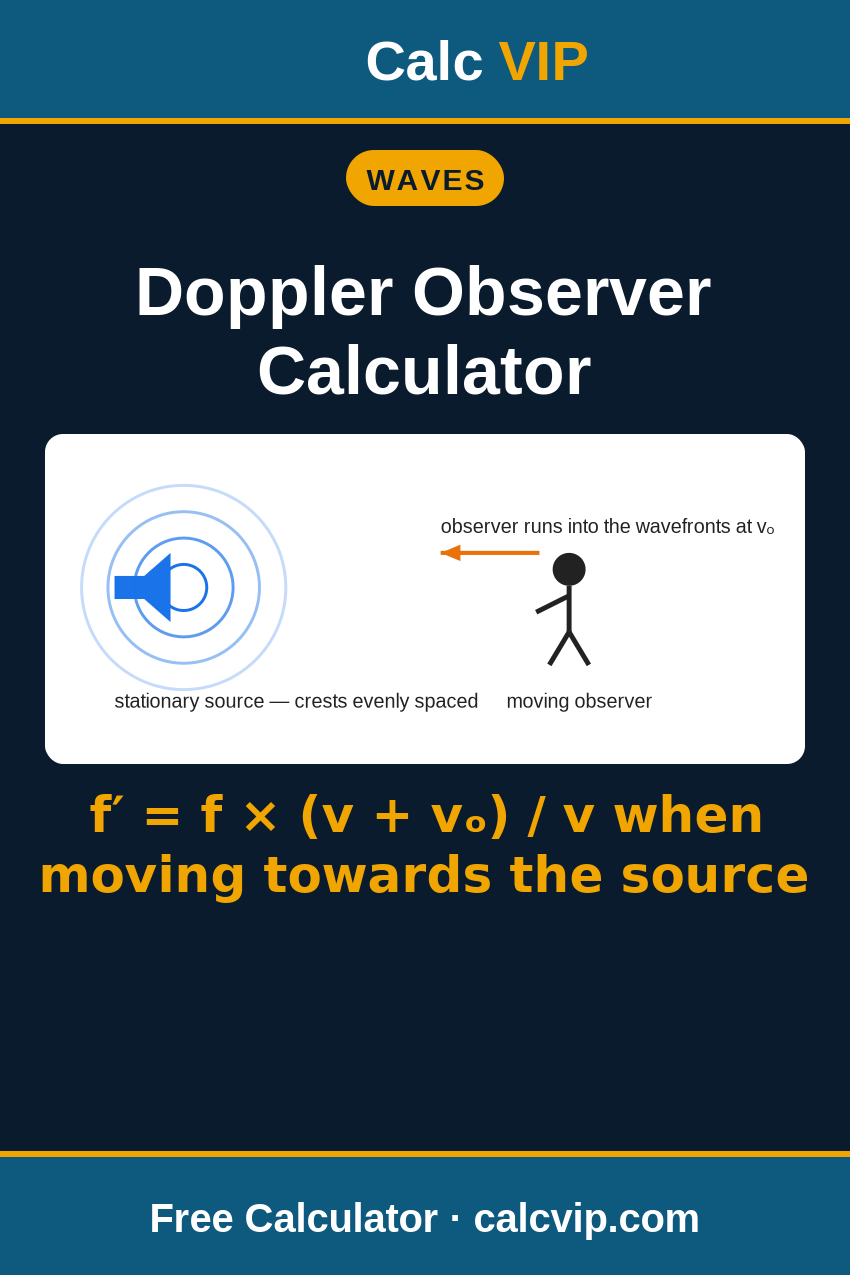
The Doppler effect is usually introduced with a moving ambulance, but half of the phenomenon belongs to the listener. Stand still and a stationary siren sounds its true note; walk towards it and the note sharpens; hurry away and it flattens — even though the siren itself never changes. What changes is the rate at which wavefronts meet your ears. The source lays down crests at fixed spacings in the air, and your motion through that pattern decides how many crests you collect per second. Collect them faster than they were emitted and you hear a higher frequency; dawdle and you hear a lower one.
The moving-observer case is the cleanest form of the effect because the wave pattern in the air is completely undisturbed: the wavelength stays exactly what the source made it, and only the encounter rate changes. Your speed through the wave train adds to (or subtracts from) the speed at which the train itself sweeps past, so the heard frequency is the emitted frequency scaled by (v + vₒ)/v when approaching and (v − vₒ)/v when retreating. This calculator applies that scaling and reports the shift in hertz as well as the new pitch, so you can see at a glance how feeble — or how dramatic — everyday speeds make the effect.
Everyday speeds, honestly, make it modest: a sprinting listener shifts a note by about 1%, a fast car by about 10%. But modest is not useless. The same encounter-rate arithmetic, applied to reflected waves, measures blood flow in arteries and storms in weather radar, and its electromagnetic twin — where the formula is adjusted for relativity — reads the recession speeds of galaxies. The humble case on this page is the doorway into all of that.
Formula
Moving observer, stationary source: f′ = f × (v + vₒ) / v when moving towards the source, and f′ = f × (v − vₒ) / v when moving away • f′ is the heard frequency, v the speed of sound, vₒ the observer's speed
The derivation is a counting argument. The source emits f crests per second, spaced λ = v/f apart in the air. A stationary listener is swept by crests at speed v and counts v/λ = f per second — the true note. An observer moving towards the source at vₒ meets the crests at a closing speed of v + vₒ, so counts (v + vₒ)/λ per second; dividing by the stationary count gives the scaling (v + vₒ)/v directly. Moving away, the crests must chase the observer, the closing speed falls to v − vₒ, and the count falls in the same proportion. Two features deserve attention: the shift depends on the fraction vₒ/v, so the same walking pace produces the same percentage shift on any note; and the formula is linear in vₒ — double your speed and you double the shift, with no surprises until vₒ approaches v itself.
| Symbol | Meaning | Units |
|---|---|---|
| f′ | frequency heard by the moving observer | hertz (Hz) |
| f | frequency emitted by the stationary source | Hz |
| v | speed of sound in the medium | m/s |
| vₒ | observer's speed towards or away from the source | m/s |
| λ | wavelength in the air — unchanged by observer motion | m |
Observer motion versus source motion: a real difference
Sound travels through a medium, and the medium keeps score of who is moving. When the observer moves, the wave pattern in the air is untouched — the crests keep their spacing λ = v/f — and only the meeting rate changes, giving the multiplicative formula on this page. When the source moves, the pattern itself is rewritten: each new crest is emitted from a shifted position, so the wavelength ahead of the source is genuinely compressed to (v − vₛ)/f, and the observer's formula divides instead of multiplying: f′ = f × v/(v − vₛ) for an approaching source. At street speeds the two are close but never equal — a 500 Hz source approached at 20 m/s gives 529.15 Hz by the observer formula, while a source approaching you at 20 m/s gives 500 × 343/323 = 530.96 Hz — a difference of nearly 2 Hz that precision acoustics can measure and examinations delight in testing.
The asymmetry deepens at extremes. An observer retreating at the speed of sound hears nothing at all — the crests never arrive, f′ = 0 exactly. An observer advancing at the speed of sound hears exactly double frequency, f′ = 2f. But a source advancing at the speed of sound piles all its crests into a single shock front — a sonic boom — and the formula's denominator hits zero: the frequency formally diverges. One situation is a quiet doubling, the other is an explosion of piled-up waves. "Who moves" is not a pedantic distinction; it is the physics.
How to use
- Choose whether the observer is moving towards or away from the source.
- Enter the frequency the source emits, in hertz.
- Enter the speed of sound (343 m/s in air at 20 °C is pre-filled) and the observer's speed in metres per second.
- Click "Calculate Observed Frequency" to hear — on paper — the shifted pitch, and the size of the shift in hertz.
- For a percentage feel, divide the shift by the original frequency: at low speeds the percentage shift is very nearly 100 × vₒ/v, whatever the note.
Worked examples
Example 1 — driving at a siren. A stationary siren emits 500 Hz. You drive towards it at 20 m/s through air where sound travels at 343 m/s.
f′ = 500 × (343 + 20) / 343 = 500 × 363 / 343 = 529.15 Hz.
Driving away instead, you would hear 500 × 323 / 343 = 470.85 Hz.
Example 2 — a cyclist and a church bell. A bell rings at 600 Hz; a cyclist rides towards it at 8 m/s. She hears f′ = 600 × (343 + 8) / 343 = 600 × 351 / 343 = 613.99 Hz — about 14 Hz sharp, a shift of 2.3%. Notice the percentage is the same as vₒ/v = 8/343: at these speeds the shift fraction is the speed fraction, for any bell.
Example 3 — the pass-by, both halves. A car at 30 m/s (108 km/h) passes a stationary crossing bell ringing at 700 Hz. Approaching, the driver hears f′ = 700 × 373 / 343 = 761.22 Hz; the instant after passing, receding, f′ = 700 × 313 / 343 = 638.78 Hz. The pitch does not glide between the two — for the moving observer it steps down by over 120 Hz at the moment of passing, the drop every driver recognises from passing sirens (whose own motion adds its share on top).
Example 4 — designing for a 10% shift. How fast must an observer move to hear a note shifted by exactly 10%? The scaling must be 1.10, so vₒ = 0.10 × 343 = 34.3 m/s — about 123 km/h, motorway speed. Musical pitch is logarithmic, and 10% is roughly 1.65 semitones: even a fast car buys less than two semitones of Doppler.
Example 5 — a runner's small change. A runner at 3 m/s approaches a loudspeaker playing 440 Hz: f′ = 440 × 346 / 343 = 443.85 Hz. A shift of under 4 Hz — far too small to notice as pitch, though (as the beat page shows) easily large enough to beat against the original if both were heard together.
Example 6 — retreating at half the speed of sound. An observer fleeing a 500 Hz source at vₒ = 171.5 m/s — half the speed of sound — hears f′ = 500 × (343 − 171.5) / 343 = 500 × 0.5 = 250 Hz: exactly an octave down. Push the retreat to the full speed of sound and the heard frequency reaches zero; the waves never catch up at all.
Doppler observers in real life
Medical Doppler ultrasound. A probe listens to echoes from moving blood cells — the cells act first as moving observers of the incoming wave, then as moving sources of the echo — and the double shift measures flow speed inside arteries and the heart, with no incision at all.
Weather radar. Rain and hail moving towards or away from the radar shift the reflected pulses; the observer-motion arithmetic (in its electromagnetic form) turns those shifts into maps of wind inside storms, including the rotation that warns of tornadoes.
Radar speed measurement. A speed gun's receiver is the moving-party's mirror image: it compares transmitted and reflected frequencies and reads the difference as a velocity. The officer's display is a Doppler shift converted to km/h.
Astronomy's redshift. For light there is no medium, so only relative motion matters and relativity rewrites the formula — but the spirit is this page's: galaxies receding from us have their spectral lines shifted to lower frequencies, and the size of the shift measures the expansion of the universe.
Pass-by pitch drop. The falling note of a passing train horn or siren is the sum of both motions — source and, if you are moving, observer — and its size lets experienced listeners judge speed surprisingly well by ear.
Foetal and flow monitors. Handheld Doppler monitors detect a baby's heartbeat from the frequency shift of ultrasound reflected by the moving heart wall — encounter-rate physics at a bedside, listening to motion itself.
Quick reference: shift versus observer speed (v = 343 m/s)
| Observer speed | Towards: multiplier | Away: multiplier | Shift |
|---|---|---|---|
| 1.4 m/s (walking) | 1.004 | 0.996 | ±0.4% |
| 8 m/s (cycling) | 1.023 | 0.977 | ±2.3% |
| 20 m/s (72 km/h) | 1.058 | 0.942 | ±5.8% |
| 30 m/s (108 km/h) | 1.087 | 0.913 | ±8.7% |
| 85.75 m/s (v/4) | 1.25 | 0.75 | +25% / −25% |
| 171.5 m/s (v/2) | 1.50 | 0.50 | +50% / −50% |
The multipliers make the formula's linearity visible: the shift percentage is (to this precision) just the speed expressed as a percentage of the speed of sound. An observer at 1% of sound speed shifts every note by 1% — the source frequency never enters the percentage at all.
The double shift: echoes from moving targets
The most valuable version of the effect involves a reflection. Send a wave at a moving target and it is shifted twice: the target first acts as a moving observer, receiving the wave at a shifted frequency, then as a moving source, re-emitting (reflecting) it with a second shift on top. For speeds far below the wave speed the two shifts are nearly equal, so the echo's total shift is about Δf ≈ 2 × f × vtarget / v — the factor of two is the signature of every radar gun and Doppler scanner. Put numbers to it for medical ultrasound: a 5 MHz probe in tissue (v = 1,540 m/s) listening to blood moving at 0.5 m/s receives a shift of 2 × 5 × 10⁶ × 0.5 / 1,540 ≈ 3,247 Hz. That lands squarely in the audible range — which is why Doppler ultrasound machines literally play the shift as sound, and why an experienced clinician can hear a valve leak. The same doubling, with light-speed waves, is how a radar gun turns a passing car into a number: the returning microwaves arrive shifted by an amount proportional to the car's speed, measured against the gun's own transmission.
What about wind — the medium itself moving?
A steady wind is a third kind of motion, and its effect surprises most people: for a stationary source and a stationary observer, a steady wind does not change the heard frequency at all. The wind stretches the wavelength (crests are laid down into moving air and carried along, spacing them wider downwind) but it speeds the crests' passage by exactly the same factor, so they arrive at the same rate they were emitted. What the wind changes is the travel time and, through refraction of sound rays in wind gradients, the loudness at a distance — not the pitch. Frequency shifts require the source–observer distance itself to be changing. It is a neat test of understanding: motion of the medium alone, however fast, leaves f′ = f.
Common mistakes
- Using the moving-source formula for a moving observer. The observer formula multiplies f by (v ± vₒ)/v; the source formula divides f by (v ∓ vₛ)/v. They differ by nearly 2 Hz in Example 1's territory and enormously at high speeds. Decide who moves before choosing.
- Getting the sign backwards. Towards always raises the frequency, away always lowers it. If your "towards" answer comes out below the original frequency, the sign — or the direction selector — is wrong.
- Believing the wavelength changes for a moving observer. It does not: the crests in the air keep the spacing the source gave them. Only the rate of meeting them changes. Wavelength change is the moving source's signature, not the observer's.
- Forgetting that both motions can combine. If the source and the observer both move, apply both corrections: f′ = f × (v ± vₒ)/(v ∓ vₛ). Using only one when a problem gives two speeds silently drops half the physics.
- Expecting a shift for sideways motion. In classical acoustics, motion perpendicular to the line to the source produces no shift at the instant of closest approach — the distance is momentarily not changing. (Light adds a tiny relativistic transverse effect, far beyond this calculator's scope.)
FAQ
Why does moving towards the source raise the pitch?
The wavelength in the air does not change, but you rush into the wavefronts and meet them more often. Meeting more waves per second means a higher observed frequency.
Is this different from a moving source?
Yes, slightly. A moving source actually changes the wavelength in the air, so its formula divides by (v ∓ vₛ) instead. At everyday speeds the two effects are nearly equal, but they are not identical — sound needs a medium, so "who moves" matters.
What if the observer moves at the speed of sound away from the source?
Then f′ = 0 in this simple model: the wavefronts never catch up with the observer, so no sound is heard at all.
What if both the source and the observer are moving?
Combine both corrections in one formula: f′ = f × (v ± vₒ) / (v ∓ vₛ), with the observer's sign chosen by approach or retreat and the source's by its own motion. A driver approaching an approaching ambulance gets both boosts multiplied together.
Does moving change how loud the sound is, too?
Not through the Doppler mechanism. Loudness follows the distance through the inverse square law, so approaching a source makes it louder for that separate reason — the two effects (rising pitch from Doppler, rising volume from closeness) arrive together in real life but are computed by different pages of physics.
How fast would I need to go to hear a note an octave higher?
An octave is a doubling: (v + vₒ)/v = 2 requires vₒ = v — you would have to advance on the source at the full speed of sound, 343 m/s. An octave down by retreat needs only vₒ = v/2, as Example 6 shows: the away direction reaches its extremes sooner.
Why does the pitch drop suddenly as a vehicle passes?
While approaching, you collect crests at the boosted rate; the moment you draw level and begin receding, the rate switches to the reduced one. The frequency steps between the two values rather than gliding, and your ear hears that step as the characteristic falling "nee-yow" of a pass-by.
Can the Doppler effect measure things we cannot touch?
It is the standard remote speedometer of physics: blood flow, storm winds, aircraft, stars and galaxies are all measured by comparing emitted and received frequencies. Anything that moves and radiates waves reports its line-of-sight speed through its frequency shift.
Is there a Doppler shift if I move in a circle around the source?
At constant distance, no classical shift: crests are met at the emitted rate because the distance never changes. Only the component of motion directly towards or away from the source — the radial component — counts, which is why astronomers speak of radial velocity.
Does the formula work for light?
Not exactly. Light needs no medium, so "who moves" cannot matter, and Einstein's relativity replaces the formula with one depending only on relative speed (plus a small transverse effect). At everyday speeds the classical answer is an excellent approximation — which is why police radar, using microwaves, can be designed with either and read the same.