 Calc
Decibel Solver Calculator – Convert Decibels to Intensity & Compare Sound Levels
 Created by David Okafor · Physics Writer · Waves & Light · Last updated: November 2026
Use this free Decibel Solver Calculator to turn a decibel level back into a sound intensity in W/m², or to find how many times more intense one sound is than another from the difference in their levels.
Decibels are everywhere in audio, acoustics and electronics, yet they hide the actual physics behind a logarithm. This solver lifts the lid. Give it a decibel level and it hands back the true intensity in watts per square metre; give it two levels and it tells you the honest ratio between them — how many times more intense one sound really is than the other. Those conversions matter because decibel differences are deceptive: a sound 30 dB above another is not "a bit louder", it carries a thousand times the intensity, and two sounds that differ by a mere 3 dB differ by a full factor of two in power.
The decibel was invented by telephone engineers who needed to talk about enormous ranges of power without writing strings of zeros. The sound intensity at the threshold of hearing is 10−12 W/m²; at the threshold of pain it is about 1 W/m². A linear scale would force you to juggle numbers like 0.000000000001 and 0.001 in the same sentence. The decibel scale takes the logarithm of the ratio to the hearing threshold, multiplies by ten, and the whole trillion-fold range of hearing collapses into 0 to about 130 dB. The price of that convenience is that decibels never add, subtract or compare the way ordinary numbers do — and un-converting them, as this calculator does, is how you recover the physical truth underneath.
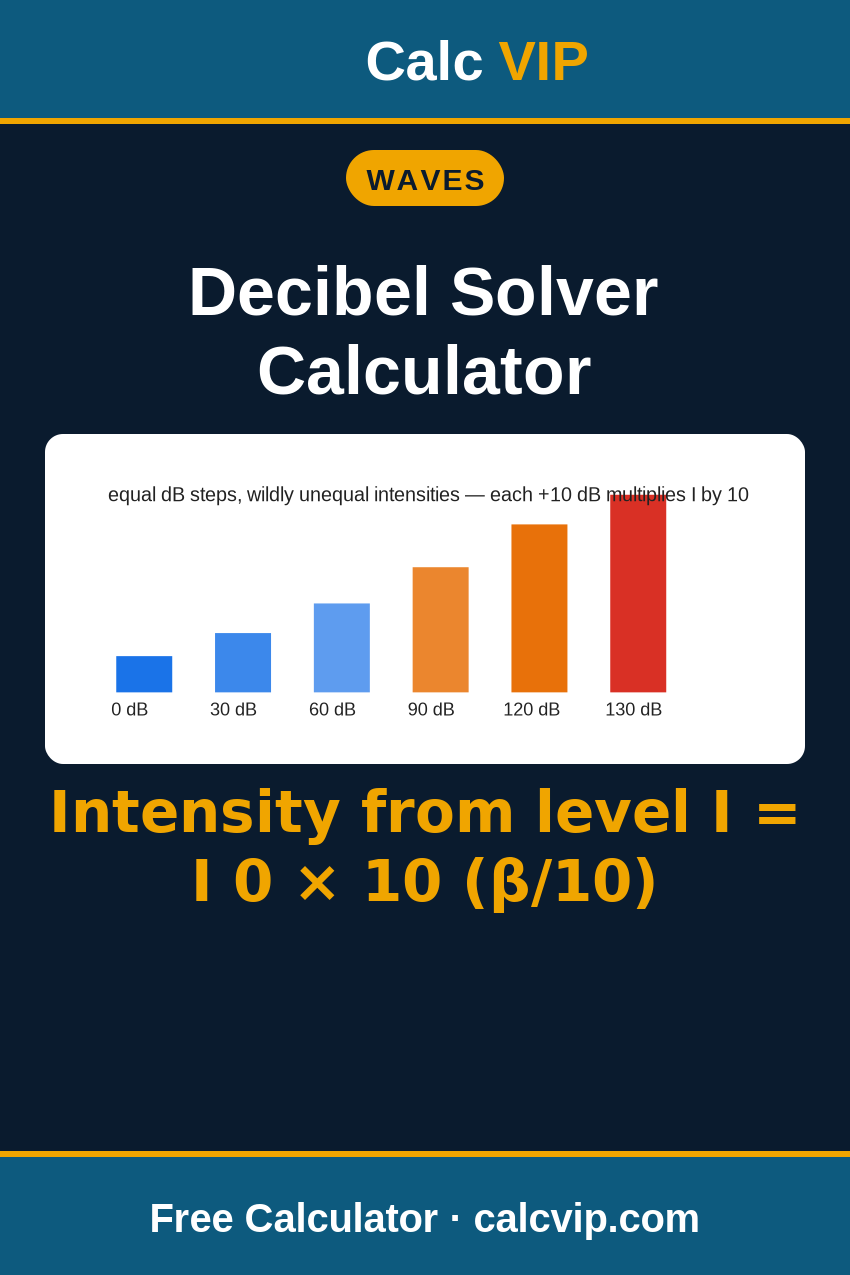
Two directions of travel cover nearly everything. Level → intensity, I = I0 × 10(β/10), is what you need when a regulation, a datasheet or a meter reading must become an actual energy flow — for hearing-damage calculations, for adding several sources together, for working out how much power a source must radiate. Level difference → ratio, I₂/I₁ = 10((β₂−β₁)/10), is what you need when comparing: how much louder is the factory than the library, the concert than the conversation. Master these two moves and decibels stop being a mysterious dialect and become what they always were — a compression scheme you can expand at will.
Formula
Intensity from level I = I0 × 10(β/10), with I0 = 1 × 10⁻¹² W/m² • Ratio from two levels I₂/I₁ = 10((β₂ − β₁)/10) • the forward formula is β = 10 × log10(I/I0)
Everything follows from one definition: the level β counts how many factors of ten the intensity stands above the reference I0, with each factor of ten worth 10 dB. Divide β by 10 and you have the number of powers of ten; raise 10 to that power and multiply by I0 and the intensity reappears. The ratio formula is the same idea with the reference cancelled out: only the difference of levels matters, so a 30 dB gap is a 10³ = 1,000× ratio wherever it sits on the scale — 40 vs 70 dB or 90 vs 120 dB alike. Three landmarks are worth fixing in memory: +10 dB = ×10 intensity, +3 dB ≈ ×2, and +1 dB ≈ ×1.26. With those, most decibel questions can be estimated in your head before the calculator confirms them.
| Symbol | Meaning | Units |
|---|---|---|
| β | sound intensity level | decibels (dB) |
| I | sound intensity — power per unit area | W/m² |
| I₀ | reference intensity — threshold of hearing | 1 × 10⁻¹² W/m² |
| β₂ − β₁ | level difference between two sounds | dB |
Why the ear itself is logarithmic
The decibel is not an arbitrary engineering trick; it matches the hardware it measures for. Your ear responds to intensity ratios, not intensity differences. A candle added to a dark room is obvious; the same candle added to a sunlit field is invisible — perception tracks proportion. Sound behaves the same way: the just-noticeable difference in loudness is roughly a constant percentage change in intensity (about 25%, near 1 dB), whether the sound is a whisper or a shout. A scale built on ratios — a logarithmic scale — therefore spaces perceptually equal steps equally. The decibel's ×10-per-10-dB ladder is the ear's own ladder, formalised.
This also explains the famous rule of thumb that +10 dB sounds about twice as loud. Ten times the intensity does not feel ten times as loud; psychoacoustic experiments consistently find that listeners judge a sound with ten times the intensity as roughly twice as loud. So the physical and perceptual scales pull apart in a fixed way: ×10 intensity (this calculator's world) ≈ ×2 loudness (the listener's world), and ×100 intensity ≈ ×4 loudness. Confusing the two is the root of most decibel misunderstandings in everyday argument — a "50% louder" amplifier setting and a "3 dB increase" are different claims about different scales, and the conversions on this page let you keep them straight.
How to use
- Choose a mode: "Intensity from a decibel level" to un-convert one level, or "Intensity ratio from two levels" to compare two sounds.
- For intensity mode, enter the level β in decibels. For ratio mode, enter both levels — the calculator reports how many times more intense the first is than the second (or how many times less, if it is quieter).
- Click "Calculate" and read the intensity in scientific notation, or the ratio as a plain multiplier.
- Cross-check with the landmarks: a level ending in 0 should give a clean power of ten times 10−12; a 10 dB difference should give exactly ×10; a 3 dB difference, almost exactly ×2.
Worked examples
Example 1 — busy traffic. What intensity is a 90 dB sound?
I = 10−12 × 10(90/10) = 10−12 × 109 = 0.001 W/m².
And compared with a 60 dB conversation, the ratio is 10((90−60)/10) = 1,000 times more intense — thirty decibels is three factors of ten.
Example 2 — the pain threshold. What intensity is 120 dB?
I = 10−12 × 1012 = 1 W/m². A full watt crossing every square metre — the top of the ear's range, and the anchor that makes the whole scale memorable: 0 dB is a trillionth of a watt, 120 dB is one watt.
Example 3 — a whisper. What intensity is a 30 dB whisper at close range?
I = 10−12 × 103 = 1 × 10⁻⁹ W/m² — a nanowatt per square metre, yet clearly audible in a quiet room. The ear is an astonishingly sensitive power meter.
Example 4 — vacuum cleaner vs quiet room. How many times more intense is a 70 dB vacuum cleaner than a 40 dB quiet room?
Ratio = 10((70−40)/10) = 10³ = 1,000 times. The same 30 dB gap as Example 1's traffic-versus-conversation — the ratio depends only on the gap, never on where it sits.
Example 5 — a small gap, honestly measured. How many times more intense is a 94 dB sound than an 88 dB sound?
Ratio = 10((94−88)/10) = 100.6 = 3.98 ≈ 4 times. Six decibels is a factor of four — two doublings of 3 dB each — a useful antidote to the feeling that "only 6 dB" must be negligible.
Example 6 — adding two machines. Two identical machines each produce 80 dB (I = 10−4 W/m²). Together their intensities add: I = 2 × 10⁻⁴ W/m².
β = 10 × log10(2 × 10⁻⁴ / 10−12) = 83 dB. To add decibels you must always travel through intensity — which is what this solver is for.
Decibel conversions in real life
Hearing-damage maths. Safe exposure times are computed from intensities: every +3 dB doubles the intensity and halves the permitted time. Converting a meter reading into W/m² is the first step of any honest risk assessment.
Adding sources. Factories, server rooms and orchestras contain many sources at once. Their decibels cannot be added, but their intensities can — convert each, add, convert back. Ten identical 80 dB machines give 90 dB, not 800.
Comparing products. A dishwasher rated 44 dB against one rated 38 dB: the gap is 6 dB, a factor of 100.6 ≈ 4 in intensity. Whether that is worth the price difference is a judgement — but now it is an informed one.
Amplifier power. Doubling amplifier watts buys +3 dB; ten times the watts buys +10 dB, which sounds about twice as loud. This is why a 100 W amp is not dramatically louder than a 10 W amp, and why speaker sensitivity (dB per watt) matters more than raw power.
Environmental reports. When a planning document says a development raises noise from 55 dB to 58 dB, the ratio mode translates: 100.3 ≈ 2 — the sound intensity at that home doubles. Small decibel changes in reports are rarely small physics.
Recording and mixing. Audio engineers ride faders marked in decibels precisely because the scale matches perception; converting a −6 dB fader move into a ×0.25 intensity change (and ×0.5 amplitude) is daily bread in the studio.
Decibels beyond sound
The decibel is a general-purpose ratio unit that escaped from acoustics. In electronics, amplifier gain is quoted in decibels — but with a twist: because electrical power goes as voltage squared, voltage ratios use 20 log10 instead of 10 log10, so +6 dB doubles a voltage while +3 dB doubles a power. Antenna gains, fibre-optic losses (dB per kilometre), signal-to-noise ratios, camera exposure values and even earthquake energy comparisons all borrow the same logarithmic skeleton. The sound version on this page uses the intensity reference I0 = 10−12 W/m² and the factor 10 — the right combination whenever the quantity is a power or an intensity. Meeting a "dB" figure anywhere else, the first question is always the same: a ratio of what, relative to what reference, with a factor of 10 or 20? Answer those and the conversion is the one you already know.
Quick reference: familiar sounds, un-converted
| Sound | Level | Intensity |
|---|---|---|
| threshold of hearing | 0 dB | 1 × 10⁻¹² W/m² |
| rustling leaves | 20 dB | 1 × 10⁻¹⁰ W/m² |
| whisper | 30 dB | 1 × 10⁻⁹ W/m² |
| quiet room | 40 dB | 1 × 10⁻⁸ W/m² |
| conversation | 60 dB | 1 × 10⁻⁶ W/m² |
| busy traffic | 80 dB | 1 × 10⁻⁴ W/m² |
| motorcycle nearby | 100 dB | 0.01 W/m² |
| threshold of pain | 120 dB | 1 W/m² |
Every 20 dB down the table is a factor of 100 in intensity; every 10 dB, a factor of 10. The table is the exponential curve of the diagram, written out as a shopping list of everyday sounds.
Averaging decibels: why the mean level is not the mean of levels
Noise regulations rarely quote an instant level; they quote a time average — the equivalent continuous level, Leq — and computing it is this solver's finest trick. Because decibels are logarithms, the honest average is an average of intensities, weighted by time, converted back at the end. Suppose a worker spends half a shift at 90 dB (I = 10−3 W/m²) and half at 70 dB (I = 10−5 W/m²). The naive average of the levels is 80 dB — and it is wrong by 7 dB. The intensity average is (10−3 + 10−5)/2 = 5.05 × 10⁻⁴ W/m², which converts back to β = 10 log10(5.05 × 10⁸) = 87 dB. The loud half-shift contributes a hundred times the intensity of the quiet half, so it drags the average to within 3 dB of itself; the quiet hours barely register. This is why a single loud hour can dominate a whole day's noise dose, why "it was only noisy for a few minutes" rarely rescues an exposure assessment, and why every professional noise meter performs exactly this convert–average–convert-back dance internally. Whenever you see an averaged, maximum or percentile decibel figure in a report, intensities were averaged underneath — never the decibels themselves.
The same machinery produces the percentile levels quoted in environmental surveys: L90, the level exceeded for 90% of the time, is read as the background hush between events, while L10 captures the intrusive peaks. Both are just orderly ways of slicing a long intensity record — further proof that once you can move freely between decibels and intensities, as this solver does, the entire professional vocabulary of noise measurement opens up.
Common mistakes
- Adding decibels like ordinary numbers. 60 dB + 60 dB is 63 dB, not 120 dB. Intensities add; decibels must be converted first — the single most common decibel error in the world.
- Reading a level difference as a percentage. "Only 3 dB more" is a doubling of intensity, and "10 dB more" is ten times, not ten percent more. Small decibel numbers routinely hide large physical changes.
- Forgetting the reference. A decibel level is meaningless without its reference: sound levels in air use I₀ = 10⁻¹² W/m² (equivalently 20 µPa of pressure). Underwater acoustics uses a different reference, so water and air decibels cannot be compared directly.
- Mixing the ×10 and ×20 formulas. Intensity and power ratios take 10 log₁₀; amplitude and pressure ratios take 20 log₁₀, because intensity goes as amplitude squared. Using 20 on an intensity understates or overstates by a factor of two in the exponent.
- Assuming 0 dB means no sound. 0 dB means the intensity equals the reference threshold — the sound is there, just at the edge of hearing. Sounds below it have negative levels and are simply too faint for human ears.
FAQ
Why does +10 dB mean ten times the intensity?
The decibel scale is logarithmic with a factor of 10 in the exponent: every 10 dB step multiplies the intensity by 10, and every 3 dB roughly doubles it.
Can a sound have a negative decibel level?
Yes — it just means the intensity is below the reference threshold of 10−12 W/m². Very quiet, specially built rooms measure below 0 dB.
If two identical 80 dB machines run together, is it 160 dB?
No. Their intensities add, doubling the intensity, which adds only about 3 dB — so the pair measures roughly 83 dB.
How many decibels is a doubling of intensity?
10 × log10(2) = 3.01 dB. Halving is −3.01 dB. This is the most-used conversion in acoustics: +3 dB per doubling, −3 dB per halving, −6 dB per quartering.
What does a 1 dB change correspond to?
A ratio of 100.1 = 1.26 — about 26% more intensity. It is roughly the smallest change an average listener can detect in a direct comparison, which is why audio equipment is specified to fractions of a decibel.
Is 100 dB twice as loud as 50 dB?
Physically it is 105 = 100,000 times the intensity. Perceptually, each +10 dB feels about twice as loud, so 100 dB feels roughly 2⁵ = 32 times as loud as 50 dB. Neither answer is "twice" — decibels punish casual reading.
Why do some meters show dB(A) instead of dB?
The A-weighting filters the measurement to mimic the ear's uneven sensitivity — we hear mid frequencies far better than bass or treble extremes. A dB(A) level converts to intensity with the same formula, but it describes the weighted intensity the ear effectively receives.
What intensity is 0.5 W/m² in decibels?
β = 10 × log10(0.5 / 10−12) = 10 × log10(5 × 10¹¹) ≈ 117 dB — just below the pain threshold.
Can two sounds cancel to give fewer decibels than either alone?
In special conditions, yes: identical waves meeting exactly out of phase interfere destructively — the principle behind noise-cancelling headphones, which manufacture an anti-phase copy. Ordinary unrelated sounds never cancel this way; their intensities simply add.
How loud is the loudest possible sound in air?
About 194 dB. Beyond that the rarefaction half of the wave would need to be a perfect vacuum, so the wave distorts into a shock wave instead — a ceiling set by the atmosphere itself, corresponding to an intensity of roughly 107 W/m² by the formula.