 Calc
Doppler Effect Calculator – Observed Frequency for a Moving Source
 Created by David Okafor · Physics Writer · Waves & Light · Last updated: November 2026
Use this free Doppler Effect Calculator to find the frequency a listener hears when a sound source is moving. Waves bunch up in front of a moving source (higher pitch) and spread out behind it (lower pitch).
You have heard the Doppler effect every time an ambulance, police car or train has swept past you. As the vehicle approaches, its siren or horn sounds high-pitched; the moment it passes, the pitch drops noticeably, and it stays lower as the vehicle speeds away. Nothing about the siren itself changes — it produces exactly the same note the whole time. What changes is the spacing of the sound waves arriving at your ears, and that spacing is set by the motion of the source.
Imagine the source dropping a wave crest into the air once every cycle, like a dripping tap dropping ripples into a pond. If the source stands still, the crests spread out in neat, evenly spaced circles. But if the source moves, it chases after its own waves: each new crest is emitted a little further forward than the last, so the crests ahead are squeezed closer together and the crests behind are stretched apart. Your ear measures the rate at which crests arrive, and that rate is the pitch you hear — closer spacing means a higher frequency, wider spacing a lower one.
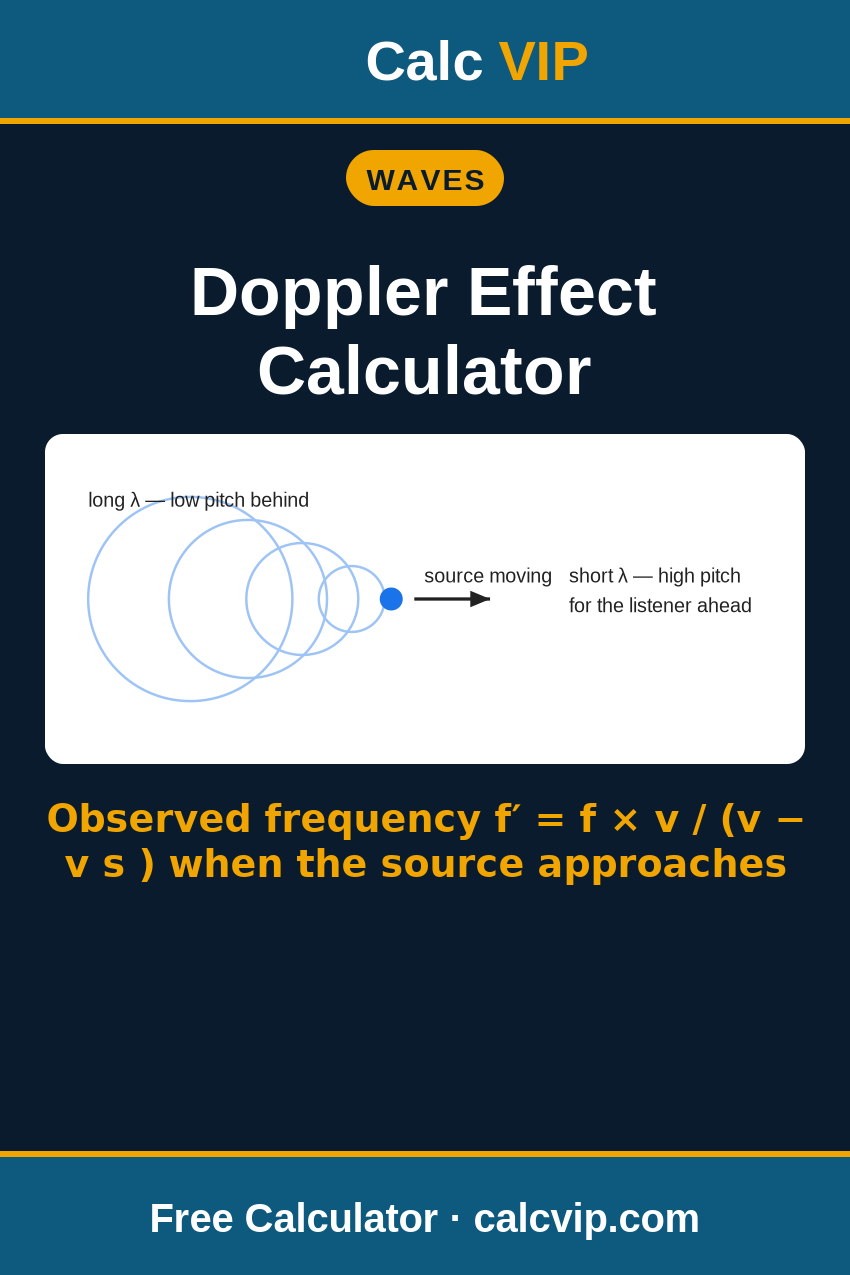
The size of the shift depends on how the source's speed compares with the speed of sound itself. A source at walking pace shifts the pitch by a fraction of a per cent — too little to notice. An ambulance at motorway speed shifts it by roughly a tenth — clearly audible. And as the source speed approaches the speed of sound, the waves ahead pile up into a single violent shock front: a sonic boom. This calculator covers the everyday range below that limit.
The effect carries the name of Christian Doppler, an Austrian physicist who proposed it in 1842 — originally for the colours of double stars, not for sound at all. The most charming test came three years later in the Netherlands, when the scientist Buys Ballot put trumpeters on an open railway wagon and musicians with perfect pitch on the platform of Utrecht station. As the train carried the trumpeters past at speed, the platform musicians noted the pitch rise on approach and fall on recession, matching Doppler's prediction. It remains one of the few fundamental physics effects you can demonstrate with a brass band and a steam train — and the same mathematics now steers spacecraft, reads the weather and listens to unborn hearts.
Formula
Observed frequency f′ = f × v / (v − vs) when the source approaches, and f′ = f × v / (v + vs) when it moves away • v = speed of sound, vs = source speed
The two versions are really one idea: approaching motion shrinks the wavelength, so the denominator shrinks and the frequency grows; receding motion stretches the wavelength, so the denominator grows and the frequency falls. The formula rearranges if you need the other quantities. Hearing f′ from a source of known f that is approaching, its speed was vs = v × (1 − f / f′) — for a 500 Hz siren heard at 547.92 Hz, vs = 343 × (1 − 500 ÷ 547.92) = 343 × 0.0875 = 30 m/s, the ambulance's speed. And the true frequency of a receding source can be recovered from what you hear: f = f′ × (v + vs) / v. Traffic radar and speed guns exploit this back-calculation, using radio waves instead of sound.
| Symbol | Meaning | Units |
|---|---|---|
| f | frequency the source actually emits | hertz (Hz) |
| f′ | frequency the listener observes | hertz (Hz) |
| v | speed of the wave in the medium (343 m/s for sound in air at 20°C) | m/s |
| vs | speed of the source through the medium | m/s |
Why the waves bunch up
The cleanest way to see the effect is to follow the wavelength. A 500 Hz source emits a crest every 1/500 of a second. In still air each crest travels at 343 m/s, so the crests settle into a spacing of 343 ÷ 500 = 0.686 m — the ordinary wavelength. Now let the source move at 30 m/s towards you. Between emitting one crest and the next, the source itself advances 30 ÷ 500 = 0.06 m, so each new crest starts 0.06 m closer to you than it otherwise would: the spacing ahead shrinks to 0.686 − 0.06 = 0.626 m. Those crests still pass you at 343 m/s, so they arrive at 343 ÷ 0.626 = 547.92 per second — the higher pitch. Behind the source the same logic stretches the spacing to 0.686 + 0.06 = 0.746 m, and the arrival rate drops to 343 ÷ 0.746 = 459.79 Hz. Nothing about the wave speed changes; only the spacing, and therefore the count of crests per second, is different.
Push the source faster and the bunching becomes extreme. At half the speed of sound the wavelength ahead is already halved. At exactly the speed of sound, every crest is emitted at the very point the previous crest has reached, so they all stack onto a single expanding shell — the sound barrier. A listener hears nothing of the approach, then everything at once as the shell arrives: a boom. Faster still, the source outruns its own waves entirely, trailing a cone of piled-up crests behind it (the Mach cone), and the boom is heard after the aircraft has already passed. Pilots quote such speeds in Mach numbers — the source speed divided by the speed of sound — so Mach 1 is 343 m/s at sea level, and this calculator's territory is everything below Mach 1.
How to use
- Enter the frequency the source actually produces, in hertz (Hz).
- Enter the speed of sound (343 m/s in air at 20°C is pre-filled) and the speed of the moving source.
- Choose whether the source is approaching the listener or moving away, then click "Calculate Observed Frequency".
- Make sure the source speed is in metres per second: to convert from km/h, divide by 3.6 — so a car at 108 km/h is travelling at 30 m/s.
Worked examples
Example 1 — the ambulance. An ambulance siren produces 500 Hz and travels at 30 m/s through air (v = 343 m/s).
Approaching: f′ = 500 × 343 ÷ (343 − 30) = 500 × 343 ÷ 313 = 547.92 Hz (higher pitch)
Moving away: f′ = 500 × 343 ÷ (343 + 30) = 500 × 343 ÷ 373 = 459.79 Hz (lower pitch)
The total drop as it passes is 547.92 − 459.79 = 88.13 Hz — a fall of about 16% from the approaching pitch, which is why the change sounds so dramatic.
Example 2 — a train horn. A train sounds a 400 Hz horn while approaching the platform at 25 m/s. f′ = 400 × 343 ÷ (343 − 25) = 137,200 ÷ 318 = 431.45 Hz. After it passes and recedes at the same speed, f′ = 137,200 ÷ (343 + 25) = 137,200 ÷ 368 = 372.83 Hz.
Example 3 — a slower source. A car horn of 600 Hz in town traffic moving at 20 m/s: approaching, f′ = 600 × 343 ÷ (343 − 20) = 205,800 ÷ 323 = 637.15 Hz; moving away, f′ = 205,800 ÷ (343 + 20) = 205,800 ÷ 363 = 566.94 Hz. Even at town speeds the shift is around ±6% — easily heard if you listen for it.
Example 4 — how big is the shift? For the ambulance in Example 1, the approaching shift is (547.92 − 500) ÷ 500 = 9.58% sharp. A useful rule of thumb: at speeds well below the speed of sound, the percentage shift is roughly the source speed as a percentage of 343 m/s — 30 ÷ 343 ≈ 8.7%, close to the exact 9.58% (the exact value is a little bigger because the denominator shrinks).
Example 5 — finding a speed from the shift. A car horn truly sounds 580 Hz. Standing at the roadside you record it approaching at 620 Hz. How fast is the car? Rearranging, vs = v × (1 − f / f′) = 343 × (1 − 580 ÷ 620) = 343 × 0.0645 = 22.13 m/s, which is 22.13 × 3.6 = 79.7 km/h. This is precisely the logic of a radar speed check, run here on sound instead of radio waves: measure the shift, recover the speed.
The Doppler effect in real life
Speed guns and radar. Police radar bounces radio waves off your car; the returning waves are Doppler-shifted by an amount proportional to your speed, and the gun works backwards to a speed reading. Weather radar uses the same trick on raindrops to map wind speeds inside storms.
Medicine. A Doppler ultrasound probe listens to sound reflected from moving blood cells. The shift reveals how fast blood is flowing and whether a heart valve or artery is narrowed — all without breaking the skin.
Astronomy. Light from a receding galaxy is stretched to lower frequencies — redshifted — and light from an approaching object is blueshifted. Measuring these shifts showed that the universe is expanding, and today they reveal planets tugging their stars back and forth.
Bats and dolphins. A bat listens to the Doppler shift of its own squeaks echoing off a flying insect to judge the insect's speed and direction.
Sport and road safety. The radar gun behind home plate measures a baseball's speed from the shift of its reflected radio waves, and the roadside sign that flashes your speed at you is doing the same calculation continuously, hoping the number slows you down.
Before birth. The handheld Doppler monitor a midwife presses to a mother's abdomen listens to ultrasound reflecting off the moving heart of an unborn baby, turning the shift into the reassuring rhythm of a heartbeat at around twice the mother's own rate.
Quick reference: how the shift grows with speed
| Source speed | Approaching shift | Receding shift |
|---|---|---|
| 10 m/s (36 km/h) | +3.00% | −2.83% |
| 20 m/s (72 km/h) | +6.19% | −5.51% |
| 30 m/s (108 km/h) | +9.58% | −8.04% |
| 50 m/s (180 km/h) | +17.06% | −12.72% |
Notice the asymmetry: the approaching shift is always bigger than the receding shift at the same speed, because approaching divides by (v − vs) while receding divides by (v + vs). It is also why the drop you hear as a vehicle passes is larger than either shift alone — your ear compares the raised pitch directly with the lowered one.
What if the listener moves instead?
This calculator covers a moving source and a stationary listener, but a moving listener hears a shift too — for a slightly different reason. If you drive towards a stationary siren, you simply meet the crests sooner, so they arrive faster: the formula becomes f′ = f × (v + vo) / v, where vo is your speed. At everyday speeds the two effects give nearly the same answer, which is why a passing siren sounds much the same whether you stand still or drive past it. They are not identical, though: a moving source physically changes the wavelength in the air, while a moving listener only changes how fast they run into the waves. For light there is no air to carry the waves, and Einstein's relativity blends the two cases into a single formula — the version astronomers use for redshift.
The two cases can be compared head-to-head. Take a 500 Hz siren and a closing speed of 20 m/s. If the source moves and you stand still, you hear f′ = 500 × 343 ÷ (343 − 20) = 530.96 Hz. If instead the siren is stationary and you drive towards it at 20 m/s, you hear f′ = 500 × (343 + 20) ÷ 343 = 529.15 Hz. The answers differ by less than 2 Hz — far too little to tell apart by ear — yet they are genuinely different, and at speeds near that of the wave itself the gap grows large. Sound in air can, in principle, tell you who is doing the moving; light in vacuum cannot, which was one of the clues that led to relativity.
Common mistakes
- Typing km/h straight in. The formula needs metres per second. Divide km/h by 3.6 first: 90 km/h is 25 m/s, not 90.
- Expecting the pitch to change gradually as it passes. The heard pitch is high (and steady) for the whole approach, then switches to low (and steady) for the whole retreat. The famous "eee-oww" is a sudden step, not a slide — plus a little smearing from the changing distance in real streets.
- Thinking the wave itself speeds up. Sound from a moving source still travels at 343 m/s. Only the wavelength and frequency change; the speed is fixed by the air.
- Using the sound formula for fast-moving light sources. For light, especially at a fair fraction of light speed, the relativistic formula is needed. The sound version here is exact for sound with a stationary listener.
- Ignoring the direction of travel. Only the component of motion directly towards or away from the listener counts. A source crossing in front of you at its closest point is, at that instant, neither approaching nor receding — which is why a drive-by horn seems to glide downwards in pitch around the moment of passing rather than switching in one jump when the source is very close and fast.
FAQ
Why does an ambulance siren drop in pitch as it passes?
While it approaches, each wave is emitted from a point closer to you, so the waves arrive bunched together — a higher frequency. Once it passes and moves away, the waves are stretched out, so you hear a lower frequency.
Does the Doppler effect work for light too?
Yes. Light from objects moving away from us is shifted to lower frequencies (redshift), which is how astronomers know distant galaxies are moving away from Earth.
What if the source moves at the speed of sound?
The waves pile up on top of each other in front of the source, forming a shock wave — a sonic boom. This calculator needs the source speed to be below the speed of sound.
What if both the source and the listener are moving?
Both effects combine: the source's motion changes the wavelength in the air, and the listener's motion changes how fast they meet the crests. If both move towards each other, the shifts add up; the general formula is f′ = f × (v + vo) / (v − vs) for approach.
Does a headwind change the Doppler shift?
Wind carries the sound waves along, effectively adding to the wave speed downwind. In practice the effect is small, and standard calculations — including this calculator — assume still air.
Why doesn't the pitch of a plane overhead drop suddenly?
It does shift, but the plane is far away, so the part of its motion directly towards or away from you changes slowly. The dramatic step happens for nearby sources passing close by, where the direction of motion flips quickly.
Can the Doppler effect measure things we cannot touch?
Yes — that is one of its great uses. Doctors measure blood flow, police measure car speeds, meteorologists measure winds inside storms, and astronomers measure the speeds of stars and galaxies, all from frequency shifts alone.
Does the Doppler effect change how loud the sound is?
No. The shift is purely in frequency — pitch, not volume. A passing siren does also get louder then quieter, but that is simply distance changing, a separate effect that would happen even if the pitch stayed fixed.
Does the effect happen with water waves?
Yes. A duck paddling across a pond makes ripples that are bunched in front of it and spread behind it, exactly like sound from a moving source. A boat going faster than its own waves leaves the familiar V-shaped wake, the watery version of a Mach cone.
What do you hear from a supersonic plane?
Nothing at all while it approaches — it outruns its own sound. Then the shock cone sweeps past you as a sudden boom (often a double boom, from the nose and tail shocks), and only afterwards can you hear the plane's engines, with their sound arriving from behind the plane's visible position and their events effectively heard in scrambled order.