 Calc
Doppler Source Frequency Solver – Find the True Frequency from the Observed Frequency
 Created by David Okafor · Physics Writer · Waves & Light · Last updated: November 2026
Use this free Doppler Source Frequency Solver Calculator to work backwards from the frequency you actually hear to the true frequency the source is emitting. It is the reverse of the usual Doppler question — handy for analysing sirens, horns and radar-style measurements.
Most Doppler problems run forwards: given the siren's true note and its speed, predict what you will hear. Real life usually runs the other way. You have a recording, a measurement, a pitch you actually heard — and you want the truth underneath it: what frequency is that source really emitting? That is the problem this solver tackles. It takes the observed frequency f′, the speed of sound, and the speeds and directions of source and observer, and unwraps the Doppler shift to recover the source's own frequency f.
The need is more common than it sounds. A manufacturer wants to certify that a siren truly produces its rated tone, but the test vehicle is moving. A researcher records a bat's call from a car, or a bird's song from a train, and must correct for the motion before the recording means anything. A musician tunes against a reference played from a moving parade float. In every case the measurement is contaminated by motion in a precisely known way — the Doppler formula — and anything known precisely can be inverted precisely. That inversion, done carefully with the right signs, is all this calculator does.
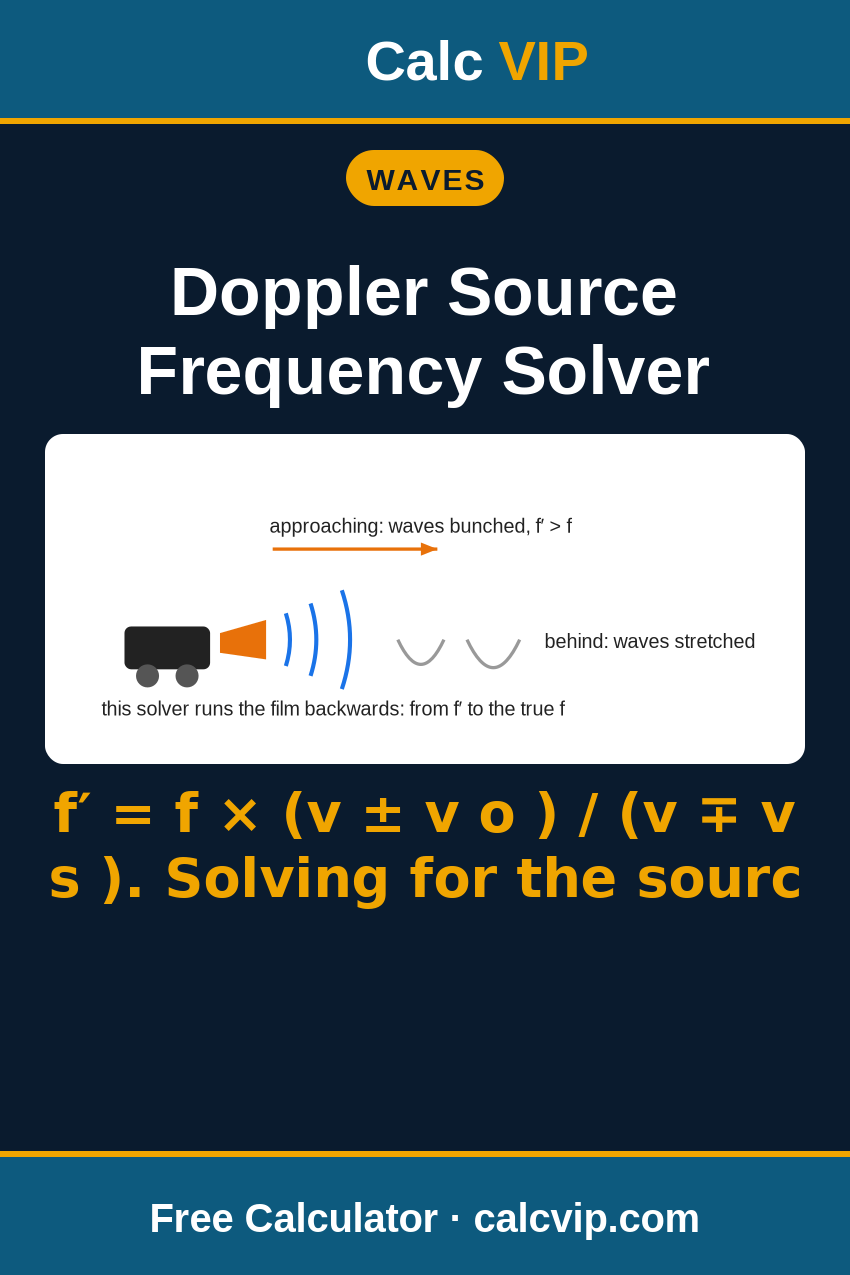
The signs are where the physics lives. Motion towards raises the observed pitch; motion away lowers it — but source motion and observer motion enter the formula in different places, one in the denominator and one in the numerator, and they are not interchangeable. A source moving towards you at 20 m/s shifts the pitch more than you moving towards a stationary source at 20 m/s, because a moving source physically compresses the wavelength in the air, while a moving observer merely crosses the waves faster. The solver keeps the two roles separate, with a direction choice for each, so the unwrapping respects that asymmetry instead of blurring it.
Formula
The Doppler effect says f′ = f × (v ± vo) / (v ∓ vs). Solving for the source frequency:
f = f′ × (v ∓ vs) / (v ± vo)
In the numerator (observer term): use + vo if the observer moves towards the source, − vo if away. In the denominator (source term): use − vs if the source moves towards the observer, + vs if away.
Read the forward formula physically and the inversion becomes obvious. A source moving towards the observer lays each new wave crest a little closer to the previous one — the wavelength in the air shrinks to λ × (v − vs)/v — so the observer receives crests faster: f′ rises by the factor v/(v − vs). An observer moving towards the source sweeps up crests at a rate increased by their own speed, gaining the factor (v + vo)/v. To undo the shift you multiply f′ by the exact reciprocal factors, which is what the solved formula does: the source term moves upstairs, the observer term stays as the divisor. Stationary participants contribute a speed of zero and drop out cleanly — set vs or vo to 0 and that factor becomes v/v = 1.
| Symbol | Meaning | Units |
|---|---|---|
| f | true frequency emitted by the source (the answer) | hertz (Hz) |
| f′ | observed frequency — what was measured | hertz (Hz) |
| v | speed of sound in the medium | m/s |
| vs | speed of the source | m/s |
| vo | speed of the observer | m/s |
Why source motion and observer motion are not the same
It feels as if only the relative speed should matter — closing at 20 m/s is closing at 20 m/s. For sound, it is not so, because sound has a medium and the medium keeps the accounts. When the source moves, it changes the wave itself: the wavelength frozen into the air behind and ahead of it is genuinely different, and every observer, moving or not, inherits that changed wavelength. When the observer moves, the waves in the air are untouched; only the rate at which this one listener crosses them changes. The numbers show the asymmetry: a 500 Hz source approaching at 40 m/s is heard at 500 × 343/303 = 566 Hz, while an observer approaching a stationary 500 Hz source at 40 m/s hears 500 × 383/343 = 558 Hz. Same closing speed, different pitch — a purely classical effect that disappears for light, where relativity makes source and observer motion truly equivalent.
The inversion inherits the asymmetry, which is why this solver asks about the two motions separately. Feed it an approaching-source scenario as if it were an approaching-observer one and the recovered "true" frequency will be wrong by several hertz — small, but exactly the kind of error that ruins a certification test or a bioacoustics dataset. There is a second asymmetry at the extremes: a source can approach the speed of sound and pile its waves into a shock front (the denominator v − vs collapses towards zero and f′ rockets), while no observer motion can do anything so dramatic — the numerator grows only linearly. The calculator guards both rails: it refuses source speeds at or above the speed of sound, where the formula stops describing pitch at all.
How to use
- Enter the frequency you measured — the observed frequency f′ — in hertz.
- Enter the speed of sound (343 m/s in air at 20 °C; adjust for temperature if your measurement demands precision).
- Enter the source's speed and choose whether it was moving towards the observer or away. Use 0 if the source was stationary.
- Enter the observer's speed and direction the same way (0 if the microphone or listener was fixed), then click "Find Source Frequency" to recover the true emitted frequency f.
Worked examples
Example 1 — the approaching siren. You hear a siren at 480 Hz as the vehicle approaches you at 20 m/s while you stand still. Take v = 343 m/s.
f = 480 × (343 − 20) / (343 + 0) = 480 × 323 / 343 = 452 Hz.
The siren's true frequency is about 452 Hz — the approach made it sound higher.
Example 2 — the receding train. A departing train's horn is measured at 420 Hz as it pulls away at 25 m/s; you are stationary.
f = 420 × (343 + 25) / 343 = 420 × 368 / 343 = 451 Hz. The true note is higher than what you heard — recession dragged it down, and the inversion restores it.
Example 3 — the moving listener. Driving towards a stationary factory whistle, you measure 500 Hz at a speed of 15 m/s.
f = 500 × 343 / (343 + 15) = 500 × 343 / 358 = 479 Hz. Your own motion inflated the reading by 21 Hz; the whistle itself sounds 479 Hz.
Example 4 — both moving. Two trains approach each other. From yours, doing 10 m/s, the other's horn (approaching at 30 m/s) is measured at 650 Hz.
f = 650 × (343 − 30) / (343 + 10) = 650 × 313 / 353 = 576 Hz. Both motions were raising the pitch; the inversion strips both away in one step.
Example 5 — running away from the sound. Cycling away from a stationary siren at 20 m/s, you hear 300 Hz.
f = 300 × 343 / (343 − 20) = 300 × 343 / 323 = 319 Hz. Outrunning the waves lowered what you heard; the source never changed.
Example 6 — a fast approach. A racing car's engine note is measured at 1,000 Hz as it approaches at 34.3 m/s — exactly a tenth of the speed of sound.
f = 1,000 × (343 − 34.3) / 343 = 1,000 × 0.9 = 900 Hz. At vs = v/10 the approach multiplies pitch by exactly 1/0.9 — a clean benchmark for checking any Doppler calculation.
Running Doppler backwards in real life
Bioacoustics. Bat and bird researchers record calls from moving vehicles and platforms, then invert the Doppler shift with the platform's logged speed to recover the animal's true call frequency — essential when species are identified by a few hertz.
Siren and horn certification. Regulations specify a siren's emitted frequency band. Drive-by tests measure f′, and this inversion converts the pass-by recording into the certified quantity: the frequency the device actually produces.
Medical Doppler ultrasound. A scanner measures the frequency shift of echoes from moving blood and runs the logic in reverse to report flow speed — the same algebra, with the blood as the moving "observer-source" and a factor of two for the round trip.
Police radar and speed guns. Radar uses the relativistic light version, twice over (out and back), inverting the returned frequency to read a vehicle's speed. The conceptual core — measured shift, known wave speed, unknown motion — is identical.
Astronomy's redshift. The spectral lines of a distant galaxy arrive shifted to lower frequencies; inverting the (relativistic) Doppler relation gives the recession speed, the measurement that revealed the expanding universe. This solver is the classical ancestor of that calculation.
Music and film sound. Sound designers synthesise pass-by effects by running the forward formula; analysts doing the reverse — identifying a vehicle or instrument from a recording — run this inversion, matching recovered f against known sources.
The pass-by: why pitch drops in two stages
Stand by a road and a passing siren does not glide smoothly from high to low — it holds a steady high note as it approaches, then steps down to a steady lower note as it recedes, with the change concentrated near the moment of passing. The formula explains it: only the component of velocity along the line joining source and observer counts. Far away, the vehicle moves almost directly towards you, so nearly its full speed feeds the shift and f′ sits at the approach value — for a 452 Hz siren at 20 m/s, 480 Hz. As it passes, the radial component collapses through zero (at the closest point the motion is purely sideways and the shift momentarily vanishes), then builds in reverse to the recession value, 452 × 343/363 ≈ 427 Hz. The famous "ee-oo" of a pass-by is the sound of a cosine curve. It also means a single recording contains the true frequency twice over: apply this solver to the approach plateau and to the recession plateau and the two recovered values of f should agree — a built-in consistency check that measurement scientists genuinely use.
Quick reference: a 500 Hz source at road speeds
| Source speed | Heard approaching | Heard receding |
|---|---|---|
| 10 m/s (36 km/h) | 515 Hz | 486 Hz |
| 20 m/s (72 km/h) | 531 Hz | 472 Hz |
| 30 m/s (108 km/h) | 548 Hz | 460 Hz |
| 40 m/s (144 km/h) | 566 Hz | 448 Hz |
Note the lopsidedness: at 40 m/s the approach adds 66 Hz but the recession removes only 52 Hz. The denominator's (v − vs) always bites harder than (v + vs) — the same asymmetry the solver untangles when it runs the numbers backwards.
Two plateaus, no unknowns: recovering f and the speed together
A passing source gives you two measurements — the approach pitch f′a and the recession pitch f′r — and they secretly determine everything. Write the two forward formulas and divide one by the other, and f cancels: f′a/f′r = (v + vs)/(v − vs), which solves to vs = v × (f′a − f′r)/(f′a + f′r). Add the two reciprocal equations instead and the speed cancels: the true frequency is the harmonic mean of the two heard pitches, f = 2 / (1/f′a + 1/f′r). Test it on the siren of the depth section: heard at 480 Hz approaching and 427 Hz receding, the harmonic mean is 2/(1/480 + 1/427) = 452 Hz, and the speed formula gives vs = 343 × 53/907 = 20 m/s — the full scenario recovered from the recording alone, with no speedometer anywhere. Traffic analysts and bioacousticians use exactly this pair of inversions when a source will not sit still to be measured.
Common mistakes
- Swapping the source and observer terms. Source speed belongs with the denominator, observer speed with the numerator. Interchanging them gives a plausible-looking but wrong answer — at 20 m/s the error is already several hertz.
- Getting the direction backwards. "Towards" for the source means (v − vs); for the observer it means (v + vo). Choosing "away" for an approaching vehicle flips the correction and doubles the error instead of removing the shift.
- Forgetting your own motion. A recording made from a moving car, boat or bicycle carries the observer term too. Analysts who correct only for the source bake a systematic error into every recovered frequency.
- Using the wrong speed of sound. v is 343 m/s only near 20 °C. A 10 °C error in temperature shifts v by 6 m/s and the recovered f by roughly 2% at road speeds — bigger than many effects being measured.
- Applying the formula at or beyond the speed of sound. At vs ≥ v the denominator collapses and the "pitch" concept dissolves into a shock wave. The solver refuses those inputs; nature refuses them too.
FAQ
Why is the true frequency lower than what I heard?
An approaching source bunches its waves together, so you receive them at a higher rate than they were emitted. Working backwards removes that bunching effect.
What if the source moves faster than sound?
The Doppler formula breaks down — the source outruns its own waves and creates a shock wave (a sonic boom) instead of a shifted pitch.
Does the same idea work for light?
Yes, in a relativistic form. Astronomers use the red shift of light from distant galaxies in exactly this spirit to measure how fast they are receding.
How big is the shift at everyday speeds?
Small but measurable: a source approaching at 20 m/s (72 km/h) raises pitch by the factor 343/323 ≈ 1.062 — about 6%, roughly one semitone in music. At 30 m/s it is about 9.6%, closing on two semitones.
Can I use this for a recording of a passing vehicle if I only know my own speed?
You need both speeds. If the other vehicle's speed is unknown, measure both the approach and recession plateaus of f′: their two equations share the same unknown f, and combining them lets you solve for the vehicle's speed as well.
Why does the formula need the speed of sound at all?
Because the shift is a ratio game: what matters is how the motion speeds compare with the wave speed. The same 20 m/s source in water (v = 1,480 m/s) would shift pitch by barely 1.4% instead of 6%.
Does wind affect the answer?
Wind carries the medium, effectively adding to or subtracting from the speeds along the sound's path. For precision work in wind, treat the speeds as measured relative to the air, not the ground.
What if both the approach and recession give different recovered f values?
Then one of the inputs is off — usually a speed, or the speed of sound for the day's temperature. Agreement between the two plateaus is the classic check that a Doppler analysis is sound.
Is the true frequency ever higher than both heard values?
No. For a pass-by, f always lies between the receding and approaching observations. If your recovered f falls outside that bracket, a direction has been entered the wrong way round.
How does this relate to the Doppler radar in weather forecasts?
Weather radar inverts the shift of echoes from raindrops to map wind motion inside storms — the same inverse problem, run millions of times per scan, with light's speed in place of sound's.