 Calc
Final Velocity Calculator – v = u + at Equation of Motion Solver
 Created by Sarah Mitchell · Physics Editor · Motion & Measurement · Last updated: November 2026
Use this free Final Velocity Calculator to find the velocity of an object after it accelerates for some time. Enter the starting velocity, the acceleration and the time, and you get the final velocity using the first equation of motion, v = u + at.
Of all the equations in kinematics, this is the one the world quietly runs on. Every time something speeds up or slows down at a steady rate — a train pulling away from a platform, a lift rising between floors, a car braking for a junction, a stone gathering speed as it falls — its velocity at the end of any interval is given by the same recipe: take the velocity it started with, and add the change that the acceleration built up during the time. The term at is literally "how much velocity the acceleration added": an acceleration of 2 m/s² acting for 4 s deposits exactly 8 m/s of extra velocity, whatever the object is and wherever it happens to be.
The equation's honesty lies in its one condition: the acceleration must stay constant over the interval. When it does — and gravity, good brakes, electric motors and rocket burns all come close for stretches at a time — v = u + at is not an approximation but an exact statement. When acceleration varies, the same idea survives in pieces: split the motion into short intervals over which the acceleration is nearly constant, apply the equation to each, and the pieces join up. That stitching process, formalised, is the calculus definition of velocity — which is why this modest formula is often the first equation of motion students meet, and the last one engineers stop using.
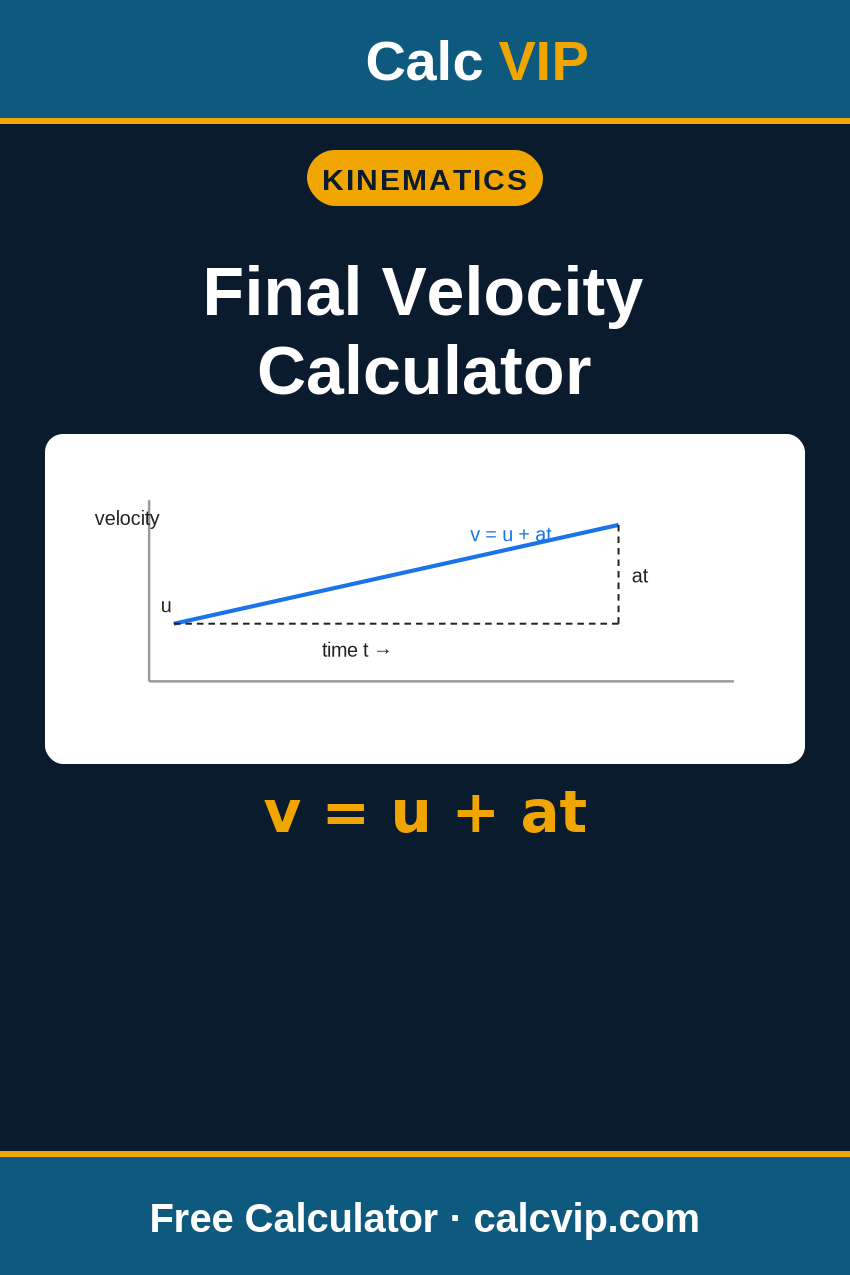
This calculator takes the three ingredients in their standard SI units — initial velocity u in m/s, acceleration a in m/s², time t in seconds — and returns the final velocity in m/s together with its km/h equivalent. Negative accelerations are welcome: enter a braking deceleration as a negative number and the calculator will show the velocity falling, all the way to a standstill and beyond into reverse if the time is long enough. Signs are not decoration here; they are the direction of the motion, and the worked examples below show how to read them.
Formula
Final velocity = Initial velocity + (Acceleration × Time) → v = u + at
Because the equation links four quantities, it rearranges to solve for any of them. The acceleration that produced a change: a = (v − u) / t. The time a change takes: t = (v − u) / a. The starting velocity, working backwards from the end: u = v − at. Each rearrangement is the same physics read from a different end — a crash investigator uses u = v − at with a measured skid deceleration to work out how fast a car was travelling when the brakes bit. Keep the signs consistent: choose a positive direction (usually the direction of travel), and any acceleration against it enters as negative. Units are equally strict: m/s, m/s² and seconds combine cleanly; if a velocity arrives in km/h, divide by 3.6 before it joins the equation.
| Symbol | Meaning | Units |
|---|---|---|
| v | final velocity — the velocity at the end of the interval | m/s |
| u | initial velocity — the velocity at the start | m/s |
| a | acceleration — the rate of change of velocity (constant) | m/s² |
| t | time over which the acceleration acts | s |
| at | the velocity gained (or lost) during the interval | m/s |
Velocity is a running total
The deepest way to read v = u + at is as bookkeeping. Velocity is a balance that acceleration keeps topping up or drawing down, second by second, at the rate a. After each second the balance grows by exactly a: starting from rest at a = 3 m/s², an object holds 3 m/s after one second, 6 after two, 9 after three — the formula simply jumps straight to the total after t seconds instead of counting the seconds aloud. This is why the equation stays true however the interval is chopped: apply it over the first half and then the second half, and the two partial gains add to the same at. Nothing is lost or created in the middle, because with constant acceleration there is nothing in the middle but steady accumulation.
On a velocity–time graph the same truth becomes geometry. Constant acceleration draws a straight line whose slope is a; the final velocity is the line's height at time t, and the vertical rise from u to v is the rectangle-plus-triangle slice of height at. The area under the line, meanwhile, is the displacement — which is how this first equation of motion shakes hands with its siblings s = ut + ½at² and v² = u² + 2as. Learn one and the others are rearrangements of the same picture: a straight velocity line, its slope, its endpoint and its area.
The sign convention deserves its own paragraph, because it is where the equation earns its keep. Velocity and acceleration are both vectors; in one dimension their directions are carried by signs. A negative a acting on a positive u first erases the forward velocity (the braking car), brings the object momentarily to rest (v = 0 when t = −u/a), and then builds velocity in the negative direction (the car rolling backwards, or a thrown ball past its peak, where u is up, a is gravity down, and v quietly changes sign at the top). One formula narrates the whole story without modification — provided you let the signs speak.
How to use
- Enter the initial velocity u in metres per second (m/s). Use 0 if the object starts from rest.
- Enter the acceleration a in m/s² — as a negative value if the object is slowing down or accelerating in the opposite direction.
- Enter the time t in seconds over which the acceleration acts.
- Click "Calculate Final Velocity" to see v in m/s and in km/h.
- If your starting velocity is in km/h, divide it by 3.6 first (100 km/h = 27.78 m/s); the calculator's km/h readout lets you check the conversion at the end.
Worked examples
Example 1 — the cyclist. A cyclist starts at u = 5 m/s and accelerates at a = 2 m/s² for t = 4 s. Final velocity v = 5 + (2 × 4) = 13 m/s, which is 13 × 3.6 = 46.8 km/h — brisk riding, built from a gentle push sustained for four seconds.
Example 2 — a car leaving the lights. From rest (u = 0), a car accelerates at a = 3 m/s² for 6 s: v = 0 + (3 × 6) = 18 m/s = 64.8 km/h. Starting from rest strips the formula to its skeleton, v = at — the entire final velocity is the acceleration's accumulated gift.
Example 3 — braking on the motorway. A car travelling at u = 30 m/s (108 km/h) brakes at a = −6 m/s² for 3 s: v = 30 + (−6 × 3) = 30 − 18 = 12 m/s (43.2 km/h). The negative acceleration subtracts velocity exactly as a positive one adds it — three seconds of firm braking shed more than half the car's speed.
Example 4 — a falling stone. Dropped from rest, a stone accelerates at g = 9.81 m/s². After 2.5 s: v = 0 + 9.81 × 2.5 = 24.53 m/s, or 88.29 km/h. Two and a half seconds of falling is enough to reach motorway speed, which is why even modest falls are dangerous and why this example appears in every safety course.
Example 5 — a train gathering speed. A train rolling at u = 12 m/s accelerates gently at a = 0.8 m/s² for 25 s: v = 12 + (0.8 × 25) = 12 + 20 = 32 m/s = 115.2 km/h. Small accelerations are not small results — given time, less than 1 m/s² turns a departing train into an express.
Example 6 — braking exactly to a stop. A van at u = 22 m/s brakes at a = −5.5 m/s². After 4 s: v = 22 − (5.5 × 4) = 0 m/s — a perfect stop. Rearranged, t = (v − u)/a = (0 − 22)/(−5.5) = 4 s confirms the timing, and in those 4 s the van covered its average velocity (11 m/s) × 4 s = 44 m — the stopping-distance calculation in embryo.
Final velocity in real life
0–100 km/h times. A car's brochure sprint time is v = u + at with u = 0 and v = 27.78 m/s: a 5-second car averages a = 27.78 ÷ 5 ≈ 5.6 m/s². The formula turns marketing numbers into the average acceleration the tyres and engine actually delivered.
Aircraft take-off. A jet must reach its rotation speed — say 75 m/s — within the runway. With a steady 3 m/s² of acceleration the equation gives the time, 25 s, and its sibling s = ½at² gives the 940 m of runway consumed; both numbers are checked before every departure.
Lifts and fairground rides. Ride designers work backwards from comfort: passengers tolerate about 1.5 m/s², so reaching a lift's cruising 4 m/s takes t = 4 ÷ 1.5 ≈ 2.7 s of gentle acceleration — a figure chosen by this equation, not by guesswork.
Crash reconstruction. Investigators measure a vehicle's braking deceleration from skid tests, then run the equation backwards — u = v − at — from the final rest state (v = 0) to recover the speed when braking began, evidence that stands up in court.
Spaceflight burns. A rocket's velocity change, its Δv, is exactly the at of a burn: a modest 0.5 m/s² sustained for 6 minutes adds 180 m/s. Mission plans are budgets of such additions, which is why burn durations are quoted to the second.
Sport sprinting. A sprinter reaching 10 m/s in about 2 s of drive phase has averaged a ≈ 5 m/s² horizontally — a number coaches extract from video timing gates by running this formula on each interval of the race.
When acceleration is not constant
Real vehicles rarely accelerate at a perfectly steady rate: a car's push fades as speed rises, a falling object meets growing air resistance, a cyclist's legs deliver pulses. The equation adapts in two ways. First, it can be applied piecewise — interval by interval, with each interval's final velocity becoming the next interval's u; with short enough intervals the result is as accurate as you need, and this is literally how flight simulators and games update motion dozens of times per second. Second, if you know the average acceleration over an interval, v = u + āt is exact for the endpoints. What the formula cannot do is rescue a single average acceleration guessed carelessly — with strongly varying acceleration, endpoints-only arithmetic must be replaced by the piecewise approach or by calculus, which is this same stitching carried to the limit.
The equation in two dimensions: one component at a time
Velocity and acceleration are vectors, and v = u + at holds for each component separately — which is what makes projectile motion solvable. Throw a ball at 20 m/s at 30° above the horizontal and its velocity splits into ux = 20 cos 30° = 17.32 m/s horizontally and uy = 20 sin 30° = 10 m/s vertically. Gravity accelerates only the vertical component, so the horizontal equation reads vx = 17.32 + 0 × t = 17.32 m/s forever, while the vertical one reads vy = 10 − 9.81t. At t = 10 ÷ 9.81 ≈ 1.02 s the vertical component passes through zero — the top of the flight — and the ball's whole velocity at that instant is its untouched horizontal 17.32 m/s. Two copies of one simple equation, one with a = 0 and one with a = −g, describe the entire arc; the calculators elsewhere in this batch that deal with projectiles are built on exactly this split.
Quick reference: velocity gained from rest
| Acceleration | After 2 s | After 5 s | After 10 s |
|---|---|---|---|
| 1 m/s² (gentle lift) | 2 m/s | 5 m/s | 10 m/s |
| 3 m/s² (brisk car) | 6 m/s | 15 m/s | 30 m/s |
| 5.6 m/s² (sports car) | 11.2 m/s | 28 m/s | 56 m/s |
| 9.81 m/s² (free fall) | 19.62 m/s | 49.05 m/s | 98.1 m/s |
Every row is v = at with u = 0. The free-fall row is the sobering one: ten seconds of falling reaches 98.1 m/s — 353 km/h — which is why falling objects so quickly pass from harmless to lethal, and why parachutes exist to break the accumulation this table celebrates.
Common mistakes
- Feeding in km/h. The equation needs u in m/s when a is in m/s². A car at 72 km/h has u = 20 m/s, not 72 — divide by 3.6 first, or the answer is inflated beyond sense.
- Using a positive sign for braking. If the object slows, the acceleration opposes the velocity and must be negative. Entering +6 instead of −6 turns a braking car into a speeding one.
- Assuming the formula needs the distance. It does not — v = u + at is the one SUVAT equation with no s in it. If a problem gives distance instead of time, a different equation (v² = u² + 2as) is the right tool.
- Applying it through a change of acceleration. One value of a must rule the whole interval. If a bus accelerates then cruises, that is two intervals and two applications, the first v feeding the second as u.
- Panicking at a negative answer. A negative v is not an error; it means the object now moves in the negative direction — backwards, downwards past the start level, or returning. Read it as direction, and check whether the story makes sense.
FAQ
Which equation of motion is v = u + at?
It is the first equation of motion. It links final velocity, initial velocity, acceleration and time, and it works whenever the acceleration stays constant.
Can acceleration be negative?
Yes. A negative acceleration (deceleration) makes the final velocity smaller than the initial velocity, which is what happens when a vehicle brakes.
What if the object starts from rest?
Then u = 0 and the formula becomes simply v = at.
How long until a braking object stops?
Set v = 0 and rearrange: t = −u/a (with a negative, this gives a positive time). A car at 20 m/s braking at −5 m/s² stops in exactly 4 s — and this calculator confirms it: 20 + (−5 × 4) = 0.
Does the object's mass matter?
Not in this equation. Mass decides how much force a given acceleration requires (F = ma), but once the acceleration is known, the velocity change at is the same for a bicycle and a lorry.
What if acceleration changes halfway through?
Split the motion at the change. Calculate v at the end of the first interval, then use it as the u of the second interval with the new acceleration. The two applications join seamlessly.
Can I use this for a falling object?
Yes — set a = 9.81 m/s² (or −9.81 if up is positive) and u to the velocity at the moment you start timing. Ignore air resistance, as all such calculations do, and the result is excellent for dense objects over short falls.
Why is the answer sometimes in km/h?
Because m/s is unintuitive for road speeds. The calculator shows both: multiply m/s by 3.6 for km/h. A final velocity of 13 m/s is 46.8 km/h.
What is the difference between v = u + at and v² = u² + 2as?
The first trades in time, the second in distance. Use v = u + at when you know (or want) the time; use v² = u² + 2as when the displacement is the known quantity and time is absent.
Is average velocity hidden in this formula?
Yes. For constant acceleration the average velocity over the interval is (u + v)/2, exactly midway — because the velocity grows steadily from u to v. It is the quickest way to the displacement: s = ((u + v)/2) × t.