 Calc
Conductor Surface Field Calculator – E = σ/ε0 Just Outside a Charged Conductor
 Created by Thomas Becker · Physics Writer · Electricity & Magnetism · Last updated: November 2026
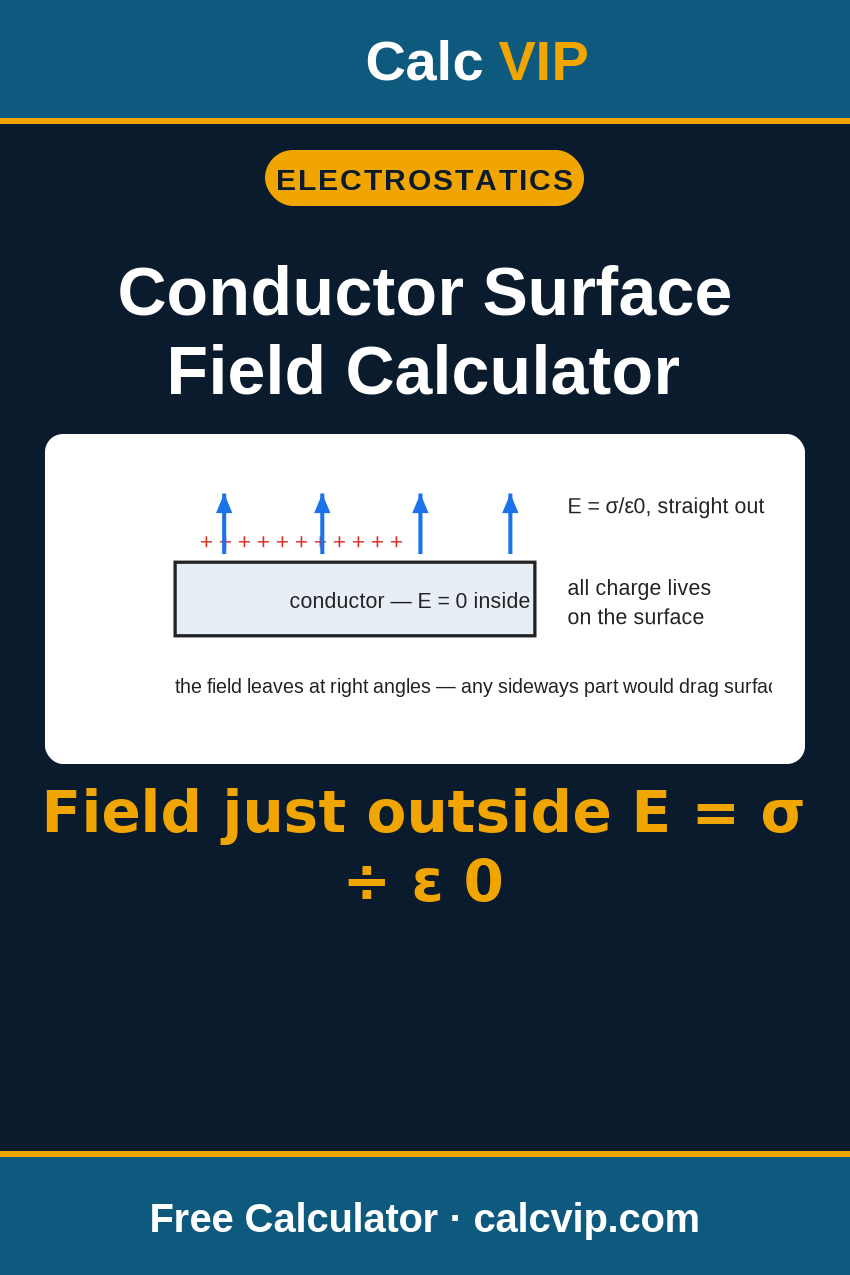
Use this free Conductor Surface Field Calculator to find the electric field just outside a charged conductor, E = σ/ε0. On a conductor, all the charge sits on the surface, and the field just outside is perpendicular to that surface. You can enter the surface charge density σ directly, or let the calculator work it out from the total charge Q and surface area A. Scientific notation works — for example 8.854e-6.
Conductors are the great organisers of electrostatics. Give a piece of metal some spare charge and its free electrons (or the atoms they leave behind) rearrange within a fraction of a second until every trace of field inside the metal has been cancelled. What survives is a remarkably clean arrangement: all the charge spread over the outer surface, none inside, and a field outside that leaves the surface at exactly right angles, with a strength set by one number — the local surface charge density σ, the coulombs per square metre, divided by ε0. No other detail of the conductor's shape or history matters for the field at a flat patch of its surface.
The formula's one surprise is the missing factor of 2. A free-standing charged sheet, with field escaping from both faces, gives σ/(2ε0) on each side. A conductor manages twice that outside, because the field that "would have" gone inwards is forbidden — the interior must stay at zero — so the full effect appears outside. This calculator handles both entry routes: type σ directly if you know it, or give the total charge Q and surface area A and it will divide them for you, then report the outside field and remind you that the inside field is exactly zero.
The numbers involved explain a lot of everyday drama. Air breaks down at about 3 × 10⁶ N/C, which caps σ at ε0 × 3 × 10⁶ ≈ 2.66 × 10⁻⁵ C/m² — about 27 microcoulombs per square metre — no matter how determined the charging. Where a surface curves sharply, charge crowds in, σ soars locally, and that cap is reached at the tip long before the rest of the surface is stressed: the whole theory of lightning rods, corona discharge and high-voltage design grows out of this one page's formula.
Formula
Field just outside E = σ ÷ ε0 • Surface charge density σ = Q ÷ A • Field inside = 0 • ε0 = 8.854 × 10⁻¹² C²/(N·m²)
The pair rearranges for design work: σ = E × ε0 tells you how much charge per square metre a target field requires (or permits), and Q = E × ε0 × A gives the total charge a surface of area A carries when its field is E. The most useful rearrangement is a limit rather than an answer: setting E to air's breakdown strength, 3 × 10⁶ N/C, gives σmax ≈ 2.66 × 10⁻⁵ C/m², the most charge any square metre of surface can hold in open air. Note that ε0 is doing all the unit conversion here — σ in C/m² divided by ε0 lands in N/C because ε0 is precisely the constant that measures how much field a given surface charge produces in vacuum.
| Symbol | Meaning | Units |
|---|---|---|
| E | field just outside the surface | N/C |
| σ | surface charge density | C/m² |
| Q | total charge on the conductor | coulombs (C) |
| A | total surface area the charge spreads over | m² |
| ε0 | permittivity of free space | 8.854 × 10⁻¹² |
The pillbox argument: where σ/ε0 comes from
Here is the whole derivation in one picture. Straddle the surface with a tiny imaginary can — a "pillbox" — whose top face sits just outside the conductor and whose bottom face sits just inside. Field can only escape through the top face, because inside the conductor the field is zero and the can's sides are negligibly thin. Gauss's law says the total escape of field through a closed surface equals the enclosed charge divided by ε0. The enclosed charge is σ times the face area, and the escape is E times the same area; the areas cancel and E = σ/ε0 falls out. No approximation is involved — the result is exact for any conductor, at any flat-enough patch of its surface.
Run the same pillbox over a free-standing charged sheet and the picture changes: field escapes through both faces of the can, so each side carries half, giving σ/(2ε0) per side. The conductor's trick is that it has already spent its internal field budget getting to equilibrium — the interior is a field-free zone the pillbox cannot draw from. This is also why the field just outside a conductor is exactly twice the field just outside one face of a charged insulator with the same σ, a comparison examiners love and students reliably reverse.
How to use
- Choose the input mode: "σ directly" if you already know the surface charge density, or "from Q and A" if you know the total charge and the area it spreads over.
- Enter the values — scientific notation like 8.854e-6 is welcome, and for a sphere remember A = 4πR² (for R = 0.1 m, A = 0.1257 m²).
- Click "Calculate" to see σ, the field just outside the surface, and the (always zero) field inside.
- Compare the outside field with 3 × 10⁶ N/C: above it, the surrounding air would break down and the charge would leak away as corona or sparks — the surface cannot actually hold that much charge in open air.
- For curved surfaces, treat the result as the local field where the local σ applies; σ itself varies from place to place on anything that is not flat or spherical.
Worked examples
Example 1 — the reference surface. A conductor carries Q = 8.854 × 10⁻⁶ C spread over A = 1 m².
σ = Q ÷ A = 8.854 × 10⁻⁶ C/m², and E = σ ÷ ε0 = 8.854 × 10⁻⁶ ÷ 8.854 × 10⁻¹² = 1,000,000 N/C just outside — and 0 inside, always. (The charge was chosen so σ numerically equals ε0 × 10⁶; it makes a handy calibration case.)
Example 2 — entering σ directly. A lightly charged panel has σ = 1 × 10⁻⁹ C/m².
E = 1 × 10⁻⁹ ÷ 8.854 × 10⁻¹² = 112.9 N/C — coincidentally close to the Earth's fair-weather field, which is no accident: the ground beneath a charged sky is itself a conductor surface, and this is roughly its σ at work.
Example 3 — a charged sphere, two ways. A metal sphere of radius 0.1 m holds Q = 1 × 10⁻⁶ C. Its area is A = 4π × 0.1² = 0.1257 m², so σ = 1 × 10⁻⁶ ÷ 0.1257 = 7.96 × 10⁻⁶ C/m² and E = σ/ε0 = 898,774 N/C at the surface. Cross-check with the point-charge formula, kQ/R² = 8.99 × 10⁹ × 10⁻⁶ ÷ 0.01 = 899,000 N/C — the same answer (the whisker of difference is the rounded k), because a sphere's outside field is its centre-charge field.
Example 4 — the most charge air allows. What is the largest σ a surface can hold in air?
σmax = ε0 × Ebreakdown = 8.854 × 10⁻¹² × 3 × 10⁶ = 2.66 × 10⁻⁵ C/m². Any attempt to pack more charge onto a square metre ends with the excess leaving as corona discharge — nature enforces the cap.
Example 5 — a Van de Graaff dome. The dome (radius 0.25 m, area 4π × 0.25² = 0.785 m²) carries Q = 5 × 10⁻⁶ C.
σ = 5 × 10⁻⁶ ÷ 0.785 = 6.37 × 10⁻⁶ C/m²; E = 6.37 × 10⁻⁶ ÷ 8.854 × 10⁻¹² = 719,019 N/C at the surface — comfortably below breakdown, which is why the dome is big and smooth: size spreads charge and tames σ.
Example 6 — the ground under a thundercloud. Field meters at the surface read about 1 × 10⁵ N/C before a strike. The induced σ on the ground (a conductor) is σ = ε0 × E = 8.854 × 10⁻¹² × 1 × 10⁵ = 8.85 × 10⁻⁷ C/m² — under a microcoulomb per square metre, yet spread over a hillside it sums to the enormous charge that a lightning bolt then rearranges.
Conductor surfaces in real life
Lightning rods. A rod's tip has a tiny radius, so charge crowds there, σ spikes, and the local field reaches breakdown long before the field elsewhere does. The rod thus launches the discharge channel on its own terms and gives the bolt a chosen path — applied charge-crowding, straight from E = σ/ε0.
Faraday cages. A car's body, an aircraft skin, a screened room: external fields terminate on surface charge, the interior field stays zero, and occupants and electronics sit in the quiet inside. The pillbox argument is the whole explanation.
Electrostatic precipitators. Collector plates are conductors whose surface fields must be strong enough to hold charged ash against the gas flow yet below sparking. Plate σ is a design variable, tuned through exactly this formula.
Corona wires and ionisers. A thin wire is an extreme curve: modest total charge produces huge σ and a field past breakdown in a thin shell around the wire, ionising air for precipitators, photocopiers and ionising air purifiers — breakdown used as a tool.
High-voltage switchgear. Engineers round every edge and add stress-relief rings to busbars because any sharp feature concentrates σ and starts corona, which erodes insulation and wastes power. Smoothness is an electrical specification, not an aesthetic one.
Electrostatic spray painting. Charged paint droplets land on a grounded metal workpiece — a conductor whose induced surface charge pulls the droplets in, even around the back. The wrap-around coverage that makes the process efficient is surface-charge physics.
Curvature, crowding and the Earth's own surface charge
On a conductor of varied shape, equilibrium demands one potential everywhere, and geometry then dictates that σ is largest where the surface is most sharply curved — roughly, σ grows as the surface gets pointier. A sphere connected to a dome shares charge so that the small sphere carries the higher σ; in the limit, a needle's tip reaches breakdown σ while the rest of the object is barely charged. This is why high-voltage terminals are polished balls, why damaged power lines hiss with corona at their nicks, and why a lightning rod can be a slender spike: it volunteers its tip as the place where the field first exceeds 3 × 10⁶ N/C.
The grandest conductor surface of all is the one under your feet. The Earth carries a net charge of roughly −5 × 10⁵ C spread over its 5.1 × 10¹⁴ m², giving σ ≈ −9.8 × 10⁻¹⁰ C/m² and a surface field of about 111 N/C — the fair-weather field of Example 2, computed here from the planet's own charge. That the two routes agree is a quiet triumph for the formula: the atmosphere's downward field is simply the field just outside the conducting Earth.
Quick reference: σ and the field it makes
| Surface density σ | Field just outside | Seen on |
|---|---|---|
| 1 × 10⁻⁹ C/m² | 113 N/C | the ground in fair weather |
| 1 × 10⁻⁷ C/m² | 11,294 N/C | ground under a storm cloud |
| 1 × 10⁻⁶ C/m² | 112,943 N/C | charged machine panels |
| 8.854 × 10⁻⁶ C/m² | 1,000,000 N/C | Example 1's reference surface |
| 2.66 × 10⁻⁵ C/m² | 3,000,000 N/C | air's breakdown limit — the ceiling |
Every row is the same division by ε0: multiply σ by ten and the field follows. The table's last row is a hard boundary — beyond it the charge simply refuses to stay.
Common mistakes
- Halving the answer out of habit. σ/(2ε0) is the field of a free-standing charged sheet, shared between two sides. A conductor puts everything outside: σ/ε0. Decide which object you have before dividing.
- Using the wrong area. σ uses the conductor's total outer surface area — both faces of a plate, the full 4πR² of a sphere — because that is where the charge spreads. Using one face of a thin plate halves σ and doubles the error in E.
- Expecting a field inside. In electrostatic equilibrium the interior field of a conductor is exactly zero, hollow or solid. If a problem seems to need an inside field, either charges are still moving (not equilibrium) or the object is not a conductor.
- Assuming σ is uniform on odd shapes. Q ÷ A gives the average σ. On pointed or lumpy conductors the local σ — and the local field, which is what sparks — can be many times the average. The calculator's E is the field where that σ actually is.
- Forgetting the air ceiling. The formula happily returns 10⁸ N/C for a huge σ, but air surrenders at 3 × 10⁶ N/C. Real surfaces in air cannot hold σ above about 2.66 × 10⁻⁵ C/m²; the excess leaves as corona whether your design invites it or not.
FAQ
Why is the field zero inside a conductor?
Free charges in the conductor move until they cancel any field inside. If a field remained, the charges would keep moving — so in the settled (electrostatic) state the inside field must be zero, and all spare charge ends up on the surface.
Why is E = σ/ε0 here but σ/(2ε0) for a charged sheet?
An isolated non-conducting sheet sends its field out of both faces, so each side gets half. A conductor has no field inside, so the full field appears on the outside face only — twice as strong.
Is σ the same everywhere on the surface?
Only on a flat or spherical surface. On a curved conductor, charge crowds where the surface curves most sharply (like a pointed tip), so σ — and the field — is largest there. That is how lightning rods work.
Does the field just outside depend on the conductor's material?
No — copper, aluminium and steel all give E = σ/ε0 for the same σ. The material decides how fast equilibrium is reached and how much charge can be delivered, not the field a given surface density produces. ε0 is a property of the vacuum (near enough, of air), not of the metal.
What is the field just inside the surface?
Zero, all the way through the material — and then, at the surface, it steps discontinuously to σ/ε0 outside. That jump is the fingerprint of a surface charge layer: the field changes by exactly σ/ε0 crossing any charged surface.
How much charge can a 1 m² panel hold in air?
At most σmax × A ≈ 2.66 × 10⁻⁵ C — about 27 µC — before corona drains the excess. In practice engineers stay well below this; humidity and dust lower the real ceiling further.
Why does the field leave the surface at right angles?
Any sideways (tangential) component would push the surface charges along the surface, and they would move until that component vanished. Equilibrium therefore permits only the perpendicular component — which is also why a conductor's surface is an equipotential.
Does a hollow conductor shield its cavity?
Yes, if no charge is placed inside: the cavity field is zero regardless of the charge outside, which is the Faraday-cage effect. Put a charge inside the cavity, though, and an equal induced charge appears on the inner surface, with fields to match.
How is σ measured in practice?
Indirectly, through the field: a field mill or electrostatic voltmeter just above the surface reads E, and σ = ε0E follows. This is how the Earth's surface charge and the charge on industrial webs and films are monitored without touching them.
What changes if the conductor is in oil or a dielectric instead of air?
The surface field formula becomes E = σ/ε, with ε = ε0εr for the surrounding material, so the same σ makes a weaker field — one reason oil-filled equipment tolerates more surface charge. The interior field stays exactly zero either way.