 Calc
Dielectric Strength Calculator – Maximum Voltage Before Breakdown
 Created by Thomas Becker · Physics Writer · Electricity & Magnetism · Last updated: November 2026
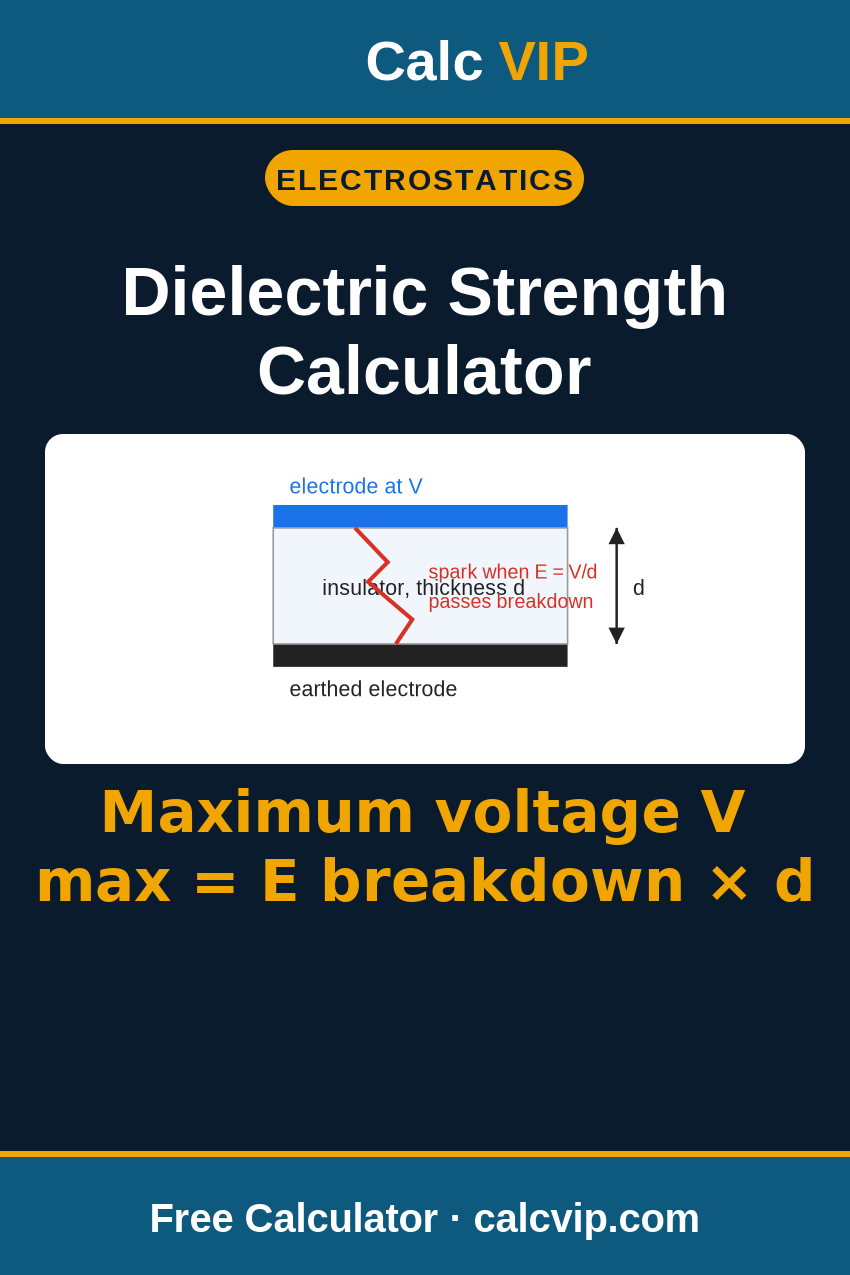
Use this free Dielectric Strength Calculator to find the maximum voltage an insulating material can stand before it breaks down and sparks through. Every insulator has a breakdown field: if the field across it passes that value, the material suddenly conducts. The maximum safe voltage is simply the breakdown field multiplied by the thickness. Pick a material — air, mica or paper — or enter a custom breakdown field.
Every insulator is a dam with a rated height. Below its breakdown field it holds charge apart indefinitely; above it, the material's own atoms are torn into ions, a conductive channel avalanches through, and the dam bursts in a spark. Dielectric strength is that rated height expressed as a field — volts per metre — and the practical consequence is disarmingly simple: the voltage an insulating layer can stand is the breakdown field times the layer's thickness. This calculator holds values for air, mica and paper, and accepts a custom breakdown field for any other material.
The linearity is the design lever. What damages insulation is never voltage alone but voltage crowded — V squeezed across a small distance d. Double the thickness and the same material stands double the voltage, because the field V/d is halved. Conversely, a modest voltage across a microscopic gap is a ferocious field: 12 V across a micrometre is 1.2 × 10⁷ V/m, beyond the strength of most solids, which is why thin films and chip insulators live dangerously despite their toy voltages.
The three built-in materials sketch the landscape. Air, at 3 MV/m, is the weakest common insulator and the one that matters most, because it surrounds everything. Paper (16 MV/m) serves inside oil-filled transformers. Mica (118 MV/m) is the aristocrat — a natural mineral that splits into flawless sheets and stands nearly forty times air's field, which is why it insulates heating elements and high-voltage capacitors where nothing else survives. Real engineering values carry margins, as the depth section explains, but the ideal numbers are where every design starts.
Formula
Maximum voltage Vmax = Ebreakdown × d • V in volts, E in volts per metre, d in metres
The rearrangements answer the design questions in both directions: d = V ÷ Ebreakdown gives the thickness a given voltage demands, and Ebreakdown = V ÷ d tells you what strength a material must have to survive a fixed geometry. The calculator takes the breakdown field in MV/m and the thickness in millimetres, converting both — a mercy, since the raw multiplication (118 × 10⁶ V/m × 0.0001 m) is exactly where powers of ten go missing. One conversion is worth memorising: 1 MV/m = 1 kV/mm, so a material's strength in MV/m is numerically the kilovolts each millimetre of it can hold. Air: 3 kV per millimetre. Mica: 118 kV per millimetre.
| Symbol | Meaning | Units |
|---|---|---|
| Vmax | largest voltage the layer can stand | volts (V) |
| Ebreakdown | dielectric strength of the material | V/m (entered in MV/m) |
| d | thickness of the insulating layer | metres (entered in mm) |
What breakdown actually is: the avalanche
An insulator is not empty of charge carriers — it has a few stray free electrons, from cosmic rays and thermal luck. In a weak field they drift harmlessly. But past a critical field, an electron accelerates enough between collisions to knock an electron off the next molecule it strikes, and now there are two carriers, then four, then millions — an avalanche. The channel heats, glows and conducts: a spark. In gases the process is visible as lightning and corona; in solids it is worse, because the channel is a permanent carbonised track — solid insulation that has broken down once is broken forever, while air heals itself the moment the field collapses.
One refinement matters for long gaps: once an avalanche channel — a streamer — forms, its tip carries the electrode's potential deep into the gap, so the rest of the distance needs a far weaker average field to keep the channel growing. Across metre-scale air gaps the average breakdown gradient can fall well below the 3 MV/m small-gap figure, which is why lightning can bridge kilometres and why clearance tables for the highest voltages are not simple multiples of the per-millimetre rule.
The avalanche picture explains the otherwise odd facts of breakdown. It needs a minimum run-up distance, so very thin layers stand higher fields than the bulk value (there is no room to avalanche). It depends on how often carriers collide, so gas breakdown tracks pressure × gap (Paschen's law) rather than gap alone — which is why aircraft wiring, at altitude's thin air, sparks at voltages that sea-level air would hold. And it starts where the field is highest, at sharp points and edges, which is why the conductor-surface formula E = σ/ε0 and this one are really two halves of one subject: geometry concentrates the field, and breakdown is what happens when the concentration wins.
How to use
- Pick the insulating material — air, mica or paper — or choose "Custom" and type a breakdown field in MV/m from a datasheet.
- Enter the thickness of the layer (or the size of the air gap) in millimetres.
- Click "Calculate" to get the breakdown field and the maximum voltage, in volts and kilovolts.
- Treat the answer as a cliff edge, not a working value: real designs operate at a half to a fifth of Vmax, because humidity, ageing, sharp edges and dirt all lower the real strength.
- To find a required thickness, run the calculator by trial: adjust the thickness until Vmax clears your voltage with the margin you want — or use d = V ÷ Ebreakdown directly, as in Example 6.
Worked examples
Example 1 — mica, the reference case. A mica sheet 0.1 mm thick, strength 118 MV/m.
Vmax = 118 × 10⁶ × 0.0001 = 11,800 V (11.8 kV). A tenth of a millimetre of mica out-insulates a centimetre of air — the reason mica appears wherever heat and voltage meet.
Example 2 — a working air gap. How much can a 5 mm air gap hold?
Vmax = 3 × 10⁶ × 0.005 = 15,000 V. High-voltage terminals spaced 5 mm apart are therefore at their limit around 15 kV in ideal conditions — and sensibly rated lower.
Example 3 — transformer paper. A layer of insulation paper 0.05 mm thick (16 MV/m).
Vmax = 16 × 10⁶ × 5 × 10⁻⁵ = 800 V per layer. Transformer windings stack many such layers, in oil, precisely because one sheet is only an 800 V dam.
Example 4 — a custom material. A polymer film with a datasheet strength of 20 MV/m, used at 2 mm.
Vmax = 20 × 10⁶ × 0.002 = 40,000 V (40 kV). The custom mode exists for exactly this: modern films, oils and resins all publish strengths, and the arithmetic is always the same multiplication.
Example 5 — the spark plug. A plug gap of 0.8 mm in air needs, at minimum, V = 3 × 10⁶ × 0.0008 = 2,400 V to spark at atmospheric pressure. In a real cylinder the mixture is compressed, collisions are more frequent, and the required voltage climbs several-fold — which is why ignition coils deliver 20 kV and more, keeping a fat margin over the ideal-gap figure.
Example 6 — designing backwards. How thick must mica be to stand 50 kV?
d = V ÷ E = 50,000 ÷ 118 × 10⁶ = 4.24 × 10⁻⁴ m = 0.42 mm — and a prudent engineer, applying a safety factor, would specify a millimetre and sleep soundly.
Dielectric strength in real life
Lightning. A thundercloud raises the field through kilometres of air until somewhere it passes ~3 MV/m; the avalanche channel then stitches cloud to ground in a stepped leader, and the main stroke follows. Even 100 m of air at breakdown field corresponds to 3 × 10⁸ V — the scale of potentials a storm assembles for free.
High-voltage cables. Underground power cables wrap their conductors in cross-linked polyethylene rated by exactly this formula; the insulation thickness is chosen from d = V/E with margins for decades of ageing, and joints — where geometry concentrates the field — are the engineering weak point.
Capacitor selection. A capacitor's voltage rating is its dielectric's Vmax with margin. Film capacitors quote both the dielectric strength and the thickness implicitly through the rating; exceeding it punctures the film at its thinnest flaw.
PCB creepage and clearance. Circuit-board standards specify millimetres of air gap and surface path per kilovolt — dielectric-strength arithmetic codified, with extra allowance for pollution and altitude, because boards must not spark in the real world of dust and damp.
Fuel and powder safety. Static sparks ignite vapour when a charged surface's field breaks down the air gap to an earthed fitting. Bonding, grounding and humidity control in fuel farms are all strategies for keeping every field below 3 MV/m.
Power-line insulators. The stacked-disc strings on transmission towers are thickness, multiplied: each disc adds its stand-off distance, rain sheds keep the surface path dry, and the string's total length is a Vmax calculation you can read from the roadside.
Why thin films beat the table: the run-up effect
The avalanche needs room to develop. An electron must accelerate over several collisions before the cascade multiplies, so in a layer only micrometres thick the process starves: there simply are not enough generations of impact ionisation to build a conducting channel. The measured consequence is that very thin films stand fields far above their bulk dielectric strength — polymer films a few micrometres thick routinely rate at several hundred MV/m, and the nanometre oxides inside integrated circuits survive fields that would be fantasy in a cable. This is why the tabulated strength is quoted for a specified thickness and test geometry, and why extrapolating Vmax = E × d down to film thicknesses with the bulk E is conservative: the film is stronger than the multiplication suggests. The calculator's linear law is the right first estimate everywhere, but at the thin end, nature adds a bonus the formula does not claim.
Heat and frequency quietly tax the table from the other side. Warm insulation conducts more, its molecules are easier to ionise, and its strength sags — a cable in a hot duct is not the cable that passed its cold test. Rapidly alternating fields add dielectric heating: the material absorbs a little energy every cycle, warms itself, and can fail thermally below its electrical limit, a failure mode called thermal runaway. Long service at high field also drives slow chemical ageing — trees of microscopic damage growing from any point where partial discharges nibble. The tabulated strength is thus best read as the material's strength on its best day, when new, cool, dry and briefly tested. Engineering is the discipline of the other days.
Why real ratings fall short of the table
Datasheet dielectric strengths are measured on flawless samples, in dry air, between polished spheres, for seconds. Service life is none of those things. Moisture films turn surfaces into conductors and slash air-gap strength; dust and salt do the same on outdoor insulators. Sharp edges concentrate the field far above V/d — the average field can look safe while a corner is already avalanching, eating the insulation by a thousand tiny partial discharges. Heat ages polymers, ultraviolet embrittles them, and every previous over-voltage leaves its scar. The professional response is the safety factor: design fields of a half, a third, even a fifth of the tabulated strength are normal, and standards for clearances encode a century of expensive lessons. Use this calculator to find the cliff — then build the fence well back from it.
Quick reference: maximum voltage by thickness
| Thickness | Air (3 MV/m) | Paper (16 MV/m) | Mica (118 MV/m) |
|---|---|---|---|
| 0.1 mm | 300 V | 1,600 V | 11,800 V |
| 0.5 mm | 1,500 V | 8,000 V | 59,000 V |
| 1 mm | 3,000 V | 16,000 V | 118,000 V |
| 2 mm | 6,000 V | 32,000 V | 236,000 V |
Every column is a straight multiplication — which is the point. Insulation design begins as arithmetic this simple; the engineering is in the margins, materials and geometry around it.
Common mistakes
- Treating dielectric strength as a voltage. It is a field — volts per metre. "Mica withstands 118" is meaningless until a thickness is supplied; 118 MV/m across 0.1 mm is 11.8 kV, across 1 mm is 118 kV.
- Millimetre slips. The thickness must reach the formula in metres. Entering 0.1 (mm) as 0.1 m inflates Vmax a thousandfold — the calculator takes mm precisely to spare you this.
- Designing to the full Vmax. The tabulated strength is a laboratory cliff edge. Humidity, edges, ageing and dirt all erode it; working at the full value guarantees eventual failure. Halve it at least.
- Using air's value inside equipment. The gap inside a device may be across a surface (creepage), through a solid, or through humid, dusty air — all weaker than the clean-air figure. Identify the actual weakest path before choosing the number.
- Assuming a thicker layer raises the strength. Thickness raises the voltage, not the field limit: Ebreakdown is a material property (for bulk samples). Doubling d doubles Vmax at exactly the same breakdown field.
FAQ
What is dielectric strength?
It is the largest electric field an insulating material can withstand without breaking down — measured in volts per metre (V/m), often quoted in MV/m or kV/mm. Past that field the insulator ionises and a spark or arc punches through it.
Why does air break down at about 3 MV/m?
That is why a 1 mm air gap can only hold about 3,000 V. Lightning is air breakdown on a huge scale: once the field in a storm cloud passes roughly 3 MV/m, the air conducts and the charge escapes as a flash.
Does a thicker insulator always help?
Yes — the safe voltage grows in direct proportion to thickness, because what matters is the field V/d. Doubling the thickness doubles the voltage the layer can stand (for the same material).
Is breakdown permanent?
In solids, yes — the avalanche melts or carbonises a channel, and the layer is weakened forever, usually failing again at lower voltage. In gases and liquids the medium flows back and largely heals, which is why spark plugs and air gaps can break down millions of times by design.
What is corona, and how does it differ from breakdown?
Corona is partial breakdown: the field exceeds strength only in a small region, usually around a sharp point or thin wire, so a local glow discharge forms without a full spark bridging the gap. It wastes energy, makes ozone and radio noise, and slowly erodes insulation — a warning shot rather than the full failure.
Does AC break insulation down more easily than DC?
Comparisons use the peak of the AC wave, since breakdown happens at the field's maximum. AC also reverses the avalanche's space charge each half-cycle, and repetitive partial discharges age insulation faster, so AC ratings are usually more conservative than DC ones for the same material.
Why is transformer oil used if paper is stronger?
Oil impregnates the paper, filling the air voids — and it is the voids, with air's low 3 MV/m, that would fail first. The composite is far stronger than either alone, and the oil also cools the windings. Insulation systems are designed as teams, not solo materials.
Is a vacuum a good insulator?
Excellent in one way — there is nothing to ionise, so no avalanche — but limited by electrons field-emitted from the cathode surface itself. Clean vacuum gaps hold tens of MV/m, which is why vacuum interrupters switch high-voltage circuits. "Nothing" turns out to be a respectable dielectric.
Why do sparks jump further in low pressure?
Fewer molecules mean longer free runs between collisions, so electrons gather avalanche energy more easily — up to a point (Paschen's law has a minimum; extremely hard vacuum insulates again). Aircraft at altitude live on the wrong side of this curve, and their clearances are specified accordingly.
What is the strongest practical dielectric?
Among everyday materials, mica (118 MV/m here) and good polymer films and ceramics reach 100–300 MV/m in thin, flawless layers. Diamond and high-grade alumina go further still. The catch is always the same: strength falls as area and thickness grow, because a bigger sample offers the avalanche more flaws to start from.