 Calc
Coulomb's Law Calculator – Electric Force Between Two Charges
 Created by Thomas Becker · Physics Writer · Electricity & Magnetism · Last updated: November 2026
Use this free Coulomb's Law Calculator to find the electric force between two point charges. Charges are tiny, so you can type them in scientific notation — for example 1e-6 means one microcoulomb (0.000001 C).
Every electric phenomenon begins with a push or a pull between charges, and Coulomb's law is the rule that sizes it. Published by Charles-Augustin de Coulomb in 1785 after exquisitely delicate experiments with a torsion balance — an instrument that measured forces by the twist of a fine wire — the law says the force between two charges grows in proportion to each charge and fades with the square of the distance between them. It is the founding equation of electrostatics: the electric field, the atom and the lightning bolt are all downstream of it.
The constant k that sets the law's scale is enormous — 8.99 × 10⁹ — and that enormity is itself information. It says that even microcoulombs, millionths of the unit, exert measurable forces at arm's length, and that a whole coulomb of separated charge would be a violent thing indeed: two one-coulomb charges a metre apart would repel with about nine billion newtons. Everyday charges stay minuscule precisely because the force grows so fast; nature balances her books in trillionths. The calculator handles the small numbers gracefully, in scientific notation, and reports not just the force's size but its character — attraction or repulsion.
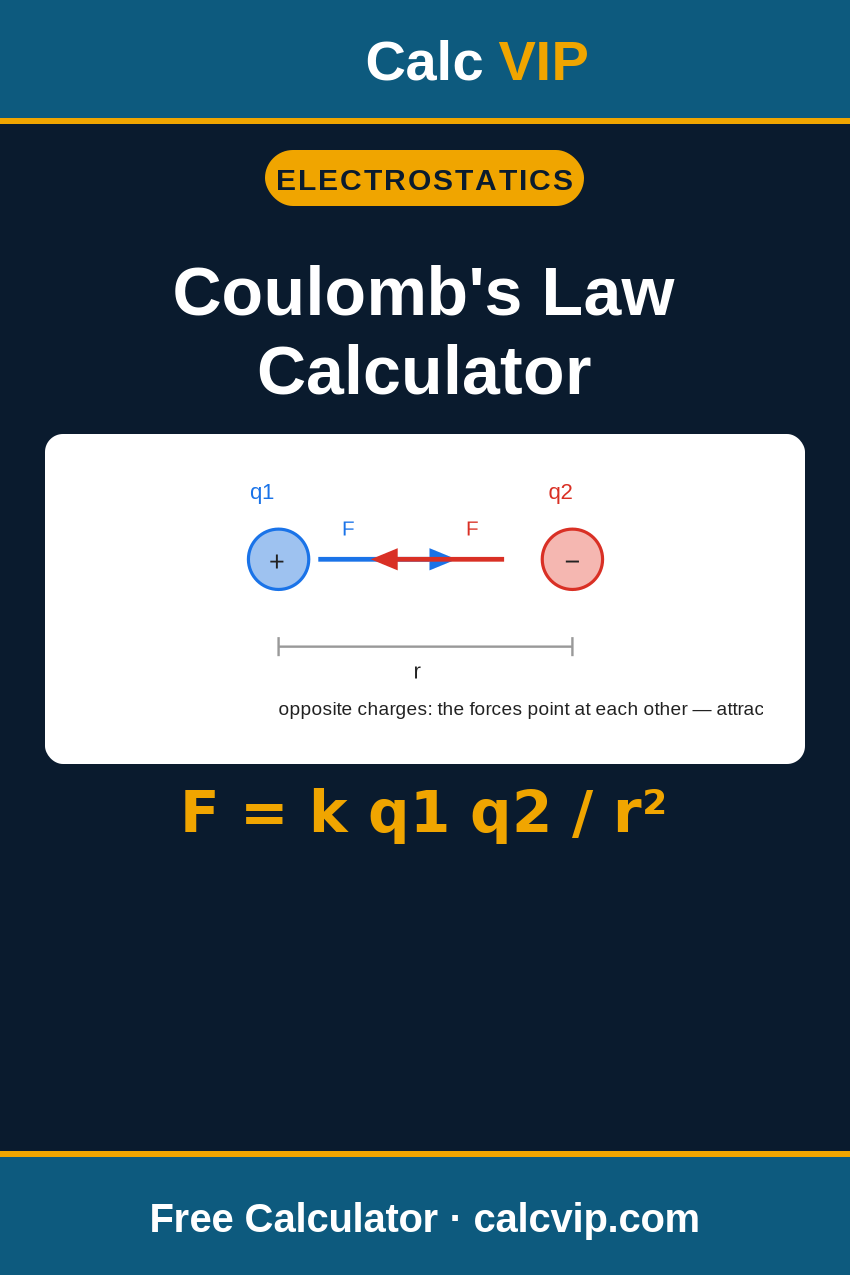
The direction rule is the one everyone knows: like charges repel, opposite charges attract. What is less often appreciated is that the force is a partnership — each charge pulls or pushes the other with exactly the same strength, Newton's third law holding inside the atom as faithfully as on the motorway. And the inverse-square fall-off places Coulomb's law in a famous family: gravity obeys the same geometry, a kinship the concept section below explores, because both forces can be pictured as influence spreading over the surface of an ever-growing sphere.
Formula
Force = k × q1 × q2 ÷ r² → F = k q1 q2 / r², where k = 8.99 × 10⁹ N·m²/C²
Read the formula as three instructions: multiply the charges (bigger charges, proportionally bigger force), divide by the square of the separation (distance is the law's strongest lever), and scale by k, the constant that converts the whole arrangement into newtons. The sign of the product q1 × q2 carries the direction: positive product, repulsion; negative product, attraction — the calculator reports both the magnitude in newtons and the character of the force. Rearranged, the law also gives a charge from a measured force, or the separation at which a target force occurs (Example 6). Units must be plain coulombs and metres; microcoulombs and centimetres are the two prefixes that most often sabotage the arithmetic.
| Symbol | Meaning | Units |
|---|---|---|
| F | electric force between the charges | newtons (N) |
| k | Coulomb's constant, 8.99 × 10⁹ | N·m²/C² |
| q1, q2 | the two charges (sign matters: + or −) | coulombs (C) |
| r | distance between the charges' centres — squared in the formula | metres (m) |
An inverse-square law: the geometry of spreading
Why the square? Picture the influence of a charge streaming outward equally in all directions, like light from a bulb. At distance r that influence is spread over a sphere of area 4πr² — four times the area at twice the distance, nine times at three times. Anything diluted over the sphere's surface must thin as 1/r², and the force does exactly that. The same picture explains gravity's identical fall-off, and it makes the law's predictions visceral: step twice as far from a charge and you stand on a sphere with four times the surface, feeling a quarter of the push.
The inverse square has a sharp practical edge: proximity is power. Halving a separation quadruples the force, which is why static cling works only at millimetre range, why dust leaps the last fraction of a millimetre onto a charged screen, and why the forces inside atoms — where separations are ten-billionths of a metre — are so ferocious despite the tiny charges involved. It also means the law's point-charge idealisation matters: for real extended objects the distance is measured between charge centres, and when charged objects come very close, their charges redistribute across the facing surfaces, politely breaking the simple formula's assumptions.
How to use
- Enter both charges in coulombs — scientific notation like 1e-6 works fine. Use a minus sign for a negative charge.
- Enter the distance between the centres of the charges, in metres.
- Click "Calculate". The result tells you the size of the force and whether the charges attract or repel.
- Experiment with the distance: doubling it should quarter the force. If it does not, a sign or a prefix has slipped — the inverse-square behaviour is the calculator's built-in lie detector.
Worked examples
Example 1 — repulsion between microcoulombs. Two positive charges, q1 = 1 × 10⁻⁶ C and q2 = 2 × 10⁻⁶ C, are 0.5 m apart.
F = 8.99 × 10⁹ × (1 × 10⁻⁶ × 2 × 10⁻⁶) ÷ 0.5²
F = 8.99 × 10⁹ × 2 × 10⁻¹² ÷ 0.25 = 0.0719 N — and because both charges are positive, the force is repulsive. Seventy-two millinewtons is about the weight of a 7-gram object: small, but easily felt by Coulomb's torsion wire.
Example 2 — attraction. Charges of +3 × 10⁻⁶ C and −3 × 10⁻⁶ C are 0.3 m apart.
F = 8.99 × 10⁹ × (3 × 10⁻⁶ × 3 × 10⁻⁶) ÷ 0.09 = 8.99 × 10⁹ × 9 × 10⁻¹² ÷ 0.09 = 0.899 N, and the opposite signs make it attractive — nearly a newton of pull between two specks of charge you could not see.
Example 3 — the price of distance. Example 1's charges, moved from 0.5 m to 1 m apart.
F = 8.99 × 10⁹ × 2 × 10⁻¹² ÷ 1 = 0.018 N — almost exactly a quarter of 0.0719 N. No new physics was needed: the inverse square predicted the whole change, and the graph above is this example drawn out.
Example 4 — two electrons. Two electrons (charge 1.6 × 10⁻¹⁹ C each) sit 1 × 10⁻¹⁰ m apart — atomic spacing.
F = 8.99 × 10⁹ × (1.6 × 10⁻¹⁹)² ÷ (1 × 10⁻¹⁰)² = 2.3 × 10⁻⁸ N, repulsive. Tiny in newtons, but an electron weighs almost nothing: this force accelerates it at some 10²¹ times the acceleration of gravity. Inside atoms, electricity is not a gentle force.
Example 5 — why big charges stay fiction. Suppose two charges of 1 mC each (1 × 10⁻³ C) could be held 1 m apart.
F = 8.99 × 10⁹ × (1 × 10⁻³ × 1 × 10⁻³) = 8,990 N — roughly the weight of a small car, from two millicoulombs. This is why real static charges are measured in microcoulombs: anything larger tears itself apart or discharges through the air long before it accumulates.
Example 6 — finding the distance. Two charges of 1 × 10⁻⁶ C each repel with a force of 0.1 N. How far apart are they?
Rearranged, r = √(k q1 q2 ÷ F) = √(8.99 × 10⁹ × 1 × 10⁻¹² ÷ 0.1) = √0.0899 = 0.30 m. Force measurements become rulers at small scales — Coulomb's own method, and the principle behind several modern force microscopes.
Coulomb's law in real life
Photocopiers and laser printers. A charged drum attracts oppositely charged toner particles exactly where light has not discharged it; the toner then transfers to paper carrying the opposite charge. Every printed page is Coulomb's law herding billions of microscopic charges into letters.
Electrostatic precipitators. Power stations and cement works clean their exhaust by charging smoke and dust particles and pulling them onto oppositely charged plates. The attraction this page calculates, applied to trillions of particles, keeps tonnes of ash out of the sky.
Electrostatic spray painting. Paint droplets are given one charge and the car body the opposite; the attraction wraps paint around edges and into recesses that a straight spray would miss, wasting less and coating more evenly. Powder coating works the same way, baked on afterwards.
The structure of everything. The attraction between electrons and nuclei — Coulomb's law at femtometre scale — is what holds atoms together, and the balance of attractions and repulsions between atoms is chemistry itself. Every bond, every reaction, every material property is this force negotiating.
Static shocks and clinging clothes. Rubbing separates charges by friction; the forces that then make clothes cling, hair rise and doorknobs spark are Coulomb attractions and repulsions across millimetres. The spark itself is the air giving up: the field grows until the air ionises and the accumulated charge escapes at once.
Lightning. A thundercloud is a charge-separating machine, parking opposite charges kilometres apart until the attraction's field exceeds what air can insulate. The bolt is Coulomb's law collecting its debt — the largest-scale demonstration of the force this calculator sizes with microcoulombs.
Electric force against gravity: the 10³⁹ mismatch
Put an electron and a proton side by side and both of physics' great inverse-square forces act at once. The electric attraction is k q²/r²; the gravitational attraction is G me mp/r². The r² cancels in the ratio, leaving a pure number: the electric force is about 2.3 × 10³⁹ times stronger. Gravity between the atom's own particles is, for all chemical purposes, nonexistent — a whisper beside a shout. Yet gravity, not electricity, runs the cosmos. The resolution is bookkeeping: charges come in two signs and cancel almost perfectly in bulk matter, while mass comes in one sign and only accumulates. Planets are electrically neutral to exquisite precision, so their quadrillions of cancelling charges fall silent and feeble gravity, never cancelled, inherits the universe. Coulomb's law is incomparably stronger — and almost perfectly hidden.
Quick reference: force against distance
For the charges of Example 1 (1 µC and 2 µC), the force at a glance — the inverse square in tabular form:
| Distance r | Force F | Compared with 0.5 m |
|---|---|---|
| 0.25 m | 0.288 N | 4 times stronger |
| 0.5 m | 0.0719 N | — |
| 1 m | 0.018 N | 4 times weaker |
| 2 m | 0.0045 N | 16 times weaker |
One more subtlety belongs in any reference: the constant k quoted here is for vacuum, and air is close enough. Immerse the charges in a material and the force drops — in water, by a factor of about 80 — because the material's own molecules polarise and shield the interaction. Coulomb's law in matter wears the medium's εr in its denominator.
From two charges to many: superposition
Real situations rarely involve just two charges, and Coulomb's law scales up by a generous rule called superposition: the force on any one charge is the vector sum of the forces from every other charge, each computed by the two-charge law as if the others were absent. The charges do not interfere with one another's claims; the accounts simply add — with direction, which is where the geometry earns its keep.
A symmetrical case first. A charge of +2 µC sits with a +1 µC charge 0.4 m to its left and another +1 µC 0.4 m to its right. Each neighbour repels it with F = 8.99 × 10⁹ × 2 × 10⁻¹² ÷ 0.16 = 0.112 N — the left neighbour pushing right, the right neighbour pushing left. Equal, opposite, and the net force is exactly zero: the middle charge is in equilibrium, squeezed equally from both sides. Now slide the right-hand charge in to 0.2 m. Its repulsion grows to 8.99 × 10⁹ × 2 × 10⁻¹² ÷ 0.04 = 0.450 N leftward, against the unchanged 0.112 N rightward, and the net force becomes 0.450 − 0.112 = 0.337 N towards the left. Symmetry broken, the balance tips — and every more complex arrangement, from crystal lattices to the charge clouds in a thunderhead, is this same addition performed with more terms and more angles.
One warning about that balanced middle charge: its equilibrium is a knife-edge. Nudge it slightly towards one neighbour and that neighbour's repulsion — inverse-square amplified — grows while the other's fades, so the nudge feeds itself and the charge is expelled. No arrangement of fixed charges can hold a free charge in truly stable equilibrium (a result called Earnshaw's theorem), which is why the ion traps of modern physics must cheat, using rapidly oscillating fields to keep their prisoners dynamically centred.
Common mistakes
- Forgetting to square the distance. The single most common error in the topic. F follows 1/r², not 1/r: doubling the distance quarters the force, and a calculation that merely halves it has lost the square.
- Leaving the distance in centimetres. k is built for metres. Five centimetres entered as "5" instead of 0.05 shrinks the computed force ten-thousandfold. Convert before calculating, every time.
- Reading a negative force as an error. A negative product q1q2 is information, not a mistake: it flags attraction. The size of the force is the magnitude; the sign is its character. Report both, as the calculator does.
- Treating the forces on the two charges as different. They are a Newton pair — equal, opposite, simultaneous. The small charge pulls the large one exactly as hard as the large pulls it; what differs is the resulting acceleration, because their masses differ.
- Applying point-charge maths at touching distance. Real charged objects redistribute their charge towards or away from a neighbour, shifting the effective centres. The formula assumes points (or spheres measured centre to centre); at very small gaps its answers become approximations.
FAQ
What is the value of k in Coulomb's law?
k = 8.99 × 10⁹ N·m²/C² (often written 9 × 10⁹ in school work). It is a constant of nature for charges in empty space or air.
When do charges attract and when do they repel?
Like charges (both + or both −) repel; opposite charges attract. The calculator works this out from the signs of q1 and q2 automatically.
What happens if the distance doubles?
The force falls to one quarter, because the law has r² in it. Halve the distance and the force becomes four times stronger — this is called an inverse-square law.
Who was Coulomb?
Charles-Augustin de Coulomb, a French physicist and engineer who published the law in 1785. His torsion balance — measuring feeble forces by the twist of a suspended wire — was sensitive enough to verify the inverse-square behaviour directly. The unit of charge is named after him.
Is the force the same on both charges?
Yes — exactly equal in size and opposite in direction, however unequal the charges. It is Newton's third law operating between charges: q1 pulls q2 precisely as hard as q2 pulls q1.
How big is one coulomb?
Enormous by everyday standards: one coulomb is the charge of about 6.24 × 10¹⁸ electrons. A lightning bolt transfers only a few tens of coulombs, and typical static charges are millionths of one — hence the microcoulomb's starring role on this page.
Does the material between the charges matter?
Yes. The quoted k is for vacuum (air is nearly identical). In an insulating material the force is reduced by the material's relative permittivity — about 80-fold in water — because its molecules polarise and partially shield the charges from each other.
What is a point charge?
An idealisation: a charge concentrated at a single point, with no size. It is a good model for small charged objects seen from far away, and for spheres the law works exactly if r is measured between centres — the model behind every example here.
Why don't we notice electric forces between everyday objects?
Because ordinary matter is almost perfectly neutral — its positive and negative charges cancel, leaving nothing for Coulomb's law to grip. Separate even a tiny imbalance, by rubbing a balloon or walking across a carpet, and the force announces itself immediately.
How is Coulomb's law different from gravity?
Same inverse-square shape, three deep differences: charges come in two signs (so forces attract or repel, and cancel in bulk), the electric constant makes it some 10³⁹ times stronger between elementary particles, and it can be shielded by materials, which gravity cannot.