 Calc
Free Fall Calculator – Distance Fallen & Impact Velocity
 Created by Sarah Mitchell · Physics Editor · Motion & Measurement · Last updated: November 2026
Use this free Free Fall Calculator for an object dropped from rest under gravity (g = 9.81 m/s²). Enter either the falling time or the drop height, and get the distance fallen and the impact velocity.
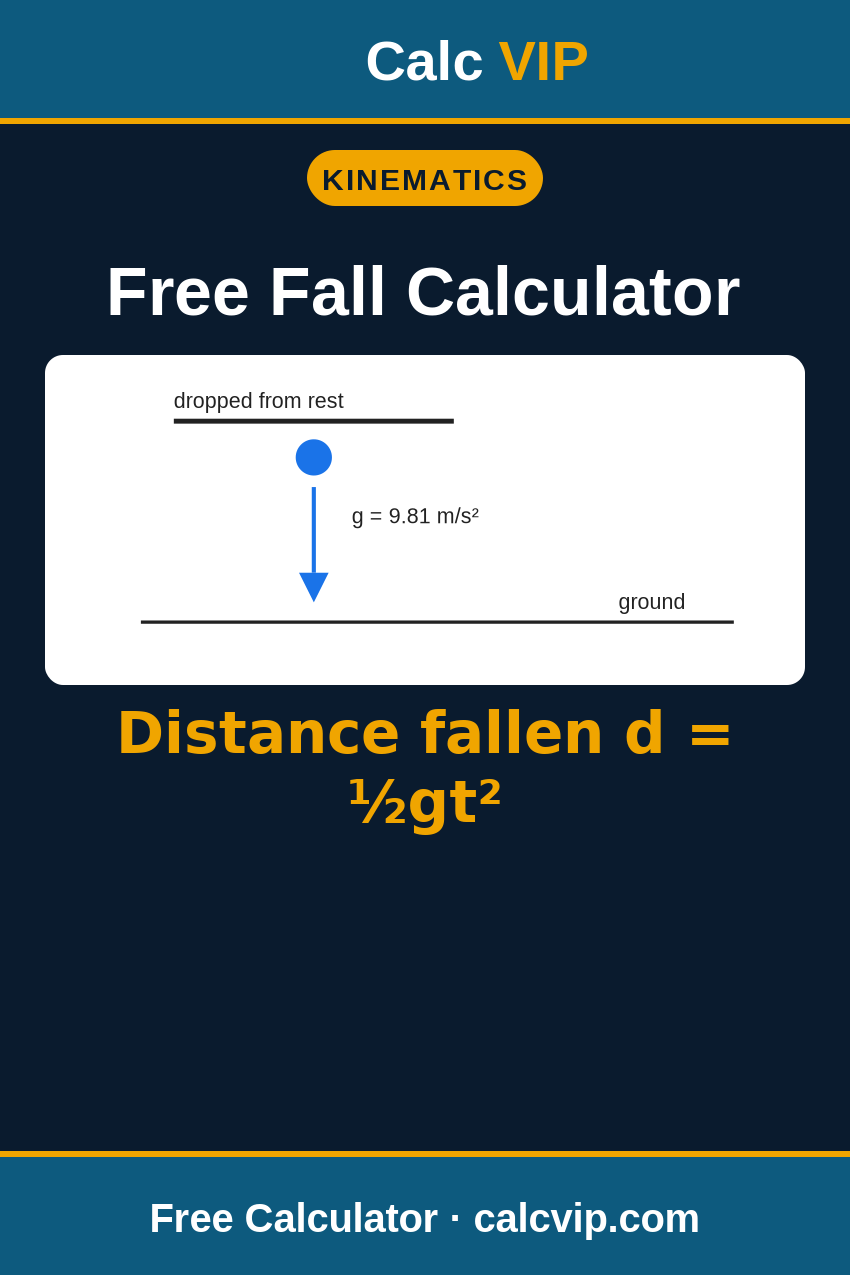
Drop a stone from a bridge and two questions come to mind: how long until it hits the water, and how fast will it be going? Free fall — motion under gravity alone, with nothing else pushing or holding back — answers both with surprising simplicity. The formulas contain no mass at all. A pebble and a boulder, dropped together in still air from the same height, fall side by side.
That was Galileo's great insight four centuries ago, overturning the ancient belief that heavy things fall faster. It has been re-tested ever since, most famously in 1971 when Apollo 15 astronaut David Scott dropped a geological hammer and a falcon feather together on the Moon. With no air to interfere, they struck the lunar dust at the same instant — exactly as the equations on this page predict.
This calculator describes the idealised version of falling: the object is dropped from rest (not thrown), air resistance is ignored, and g is taken as 9.81 m/s², its value near Earth's surface. For short falls of dense objects — a stone, a tool, a phone dropped from a balcony — the idealisation is excellent. The FAQ explains where it breaks down.
Formulas
Distance fallen d = ½gt² • Impact velocity v = gt • From a height: t = √(2h/g) and v = √(2gh)
The four formulas are two pairs. If you know the time, multiply: the velocity grows by 9.81 m/s every second (v = gt), and the distance is the average velocity (half of gt, since it started from zero) multiplied by the time — which is where d = ½gt² comes from. If you know the height instead, the same equations rearranged give t = √(2h/g) and v = √(2gh).
Because distance depends on t², falling is a motion that runs away with itself. In the first second an object falls about 4.9 m; by the end of the second second it has fallen 19.6 m in total; after three seconds, 44.1 m. Each successive second adds far more distance than the one before, as the next section shows.
| Symbol | Meaning | Units |
|---|---|---|
| d / h | distance fallen / drop height | metres (m) |
| v | impact (final) velocity | m/s |
| t | falling time | seconds (s) |
| g | acceleration due to gravity near Earth | 9.81 m/s² |
How a fall builds up, second by second
Watch the cumulative distance grow: after 1 s the object has fallen ½ × 9.81 × 1² = 4.9 m and is moving at 9.81 m/s. After 2 s: ½ × 9.81 × 2² = 19.6 m, moving at 19.62 m/s. After 3 s: 44.1 m at 29.43 m/s. Looked at another way, the distance covered during each single second is 4.9 m, then 14.7 m, then 24.5 m — the odd multiples of 4.9 (1, 3, 5), a pattern Galileo himself spotted. It is the t² in the formula made visible.
How to use
- Choose whether you know the falling time or the drop height.
- Enter the value and click "Calculate Free Fall".
- The object is assumed to start from rest with no air resistance.
Worked examples
Example 1 — the dropped stone. A stone is dropped and falls for 3 seconds. Distance fallen = ½ × 9.81 × 3² = 44.15 m. Impact velocity = 9.81 × 3 = 29.43 m/s — about 106 km/h, motorway speed, reached in three seconds of falling.
Example 2 — a tool dropped from scaffolding. A spanner slips from a platform 20 m up. Falling time t = √(2 × 20 ÷ 9.81) = √4.08 ≈ 2.02 s. Impact velocity v = √(2 × 9.81 × 20) = √392.4 ≈ 19.81 m/s (about 71 km/h). Two seconds is roughly the time a co-worker below has to react — which is why hard hats and tool lanyards exist.
Example 3 — a cliff drop. A pebble is dropped from a 45 m cliff. t = √(2 × 45 ÷ 9.81) = √9.17 ≈ 3.03 s, and v = √(2 × 9.81 × 45) = √882.9 ≈ 29.71 m/s. Timing a real drop with a stopwatch and working the formula backwards is a classic school experiment for measuring cliff and bridge heights.
Example 5 — the tower block drop. A coin slips from a balcony 80 m up. t = √(2 × 80 ÷ 9.81) = √16.31 ≈ 4.04 s, and v = √(2 × 9.81 × 80) = √1569.6 ≈ 39.62 m/s — about 143 km/h at the pavement. Four seconds feels long in the telling; it is no time at all to move out of the way, which is why building sites fence their drop zones.
Example 6 — five full seconds. A skydiver in the first 5 seconds after exit, before air resistance matters much, falls d = ½ × 9.81 × 5² = 122.63 m and reaches v = 9.81 × 5 = 49.05 m/s. Compare Example 1's three seconds (44.15 m): two extra seconds nearly tripled the distance, because distance grows with t².
Free fall in real life
Drop towers and bungee jumps. A drop-tower ride that releases you from 40 m gives, in principle, t = √(80 ÷ 9.81) ≈ 2.86 s of true free fall before the brakes bite — most of the thrill is compressed into those first two seconds, before air resistance and the braking system start to matter. Bungee jumpers are in genuine free fall until the cord begins to stretch.
Skydiving and terminal velocity. A skydiver is only in true free fall for the first several seconds. Air resistance grows with speed until it balances gravity — at about 53 m/s (190 km/h) in the belly-to-earth position — after which the fall continues at that steady terminal velocity and this calculator no longer applies. Reaching it takes roughly 12 seconds and a few hundred metres of fall.
Falling on other worlds. The same formulas work anywhere — only g changes. On the Moon (g = 1.62 m/s²) the 20 m drop of Example 2 would take t = √(40 ÷ 1.62) ≈ 4.97 s, a slow-motion version of the Earth fall, which is exactly the stately pace seen in Apollo footage. On Mars (g = 3.71 m/s²) it would take about 3.28 s.
The 10-metre diving board. A diver leaving the 10 m board takes t = √(20 ÷ 9.81) ≈ 1.43 s to reach the water and arrives at v = √(2 × 9.81 × 10) ≈ 14.01 m/s — about 50 km/h. In that 1.43 s the diver must complete every somersault and twist and arrive vertical: the choreography is budgeted by this calculator.
Rain, honestly assessed. A raindrop falling from a cloud 1000 m up would, by these formulas, arrive at nearly 140 m/s. Real rain lands at about 9 m/s, because a drop is light and wide for its mass and air resistance caps it early. Free fall's formulas are exact for stones and steel; for rain they are an upper bound that nature politely declines.
Measuring g with nothing but a stopwatch
The height mode of this calculator, run backwards, is a genuine experimental method. Drop a stone from a bridge of unknown height, time the fall at 2.5 s, and the height is h = ½ × 9.81 × 2.5² = 30.7 m. Turn it around — drop from a measured height and time it — and you can measure g itself: g = 2h/t². A class dropping a ball from a 5 m stairwell and timing 1.01 s would calculate g = 10 ÷ 1.02 ≈ 9.8 m/s². The limiting factor is human reaction time, about 0.2 s at each end, which is why careful versions of the experiment use light gates or video frames instead of thumbs. The physics, though, is exactly the two formulas above.
Example 4 — the balcony drop. A ball rolls off a balcony 10 m above the pavement (its sideways roll does not affect the fall). t = √(2 × 10 ÷ 9.81) = √2.04 ≈ 1.43 s, and it lands at v = √(2 × 9.81 × 10) = √196.2 ≈ 14.01 m/s — about 50 km/h, from a second-floor balcony. Even modest heights produce serious impact speeds, which is the entire logic behind dropped-object safety rules on building sites.
Thrown upwards: the fall in reverse
Free fall also runs the other way. Throw a ball straight up at 14.7 m/s and gravity, working against the motion now, erases its speed at 9.81 m/s per second: it stops rising after 14.7 ÷ 9.81 = 1.5 s, at a height of 14.7² ÷ (2 × 9.81) = 11.0 m, then falls back, reaching your hand after a total of 3.0 s at the same 14.7 m/s it left with. The symmetry — up time equals down time, launch speed equals landing speed — is exact in the no-air-resistance model, and the falling half of the trip is this calculator's home ground. Juggling, fountains and basketball arcs all live inside this pattern.
Why modest heights are already dangerous
The v = √(2gh) formula has a sobering consequence for everyday safety. Falling just 5 m — a first-floor roof, a tall ladder — means landing at √(2 × 9.81 × 5) ≈ 9.9 m/s, about 36 km/h: the speed of a car in town traffic, except that the "car" is your body and the stop happens in centimetres rather than over a crumple zone. Falls from standing height injure because even 1.8 m gives an impact near 5.9 m/s. This is why fall-arrest harnesses, guard rails and ladder rules are written the way they are, and why the impact velocities this calculator reports deserve respect even when the heights sound small. Gravity does not need much distance to make something fast.
Why mass cancels: the equivalence at the heart of falling
Free fall hides a coincidence so deep that Einstein built general relativity on it. Gravity's pull on an object grows in exact proportion to its mass (W = mg), while the object's resistance to being accelerated also grows in exact proportion to its mass (F = ma). Divide one by the other and the mass cancels perfectly: a = g for everything. There was no logical necessity for the two masses — gravitational and inertial — to match; experiments have checked their equality to one part in a trillion, and they always match.
The practical consequence is the one this calculator exploits: a single number, g, describes every fall. The philosophical consequence is stranger — an observer in a falling lift cannot distinguish gravity from acceleration at all, which is why astronauts in orbit (falling continuously around the Earth) experience weightlessness even though gravity up there is nearly as strong as on the ground.
Quick reference: the fall, second by second
Read this table vertically and the t² law becomes visceral: the distance column does not grow by equal steps but by 4.9, then 14.7, then 24.5, then 34.3, then 44.1 metres — each second's fall exceeding the last by a steady 9.81 m, because the velocity column grows by exactly that much each second.
| Time fallen | Distance fallen | Velocity |
|---|---|---|
| 1 s | 4.91 m | 9.81 m/s |
| 2 s | 19.62 m | 19.62 m/s |
| 3 s | 44.15 m | 29.43 m/s |
| 4 s | 78.48 m | 39.24 m/s |
| 5 s | 122.63 m | 49.05 m/s |
Timing a fall by ear: the sound correction
The classic bridge experiment — drop a stone, time the splash, compute the height — hides a small systematic error that this page's numbers can expose. For a 19.62 m drop the fall itself takes 2.00 s, but the sound of the splash must climb back up at 343 m/s, adding 19.62 ÷ 343 ≈ 0.057 s to the stopwatch reading. A student who times 2.06 s and feeds it whole into h = ½gt² overstates the height by about 0.6 m — a 3% error with a purely acoustic cause.
The correction shrinks into irrelevance for short drops and grows for tall ones, because fall time grows with the square root of height while sound time grows in direct proportion. Professional drop measurements — mine shafts, cliff surveys, well depths — either correct for the sound or sidestep it entirely with light-based timing. It is a good first lesson in experimental physics: the formula is exact, and the measurement still needs defending.
Even the humblest drop obeys the same numbers: a phone slipping 1 m from a hand reaches the floor in √(2 ÷ 9.81) ≈ 0.45 s at √(2 × 9.81 × 1) ≈ 4.43 m/s — too fast for any human reaction to intercept, which is why dropped phones are a certainty of modern life rather than a failure of attention.
Common mistakes
- Assuming heavier objects fall faster. In the idealised physics — and in a vacuum, in reality — they do not. Everyday differences come from air resistance, which depends on shape and speed, not from gravity favouring heavy objects.
- Using it for thrown objects. These formulas assume the object starts from rest. Throw a ball downwards at 5 m/s and it lands sooner and faster than the calculator says; use the SUVAT displacement calculator with u = 5 instead.
- Trusting it for long falls. Once a fall lasts more than several seconds, air resistance is no longer negligible and the real impact speed falls short of the prediction. Feathers, parachutes and skydivers all live in that regime.
- Confusing the two modes. Enter a height in the time box (or the reverse) and the answer is nonsense — check the mode selector matches the quantity you actually know.
- Forgetting the square root in height mode. From a height, t = √(2h/g) — the root is essential. For h = 20 m the time is √4.08 ≈ 2.02 s; skipping the root gives 4.08 s, double the truth, and every velocity derived from it is wrong too.
FAQ
Do heavy objects fall faster than light ones?
No. Without air resistance, all objects fall with the same acceleration g = 9.81 m/s², whatever their mass.
Why does a feather fall slowly in real life?
Because of air resistance. In a vacuum, a feather and a hammer fall together — this was famously demonstrated on the Moon by Apollo 15.
What is terminal velocity?
It is the maximum falling speed reached when air resistance balances gravity. This calculator assumes no air resistance, so it does not apply to long falls through air.
How long does it take to fall 100 metres?
t = √(2 × 100 ÷ 9.81) = √20.39 ≈ 4.52 s, hitting the ground at v = 9.81 × 4.52 ≈ 44.3 m/s (about 160 km/h) — in the idealised no-air-resistance model.
What is g on other planets?
It depends on the planet's mass and size: about 1.62 m/s² on the Moon, 3.71 m/s² on Mars, and 24.79 m/s² on Jupiter. The same formulas apply with the local value of g.
What if the object is thrown downwards instead of dropped?
Then it starts with a velocity, and the free-fall formulas understate both the speed and the distance. Use s = ut + ½gt² (the displacement calculator) with u set to the throwing speed.
Does air resistance always matter?
No. For dense objects falling short distances at modest speeds — a stone dropped from a bridge, a dropped phone — its effect is tiny and the idealised answers are accurate to a few percent. It dominates only for light, large-area objects or long, fast falls.
How far does an object fall in the first second?
About 4.9 metres — half of 9.81, because the average velocity over that first second is half the final 9.81 m/s. It is the second second that surprises people: the object covers another 14.7 m as its speed builds.
Is an orbiting astronaut in free fall?
Completely. The station and everything in it are falling towards Earth with acceleration g (about 8.69 m/s² at that altitude) while moving sideways fast enough to keep missing. Weightlessness is not the absence of gravity; it is gravity with nothing pushing back.
How high is a bridge if a stone takes 2 seconds to splash?
h = ½ × 9.81 × 2² = 19.62 m. Add a small correction for the sound of the splash travelling back up (about 0.06 s at this height) if you are timing by ear — a favourite refinement in the classic experiment.