 Calc
Free Fall Height Calculator – Height From Fall Time or Impact Velocity
 Created by Sarah Mitchell · Physics Editor · Motion & Measurement · Last updated: November 2026
Use this free Free Fall Height Calculator to find the height an object fell from, using either the time it took to fall or the speed it reached at impact. This is handy for drop tests, cliff-height estimates and reaction-time ruler-drop experiments.
Some heights refuse to be measured directly. The cliff is too steep to tape, the well too dark, the tower's plans lost, the warehouse racking too tall for the ladder. But anything dropped from the top carries the measurement down with it: the fall's duration, or the speed it reaches at the bottom, encodes the height exactly. That is the trade this calculator makes — time a fall, or measure an impact speed, and receive the height. It works because free fall is the most law-abiding motion there is: from rest, under gravity alone, distance and time are locked together by h = ½gt², and impact speed by v = gt, with no free parameters and no dependence on what the object is.
The two modes are the same physics read from different instruments. Time mode suits the stopwatch and the phone camera: drop, count, and h = ½gt² converts seconds into metres, with v = gt reporting the impact speed as a bonus. Velocity mode suits the radar gun, the speed trap and the accelerometer log: h = v²/2g converts the impact speed back into the height it must have fallen from, with t = v/g returning the fall's duration. The modes agree wherever both measurements exist — they must, being one equation — and checking that agreement is how careful experimenters catch a mistimed drop.
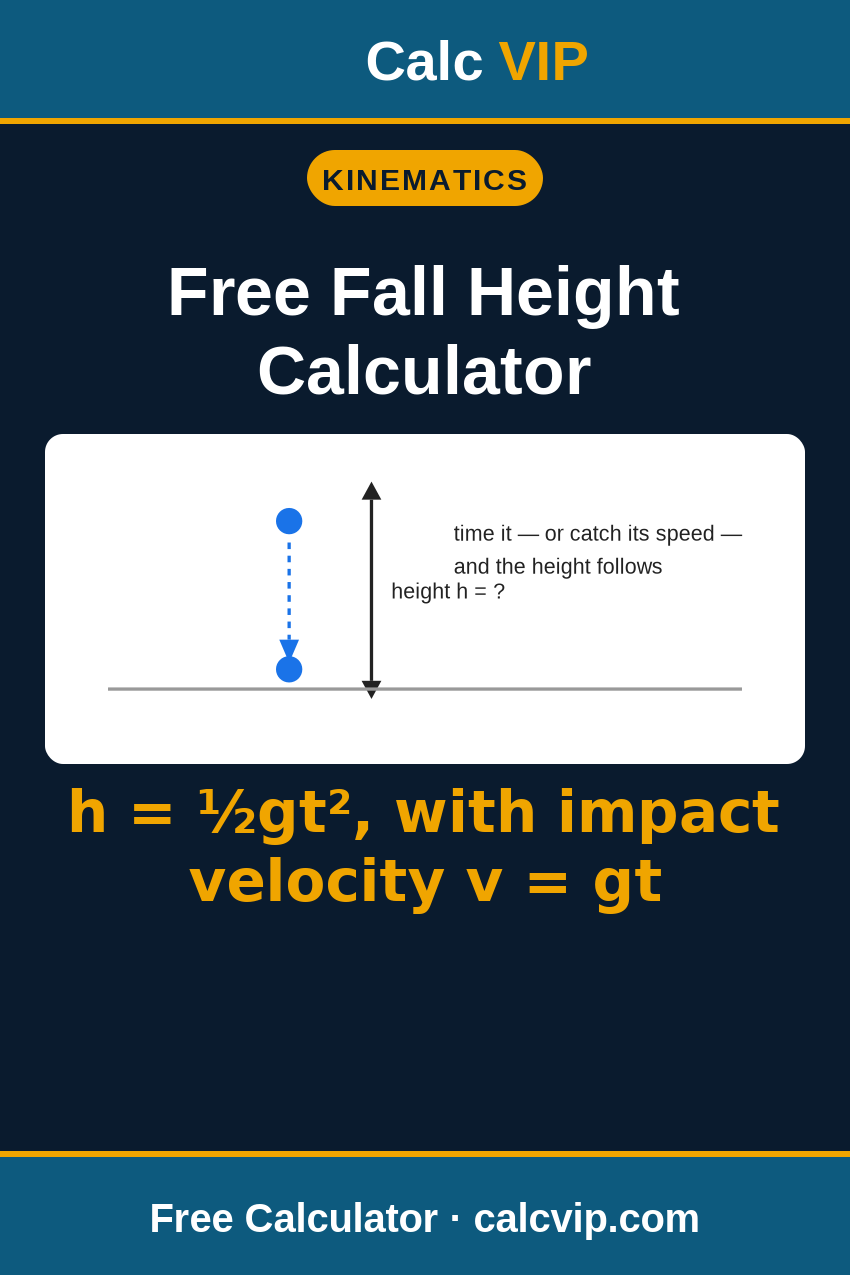
The model's assumptions deserve their sentence: the object starts from rest, falls vertically, and meets no air resistance worth mentioning. For stones, tools, water drops over modest heights and anything dense, the model is excellent. For feathers, leaves, paper and skydivers it is a first sketch only — drag rewrites those falls. Within its home territory, though, this is among the most useful calculators in the kinematics set: it turns the two easiest quantities in physics to measure — time and speed — into the one that is often impossible to reach with a ruler.
Formula
From fall time: h = ½gt², with impact velocity v = gt • From impact velocity: h = v² / 2g, with fall time t = v / g (g = 9.81 m/s²)
The two modes are one relationship viewed from either end: eliminate t between v = gt and h = ½gt² and the velocity form appears. Both assume a start from rest; if the object was thrown downward with initial speed u, the general forms are h = ut + ½gt² and v² = u² + 2gh, and the height for a given time is larger — this calculator's answers are then underestimates. Handy landmarks from the time mode: the height grows with the square of the time, so the fall covers 4.9 m in the first second, 19.6 m by two seconds (an extra 14.7), 44.1 m by three (an extra 24.5) — each second adds more than the last, which is why falls turn lethal so quickly with height. The calculator fixes g at 9.81 m/s²; the same falls timed on the Moon would imply heights about six times smaller for the same durations.
| Symbol | Meaning | Units |
|---|---|---|
| h | fall height — vertical distance from release to impact | m |
| t | fall time from release to impact | seconds (s) |
| v | impact velocity | m/s |
| g | acceleration due to gravity (fixed at 9.81 here) | m/s² |
The square that makes falls dangerous
Everything important about falling is in the t². Because distance grows with the square of time, a falling object covers its ground in a violently back-loaded way: of a 44.1 m, three-second fall, only 4.9 m passes in the first second — the final second alone delivers 24.5 m and the impact speed has tripled since the first second ended. Double the height and the impact speed does not double; it grows by √2, about 41%, because v = √(2gh). Quadruple the height and impact speed exactly doubles. These square-root economics govern real safety margins: a fall from twice the height is not twice the accident, it is a 41%-faster impact carrying twice the kinetic energy per kilogram — the energy being ½v² = gh, neatly proportional to height after all.
The same square explains the calculator's sensitivity. Timing a fall by hand carries perhaps ±0.1 s of reaction error; on a 1 s fall that is a 20% height error (the square doubles the percentage), while on a 4 s fall it is only 5%. Long falls forgive stopwatches; short falls demand frame-counted video or light gates. The ruler-drop reaction test exploits the forgiving end deliberately: at 0.2 s the distance is a conveniently measurable 19.6 cm, and every extra centimetre of ruler maps cleanly back to a slower reaction through h = ½gt² read in reverse.
Galileo found the square law's fingerprint before he could prove it, in the odd-number rule: a falling object covers distances in successive seconds that grow as 1 : 3 : 5 : 7. With g = 9.81 the unit is 4.9 m — the first second delivers 4.9 m, the second 14.7 m, the third 24.5 m, the fourth 34.3 m — and the running totals, 4.9, 19.6, 44.1, 78.5, are the squares 1, 4, 9, 16 wearing metres. The rule is a gift for field estimation: if a timed fall's per-second distances (from video frames) refuse the odd-number pattern, the fall was not free — something dragged, bounced or was thrown — and this calculator's assumptions, not its arithmetic, are what failed.
How to use
- Choose the mode: "Fall time t" if you timed the fall, or "Impact velocity v" if you know how fast it landed.
- Enter the value — seconds for time mode, m/s for velocity mode.
- Click "Calculate Height" to see the fall height, plus the other quantity (impact velocity, with a km/h conversion, or fall time).
- For hand-timed falls, repeat several drops and average the times before calculating — the square in t² punishes a single sloppy timing.
- Make sure the object truly started from rest and fell vertically; a downward throw or a bouncing, rolling start breaks the model.
Worked examples
Example 1 — the two modes agree. Time mode: a stone falls for t = 2.5 s. Height h = ½ × 9.81 × 2.5² = 30.66 m, and it lands at v = 9.81 × 2.5 = 24.53 m/s.
Velocity mode: an object lands at v = 30 m/s. Height h = 30² ÷ (2 × 9.81) = 45.87 m, and the fall took t = 30 ÷ 9.81 = 3.06 s.
Example 2 — the first second. Anything falling for exactly 1 s from rest drops h = ½ × 9.81 × 1 = 4.90 m and lands at 9.81 m/s (35.32 km/h) — about one and a half storeys in the time it takes to say "one".
Example 3 — four seconds of fall. A dropped wrench timed at 4 s: h = ½ × 9.81 × 16 = 78.48 m, landing at 39.24 m/s — 141.26 km/h. A 23-storey building's height, recovered from a stopwatch.
Example 4 — from a measured impact speed. Debris radar-logged at 15 m/s at ground level: h = 225 ÷ 19.62 = 11.47 m, and the fall lasted t = 15 ÷ 9.81 = 1.53 s — consistent with a third-floor balcony, not the roof, a distinction investigators care about.
Example 5 — the ruler-drop reaction test. A ruler falls 0.196 m before being caught: that is h = ½ × 9.81 × t² with t = 0.2 s — a typical human reaction time, measured with a 20 cm ruler and this formula.
Example 6 — the motorway-speed impact. An object lands at 50 m/s (180 km/h): h = 2500 ÷ 19.62 = 127.42 m, t = 50 ÷ 9.81 = 5.10 s. Anything falling from a 40-storey height arrives at motorway speed — the velocity mode working as a height gauge for very tall structures.
Free fall height in real life
Cliff and waterfall estimation. The hiker's classic: drop a stone, count the seconds to the splash or the crack of impact, and h = ½gt² gives the height — with a small correction for the sound's return journey on deep drops.
Reaction-time testing. The ruler-drop test in every school lab and sports-science kit is this calculator inverted: the catch distance is the reaction time, via t = √(2h/g).
Drop testing of products. Manufacturers certify phones and instruments by drop height; the impact speed v = √(2gh) is what the casing must survive, and this calculator converts between the test height and the impact severity.
Accident and insurance investigation. A fallen load, a collapsed scaffold component, debris from a building — the impact speed estimated from damage, run through h = v²/2g, identifies the storey or structure it fell from.
Well and shaft depth sounding. Drop a stone into a well, time the splash, correct for sound travel, and the depth follows — a technique older than the formula's notation.
Film and stunt safety. Fall guys and riggers plan descenders and airbags from the impact speed at a given height; v = √(2gh) is the number the safety case is built around.
Correcting the stone-drop: the sound comes back
The classic cliff measurement hides a refinement worth knowing. The time you actually measure — release to hearing the splash — is the fall time plus the time the sound takes to climb back up at about 343 m/s. For a 30.66 m cliff the fall is 2.5 s but the sound adds 30.66 ÷ 343 ≈ 0.09 s, so a naive 2.59 s count overstates the height to about 32.9 m. The exact treatment solves h = ½gt₁² with t₁ = T − h/343 simultaneously; for drops under about 20 m the correction is under 2% and ignorable, but for the 78 m fall of Example 3 the sound takes 0.23 s of the measured time and the correction matters. Precise work also replaces the stopwatch with frame counting — at 240 frames per second, a phone resolves the fall to ±0.004 s and the t² error nearly vanishes.
Quick reference: fall time, height and impact speed
| Fall time t (s) | Height h (m) | Impact v (m/s) | Impact v (km/h) | Roughly |
|---|---|---|---|---|
| 0.2 | 0.20 | 1.96 | 7.06 | a ruler drop |
| 1 | 4.90 | 9.81 | 35.32 | a first-floor window |
| 2 | 19.62 | 19.62 | 70.63 | a six-storey block |
| 2.5 | 30.66 | 24.53 | 88.31 | a ten-storey block |
| 3 | 44.14 | 29.43 | 105.95 | a cliff path drop |
| 4 | 78.48 | 39.24 | 141.26 | a tall tower |
The middle row is a curiosity worth noticing: at t = 2 s the height in metres and the impact speed in m/s are the same number, 19.62 — a coincidence of g's value, true at no other time.
For a sense of scale at the tall end: an object falling from the Eiffel Tower's 330 m would take √(660 ÷ 9.81) = 8.20 s and the Burj Khalifa's 828 m about 12.99 s in this model — though at those heights air resistance has long since begun its takeover for anything but the densest objects, and the true times run longer. The model times are best read as the fall's skeleton: exact in vacuum, a close sketch for a dropped hammer, a fantasy for a dropped leaf.
Terminal velocity: where this model ends
Free fall's perfection lasts only until the air pushes back. Drag grows with speed — roughly with its square — until it equals the object's weight, acceleration ceases, and the fall continues at a constant terminal velocity. From that moment the calculator's world quietly expires: h stops following ½gt², and impact speed stops growing altogether. The numbers show how total the takeover is. The ideal model says an object falling 1,000 m lands at √(2 × 9.81 × 1000) = 140.07 m/s. A skydiver in a spread position, terminal velocity about 53 m/s, lands at 53 m/s whether the exit was at 1,000 m or 4,000 m — in the ideal model's language, their impact speed "reports" a height of only 53² ÷ 19.62 = 143.17 m, and every metre above that was spent at constant speed, contributing time but no velocity. This is why the FAQ's caution about skydivers is quantitative, not decorative: beyond roughly the first 5–6 seconds (the ideal time just to reach 53 m/s is 5.4 s), drag owns the fall. Dense, compact, slow — the model's charter. The moment an object is light for its size or the fall runs long, treat this page's answers as the upper bound they are, and the true height as larger than the true time suggests.
Common mistakes
- Timing a thrown object. The formulas assume release from rest. A stone hurled downward falls faster and lands sooner, and the calculator will under-report the height; a stone tossed upward does the opposite. Drop, don't throw.
- Forgetting the sound's return on deep drops. Timing to the heard splash includes the sound's climb back at 343 m/s. Past about 20 m of depth the correction stops being negligible.
- Trusting one hand-timed fall. Reaction error enters twice (start and stop) and t² doubles its percentage effect. Average several drops, or film it and count frames.
- Using it for skydivers and feathers. Air resistance caps real falls at terminal velocity — a skydiver's ~53 m/s in freefall posture — so beyond a few seconds the model's heights balloon past reality. Dense, compact objects over modest heights only.
- Entering the impact speed in km/h. Velocity mode wants m/s. A "50" that is really km/h overstates the height thirteenfold. The calculator's time-mode output shows km/h precisely so the two units can be compared honestly.
FAQ
Does the mass of the object matter?
No. Ignoring air resistance, all objects fall with the same acceleration g, so the height depends only on time or impact speed.
Why do the two modes agree with each other?
They are the same physics written two ways: v = gt and h = ½gt² combine to give h = v²/2g.
Can I use this for a falling person or skydiver?
Only roughly. Real falls are slowed by air resistance, so the true height is larger than this ideal calculation suggests.
What if the object was thrown downward?
Then it falls further in the same time: h = ut + ½gt² with u the throw speed. This calculator's answer is the height for a pure drop — a lower bound for a thrown one.
How do I measure a well's depth with it?
Drop a stone, time until the splash is heard, then correct: the fall time is the measured time minus h/343 for the sound's return. Iterate once with the calculator's height and the answer settles.
Why 9.81 and not 10?
9.81 m/s² is Earth's measured surface average. Using 10 is a fine mental shortcut (it overstates heights by about 2%), but the calculator keeps the measured value so its two modes agree with each other and with the other tools on this site.
Does height above sea level change g?
Barely: g weakens by about 0.03% per kilometre of altitude and varies slightly with latitude (9.78 at the equator, 9.83 at the poles). For any fall you can time by hand, 9.81 is far more precise than the timing.
What is the fastest a falling object can go?
In this model, unlimited — v grows with t forever. In air, drag caps it at terminal velocity: about 53 m/s for a spread skydiver, over 90 m/s head-down, and hundreds for dense streamlined objects. The model is trustworthy until drag becomes a visible fraction of g.
Can the fall time be found from the height alone?
Yes — that is the velocity mode read backwards, or simply t = √(2h/g): a 20 m fall takes 2.02 s whoever drops what from it.
Why does the height grow with t² and not t?
Because the object accelerates: its average speed over the fall is half its final speed, gt/2, and distance is average speed × time — (gt/2) × t = ½gt². The square is acceleration's signature.