 Calc
Doppler Wavelength Calculator – Observed Wavelength from a Moving Source
 Created by David Okafor · Physics Writer · Waves & Light · Last updated: November 2026
Use this free Doppler Wavelength Calculator to find the wavelength a stationary listener receives when the sound source itself is moving. A source moving towards you squeezes its wavefronts closer together (shorter wavelength, higher pitch); a source moving away stretches them out. Enter the source frequency, the speed of sound and the source speed.
The cleanest way to see why is to watch the wavefronts being born. A stationary source emits a crest, waits one period, and emits the next; in that period the first crest has travelled exactly one wavelength, so the crests march away evenly spaced at λ = v/f. Now let the source move. During that same period it advances a distance vs/f towards you before releasing the next crest — so the gap between successive crests ahead of it is no longer v/f but (v − vs)/f: the emitted wavelength minus the distance the source chased after its own wave. Behind the source the arithmetic reverses and the crests are stretched by the same amount. Nothing about the sound itself has changed; the pattern has simply been written onto the air by a moving pen.
This calculator works with the wavelength because that is the quantity the motion actually alters. The speed of sound is the medium's property and stays fixed; the received frequency is then a consequence, f′ = v/λ′, which the calculator reports alongside. Note what it deliberately does not model: a moving listener. A moving listener receives the original wavelength but crosses the crests faster, which changes the frequency by a slightly different formula — the two effects agree at low speeds but are not identical, and the depth section below puts them side by side with numbers.
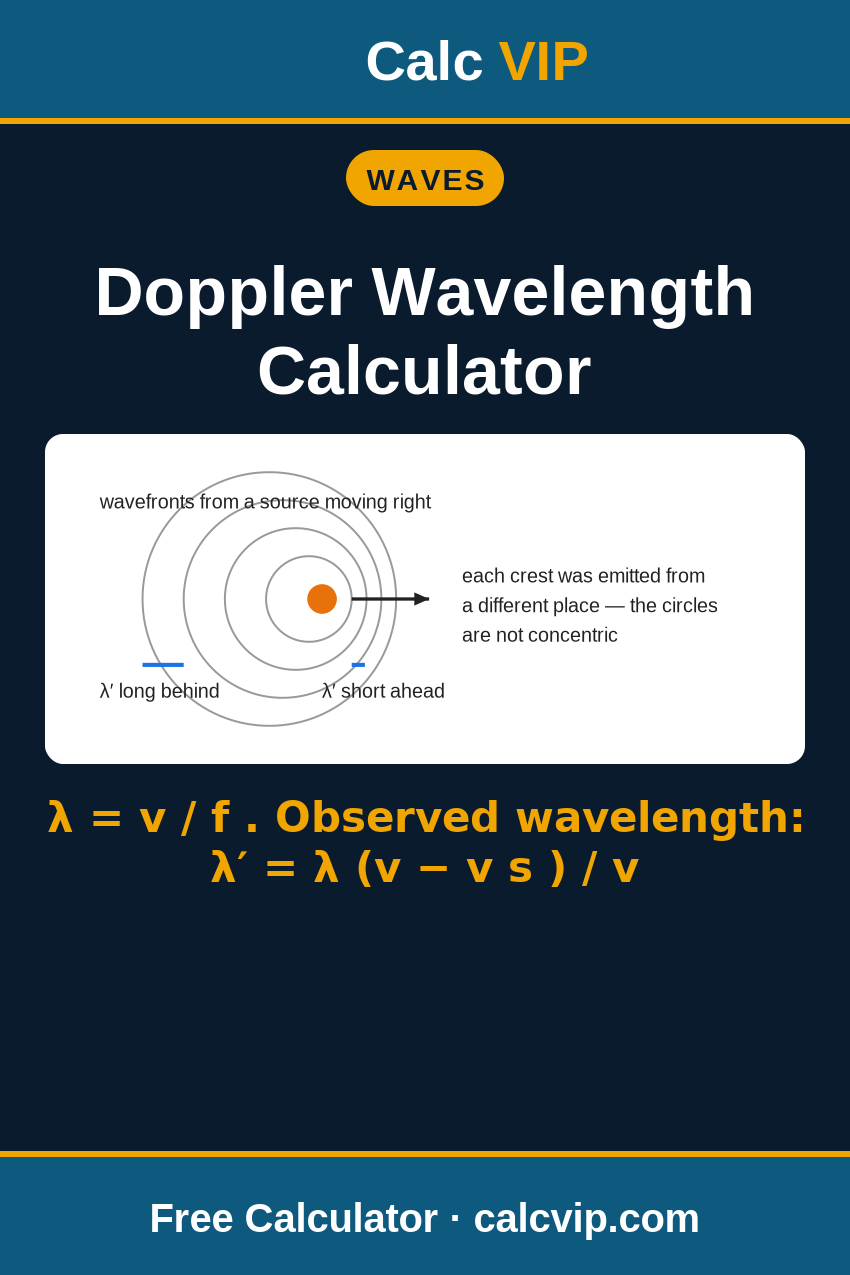
Everything here assumes the source moves directly towards or away from you and stays well below the speed of sound. As vs approaches v the forward wavelength is squeezed towards zero, the wavefronts pile into a shock, and the smooth Doppler picture gives way to the Mach cone — the subject of the Mach Angle Calculator elsewhere in this collection.
Formula
Emitted wavelength λ = v / f. Observed wavelength: λ′ = λ (v − vs) / v for a source moving towards you, and λ′ = λ (v + vs) / v for a source moving away. The frequency you hear is f′ = v / λ′.
Substituting λ = v/f gives the frequency forms directly: approaching, f′ = f × v / (v − vs); receding, f′ = f × v / (v + vs). The only dimensionless number that matters is the ratio vs/v — the source's Mach number. At vs/v = 0.1 the wavelength shifts by exactly 10%, whatever the frequency; the frequency shift is then fixed by f′ = v/λ′. Rearranged, the source speed can be recovered from a measured wavelength: vs = v (1 − λ′/λ) approaching. Units must be consistent — all speeds in m/s (divide km/h by 3.6), frequencies in hertz, and the result is a wavelength in metres.
| Symbol | Meaning | Units |
|---|---|---|
| λ | wavelength the source emits (at rest) | metres (m) |
| λ′ | wavelength the listener receives | metres (m) |
| v | speed of sound in the medium | m/s |
| vs | speed of the source towards/away from you | m/s |
| f, f′ | emitted and received frequencies | hertz (Hz) |
Moving source versus moving listener: a real, measurable difference
Sound is unusual among waves in having a medium you can move through, and that makes the two kinds of motion genuinely different experiments. Move the source and the wavelength in the air really changes, as this page calculates: crests are physically closer together ahead of the source. Move the listener instead, towards a stationary source, and the wavelength in the air is untouched — the listener simply crosses the crests at a relative speed of v + vo, receiving them at f′ = f (v + vo)/v. Put numbers to it with the worked example's figures — f = 500 Hz, v = 340 m/s, motion at 20 m/s: a moving source approaching gives f′ = 531.25 Hz, while a moving listener approaching gives f′ = 500 × 360/340 = 529.41 Hz. The difference, about 1.8 Hz, is small but perfectly measurable — beats between the two arrangements would pulse roughly twice a second.
The asymmetry grows with speed because the formulas have different shapes: the moving-source shift has (v − vs) in a denominator and blows up as the source nears Mach 1, while the moving-listener shift is a plain ratio and stays tame. Light abolishes the distinction entirely — with no medium, only relative motion can matter, and Einstein's relativistic Doppler formula treats both cases as one. The sound formulas on this page are the low-speed, medium-based originals, and their slight disagreement with each other is a fossil of the air's privileged rest frame.
The wavelength picture is also the one you can measure directly. Trail a microphone slowly through the air in front of an approaching source — or photograph the wavefronts from a moving boat — and the compressed spacing ahead and the stretched spacing behind are simply there to be read off with a ruler: 0.64 m against 0.72 m for this page's example. Radar engineers live in this picture permanently, since their instruments time echoes crest by crest, and it is why this calculator is organised around λ′ rather than f′: convert at the end, with the frequency formula, once the geometry has been handled in the units in which it was measured.
How to use
- Enter the frequency the source emits — the pitch it would have at rest (e.g. a siren at 500 Hz).
- Enter the speed of sound in the medium: about 340 m/s in air at 15 °C, 343 m/s at 20 °C.
- Enter the source's speed along the line towards or away from you (convert km/h to m/s by dividing by 3.6), and choose its direction.
- Click "Calculate Observed Wavelength" to see the emitted wavelength, the received wavelength, and the frequency you actually hear.
Worked examples
Example 1 — the ambulance. An ambulance siren emits 500 Hz; sound travels at 340 m/s and the ambulance drives at 20 m/s.
Emitted wavelength λ = 340 / 500 = 0.68 m.
Approaching: λ′ = 0.68 × (340 − 20) / 340 = 0.64 m, so you hear f′ = 340 / 0.64 = 531.25 Hz.
Receding: λ′ = 0.68 × (340 + 20) / 340 = 0.72 m, so you hear f′ = 340 / 0.72 = 472.22 Hz.
Example 2 — the passing train horn. A train sounding a 400 Hz horn approaches at 30 m/s on a day when v = 343 m/s. The emitted wavelength is 343/400 = 0.86 m. Approaching, λ′ = 0.86 × (343 − 30)/343 = 0.78 m and you hear 438.34 Hz; after it passes, λ′ stretches to 0.93 m and the pitch drops to 367.83 Hz — the dramatic two-tone drop every trackside listener knows, here a fall of over 70 Hz in the moment of passing.
Example 3 — the police siren at speed. A patrol car's siren emits 800 Hz while travelling at 25 m/s (90 km/h), v = 340 m/s. λ = 0.42 m. Approaching: λ′ = 0.39 m, f′ = 863.49 Hz. Receding: λ′ = 0.46 m, f′ = 745.21 Hz. Note the asymmetry the FAQ below highlights: the rise (+63.49 Hz) exceeds the fall (−54.79 Hz) even though the speed is the same.
Example 4 — the bat and the wall. A bat flies at 8 m/s towards a wall, calling at 40,000 Hz (v = 343 m/s). Its emitted wavelength is 343/40,000 = 8.57 mm, but the wall receives crests squeezed to λ′ = 8.57 × (343 − 8)/343 = 8.37 mm — a frequency at the wall of 40,955.22 Hz. The echo then returns from what is effectively a stationary source at that frequency, and the approaching bat, now acting as a moving listener, hears it shifted again: about 41,910.45 Hz. The bat's brain reads its own call against this double-shifted echo to judge closing speed — Doppler echolocation, run twice through the formulas on this page.
Example 5 — the race car. A racing engine's dominant note is 1000 Hz; the car passes at 60 m/s (216 km/h), v = 343 m/s, λ = 0.34 m. Approaching: λ′ = 0.28 m, f′ = 1212.01 Hz. Receding: λ′ = 0.40 m, f′ = 851.12 Hz. The pitch collapses by 360.9 Hz — more than five semitones — as the car passes the microphone, which is why broadcast engineers ride the volume but can do nothing about the unmistakable "eee-yow" of a Doppler pass.
Example 6 — recovering a speed from a recording. A dashcam records a siren's approach pitch as 548.39 Hz from a siren known to emit 500 Hz, with v = 340 m/s. Rearranged: f′ = f × v/(v − vs) gives v − vs = 500 × 340/548.39 = 310 m/s, so vs = 30 m/s = 108 km/h. This is precisely how Doppler evidence is extracted from bystander recordings after incidents — the wavelength form of the same algebra.
Doppler wavelengths in real life
Traffic radar and speed guns. A radar gun compares the wavelength of its reflected microwaves with what it sent: the returning wave is Doppler-shifted twice (once on arrival at the car, once on re-emission), and the beat between sent and received waves gives the speed directly. The sound formulas here are the classical originals of the same idea.
Medical ultrasound. Doppler ultrasound measures blood flow by bouncing megahertz sound off moving red blood cells. The double shift — cells as moving listeners, then as moving sources — reports flow speed and direction, colour-coded on the scanner screen; a narrowing artery announces itself as a pitch rise in the audio monitor.
Weather radar. Rain and hail shift the wavelength of radar pulses as they approach or recede, letting meteorologists map wind fields inside a storm — including the tell-tale couplet of opposite shifts that betrays a rotating mesocyclone and triggers tornado warnings.
Astronomy's redshift. Distant galaxies show spectral lines stretched to longer wavelengths — the optical cousin of this page's receding case. For light the relativistic formula replaces the classical one, but the reading is the same: λ′/λ measures recession, and it underpins the expanding-universe picture and the Hubble law.
Foetal and cardiac monitors. A Doppler wand on a patient's chest turns the motion of heart valves and blood into audible pitch — clinicians literally listen to wavelength shifts to judge whether a valve opens cleanly.
Vehicle and drone detection. Passive acoustic sensors identify approaching vehicles by their characteristic pitch trajectory — rise, peak at closest approach, fall — whose shape encodes speed through these formulas, no transmitter required.
Quick reference: a 500 Hz source in air (v = 340 m/s)
| Source speed | λ′ approaching | f′ approaching | λ′ receding | f′ receding |
|---|---|---|---|---|
| 0 m/s | 0.68 m | 500 Hz | 0.68 m | 500 Hz |
| 10 m/s (36 km/h) | 0.66 m | 515.15 Hz | 0.70 m | 485.71 Hz |
| 20 m/s (72 km/h) | 0.64 m | 531.25 Hz | 0.72 m | 472.22 Hz |
| 30 m/s (108 km/h) | 0.62 m | 548.39 Hz | 0.74 m | 459.46 Hz |
Two patterns worth memorising from the table: the wavelength changes are perfectly symmetric (±0.02 m per 10 m/s), because λ′ is linear in vs; the frequency changes are not, because f′ = v/λ′ inverts the relationship. The faster the source, the more the approach shift outruns the recession shift — the denominator (v − vs) sees to that.
Common mistakes
- Changing the speed of sound. The moving source does not make its sound travel faster. v is the medium's property throughout; only the spacing of the crests changes. Any calculation that starts "the sound now travels at v + vs" has gone wrong at the first step.
- Using the moving-listener formula for a moving source. They differ (531.25 vs 529.41 Hz in the comparison above). If the source moves, the wavelength changes and this page's formulas apply; if only you move, use f′ = f (v ± vo)/v.
- Forgetting the km/h conversion. Speeds quoted for vehicles are almost always in km/h. Entering 72 (km/h) as if it were m/s overstates the shift more than threefold; divide by 3.6 first — 72 km/h is 20 m/s.
- Applying the shift to a source moving across your view. Only the radial component — motion directly towards or away — compresses the wavelength. A source passing at closest approach has, at that instant, no radial motion and no shift, which is why the pitch drop is centred on the moment of passing.
- Expecting symmetric pitch changes. Equal speeds towards and away do not give equal and opposite frequency changes (see Example 3: +63.49 Hz against −54.79 Hz). The wavelength changes are symmetric; the frequencies, being reciprocals, are not.
FAQ
Why does the wavelength change but not the speed of sound?
The speed of sound is set by the medium (air), not by the source. The moving source changes where each new wavefront starts, which squeezes or stretches the spacing between crests — the wavelength — while every crest still travels at v.
Is the pitch shift the same for approaching and receding?
No. The formula is not symmetric: approaching divides by (v − vs) in frequency terms, which grows faster than the receding shift shrinks. In the example the pitch rises by 31.25 Hz but falls by only 27.78 Hz.
What happens if the source moves at the speed of sound?
The wavefronts pile up on top of each other in front of the source, forming a shock wave (a sonic boom). The formula breaks down there — the wavelength ahead would be zero — so this calculator requires vs < v.
Does the Doppler effect change the volume as well as the pitch?
Not by itself — but an approaching source is also getting closer, so the inverse-square rise in loudness happens at the same time. The two effects are independent: the pitch encodes the radial speed, the loudness the distance, and a good recording lets you extract both.
What if both the source and the listener are moving?
Combine the two corrections: the source changes the wavelength to λ′ = λ(v ∓ vs)/v, and the listener crosses crests at v ± vo, so f′ = (v ± vo) / λ′. The bat example above applies exactly this combination to the returning echo.
Why is there no Doppler shift when the source moves sideways?
Because the distance between source and listener is not changing (to first order), so successive crests have the same journey and arrive evenly spaced at the original wavelength. For sound there is no transverse effect at all; light adds a tiny second-order one from time dilation, far outside this calculator's classical model.
Can the received frequency ever double?
Yes: f′ = 2f requires v/(v − vs) = 2, i.e. vs = v/2 — a source approaching at Mach 0.5 doubles its pitch, a full octave rise. Receding, the pitch can never fall below f/2 within this formula, since even at vs → v the limit is f × v/(2v) = f/2.
Is this the same effect as the redshift of galaxies?
The same family, different formula. Sound needs the medium-based treatment on this page; light in vacuum obeys the relativistic Doppler formula, which depends only on relative velocity and includes time dilation. At the low speeds of everyday life the two agree closely, which is why the classical version remains the right teaching model.
Why does the pitch drop suddenly rather than slide?
It does slide — but the radial speed changes fastest near the point of closest approach, where the geometry swings from "mostly towards you" to "mostly away" in a second or two. The ear hears that rapid swing as a sudden drop, especially for fast, close sources like the race car of Example 5.
What speed of sound should I use?
For air, 343 m/s at 20 °C is the standard figure; the original examples use 340 m/s for round numbers. The speed rises about 0.6 m/s per °C and is roughly 1,480 m/s in water and 5,900 m/s in steel — the same formulas apply in any medium with its own v, which is why Doppler sonar works exactly like Doppler radar with a different constant.