 Calc
Horizontal Projectile Calculator – Fall Time, Range & Impact Velocity
 Created by Sarah Mitchell · Physics Editor · Motion & Measurement · Last updated: November 2026
Use this free Horizontal Projectile Calculator for objects thrown or rolled horizontally off a height — a ball off a table, a package dropped from a moving plane, or a stone thrown flat off a cliff. Enter the height and the horizontal speed to get the fall time, the range, and the velocity and angle at impact.
The horizontal launch is projectile motion stripped to its essence, and it contains the subject's most counterintuitive fact: the fall time depends only on the height. Not on the speed, not on the mass, not on how dramatically the object was launched — only on h. A ball rolled gently off a table edge and a ball fired from a cannon at the same height land at the same instant, because both begin with exactly zero vertical velocity and gravity builds their downward motion identically, millimetre by millimetre. The fast ball simply spends that shared fall time travelling much further sideways. This calculator is built on that separation: time from height alone, range from time × speed, and an impact velocity assembled from the two at the end.
The formulas are the shortest in the projectile family. Fall time t = √(2h/g) is free fall rearranged. Range R = u × t is constant-speed motion. The vertical speed at impact, vy = gt, grows through the fall to exactly the speed a dropped object would reach — √(2gh) — and the impact velocity combines the untouched horizontal u with that vy by Pythagoras, arriving at an angle tan⁻¹(vy/u) below the horizontal. Four quantities, each one line of algebra, and the whole flight is described.
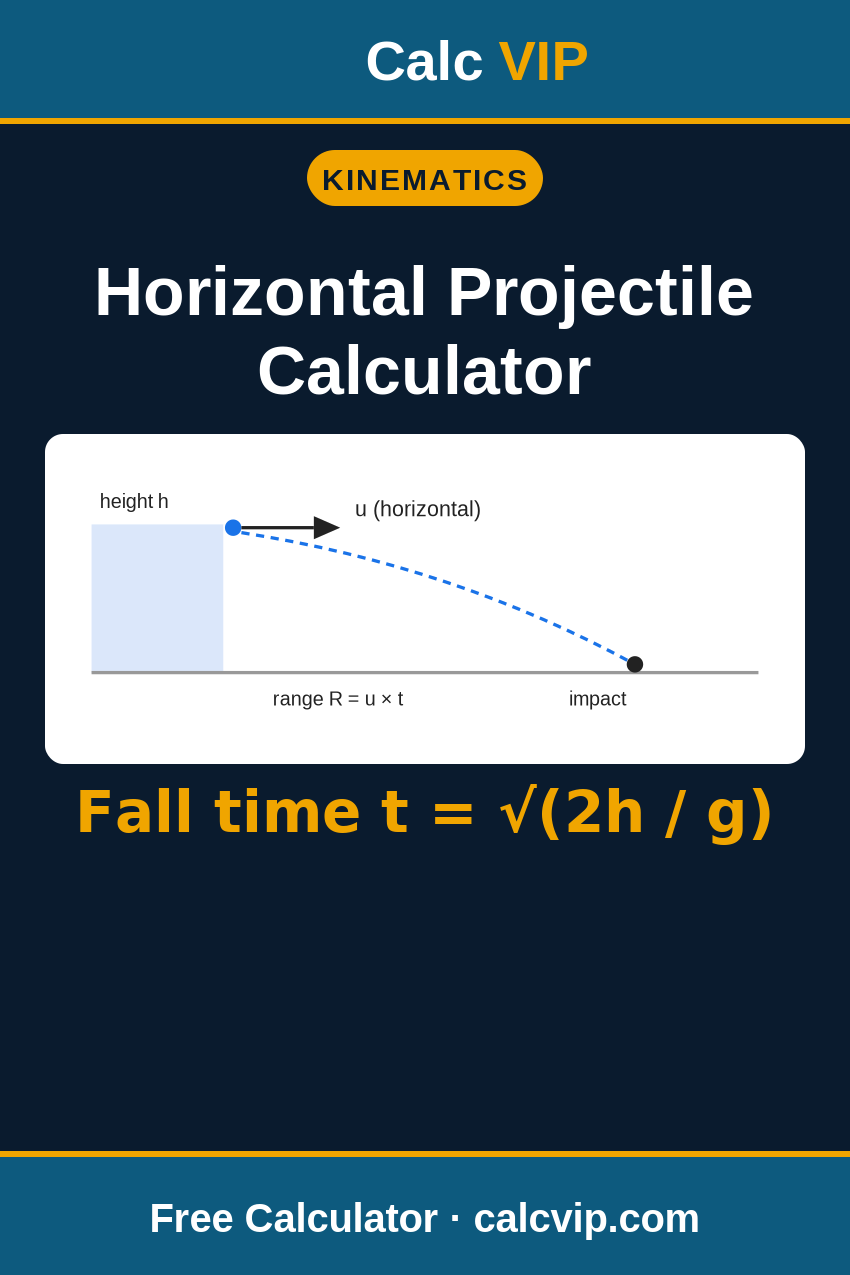
Because the model is so clean, it is the one nature keeps demonstrating: water leaving a hose held horizontally, a book sliding off a desk, a package leaving a conveyor, rain leaving a roof edge in windless air. In each case the arc you see — flat at first, steepening relentlessly — is the graph of a horizontal speed that never changes being carried downward by a vertical speed that never stops growing. The calculator quantifies that arc's end: when it lands, how far out, how fast, and at what angle.
Formula
Fall time t = √(2h / g) • Range R = u × t • vy = g × t • Impact velocity = √(u² + vy²) at tan⁻¹(vy / u) below horizontal (g = 9.81 m/s²)
Each formula is one idea. The fall time is the free-fall equation h = ½gt² solved for t — the launch speed appears nowhere in it, which is the whole point. The range is constant-speed motion, s = vt, because the horizontal component never changes. The impact vertical speed is v = gt starting from zero — equivalently vy = √(2gh), the speed any object gains falling h metres. And the impact velocity is the Pythagorean sum of the two perpendicular components at the final instant, with the angle from the same triangle. Useful rearrangements: h = ½g(R/u)² finds the height from a measured range and speed, and u = R / √(2h/g) finds the launch speed a target range requires. The calculator uses g = 9.81 m/s² and no air resistance, so light or fast objects will land sooner and shorter than shown.
| Symbol | Meaning | Units |
|---|---|---|
| h | height of the launch above the landing surface | m |
| u | horizontal launch speed (constant all flight) | m/s |
| t | fall time, √(2h/g) | seconds (s) |
| R | range — horizontal distance from the base | m |
| vy | vertical speed at impact, gt | m/s |
The great simultaneity: dropped and fired land together
It is the most demonstrated fact in mechanics — in textbooks, in lecture halls, in slow-motion footage — and it still startles: an object dropped from a height and an object launched horizontally from the same height at the same moment strike the ground together. The reason is the independence of the components. Vertically, both objects begin at vy = 0 and are accelerated identically by gravity; their vertical biographies are the same story word for word. Horizontally, one has a story and the other does not, but horizontal motion neither hastens nor delays the fall. Position snapshots at equal time intervals show the two objects level with each other at every instant, the launched one simply displaced sideways — a fact the third diagram on this page draws, and which no amount of launch speed can break, because u never enters t = √(2h/g).
The practical consequences run far. It is why a package dropped from a level-flying plane lands directly below the point the plane has reached at impact time — the package keeps the plane's horizontal speed, falling in formation beneath it. It is why the range of a hose or a waterfall scales so simply with its exit speed. And it is why "leading" a falling target is a matter of flight time alone: everything launched flat from a height shares the same clock, set only by h.
The simultaneity has a famous theatrical form — the falling-target demonstration. Aim a launcher directly at a target hanging at the same height, and arrange for the target to be released at the exact instant of launch. Intuition says the projectile, aimed at where the target was, must pass above where it falls to. The components say otherwise: the projectile falls below its aim line by ½gt² at every instant, and the target falls by exactly ½gt² too, so the two meet — the aim was correct all along, because gravity edits both trajectories with the same hand. It is the dropped-and-fired simultaneity in costume, and it works at any launch speed slow enough to watch: the meeting is guaranteed by the shared vertical story, not by marksmanship.
How to use
- Enter the height h in metres — the vertical distance from the launch edge to the landing surface.
- Enter the horizontal speed u in m/s (enter 0 for an object simply dropped or released).
- Click "Calculate Impact" to see the fall time, the range, the vertical speed at impact, and the impact velocity with its angle below the horizontal.
- To find what speed a desired range needs, note that u = R ÷ t with t fixed by h alone — the calculator's fall time is the divisor.
- For objects launched from moving vehicles or aircraft, u is the vehicle's speed at release: the object keeps it.
Worked examples
Example 1 — the platform ball. A ball rolls off a h = 20 m platform at u = 15 m/s.
Fall time t = √(2 × 20 ÷ 9.81) = 2.02 s. Range = 15 × 2.02 = 30.29 m. Vertical speed at impact vy = 9.81 × 2.02 = 19.81 m/s, so the impact velocity is √(15² + 19.81²) = 24.85 m/s at 52.87° below the horizontal.
Example 2 — the tabletop marble. A marble rolls off a 1.2 m table at 2 m/s: t = √(2.4 ÷ 9.81) = 0.49 s, range = 2 × 0.49 = 0.99 m, vy = 4.85 m/s, impact = √(4 + 23.56) = 5.25 m/s at 67.6° — even a gentle roll lands steeply, because the fall had half a second to build downward speed while the sideways speed stayed small.
Example 3 — the supply drop. A package released from a plane flying level at 60 m/s at 500 m altitude: t = √(1000 ÷ 9.81) = 10.10 s, range = 60 × 10.10 = 605.78 m — the release must happen over half a kilometre early. vy at impact = 99.05 m/s, impact velocity = 115.8 m/s at 58.79° (in practice air resistance and a parachute rewrite these numbers entirely — the model's job is the release geometry).
Example 4 — the cliff stone. A stone thrown flat at 8 m/s from a 45 m cliff: t = √(90 ÷ 9.81) = 3.03 s, range = 24.23 m, vy = 29.71 m/s, impact = 30.77 m/s at 74.93° — it arrives moving nearly four times faster downward than it ever moved sideways.
Example 5 — simply dropped. A tool dropped (u = 0) from an 80 m mast: t = 4.04 s, range 0 m, and it lands at vy = √(2 × 9.81 × 80) = 39.62 m/s straight down — the reason dropped-object exclusion zones exist on every rig and building site.
Example 6 — the car off the bridge deck. A vehicle leaving a 10 m-high broken bridge deck at 25 m/s: t = √(20 ÷ 9.81) = 1.43 s, carrying it 35.7 m out, with vy = 14.01 m/s and impact at 28.66 m/s at 29.26° — the shallow angle shows in the numbers: from low heights at road speeds, the horizontal story still dominates at impact.
Horizontal launches in real life
Conveyor and chute transfers. Material leaving a conveyor belt is a horizontal projectile; the receiving bin is placed at range = belt speed × fall time between the belts — this calculator, run on every bulk-handling design.
Aerial firefighting. A water bomber's drop is a horizontal launch from altitude at flight speed; the crew aims by flight time, releasing the load hundreds of metres before the fire line.
Water features and drainage. A spout's throw — how far water lands from a wall — is u × √(2h/g); architects use it to place basins and to keep footpaths dry.
Ball-off-the-table experiments. The classic school measurement of a projectile's speed: measure h, measure the range where it lands, and u = R/√(2h/g) — a speedometer made of a tape measure and gravity.
Cliff and quarry safety. Rockfall trajectories start as horizontal launches at the edge's lip velocity; barrier placement distances come from the range formula with generous margins.
Ski and skate ramps. A rider leaving a flat kicker is a horizontal projectile whose landing is arranged by the slope's designer so the flight time and the slope's fall meet comfortably.
Why every flat launch lands steeper than intuition says
Compare the impact angles across the examples: 52.87° from 20 m at 15 m/s, 67.6° off a table, 74.93° off the cliff. Launches that felt "flat" land steep — past 45° in most realistic cases. The reason is the race between the components: u is frozen at its modest launch value while vy accumulates 9.81 m/s for every second of fall, and falls from real heights last whole seconds. vy overtakes u whenever gt > u, i.e. whenever the fall lasts longer than u/9.81 seconds. Only low heights and high speeds (Example 6) keep the impact shallow. Any design that receives a launched object — a bin, a net, a landing slope — must be angled for the arrival the calculator reports, not for the launch that intuition remembers.
Nature's own demonstration runs at every waterfall. Water leaves the lip at whatever speed the river had — say 3 m/s over a 50 m fall: the fall time is √(100 ÷ 9.81) = 3.19 s, so the water lands just 3 × 3.19 = 9.58 m out from the cliff face, arriving at a steep angle that deepens the plunge pool close to the rock. That is why waterfall pools hug the cliff and why the dry ledge behind a falling sheet of water exists at all: the river's modest horizontal speed buys it less than ten metres of clearance on a fifty-metre fall.
Quick reference: fall time and impact vy by height (any u)
| Height h (m) | Fall time t (s) | vy at impact (m/s) | Range at u = 5 m/s | Range at u = 15 m/s |
|---|---|---|---|---|
| 1.2 | 0.49 | 4.85 | 2.47 m | 7.42 m |
| 5 | 1.01 | 9.90 | 5.05 m | 15.14 m |
| 20 | 2.02 | 19.81 | 10.10 m | 30.29 m |
| 45 | 3.03 | 29.71 | 15.14 m | 45.42 m |
| 80 | 4.04 | 39.62 | 20.19 m | 60.57 m |
Two patterns to keep: fall time grows only with the square root of height (four times the height, twice the time), while the range grows in direct proportion to u — speed is the generous variable, height the stingy one.
Measuring launch speed with two tape measures
The rearrangement u = R ÷ √(2h/g) turns this calculator into the cheapest speedometer in physics, and the protocol deserves to be written down properly. Set a launch edge at a measured height — a 1.00 m lab bench is ideal — and mark the floor line directly beneath the edge with a plumb line, because every range is measured from that line, not from the bench's leg. Launch the object flat (a ramp or a rolling track guarantees horizontality better than a hand), let it land on a surface that records the spot — sand, flour, or paper over carbon paper — and measure to the first mark, since bounces lie. With h = 1.00 m the fall time is √(2 ÷ 9.81) = 0.45 s, so a landing at 1.35 m reports u = 1.35 ÷ 0.45 = 2.99 m/s. The error budget is friendly: a ±5 cm range uncertainty moves the answer only between 2.88 and 3.10 m/s, and five launches averaged tighten it further. The method's one systematic enemy is a launch that is not truly flat — a ramp tilted up by even 3° lends the projectile a small uy and stretches the range, flattering the speed. Level the ramp with the same care as the measurements, and a metre rule and a stopwatch-free method outperform most gadgets schools can buy.
Common mistakes
- Believing a faster launch falls faster. It does not — t = √(2h/g) contains no u. Doubling the launch speed doubles the range and leaves the fall time untouched. If an answer shows the time changing with speed, the model has been contaminated.
- Measuring h from the wrong place. h is launch edge to landing surface. A ball leaving a table on a hill, or landing on a lower floor, needs the true vertical drop, not the furniture's catalogue height.
- Reporting the impact speed as u + vy. Components combine by Pythagoras, not addition: √(u² + vy²), always less than the sum. Example 1's impact is 24.85 m/s, not 34.81.
- Giving the impact angle from the vertical. The calculator reports the angle below the horizontal. A 52.87° impact is steep, but it is not 52.87° from vertical — that would be a shallow 37° arrival, a different landing entirely.
- Ignoring air resistance for light objects. A table-tennis ball launched flat lands noticeably sooner and shorter than this model says — drag eats its horizontal speed throughout. Dense objects at modest speeds are the model's home ground.
FAQ
Does the horizontal speed affect the fall time?
No. The fall time depends only on the height. A dropped object and a fast-thrown object from the same height land at the same moment (ignoring air resistance).
Why is the impact speed bigger than the throw speed?
Gravity adds a vertical component vy during the fall, and the impact speed combines both components.
What if the object is just dropped?
Enter u = 0. The range is then zero and it falls straight down, hitting at speed √(2gh).
How can I find the launch speed from a measured range?
Divide the range by the fall time: u = R ÷ √(2h/g). This is the standard school experiment — the landing mark and the height together reveal the speed the object left with.
Does the object's mass matter?
Not in this model: mass appears in none of the four formulas. In real air, heavier and denser objects hold their speed better and track the model more closely than light ones.
What if the launch is slightly angled rather than flat?
Then it is a general projectile: even a few degrees up adds uy = u sinθ of rise time. Use the Projectile Flight Time calculator, which accepts the angle and the height together.
Why does the trajectory curve downward ever more steeply?
Because in each equal time slice the object advances the same horizontal distance but a growing vertical distance — the equal-spacing snapshots in the diagram show the vertical gaps stretching while the horizontal gaps stay fixed.
How far does a hose jet land from a wall?
Measure the exit speed u and the height h, and the answer is u × √(2h/g) — for a typical garden hose at 8 m/s held 1 m up, about 8 × 0.45 = 3.6 m.
Is the impact angle ever less than 45°?
Yes, when the fall is short and the speed high — gt stays below u, as in Example 6 (29.26°). Tall or slow launches always land steeper than 45°.
What g does the calculator use?
9.81 m/s², Earth's surface gravity. The same launches on the Moon (g = 1.62) would take about 2.5 times longer to fall and travel about 2.5 times further at the same u.