 Calc
Echo Distance Calculator – Distance from Echo Return Time
 Created by David Okafor · Physics Writer · Waves & Light · Last updated: November 2026
Use this free Echo Distance Calculator to find how far away a wall, cliff or building is from the time an echo takes to come back. Enter the return time and the speed of sound, and the calculator halves the round trip for you. This is the same idea sonar and bats use to measure distance.
An echo is a measuring instrument you carry in your throat. Clap once in front of a cliff and start counting: the returning slap of sound has travelled to the rock face and back, at a speed you know. Time the journey, multiply by the speed, halve the answer, and you have paced out the distance without taking a step. Few physics formulas are this direct — one multiplication, one division — yet the same arithmetic, scaled up and electrified, sounds the depth of oceans, images unborn babies, guides bats through black caves and once measured the distance to the Moon to within centimetres.
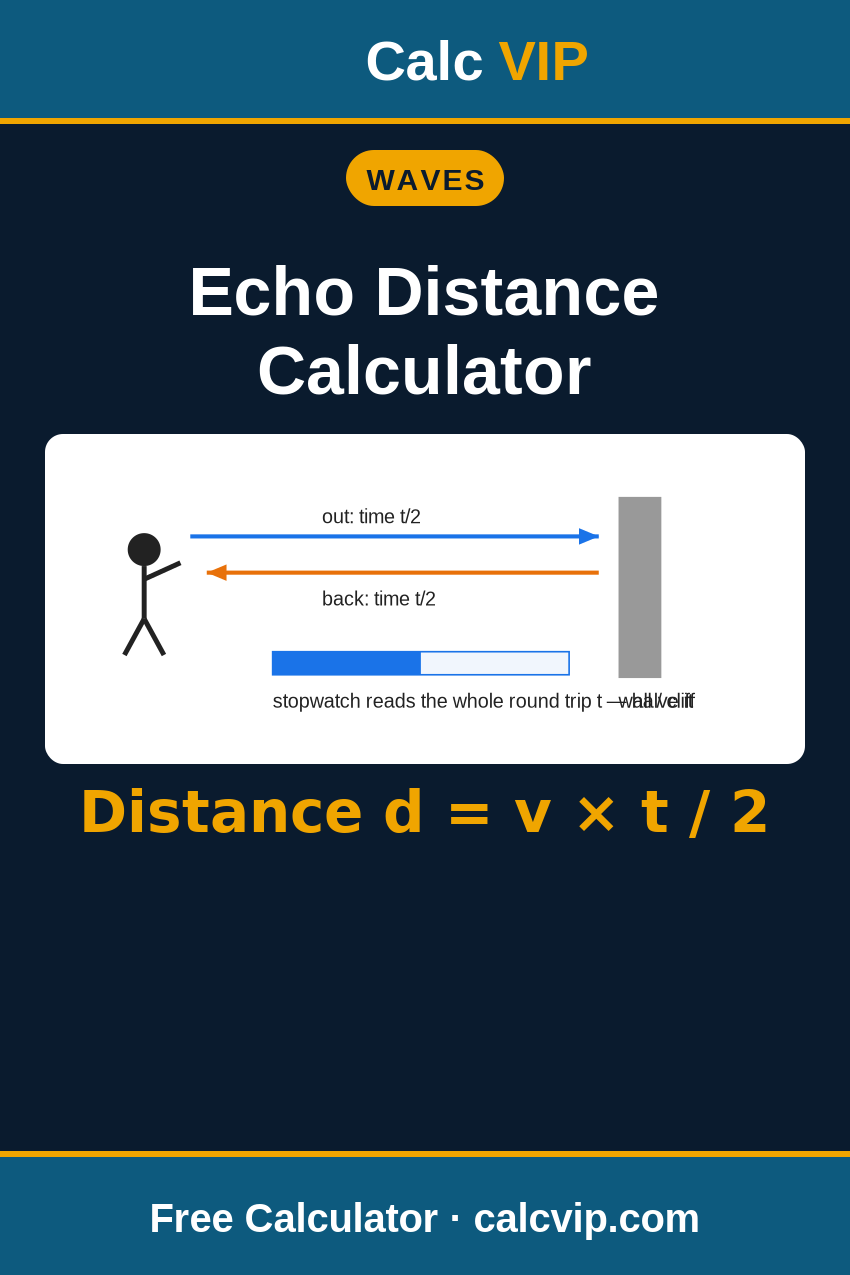
The halving is the heart of it, and the part everyone forgets once. Your stopwatch times a round trip: out to the surface and back again. The sound covers the unknown distance twice, so the distance itself is half of v × t. Everything else — choosing the right wave speed for air, water or tissue, allowing for temperature, timing repeated claps to beat your own reaction time — is refinement of that single idea. This calculator performs the core calculation and reports the total path as well, so you can see the round trip your timing actually measured.
It is worth pausing on how sensitive the method is. Sound takes about 6 milliseconds to make a one-metre round trip, so a stopwatch honest to a hundredth of a second resolves distances to about 1.7 m; electronics timing to a microsecond resolve millimetres. That is why echo ranging scaled from cliffs to foetal hearts without changing its formula — only its clocks got better.
Formula
Distance d = v × t / 2 • the sound travels to the surface and back, so the total path is 2d — that is why we divide by 2
The formula rearranges for the other two questions you might bring to it. Given a known distance, the echo time is t = 2d / v — how long you will wait for the reply. And given a measured time over a known distance, the wave speed itself is v = 2d / t, which is exactly how the speed of sound was first measured with cannons and church towers, and how school classes still measure it with claps and a playing field. Everything hinges on using the speed for the medium the wave actually travelled through: 343 m/s in air at 20 °C, about 1,480 m/s for sound in water, 3 × 10⁸ m/s for the radar pulses that bounce off aircraft and the Moon. Same formula, three clocks of wildly different pace.
| Symbol | Meaning | Units |
|---|---|---|
| d | one-way distance to the reflecting surface | m |
| t | round-trip time — out and back together | seconds (s) |
| v | speed of the wave in the medium | m/s |
| 2d | total path travelled by the sound, v × t | m |
Why you need 17 metres: the ear's time window
An echo is only an echo if your brain registers it as a separate event, and the auditory system merges sounds arriving within roughly a tenth of a second of each other into one. That persistence-of-hearing window sets the minimum range of the whole technique in air: the round trip must take at least ~0.1 s, so the surface must be at least v × t/2 = 343 × 0.1 / 2 ≈ 17 m away. Closer than that, the reflection still exists — it just fuses with the original sound, thickening it. That fused reflection is reverberation, the quality that makes bathrooms sing and concert halls glow, and it is why a small room never gives a clean echo no matter how hard its walls are: the returns arrive inside the window, as texture rather than as a distinct reply.
The same window explains the classic clap-echo trick for beating your own reaction time. A single clap and a single echo are both hard to time — your start and stop reactions corrupt a lone half-second badly. Instead, clap in rhythm with the returning echoes, each clap triggered by the previous echo, and time ten or twenty round trips at once: the errors shrink by the number of trips, and a school class can measure the speed of sound to a few percent with nothing but hands and a phone timer. Professionals use the identical idea — many repeated pings, averaged — inside every sonar and parking sensor.
How to use
- Make a sharp sound (a clap works well) and time how long it takes for the echo to return, in seconds. For short times, time a train of claps locked to the echoes and divide by the number of round trips.
- Enter that time. The speed of sound in air, 343 m/s, is pre-filled — change it if the air is much hotter or colder, or for another medium entirely (about 1,480 m/s in water).
- Click "Calculate Distance" to find how far away the reflecting surface is.
- Check the answer against the 17 m rule: if your surface was much closer than that, what you timed was probably not a clean, separated echo.
Worked examples
Example 1 — the cliff. You clap and the echo from a cliff comes back after 0.5 s, with sound travelling at 343 m/s.
d = 343 × 0.5 / 2 = 171.5 / 2 = 85.75 m. The cliff is about 86 metres away.
Example 2 — a long wait, a long way. A shout returns from a far canyon wall after 2 s: d = 343 × 2 / 2 = 343 m. When the round trip takes exactly two seconds at this speed, the numbers arrange themselves so the distance in metres equals the speed itself — a handy sanity check for field estimates.
Example 3 — sonar over the side. A ship's echo sounder sends a ping down through seawater (v ≈ 1,480 m/s) and hears the seabed's reply after 1.2 s. The depth is d = 1,480 × 1.2 / 2 = 888 m. Identical formula, different medium — which is why the calculator accepts any speed you give it.
Example 4 — a bat closing in. A bat's cry returns from a moth after 0.03 s. The moth is d = 343 × 0.03 / 2 = 5.15 m away — and the bat recomputes this hundreds of times per hunt, tracking how the answer shrinks as it closes in. Bats use ultrasound, whose short wavelength reflects from insect-sized targets that long audible waves would flow around.
Example 5 — the parking sensor. A car's ultrasonic sensor hears its ping return from a wall in 0.006 s (6 milliseconds): d = 343 × 0.006 / 2 = 1.03 m. The beeps quicken as the time — and so the distance — shrinks, turning this page's formula into a soundtrack every driver knows.
Example 6 — radar to the Moon. In 1946 a radar pulse was bounced off the Moon: the round trip took 2.56 s at light speed, 3 × 10⁸ m/s. The distance came out as d = 3 × 10⁸ × 2.56 / 2 = 3.84 × 10⁸ m — 384,000 km, the Moon's distance, measured with the echo formula and a very fast wave. Lunar laser ranging still uses exactly this, now timing the trip to picoseconds.
Echo ranging in real life
Echo sounders and fish finders ping the water continuously and paint depth — and fish, wrecks and weed beds — from the returning times, turning Example 3 into a live picture of the world under the hull.
Medical ultrasound. A scanner times echoes from boundaries inside the body (using ≈1,540 m/s in tissue) and builds an image line by line: every pixel's depth is d = vt/2. Obstetric scans, heart imaging and physiotherapy machines are all this formula, repeated millions of times.
Bats, dolphins and oilbirds navigate and hunt by echolocation, emitting clicks and reading the returning times — and the frequency shifts and spectral details — to build a working map of a dark world.
Parking sensors, robots and level gauges use cheap ultrasonic modules that time echoes to the microsecond, measuring gaps, obstacles and the surface level in tanks and silos without touching anything.
Radar, lidar and lunar ranging swap sound for radio waves or laser light and keep the formula untouched: air-traffic radar, self-driving-car lidar and the Apollo retroreflector measurements are all echo timing at 3 × 10⁸ m/s.
Measuring wells and caves. Drop nothing: shout, or drop a stone and time differently — cavers and well-diggers have long estimated depth from echo return times before sending anyone down.
Quick reference: echo times in air (v = 343 m/s)
| Echo return time | Distance to surface | Typical scene |
|---|---|---|
| 0.1 s | 17.15 m | minimum for a distinct echo |
| 0.25 s | 42.88 m | a large sports hall's end wall |
| 0.5 s | 85.75 m | a cliff across a field |
| 1 s | 171.5 m | a tower block down the street |
| 2 s | 343 m | a canyon wall |
| 4 s | 686 m | a mountain face across a valley |
A pocket rule falls out of the table: in air, the distance in metres is about 170 times the echo time in seconds. Hear a two-second echo and you are roughly 340 m from the wall — close enough for hiking estimates and classroom demonstrations alike.
From echoes to images: how ultrasound sees
Medical ultrasound deserves a closer look, because it is this page's formula industrialised. The probe emits a pulse lasting a microsecond or so, then listens. Every boundary between tissues of different acoustic character returns a small echo; the scanner times each return, converts it with d = vt/2 (using v ≈ 1,540 m/s for soft tissue), and plots a dot at that depth with brightness set by the echo's strength. Sweep the beam and the dots assemble into the familiar grey image — a map built entirely of echo times. The frame refreshes dozens of times a second, so the "camera" is really a very fast stopwatch. The coupling gel, incidentally, exists because the formula's other assumption — a continuous medium — fails at an air gap: even a film of air reflects nearly all the sound before it starts, so the gel replaces air against the skin.
The method has an honourable prehistory in air, too. In the 18th and 19th centuries the speed of sound itself was measured by echo's grander cousin: observers timed the gap between a distant cannon's flash and its report, and later refined it by firing two cannons and timing each other's shots to cancel the wind. Those experiments fixed v so that d = vt/2 could be trusted in reverse — the moment a constant of nature becomes a ruler. Sonar in the First World War, radar in the Second, and ultrasound in the 1950s are all that same ruler, reissued with better clocks.
An echo carries two messages: distance and speed
Everything so far reads only the echo's timing, but a returning echo also carries a frequency, and if the reflector is moving, that frequency is shifted by the Doppler effect — twice over, once on the way out (the reflector acts as a moving observer) and once on the way back (it re-emits as a moving source). A single ping therefore reports two facts: the delay gives the range through d = vt/2, and the shift gives the closing speed. That is the whole operating principle of radar speed guns, of weather radar watching rain approach or retreat, and of Doppler ultrasound distinguishing blood flowing towards the probe from blood flowing away. Sonar operators have used it for a century to tell whether a contact is coming or going. The echo, it turns out, is not just a ruler — it is a speedometer as well, and the two readings arrive in the same reply.
Common mistakes
- Forgetting to divide by 2. The classic error, doubling every answer. The stopwatch times a round trip; the distance is half the path. The calculator exists largely to make this mistake impossible.
- Using the speed for the wrong medium. Timing an echo in air but calculating with water's 1,480 m/s inflates the distance more than fourfold. Match v to what the wave actually travelled through — and to the day's temperature, if precision matters.
- Trying to time a single short echo by hand. Human reaction time is 0.15–0.25 s at each end of the measurement — comparable to the whole round trip from a nearby wall. Use the rhythmic clap-train method and divide, or record the sound and read the gap off the waveform.
- Expecting a distinct echo from a close or soft surface. Inside ~17 m the return fuses into reverberation, and soft or angled surfaces scatter or deflect the sound instead of returning it. A missing echo usually says something about the surface, not about your arithmetic.
- Confusing echo with reverberation. An echo is one identifiable repetition; reverberation is thousands of fused reflections decaying together. The formula prices the first; the second is described by decay times, not distances.
FAQ
Why do we divide by 2?
The measured time covers the sound's return trip: from you to the surface and back again. The sound covers the distance twice, so the one-way distance is half of v × t.
How close can a wall be and still give a clear echo?
Your ear needs the echo to arrive at least about 0.1 s after the original sound to tell them apart, which means the surface must be at least roughly 17 m away in air.
Is this how sonar and bats work?
Yes — sonar on ships, radar-style ranging and bat echolocation all time a reflected signal and halve the round-trip distance. They just use different wave speeds (about 1,480 m/s for sound in water).
How can I measure an echo time accurately with a phone?
Record the clap and its echo as audio, then read the time gap between the two spikes in any audio app — this removes your reaction time entirely. Alternatively, clap rhythmically in time with the echoes and time 10 or 20 round trips at once, then divide.
Why don't I hear echoes indoors?
You do — but the walls are closer than about 17 m, so the reflections return inside the ear's 0.1 s merging window and are heard as reverberation: the fullness and ring of the room, rather than a separate repeated sound. Large halls and gymnasiums, with longer paths, can produce true echoes.
Can echoes measure the speed of sound itself?
Yes — turn the formula around: v = 2d/t. Pace out a known distance to a wall (100 m is convenient), time the echo train, and the speed of sound for that day's air drops out. It is one of the oldest quantitative experiments in acoustics and still a school standard.
Why do bats and ultrasound scanners use such high frequencies?
Resolution. A wave reflects strongly from objects comparable to or larger than its wavelength, and ultrasound's millimetre-scale wavelengths bounce off insects, blood vessels and tissue boundaries that audible sound would wash around. The timing formula is unchanged; the short waves simply see a finer world.
Do echoes work in space?
Sound echoes do not — there is no air to carry them. But the formula works for any wave that reflects: radar and laser pulses echo off spacecraft, planets and the Moon through empty space perfectly well, travelling at light speed.
What are multiple echoes?
Between two parallel hard surfaces — facing cliffs, warehouse walls, city towers — sound can bounce back and forth several times, producing a flutter of repeated echoes, each round trip adding the same delay. Studios and squash courts are designed to avoid exactly this.
How accurate is the pre-filled 343 m/s?
It is the speed at 20 °C. Sound runs about 0.6 m/s slower per degree below that and faster per degree above, so on a freezing day the true distance is roughly 3–4% less than the calculator's answer. For cliff-and-canyon estimates that is plenty; for precision work, set v from the day's temperature first.