 Calc
Light Intensity Calculator – Inverse Square Law & Electric Field of Light
 Created by David Okafor · Physics Writer · Waves & Light · Last updated: November 2026
Use this free Light Intensity Calculator to find how bright a light source is at any distance, using the inverse square law, and to find the strength of the electric field in the light wave itself. Enter the source's radiated power and your distance from it.
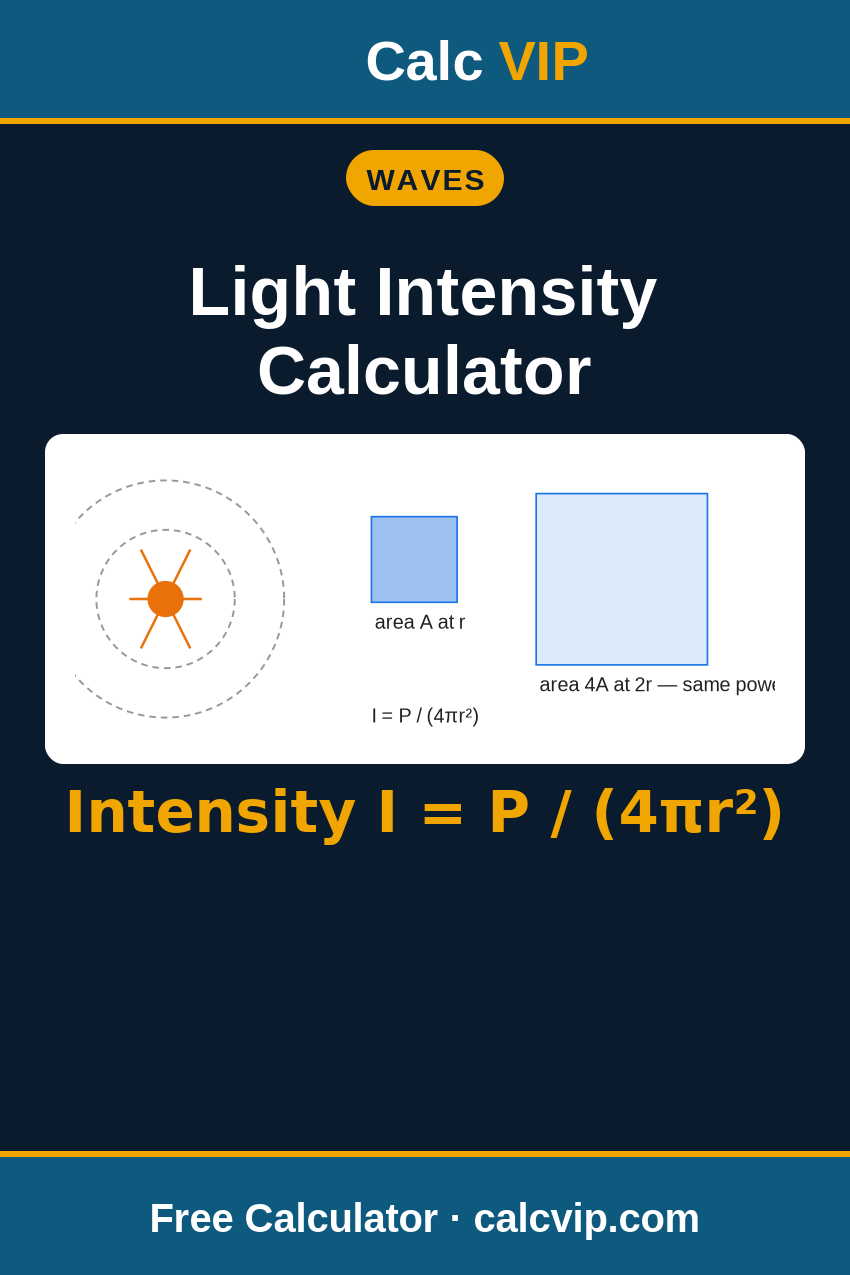
Intensity is where the inverse square law meets the wave itself. A source radiating power P uniformly paints that power over the surface of an ever-expanding sphere, and since the sphere's area is 4πr², the power landing on each square metre falls as 1/r²: double the distance, quarter the intensity. That is the first half of this calculator. The second half goes one level deeper: light is an oscillating electric and magnetic field, and the intensity fixes how strong that field is. From I alone you can recover the rms electric field Erms = √(I/(cε₀)) — the actual electrical strength of the light arriving at your eye, your solar panel or your radio aerial.
The numbers surprise most people. Ordinary sunlight, I ≈ 1000 W/m² at ground level, carries an electric field of about 614 V/m — hundreds of volts per metre, oscillating a hundred trillion times a second and averaging to zero, which is why you are not electrocuted by a sunny day. At the top of the atmosphere the solar constant, 1361 W/m², corresponds to about 716 V/m rms, or just over 1000 V/m at the wave's peak. This calculator assumes the textbook case — a point source radiating equally in all directions into empty space — and the applications section is honest about where real sources (beams, bulbs with reflectors, the Sun itself) depart from that ideal.
Use it for lighting estimates, radio link budgets, solar calculations and the physics of radiation pressure. If your source is directional, the formula still gives the right form of answer — spread the power over the area it actually illuminates, as the laser example below demonstrates — but the isotropic number will understate the intensity inside a beam, sometimes by a million times.
Formula
Intensity I = P / (4πr²) • rms electric field Erms = √( I / (c ε₀) ), with c = 3 × 10⁸ m/s and ε₀ = 8.854 × 10⁻¹² C²/N·m².
The pair rearranges freely: given a target intensity, the distance at which a source delivers it is r = √( P / (4πI) ), and the power needed is P = 4πr²I. The field form also inverts: I = cε₀Erms², and the peak field of the wave is E₀ = √2 × Erms. Two companion quantities come free: the rms magnetic field is Brms = Erms/c, and the radiation pressure on a perfectly absorbing surface is I/c (double that, 2I/c, for a perfect mirror). Units: P in watts, r in metres, I in watts per square metre, E in volts per metre.
| Symbol | Meaning | Units |
|---|---|---|
| I | intensity — power per unit area | W/m² |
| P | power radiated by the source (all directions) | watts (W) |
| r | distance from the source | metres (m) |
| Erms | root-mean-square electric field of the wave | V/m |
| c, ε₀ | speed of light; permittivity of free space | m/s; C²/N·m² |
Why the field strength follows from the intensity
An electromagnetic wave carries its energy in two equal shares, electric and magnetic, and the rate at which energy crosses a square metre — the intensity — is the product of the energy density and the speed of light: I = c × u. The electric share of the energy density is uE = ½ε₀E² at each instant; averaging the squared field over a cycle turns E² into Erms² and, with the magnetic share equal, gives I = cε₀Erms². That is all the calculator's second formula says: intensity and field are two descriptions of one flow of energy, convertible through the constants c and ε₀. Radio engineers live on the E side of the equation (an aerial responds to field, and receiver sensitivities are quoted in µV/m), while lighting and solar engineers live on the I side — this page translates between their dialects.
It is worth pausing on how large the fields of ordinary light are. Sunlight's 614 V/m rms exceeds the field inside many electronic circuits, yet it is harmless because it reverses direction 10¹⁴ times per second: charges are shaken, not transported, and only the tiny fraction of energy absorbed as heat registers. Raise the intensity enough, though, and the field itself becomes a tool and a hazard — a focused laser's field can ionise air — which is why laser safety is specified in intensity at the cornea, and why the field form of this calculation matters.
How to use
- Enter the power the source radiates as electromagnetic waves in all directions, in watts. (For a bulb, only part of its electrical power becomes light — a 100 W incandescent radiates most of its energy as heat, so treat this as an idealised source.)
- Enter your distance from the source in metres.
- Click "Calculate Intensity" to see the intensity in W/m², the rms electric field strength of the wave, and the area of the sphere the power is spread over at your distance.
- For a target intensity instead, rearrange: r = √(P/(4πI)) tells you how far away that intensity occurs.
Worked examples
Example 1 — the reference source. A source radiates P = 100 W uniformly in all directions. At r = 2 m:
I = 100 / (4π × 2²) = 100 / 50.27 = 1.99 W/m².
Erms = √(1.99 / (3 × 10⁸ × 8.854 × 10⁻¹²)) = 27.37 V/m.
Example 2 — the solar constant. The Sun radiates P = 3.83 × 10²⁶ W; Earth orbits at r = 1.496 × 10¹¹ m. The sphere's area is 4π × (1.496 × 10¹¹)² = 2.81 × 10²³ m², so I = 1361 W/m² — the solar constant, measured by satellites to just this value. The field: Erms = √(1361/(cε₀)) = 715.81 V/m, peaking at √2 × 715.81 ≈ 1012 V/m — a kilovolt per metre of free sunlight, before the atmosphere takes its share.
Example 3 — the laser pointer paradox. A 5 mW laser pointer spread isotropically would give, at 1 m, I = 0.005/(4π) = 0.0004 W/m² — utterly negligible. But the beam concentrates those 5 milliwatts into a spot of radius 1 mm, area π × (0.001)² = 3.14 × 10⁻⁶ m², giving I = 0.005 / 3.14 × 10⁻⁶ = 1591.55 W/m² — brighter than sunlight at the spot. That single comparison is the whole of laser safety in one line: the power is trivial, the intensity is not, because intensity is power divided by area and the area is microscopic.
Example 4 — a room bulb. A bulb radiating 60 W, measured at a desk 3 m away: I = 60/(4π × 9) = 0.53 W/m², with Erms = 14.13 V/m. Compare Example 2: full sunlight delivers roughly two thousand times the intensity of a household bulb at reading distance — a fact anyone who has tried to read by a window versus a lamp already knows in their bones.
Example 5 — a radio transmitter. A 50 kW broadcast transmitter, received 10 km away: I = 50,000/(4π × (10⁴)²) = 3.98 × 10⁻⁵ W/m². Tiny as power — but as a field it is Erms = 0.122 V/m = 122 mV/m, and a half-wave aerial a metre long develops a healthy fraction of a volt from it. Radio works at intensities where lighting calculations see only darkness, because receivers respond to field, not power.
Example 6 — designing to a target. A photographer wants the intensity of a 100 W studio source to fall to 0.01 W/m² at the backdrop. Rearranged: r = √(100/(4π × 0.01)) = √795.77 = 28.21 m — an impractically large studio, which is the inverse square law's real lesson: intensity is cheap to lose. Halving the required drop to 0.04 W/m² halves the distance to 14.1 m, because distance responds only to the square root.
Light intensity in real life
Solar power engineering. Panel ratings begin from this page: the 1361 W/m² solar constant, reduced by atmosphere and angle to a design figure near 1000 W/m² at the surface. A 20%-efficient panel is, by definition, harvesting 200 of those watts per square metre — the rest of the industry's engineering is packaging around this one number.
Photography and lighting design. The inverse square law is the photographer's rule of thumb: move a flash from 1 m to 2 m and the subject receives a quarter of the light — two stops — whatever the flash. Lighting designers place luminaires by computing I over work surfaces, exactly as in Example 4.
Radio link budgets. Every wireless link — Wi-Fi, satellite TV, deep-space probes — is budgeted with I = P/(4πr²) at its core. The Voyager spacecraft's 20 W transmitter, spread over a sphere 25 billion kilometres across, arrives at Earth with an intensity so small that the received power is around 10⁻¹⁸ W; giant dishes exist to collect enough of that sphere.
Radiation pressure and solar sails. Light pushes: pressure = I/c on an absorber, 2I/c on a mirror. Sunlight at Earth gives only 4.54 µPa (absorbing) — yet spread over the 800 m² sail of the IKAROS probe it produced a measurable, mission-changing thrust, and sail designs scale directly from this calculator's I.
Laser and LED safety. Exposure limits are intensity limits at the eye or skin, and Example 3 shows why a 5 mW beam outranks a 100 W bulb as a hazard. Safety classifications, goggles and interlocks are all specified in W/m² at the accessible surface.
Heat lamps and infrared heating. Radiant heaters are rated by the intensity they deliver at the target distance, not by raw wattage — a 2 kW patio heater is comfortable at 3 m and fierce at 1 m, a ninefold difference from the 1/r² law alone.
Quick reference: a 100 W isotropic source at increasing distance
| Distance r | Sphere area 4πr² | Intensity I | Erms |
|---|---|---|---|
| 1 m | 12.57 m² | 7.96 W/m² | 54.73 V/m |
| 2 m | 50.27 m² | 1.99 W/m² | 27.37 V/m |
| 5 m | 314.16 m² | 0.32 W/m² | 10.95 V/m |
| 10 m | 1256.64 m² | 0.08 W/m² | 5.47 V/m |
Read the two right-hand columns against each other: intensity quarters with each doubling of distance, but the field only halves — because I ∝ E². This square-root relationship is why radio reception degrades gracefully over huge distances while illumination gives up quickly: a receiver chasing field strength loses ground half as fast as one chasing power per square metre.
Where the sphere model stops: near fields, gain and light pressure
Everything on this page assumes the far field: a distance large compared with the source itself and with the wavelength, where the wavefronts are locally flat and I and E settle into their fixed proportion. Close to a real source neither holds — fields slosh reactively, E and H fall out of step, and the tidy Erms = √(I × 377) conversion fails. For a 2.4 GHz Wi-Fi antenna the wavelength is 12.5 cm, so a laptop a metre away is safely far-field, while a phone against the ear is a genuinely near-field exposure problem, which is why handset safety is assessed with SAR measurements in tissue phantoms rather than with this calculator. Real antennas also cheat the sphere deliberately: a reflector or array concentrates the same total power into a beam, multiplying the on-axis intensity by the antenna's gain — a 10 dB gain dish delivers ten times the isotropic intensity on boresight, paid for by starving every other direction. The calculator's isotropic sphere is the honest baseline from which all such gains are measured.
Intensity also pushes. Radiation carries momentum, and absorbing a watt of it exerts a force of P/c; sunlight at Earth's distance, I ≈ 1361 W/m², presses on an absorbing surface with I/c ≈ 4.5 micropascals — utterly negligible against a hand, yet across the 200 m² of a solar sail it accumulates to the millinewtons that propelled Japan's IKAROS sail to Venus. Double the pressure for a mirror, since reflection reverses the momentum. The same I that this page converts into field strengths is, quite literally, a force per unit area waiting for a big enough sail.
Common mistakes
- Using the electrical wattage of a bulb as P. P must be the power actually radiated as waves. A 100 W incandescent converts only a few watts to visible light (the rest is infrared and conducted heat); an LED does far better. The calculator computes the idealised source you describe — describe it honestly.
- Applying the isotropic formula inside a beam. Torches, lasers and spotlights concentrate power into a cone. Inside the beam the true intensity is the isotropic value multiplied by roughly 4π divided by the beam's solid angle — easily a factor of thousands (Example 3).
- Confusing intensity with total power. Intensity is per square metre. A detector's received power is I × its collecting area — which is why telescope and dish diameters matter more than almost anything else in their design.
- Mixing up rms and peak field. E₀ = √2 Erms ≈ 1.41 × Erms. Breakdown and ionisation depend on the peak; heating and power depend on the rms. Quoting one where the other is meant introduces a 41% error.
- Forgetting the medium. These formulas are for vacuum (air is close enough). Inside glass or water the wave slows, the field for a given intensity changes, and reflections at the surface skim off a percentage before the calculation even starts.
FAQ
Why does the intensity fall with the square of the distance?
The same total power must cross every sphere centred on the source, and a sphere's area grows as r². Twice as far away means the power is spread over four times the area, so each square metre receives one quarter as much.
What is the electric field of sunlight?
Sunlight at the Earth has an intensity of about 1000 W/m² on a clear day, which gives Erms ≈ 614 V/m — surprisingly large, though it oscillates 10¹⁴ times per second and averages to zero.
Does this work for a laser or a torch with a beam?
Only approximately. The formula assumes the power spreads evenly in all directions. A beam concentrates the power into a small solid angle, so the intensity inside the beam is much higher than this calculation suggests.
What is the magnetic field of sunlight?
Brms = Erms/c. For ground-level sunlight (I = 1000 W/m², Erms ≈ 614 V/m) that is about 2.05 µT — roughly a twenty-fifth of the Earth's magnetic field, oscillating at optical frequency. Light's magnetism is real but, at everyday intensities, feeble next to its electric side.
Does intensity depend on the colour or frequency of the light?
The inverse-square geometry does not — I = P/(4πr²) is colour-blind. Frequency enters only if you ask about photons: at fixed intensity, red light delivers more photons per second than blue, each carrying less energy. For field strength and heating, intensity alone decides.
How close to a source does the formula break down?
Within a distance comparable to the source's own size (or, for radio, within a wavelength or so — the "near field"). A real bulb is not a point: at 5 cm from a 10 cm bulb the sphere picture fails. Beyond a few source diameters the inverse square law is excellent.
Why do radio stations quote field strength instead of intensity?
Because an aerial's output voltage is proportional to the field it sits in, and field falls only as 1/r rather than 1/r² — the friendlier number for planning coverage. The two are interchangeable through I = cε₀Erms², which is this calculator's second formula.
Can intensity be negative or zero?
Zero, yes — in the shadow of an obstacle, or (instantaneously, at a node) in a standing wave. Negative, no: intensity is a flow magnitude. In interference patterns the average intensity still obeys conservation — energy is redistributed into bright fringes, never destroyed.
How much intensity does a phone torch produce?
A phone LED radiates perhaps 1 W of light. At 0.5 m the isotropic estimate gives I = 1/(4π × 0.25) ≈ 0.32 W/m² — and because the LED is mildly directional, the true figure in the beam is a few times higher. Enough to read by, roughly a three-thousandth of sunlight.
What intensity would feel like standing next to a power station's output?
It is a meaningless picture without a distance — which is the point of the law. A gigawatt radiated isotropically gives 79.6 W/m² at 1 km but only 0.08 W/m² at about 31.5 km. Total power impresses; intensity at your location is what you live with.