 Calc
Incline Roll Time Calculator – Slide or Roll Down a Frictionless Slope
 Created by Sarah Mitchell · Physics Editor · Motion & Measurement · Last updated: November 2026
Use this free Incline Roll Time Calculator to find how long an object takes to slide or roll down a frictionless slope, and how fast it is moving at the bottom. Sliding is fastest; rolling objects are slower because some energy goes into spinning. Choose the shape to apply the correct rolling factor.
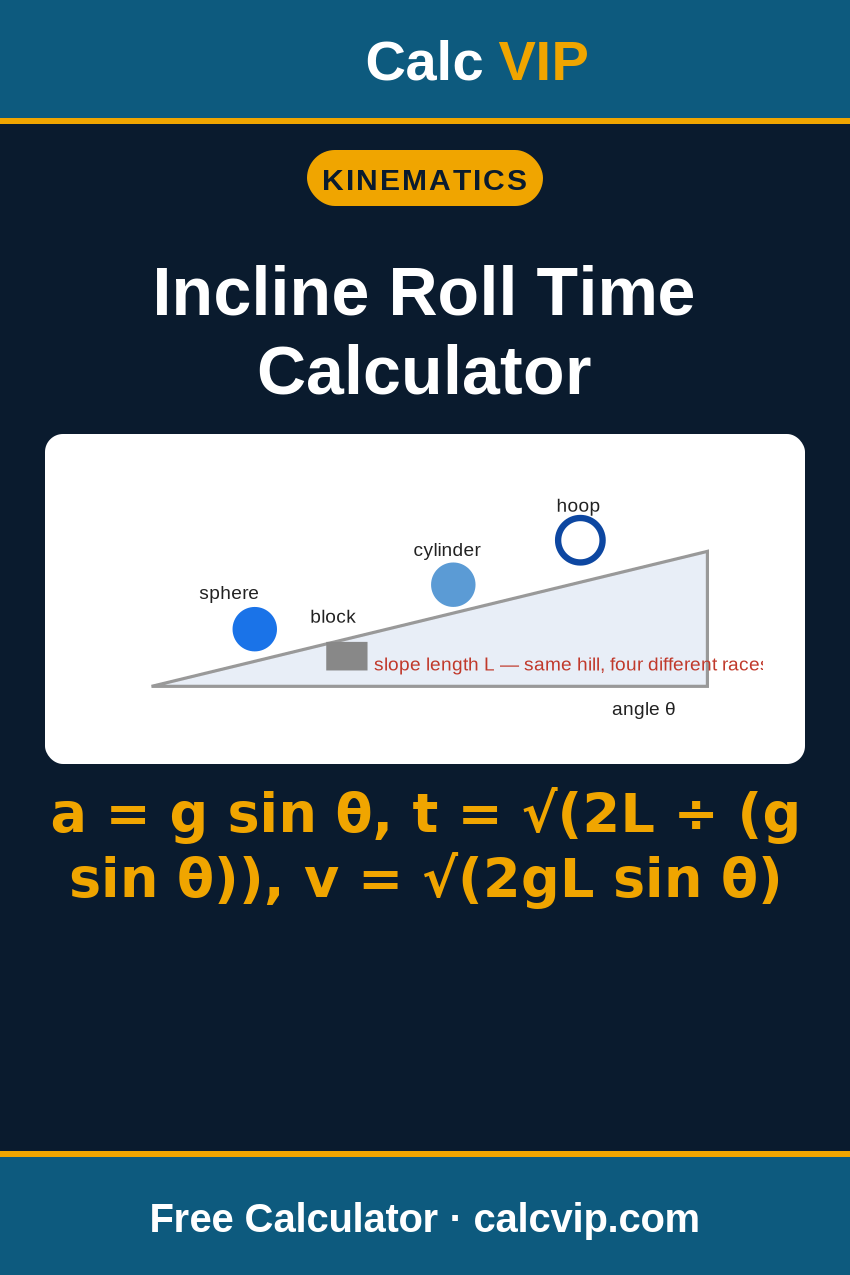
Release a block, a ball, a cylinder and a hoop at the top of the same slope and a small parliament of physics debates breaks out. The block wins, every time. The solid ball beats the cylinder; the cylinder beats the hoop; and the mass of every competitor is irrelevant to the result. The reason is a tax: rolling objects must spend part of their gravitational energy on spinning, and the fraction they pay is set purely by how their mass is distributed — the factor k = I ÷ (mR²) that this calculator builds in when you choose the shape. Sliding pays no tax, which is why it always arrives first.
The physics splits cleanly in two. Gravity's component along the slope, g sin θ, is the engine; for a slider it is the whole acceleration. For a roller, the same engine must accelerate the centre of mass and wind up the rotation, and the two demands divide the acceleration by (1 + k). Time and final speed then follow from the standard constant-acceleration relations over the slope length L: t = √(2L ÷ a) and v = √(2gL sin θ ÷ (1 + k)). The calculator reports all three — acceleration, time and bottom speed — and converts the speed to km/h for a reality check.
There is an idealisation to be honest about: "frictionless" sliding and "rolling without slipping" are partners, not opposites. A roller needs friction — static friction at the contact patch is what torques it into spinning — but on a clean slope that friction does no work, so the energy bookkeeping stays exact. A slider, meanwhile, needs the friction to be absent. Real slopes sit between the ideals, and the depth sections discuss how the answers bend.
Formula
Sliding: a = g sin θ, t = √(2L ÷ (g sin θ)), v = √(2gL sin θ) • Rolling: divide the acceleration by (1 + k): a = g sin θ ÷ (1 + k), t = √(2L(1 + k) ÷ (g sin θ)), v = √(2gL sin θ ÷ (1 + k))
The engine of everything is the component of gravity along the slope, g sin θ — the slope keeps only that fraction of gravity's pull, which is why gentle hills accelerate gently. A slider converts it all into centre-of-mass motion. A roller must share it: the same force budget accelerates the mass and provides the torque for spin, and the sharing ratio is fixed by the shape's moment of inertia through k = I ÷ (mR²) — 0 for a slider, 2/5 for a solid sphere, 1/2 for a solid cylinder or disc, 1 for a hoop or hollow cylinder. The bottom speed has an energy twin: v = √(2gh ÷ (1 + k)) with h = L sin θ the vertical drop — the roller arrives with the slider's √(2gh) reduced by the spin tax, exactly as the speed-at-height energy ledger demands.
| Symbol | Meaning | Units |
|---|---|---|
| L | slope length, measured along the incline | m |
| θ | incline angle above the horizontal | degrees |
| k | shape factor, I ÷ (mR²): 0 slide, 0.4 sphere, 0.5 cylinder, 1 hoop | — |
| a | acceleration down the slope | m/s² |
| t, v | time to the bottom, and speed there | s, m/s |
| g | gravitational acceleration (9.81 on Earth) | m/s² |
The spin tax: where the rolling energy goes
Follow the energy and the race explains itself. A slider reaching the bottom has converted all of mgh into translational kinetic energy, ½mv². A roller has converted the same mgh into two accounts: ½mv² for the motion of the whole body, and ½Iω² for the spin. Rolling without slipping ties the two accounts together (ω = v ÷ R), and the spin account's share of the total is exactly k ÷ (1 + k): 28.57% for a solid sphere, 33.33% for a solid cylinder, and a full 50% for a hoop, whose mass all lives at the rim, at maximum leverage against being spun. The hoop is not lazy; it is simply obliged to bank half its inheritance in rotation, and it arrives with √(1/2) ≈ 71% of the slider's speed to show for it.
Mass distribution, not mass, is destiny — which is why the race is such a clean demonstration. A hollow and a solid ball of identical size and weight distribution class finish in a fixed order regardless of whether they are made of wood, steel or cheese, and a tiny sphere beats a huge hoop every time. Engineers exploit the same ledger in reverse: flywheels are hoops on purpose, storing the maximum energy in spin; vehicle wheels are made light at the rim because rim mass is taxed twice, once to move and once to spin.
How to use
- Enter the slope length L in metres, measured along the slope surface (not the horizontal distance, and not the height).
- Enter the incline angle θ in degrees.
- Choose the object: sliding block, solid sphere, solid cylinder/disc, or hoop/hollow cylinder — the choice sets the shape factor k.
- Adjust g if you are off Earth (Moon 1.62, Mars 3.71 m/s²).
- Click "Find Time & Bottom Speed" to get the acceleration down the slope, the descent time, and the speed at the bottom in m/s and km/h.
Worked examples
Example 1 — slide versus sphere. A block slides down a frictionless slope L = 10 m long at θ = 30°. Acceleration a = 9.81 × sin 30° = 4.905 m/s² (the calculator displays 4.9). Time t = √(2 × 10 ÷ 4.905) = 2.02 s, and the speed at the bottom is v = √(2 × 9.81 × 10 × 0.5) = 9.90 m/s. A solid sphere rolling down the same slope (k = 2/5) is slower: t = 2.39 s and v = 8.37 m/s, because part of its energy goes into rotation.
Example 2 — the full race. Complete the card on the same 10 m, 30° slope. The solid cylinder (k = 0.5): a = 4.905 ÷ 1.5 = 3.27 m/s², t = √(20 ÷ 3.27) = 2.47 s, v = 8.09 m/s. The hoop (k = 1): a = 4.905 ÷ 2 = 2.45 m/s², t = 2.86 s, v = 7.00 m/s. Finishing order — block 2.02 s, sphere 2.39 s, cylinder 2.47 s, hoop 2.86 s — is the k-order, exactly, and would be identical on any slope, anywhere, at any size.
Example 3 — a steep, short ramp. A sliding block on L = 5 m at θ = 45°: a = 9.81 × sin 45° = 6.94 m/s², t = √(10 ÷ 6.94) = 1.2 s, v = √(2 × 9.81 × 5 × 0.7071) = 8.33 m/s. Steepness pays quickly: at 45° the slope already delivers 71% of free fall's acceleration.
Example 4 — a long, gentle roll. A solid sphere on a 50 m slope at only 10°: a = 9.81 × sin 10° ÷ 1.4 = 1.22 m/s², t = √(100 ÷ 1.22) = 9.07 s, and it still arrives at 11.03 m/s — nearly 40 km/h. Gentle slopes are patient, not weak: given length, they accumulate serious speed, which is why runaway-vehicle ramps are long rather than steep.
Example 5 — the Moon. The sliding block of Example 1 under lunar gravity, g = 1.62: a = 1.62 × 0.5 = 0.81 m/s², t = √(20 ÷ 0.81) = 4.97 s, v = √(2 × 1.62 × 10 × 0.5) = 4.02 m/s. Everything unfolds in slow motion: the speeds shrink by the ratio √(1.62 ÷ 9.81) ≈ 0.41, and the times stretch by its reciprocal, about 2.46 — a scaling the calculator's g input exists to explore.
Example 6 — the energy cross-check. The Example 1 slope drops a vertical height h = L sin θ = 10 × 0.5 = 5 m. The speed-at-height ledger says a slider must arrive at √(2gh) = √(2 × 9.81 × 5) = 9.90 m/s — exactly the calculator's answer, by a completely independent route. The time, though, is path-dependent: dropped vertically, 5 m takes 1.01 s; slid at 30°, it takes 2.02 s. Energy fixes the speed; only the slope's geometry fixes the schedule.
Inclines in real life
Galileo's original experiment. The inclined plane was invented as a time machine: Galileo diluted gravity with a gentle slope — at 5°, a slider accelerates at only 0.85 m/s² and takes 4.84 s over 10 m — slowing free fall enough for water clocks and pulse beats to time it. The laws of falling were discovered on a ramp, at g sin θ, exactly as this page computes.
Accessibility ramps and road grades. A 1-in-12 ramp (about 4.76°) gives a slider — or a rolling wheelchair — an acceleration of g × sin 4.76° ≈ 0.81 m/s² before any braking or pushing: the number behind ramp standards, handrail rules and the effort calculations for self-propelling users.
Ski slopes and sledging. A piste's grade sets the free acceleration every skier must manage: at 30°, 4.9 m/s² before friction and turning take their share. The difference between a nursery slope and a black run is, in the first instance, sin θ.
Rolling-resistance demonstrations. Physics classrooms race cans of soup — and the result is this page with lunch: a can of broth (liquid contents barely spin) behaves nearly like a slider and beats a can of thick stew (contents rotate as a solid), a k-factor experiment you can eat.
Conveyor and chute design. Packages sliding down warehouse chutes must arrive fast enough to clear the run but slow enough not to damage goods: designers choose θ so that g(sin θ − μ cos θ) hits the target acceleration — this page's formula with the friction term restored.
Flywheels and yo-yos. The hoop's 50% spin tax is a feature where storage, not travel, is the goal: flywheel rotors are rim-heavy to bank energy in rotation. A yo-yo is a hoop's cousin that climbs back up by spending the stored spin — the tax, refunded.
Friction: the silent partner and the spoiler
Two different frictions haunt this page. For the roller, static friction is indispensable and benign: it grips the contact point, supplies the torque that spins the object up, and — because the contact point is instantaneously at rest — does no work and steals no energy. But it must be strong enough: rolling without slipping demands μs ≥ k tan θ ÷ (1 + k), which for a sphere at 30° means μs ≥ 0.4 × 0.577 ÷ 1.4 ≈ 0.165. On ice, that grip fails, and the object skids partway — arriving with a messy mixture of slide and spin that no single k describes. For the slider, kinetic friction is the spoiler: it subtracts μ g cos θ from the acceleration, giving a = g(sin θ − μ cos θ), and below the angle where tan θ = μ it stops the block entirely — the angle of repose that governs everything from sand piles to avalanche slopes. This calculator's clean numbers are the benchmark between those two frictions: enough grip to roll, none to retard.
Quick reference: the great slope race (L = 10 m, θ = 30°, Earth)
| Object | k | Acceleration | Time | Bottom speed | Energy in spin |
|---|---|---|---|---|---|
| Sliding block | 0 | 4.9 m/s² | 2.02 s | 9.90 m/s | 0% |
| Solid sphere | 0.4 | 3.5 m/s² | 2.39 s | 8.37 m/s | 28.57% |
| Solid cylinder | 0.5 | 3.27 m/s² | 2.47 s | 8.09 m/s | 33.33% |
| Hoop | 1 | 2.45 m/s² | 2.86 s | 7.00 m/s | 50% |
The whole table is one hill and one formula viewed four ways. Change the hill and every time scales by the same factor; change the shape and only the (1 + k) divisor moves — the cleanest illustration in mechanics of a result decided entirely by how mass is arranged.
Common mistakes
- Using the height or the horizontal distance as L. The formulas want the length along the slope. If you are given the vertical drop h, then L = h ÷ sin θ; given the horizontal run, L = run ÷ cos θ. Feeding h directly understates every time.
- Using cos θ for the along-slope component. The engine is g sin θ: at θ = 0 (flat) the acceleration must vanish, and sin delivers that while cos does not. The check "does it vanish on the flat?" catches the swap instantly.
- Expecting mass or size to matter. Neither appears in the results. A marble and a boulder of the same shape class tie exactly (in this ideal model) — entering a mass anywhere is a sign the wrong formula is being used.
- Giving the sphere the cylinder's k. Solid sphere k = 2/5 = 0.4; solid cylinder k = 1/2 = 0.5; hollow versions differ again (a hollow sphere is 2/3). The shape menu exists because these are genuinely different — check the exact entry.
- Assuming rolling is always slower than any sliding. Rolling beats frictional sliding easily: a sphere on a clean slope (3.5 m/s² in the race) outruns a block on a rough one whenever μ is appreciable. The calculator's slider is the frictionless ideal, not a typical block of wood.
FAQ
Why does the mass not appear in the formulas?
Gravity's pull grows with mass, but so does inertia — the two cancel, so on a frictionless incline every object accelerates at g sin θ (divided by 1 + k if it rolls), whatever its mass.
Which shape wins a race down the slope?
The one with the smallest k. A sliding block (k = 0) beats a solid sphere (0.4), which beats a solid cylinder (0.5), which beats a hoop (1.0) — mass near the rim is hardest to spin up.
What changes with friction?
Friction is actually needed for rolling without slipping, but a rough sliding surface slows a block: its acceleration becomes g(sin θ − μ cos θ). This calculator covers the ideal frictionless-sliding / clean-rolling case.
Why does the radius of the rolling object not matter?
Because both the moment of inertia and the rolling condition scale with R² in matching ways: I = kmR² grows with size, but the torque's leverage grows too, and the two cancel in the acceleration. A marble and a millstone of the same shape class roll in a dead heat — size is as irrelevant as mass.
What about a hollow sphere, like a basketball?
Its k is 2/3 ≈ 0.67, between the solid cylinder and the hoop, so it would finish the reference race in t = √(2 × 10 × 1.67 ÷ 4.905) ≈ 2.61 s — slower than its solid twin, because its mass lives farther from the centre. The calculator's four shapes bracket it; interpolate by k if you need the exact figure.
Can a roller ever beat the frictionless slider?
No — the slider is the k = 0 limit, the fastest possible descent of that slope for that drop. Rolling can only tie it in the limit of all mass at the axle. Anything claiming otherwise has smuggled in energy from somewhere.
Why does the time scale with √(L) and not L?
Because the object accelerates: distance grows with t², so time grows with √distance. Quadrupling the slope length only doubles the descent time — while doubling the bottom speed's square, hence doubling the kinetic energy per unit mass. The same square-root economy as the projectile range.
What happens on a very steep slope, near 90°?
Sliding approaches free fall: a → g, and the time approaches the vertical-drop time √(2h ÷ g). Rolling breaks down earlier in practice — the object bounces and loses contact — but the formula's limit is instructive: even at 90°, the (1 + k) divisor would still tax a roller that somehow stayed on the surface.
Does the object roll back up the other side to the same height?
In this ideal model, yes: the roller converts motion and spin back into height and momentarily stops at exactly the starting height, like a pendulum. Real rollers lose a little to rolling resistance and air drag, which is why Galileo's "same height" observation was an idealisation he had to argue for, not merely report.
How does this explain bicycle wheel design?
A wheel's mass is taxed twice — once to translate, once to rotate — and rim mass carries the highest k. Light rims therefore accelerate noticeably quicker for the same leg power, while the total weight saving is trivial: it is this page's (1 + k), felt in the calves on every start from the lights.