 Calc
Star Luminosity Calculator – Stefan–Boltzmann Law L = 4πR²σT⁴
 Created by Yuki Tanaka · Physics Editor · Modern Physics · Last updated: November 2026
Use this free Star Luminosity Calculator to find how much total energy a star radiates every second, from its radius and surface temperature, using the Stefan–Boltzmann law. Enter the radius in solar radii and the temperature in kelvin.
Two stars of identical temperature can differ in luminosity a million-fold, because luminosity is bought with surface area as well as heat. The Stefan–Boltzmann law prices each square metre of a star's surface: every square metre radiates σT⁴ watts, a rate set by temperature alone. Multiply by the whole surface area, 4πR², and you have the star's total output. The Sun's surface, at 5,778 K, radiates about 6.3 × 10⁷ W from every square metre — already a staggering figure — and the Sun has 6 × 10¹⁸ square metres of it. This calculator performs that multiplication for any star whose radius and temperature you know, and reports the answer in watts and in solar units.
The T⁴ is the law's drama. Temperature enters to the fourth power, so it dominates everything: double a star's temperature and each square metre radiates sixteen times more. Radius fights back with mere squaring — double the radius, four times the area — which is why the luminosity contest between stars is so often a contest between a small hot star and an enormous cool one. Betelgeuse, cooler than the Sun by more than 2,000 K, wins by radius: 764 solar radii of surface beats the temperature deficit and yields some 88,000 L☉. A white dwarf goes the other way: hotter than the Sun but Earth-sized, it fades to a thousandth of a solar luminosity. The Hertzsprung–Russell diagram is precisely a map of this two-parameter contest.
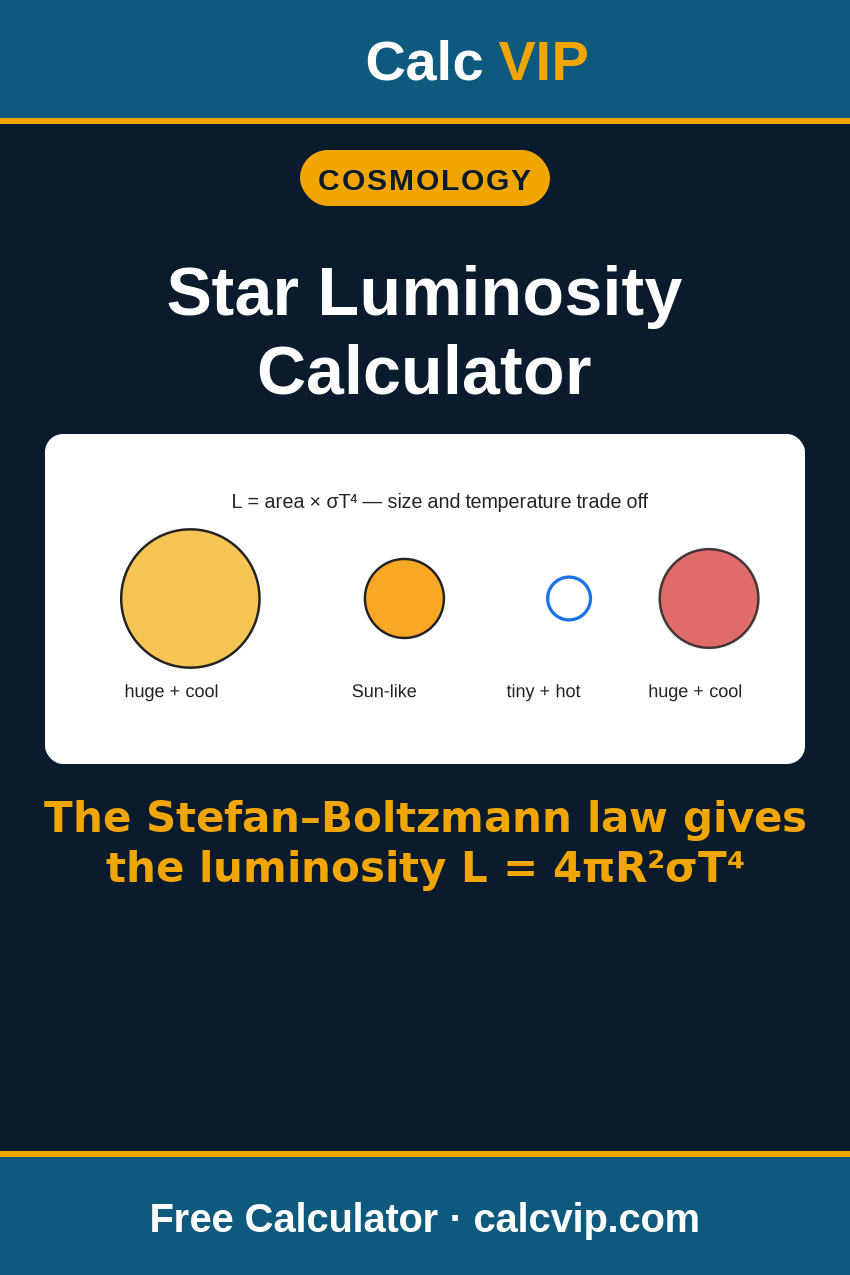
Notice how this route to luminosity differs from the flux route of the Luminosity calculator. That one needs a measured flux and a distance; this one needs a radius and a temperature and no distance at all. In practice the two interlock: temperature comes from the star's colour and spectrum, radius often comes from the luminosity (measured the flux way) combined with temperature — or, for the privileged few stars close enough for interferometry or lucky enough to eclipse a companion, radius is measured directly and this calculator returns a luminosity that owes nothing to the distance ladder. Where both routes are available, their agreement is a powerful check on stellar physics.
Formula
The Stefan–Boltzmann law gives the luminosity L = 4πR²σT⁴, where R is the star's radius, T its surface (effective) temperature, and σ = 5.67 × 10⁻⁸ W/m²K⁴. One solar radius R☉ = 6.957 × 10⁸ m and L☉ = 3.828 × 10²⁶ W. Note the T⁴: doubling the temperature multiplies the luminosity by 16. In solar units the law compresses to the pocket form L/L☉ = (R/R☉)² × (T/5,778 K)⁴, which is how astronomers estimate luminosities mentally. Solved backwards it yields the radius from a known luminosity and temperature, R = √(L / 4πσT⁴) — the standard way stellar radii are inferred.
| Symbol | Meaning | Units |
|---|---|---|
| L | luminosity — total power radiated | W (or L☉) |
| R | star's radius | solar radii R☉ (entered) |
| T | effective surface temperature | kelvin (K) |
| σ | Stefan–Boltzmann constant = 5.67 × 10⁻⁸ | W/m²K⁴ |
What "surface temperature" means for a ball of gas
A star has no solid surface. The temperature this formula wants is the effective temperature: the temperature a perfect blackbody of the same size would need to radiate the same total power. It corresponds to the layer we actually see — the photosphere, where the gas becomes transparent — and it is defined so that the Stefan–Boltzmann law is exact for it. Real stars are not perfect blackbodies: their spectra carry absorption lines, their limbs look darker than their centres, and different wavelengths escape from different depths. But effective temperature absorbs all of that into one number, measured from the total energy distribution of the star's light, and for luminosity purposes it is the right number.
The temperature scale of stars runs from about 2,500 K for the coolest red dwarfs — dull red, radiating mostly infrared — through the Sun's 5,778 K, up to 40,000 K and beyond for the great blue O-type stars, whose output peaks in the ultraviolet. Because the T⁴ punishes and rewards so steeply, this factor-of-16 temperature range is a factor of 65,000 in power per square metre before radius even enters the discussion. It is also why colour is such a reliable thermometer: Wien's law ties the peak wavelength to T, so a star's colour is its temperature, read at a glance — red cool, white middling, blue fierce.
How to use
- Enter the radius as a multiple of the Sun's radius (Sun = 1, a red giant may be 100+).
- Enter the surface temperature in kelvin (Sun ≈ 5,778 K).
- Click "Calculate Luminosity" to get L in watts and in solar luminosities.
- Cross-check with the pocket form: L/L☉ should equal (R/R☉)² × (T/5,778)⁴. If the two disagree, an input has been mistyped — the two routes are algebraically identical.
Worked examples
Example 1 — the Sun checks itself. Test it on the Sun itself: R = 1 R☉, T = 5,778 K.
L = 4π × (6.957 × 10⁸)² × 5.67 × 10⁻⁸ × 5,778⁴ ≈ 3.84 × 10²⁶ W
That is 1.00 solar luminosities — the calculator reproduces the Sun, as it should.
Example 2 — Betelgeuse: radius defeats temperature. R = 764 R☉, T = 3,600 K.
L/L☉ = 764² × (3,600/5,778)⁴ = 583,696 × 0.1506 ≈ 88,321 L☉. Each square metre of Betelgeuse radiates only 15% of a solar square metre — but there are 584,000 times as many of them. Size wins.
Example 3 — Sirius: both factors help. R = 1.711 R☉, T = 9,940 K.
L/L☉ = 1.711² × (9,940/5,778)⁴ = 2.93 × 8.76 ≈ 25.7 L☉ — matching the ≈ 25.4 L☉ found from Sirius's flux and distance by the Luminosity calculator. Two independent routes, one answer: stellar physics coheres.
Example 4 — Proxima Centauri: small and cold. R = 0.154 R☉, T = 3,042 K.
L/L☉ = 0.154² × (3,042/5,778)⁴ = 0.0237 × 0.0768 ≈ 0.0018 L☉. The nearest star to the Sun emits less than two thousandths of its power — which is why it waited until 1915 to be noticed, in our own backyard.
Example 5 — Vega: the former pole star. R = 2.36 R☉, T = 9,602 K.
L/L☉ = 2.36² × (9,602/5,778)⁴ = 5.57 × 7.63 ≈ 42.7 L☉. (Vega spins so fast it is noticeably oblate — its poles are hotter than its equator — so any single "temperature" is already an average; the calculator's answer is the honest mean.)
Example 6 — a white dwarf: hot but tiny. R = 0.01 R☉ (about Earth's size), T = 10,000 K.
L/L☉ = 0.01² × (10,000/5,778)⁴ = 10⁻⁴ × 8.97 ≈ 0.0009 L☉. A stellar corpse hotter than the Sun's surface manages less than a thousandth of its light — area, in the end, is destiny.
Star luminosity in real life
Drawing the HR diagram. Luminosity from this formula, plotted against temperature, is the Hertzsprung–Russell diagram: the main sequence is the band where radius grows smoothly with temperature, and the giants and white dwarfs sit exactly where their extreme radii put them.
Sizing exoplanet systems. A planet's equilibrium temperature follows from its star's luminosity. With L from radius and temperature, the habitable zone's location follows immediately — the starting point of every "Earth-like planet" assessment.
Estimating stellar radii. Run the law backwards: luminosity (from flux and distance) plus temperature (from spectrum) yields the radius. Most stellar radii in catalogues were obtained exactly this way, since direct measurement is possible for only a handful of stars.
Judging supernova progenitors. A star's position in the luminosity–temperature plane identifies its mass and evolutionary stage; the red supergiants that explode as Type II supernovae occupy a specific corner that this calculator maps.
Calibrating standard candles. Cepheid luminosities — the foundation of the distance ladder — are cross-checked against Stefan–Boltzmann estimates from their radii (tracked through their pulsation) and temperatures.
Understanding stellar lifetimes. Luminosity is a star's spending rate. A 25 L☉ star like Sirius exhausts its fuel far faster than the Sun despite holding more of it; the formula quantifies the profligacy that makes massive stars live fast and die young.
The mass–luminosity relation: why L reveals a star's mass
For main-sequence stars, luminosity is not a free parameter — it is slaved to mass by the physics of hydrostatic balance: a heavier star must burn hotter to support its own weight, and the burning rate explodes with temperature. The empirical result is roughly L ∝ M3.5 for Sun-like stars, steeper for the most massive and shallower for dwarfs. So a luminosity from this calculator is also a mass estimate: Sirius at ~25 L☉ implies roughly 2 to 2.5 solar masses depending on the exponent adopted (its true mass, measured from its orbit, is 2.06 M☉). Combine that with the fuel supply (proportional to M) and lifetime scales as M/L ∝ M−2.5: a 10-solar-mass star lives roughly 1/300 as long as the Sun. Luminosity, mass and lifetime are one story told three ways.
The Eddington limit: luminosity's ceiling
Luminosity cannot grow without bound. Light itself pushes: radiation pressure on the star's own gas rises with L, while gravity rises with M, and where the two balance sits the Eddington luminosity, about 30,000 L☉ per solar mass. A star that tries to exceed it blows its outer layers away until it complies. The most luminous stars known — several million L☉ — are all near this edge and visibly unstable, shedding mass in eruptions. The same ceiling, scaled down, shapes the growth of black holes in quasars. When this calculator returns an L that, paired with a plausible mass, breaches the Eddington line, it is telling you the star must be very massive, very transient, or both.
Beyond stars: planets, brown dwarfs and the same law
The Stefan–Boltzmann law does not care what the glowing sphere is, and astronomers apply it well outside the stellar zoo. A planet's equilibrium temperature is found by balancing absorbed sunlight against σT⁴ radiated from its surface — the calculation that puts Earth's effective temperature at 255 K (the observed 288 K average is warmer because the atmosphere insulates, which is the greenhouse effect expressed as a discrepancy in this law). Brown dwarfs, too massive for planets and too light for sustained fusion, glow dull red by leftover formation heat: a brown dwarf of Jupiter's radius at 1,000 K radiates 4π(7 × 10⁷)² × 5.67 × 10⁻⁸ × 1000⁴ ≈ 3.5 × 10²¹ W, about a hundred-thousandth of a solar luminosity, fading as it cools. Even spacecraft engineers use the law in reverse: a probe's radiators are sized so that σT⁴ over their area exactly sheds the electronics' waste heat at the operating temperature. Wherever something glows by its own heat, this page's multiplication is running.
The law also explains a subtlety in how stellar temperatures are quoted. Because a star's disc is limb-darkened — its edge shows shallower, cooler layers than its centre — and because spots and granulation pattern its face, the single T that makes L = 4πR²σT⁴ exact is an average with a precise definition but no single location on the star where a thermometer would read it. Interferometers that now image the surfaces of nearby giants see this directly: blotchy, boiling faces whose mean behaviour the effective temperature summarises. The calculator's clean answer rests on that well-defined average — one more case of a simple law working because its terms were defined to make it work. The extreme case is Antares: at roughly 680 R☉ and 3,660 K the formula gives 680² × (3,660/5,778)⁴ ≈ 74,000 L☉, but the largest stars, beyond 1,500 R☉, have "surfaces" that are really extended, unstable atmospheres, so their radii — and hence their luminosities — carry the widest error bars in the business.
Quick reference: luminosities from radius and temperature
| Star | Radius (R☉) | Temperature (K) | Luminosity (L☉) |
|---|---|---|---|
| Proxima Centauri | 0.154 | 3,042 | 0.0018 |
| the Sun | 1 | 5,778 | 1.00 |
| Sirius | 1.711 | 9,940 | 25.7 |
| Vega | 2.36 | 9,602 | 42.7 |
| Rigel | 79 | 12,100 | ≈ 120,500 |
| Betelgeuse | 764 | 3,600 | 88,321 |
Rigel's row rewards a second look: hotter and larger than Betelgeuse, it outshines it despite Betelgeuse's greater fame — fame, in the sky, is mostly proximity.
Common mistakes
- Entering the radius in metres or kilometres. This calculator wants solar radii. Typing 6.957 × 10⁸ into the radius box squares an already-astronomical number and returns nonsense on a cosmic scale — check the unit before the arithmetic.
- Using Celsius or the core temperature. Kelvin only, and the surface (effective) temperature: the Sun's core is 15 million K, but its radiating surface is 5,778 K. The T⁴ turns a unit slip into a catastrophe of sixteen orders of magnitude.
- Underestimating temperature errors. A 5% error in T becomes a 22% error in L (1.05⁴ = 1.216). Temperature is the input to measure carefully; radius errors, merely squared, are the lesser evil.
- Expecting blackbody perfection. Real stars deviate from the ideal spectrum — the law is exact for the effective temperature by definition, but a temperature guessed from colour alone (rather than the full energy distribution) can bias L by tens of percent for extreme stars.
- Applying it to non-stars. Planets shine by reflected light and their own feeble heat; a single temperature does not describe them. The formula is for self-luminous, roughly spherical radiators in equilibrium.
FAQ
How luminous is a red supergiant like Betelgeuse?
With R ≈ 764 R☉ and T ≈ 3,600 K, this calculator gives about 88,321 L☉ — its huge radius more than makes up for its cooler surface.
Why does temperature matter so much?
Because luminosity depends on T⁴. A star only twice as hot as the Sun radiates 16 times more power per square metre of surface.
Where do the radius and temperature come from?
Temperature comes from the star's colour/spectrum; radius can be measured for eclipsing binaries and nearby stars (by interferometry), or estimated from the luminosity itself.
What is the Sun's surface flux?
σT⁴ at 5,778 K is about 6.3 × 10⁷ W/m² — sixty-three megawatts from every square metre, roughly the output of a power station, from an area the size of a door. Luminosity is that figure times the Sun's 6 × 10¹⁸ m² of surface.
How hot is the hottest star?
Confirmed stellar surfaces reach 40,000–50,000 K for the most extreme O-type and Wolf–Rayet stars, with some central stars of planetary nebulae hotter still. At 40,000 K each square metre radiates (40,000/5,778)⁴ ≈ 2,300 times the Sun's surface rate.
Can this calculator find a star's radius?
Not directly — but the rearranged law R = √(L/4πσT⁴) does, given L from the flux-and-distance route. The two calculators on this site are designed to be chained exactly that way.
Why do red giants get so luminous if they are cool?
Area. A giant's radius grows by factors of hundreds as its core contracts and its envelope expands, and R² outruns the falling T⁴. Betelgeuse in the examples is the worked proof.
Is the Stefan–Boltzmann law exact?
For a perfect blackbody, yes. Stars approximate blackbodies well in total output — the deviations live in the spectrum's details (absorption lines), not in the integrated power, which is why the law with effective temperature is a workhorse rather than an approximation to apologise for.
What luminosity does a planet have?
Earth radiates about 1.2 × 10¹⁷ W of infrared (its thermal emission balancing absorbed sunlight) — about three ten-billionths of a solar luminosity. The formula applies formally, but a planet's day and night sides have different temperatures, so a single-T answer is only a rough average.
How does luminosity change as a star ages?
Slowly on the main sequence (the Sun has brightened about 30% over its life and will keep brightening), then dramatically: the red-giant Sun will reach thousands of L☉ before collapsing to a white dwarf that fades, over billions of years, towards zero.