 Calc
Initial Velocity Calculator – Find u Using u = v − at
 Created by Sarah Mitchell · Physics Editor · Motion & Measurement · Last updated: November 2026
Use this free Initial Velocity Calculator to work backwards and find how fast an object was already moving at the start. Enter the final velocity, the acceleration and the time, and the calculator rearranges the first equation of motion to give u = v − at. It also shows the distance covered.
Most motion problems run forwards: you are told how something starts and asked how it ends. Real investigations usually run the other way. A crash investigator measures the wreck's final state and the time over which it changed; a coach times the last stretch of a sprint and wants the speed the athlete carried into it; an engineer knows a rocket's velocity now and its burn rate, and needs the velocity it had when the burn began. In each case the known quantity is the ending velocity v, and the unknown is the starting velocity u — the initial velocity. This calculator exists for exactly that backwards question.
The physics underneath is the first equation of motion, v = u + at, read in reverse. Acceleration is simply the rate at which velocity changes, so over a time t the velocity changes by exactly at. If the object ended at v and gained at along the way, it must have started at v − at. Nothing deeper is hidden in the formula — but that simplicity is deceptive, because the sign of a does all the heavy lifting. A positive acceleration means the object started slower than it finished; a negative acceleration (braking, or gravity acting on a rising ball) means it started faster than it finished, and the subtraction of a negative correctly turns into an addition.
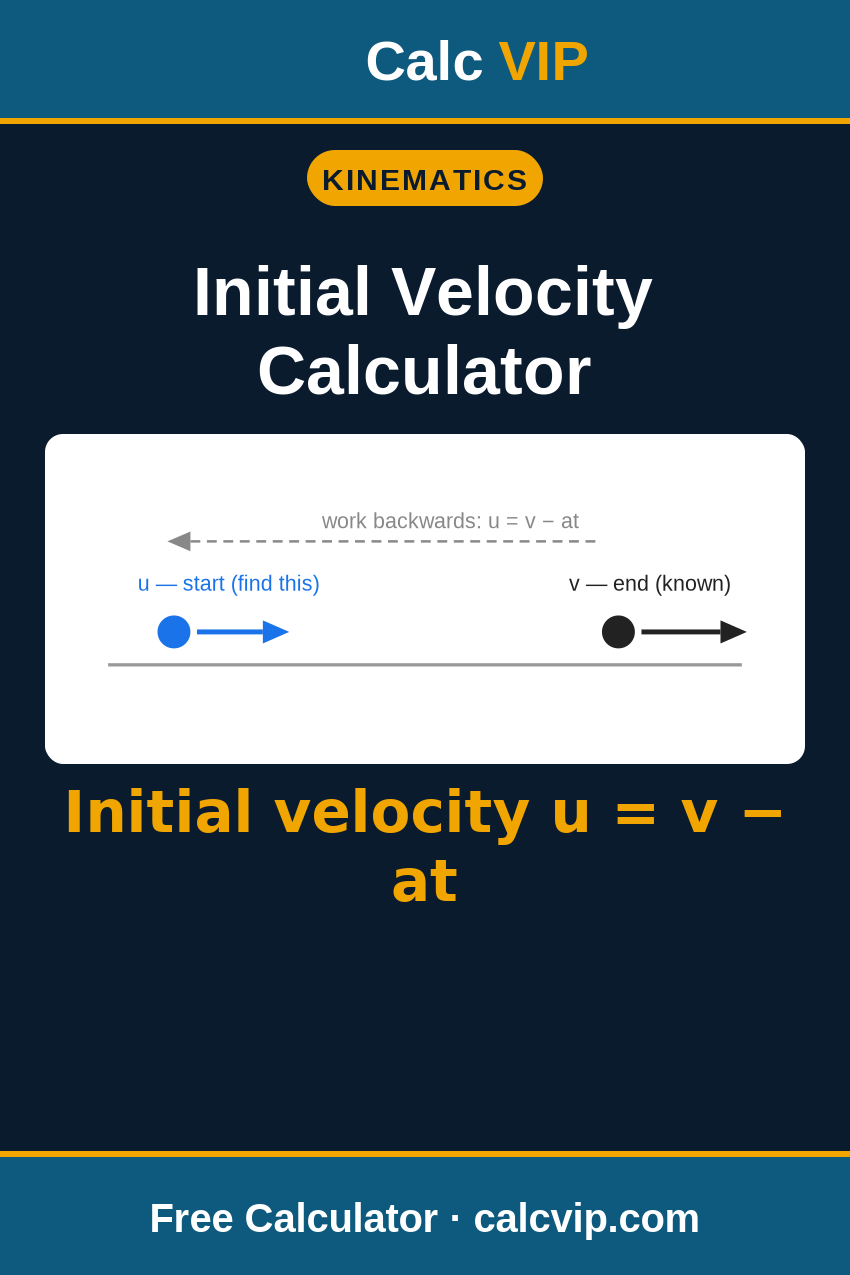
The calculator also reports the distance covered, using s = ½(u + v) × t. That formula has a picture behind it: when velocity changes steadily, the average velocity over the interval is exactly halfway between the start and end values, so the distance is just that average multiplied by the time. Between them, u = v − at and s = ½(u + v)t let you reconstruct the whole opening state of a motion from its ending state — the starting speed and the ground covered — which is why this pair of equations appears everywhere from road-safety analysis to ballistics.
Formula
Initial velocity u = v − at • u and v in metres per second (m/s), a in metres per second squared (m/s²), t in seconds (s)
The same equation rearranges every way: v = u + at finds the final velocity from the start, a = (v − u) / t finds the acceleration from the change, and t = (v − u) / a finds how long a given change took. The companion distance formula is s = ½(u + v) × t — average velocity times time — and combining the two gives the distance straight from the end state: s = vt − ½at². Sign discipline decides most real errors: pick a direction as positive (usually the direction of travel), keep velocities and acceleration in that same convention, and let negative values speak for themselves. A braking car has negative a; a ball thrown upward has a = −9.81 m/s² if up is positive. This calculator reports u in m/s and km/h, and s in metres.
| Symbol | Meaning | Units |
|---|---|---|
| u | initial velocity — the velocity at the start of the interval | m/s |
| v | final velocity — the velocity at the end of the interval | m/s |
| a | constant acceleration (negative when slowing) | m/s² |
| t | time taken for the change | seconds (s) |
| s | distance covered during the interval | m |
Why "working backwards" is a real skill, not a trick
Textbooks introduce v = u + at as a forward machine, but almost every professional use of it runs in reverse. The reason is measurement: the present is easy to measure and the past is not. A speed camera records the velocity a car has now; radar tracks a spacecraft's velocity now; a finish-line sensor catches the sprinter's velocity now. The initial velocity — at the moment the brakes were touched, the burn began, the start gun fired — has already vanished by the time anyone measures anything. Rearranged equations are how physics recovers it, provided the acceleration stayed constant over the interval, which is the one assumption everything on this page stands on.
The velocity–time graph shows why both formulas in this calculator are really the same statement. Plot velocity against time for constant acceleration and you get a straight line climbing (or falling) at slope a, from u at t = 0 to v at time t. The rise of that line is v − u = at — the first equation. The area trapped under the line is a trapezium with parallel sides u and v and width t, giving s = ½(u + v)t — the distance formula. One straight line, two facts: its slope is the acceleration, and its area is the journey. Whenever you use this calculator you are, in effect, reading that graph backwards from its right-hand edge.
How to use
- Enter the final velocity v in metres per second (m/s) — the velocity at the end of the motion you are investigating.
- Enter the acceleration a in m/s². Use a negative value if the object was slowing down, or −9.81 for a rising object under gravity with "up" as positive.
- Enter the time t in seconds over which the acceleration acted.
- Click "Calculate Initial Velocity" to see the starting velocity u in m/s and km/h, plus the distance covered during the interval.
- Sanity-check the sign: speeding up (a > 0) should give u smaller than v; slowing down (a < 0) should give u larger than v. If the result surprises you, a sign has almost certainly flipped.
Worked examples
Example 1 — the accelerating car. A car ends up travelling at v = 25 m/s after accelerating at a = 3 m/s² for t = 5 s.
u = v − at = 25 − (3 × 5) = 10 m/s (36 km/h). Distance covered s = ½ × (10 + 25) × 5 = 87.5 m.
Example 2 — how fast was the braking car going? A car is brought to a stop (v = 0) by braking at a = −5 m/s² for 4 s. u = 0 − (−5 × 4) = 20 m/s — 72 km/h, an illegal speed in most built-up areas, which is exactly the kind of conclusion this calculation is used to draw. The braking distance is s = ½ × (20 + 0) × 4 = 40 m.
Example 3 — a train pulling away. A train reaches 40 m/s after 60 s of gentle acceleration at 0.5 m/s². u = 40 − (0.5 × 60) = 40 − 30 = 10 m/s: it was already rolling at 10 m/s when the timed minute began. Distance in that minute: s = ½ × (10 + 40) × 60 = 1,500 m.
Example 4 — the thrown ball, backwards. A ball reaches the top of its flight (v = 0) exactly 2 s after leaving the hand. With a = −9.81 m/s², u = 0 − (−9.81 × 2) = 19.62 m/s (70.63 km/h) — a fast throw. The height of the peak is the distance formula's answer: s = ½ × (19.62 + 0) × 2 = 19.62 m.
Example 5 — a cyclist coasting to a junction. A cyclist rolls up to a junction at 6 m/s after 5 s of gentle slowing at −1.2 m/s². u = 6 − (−1.2 × 5) = 6 + 6 = 12 m/s (43.2 km/h) when the coasting began, and the coast covered s = ½ × (12 + 6) × 5 = 45 m.
Example 6 — a rocket burn. Ten seconds into a burn accelerating at 8 m/s², a rocket's velocity is 120 m/s. u = 120 − (8 × 10) = 40 m/s at ignition of this burn stage, and the burn carried it s = ½ × (40 + 120) × 10 = 800 m.
Initial velocity in real life
Crash reconstruction. Investigators work from final states — a stopped car, a measured skid, a timed CCTV interval — and use u = v − at to estimate the speed at the moment braking began, evidence that regularly decides fault and prosecutions.
Sprint coaching. Timing gates give a sprinter's velocity over the last metres of a race. Subtracting the known acceleration over that stretch reveals the speed carried off the blocks' drive phase, separating starting ability from top-end speed.
Spacecraft navigation. Mission control knows a probe's current velocity from Doppler tracking and knows its thrusters' acceleration precisely; running the equation backwards pins down the velocity at burn start, which the trajectory plan is then checked against.
Ballistics and forensics. A projectile's velocity measured downrange, combined with the (negative) acceleration from drag models over the flight time, estimates the muzzle velocity — the initial velocity that identifies the weapon class.
Lift and escalator design. Engineers specify a lift's speed at floor arrival and its comfortable acceleration; u = v − at then sets the speed the car must carry mid-shaft and the distance over which it may accelerate — the numbers that decide shaft length.
Everyday driving judgement. Knowing you are doing 25 m/s now, and that your car brakes at about −5 m/s², the equation tells you that 5 s ago — one glance at a phone ago — you were doing the same 25 m/s but have since covered well over 100 m. The arithmetic of looking away is this calculator.
The sign convention: the whole game in one paragraph
Every error with u = v − at is a sign error, and every sign error is a convention error. Before touching numbers, fix one direction as positive — conventionally the direction of the initial motion — and express everything in it. Velocities pointing the other way are negative; acceleration pointing the other way is negative. Gravity is the classic trap: for a rising ball with up positive, a = −9.81 m/s² and the formula yields a positive, larger u — correct. Take down as positive instead and a = +9.81, v at the peak is still 0, and u comes out −19.62 m/s: the minus sign now says "the initial velocity pointed up, opposite to my chosen positive direction", which is the same physics wearing the other convention. The calculator cannot choose for you; it can only be consistent once you have.
Quick reference: reading u from v, a and t
| Final v (m/s) | a (m/s²) | t (s) | Initial u (m/s) | Distance s (m) |
|---|---|---|---|---|
| 25 | 3 | 5 | 10 | 87.5 |
| 0 | −5 | 4 | 20 | 40 |
| 10 | 2 | 3 | 4 | 21 |
| 15 | −3 | 5 | 30 | 112.5 |
| 50 | 2.5 | 8 | 30 | 320 |
Read the second row as the template for all braking problems: final velocity zero, acceleration negative, and the initial velocity emerges larger than anything measured at the end — the past was faster than the present.
Reading the answer: four kinds of u and what each is telling you
The number that comes out of u = v − at falls into one of four regimes, and each regime is a diagnosis of the motion, worth reading before you trust the arithmetic. u = 0: the object started from rest at the beginning of your interval — the expected answer for drops, launches from a standstill and block-release experiments, and a good sign that the interval was chosen at the motion's true beginning. 0 < u < v: ordinary speeding up; the ratio u/v tells you how much of the final speed was inherited rather than earned during the interval. u > v: the object slowed — braking, climbing, dragging — and the size of the excess measures how much speed the interval cost. u < 0: the interesting case. Either the object genuinely began by moving opposite to the direction it ended in — a ball on its way up past a point it will recross falling, measured across the turn — or the inputs describe no possible single motion: an acceleration held for that long would have reversed the object before the interval ended. The formula cannot distinguish these two stories; the scenario must. Treating the four regimes as a checklist — which regime did I expect, which did I get — catches sign errors at the moment they are made, rather than at the moment they are marked.
There is a fifth, quieter check available whenever the distance is also known: the three quantities must satisfy s = ½(u + v)t with the recovered u. Investigators lean on this hard. A claimed final velocity, acceleration and time that imply a distance different from the measured skid or the surveyed scene are a claim in contradiction with the ground itself — and the ground wins.
Common mistakes
- Entering braking as a positive acceleration. If the object slowed down, a must be negative; enter +5 for a braking car and the calculator will obediently report that it started slower than it finished — the opposite of the truth.
- Mixing km/h with m/s. The formula only works in consistent units. Convert speeds to m/s first (divide km/h by 3.6); an answer 3.6 times too big or small is the fingerprint of this slip.
- Assuming the acceleration was constant when it was not. Real braking fades, real engines surge. u = v − at recovers the true starting velocity only if a held steady across the whole interval — otherwise it returns the start of an equivalent steady motion, an approximation.
- Using the distance formula with the wrong average. s = ½(u + v)t works because velocity changed steadily, making the average the midpoint. For motion that lingers at high speed then stops suddenly, the midpoint average badly underestimates the distance.
- Panicking at a negative u. A negative answer is information, not an error: it says the object began by moving opposite to your chosen positive direction — or that the entered numbers cannot describe one-directional motion at all. Check the scenario before blaming the arithmetic.
FAQ
How is u = v − at found?
It is the first equation of motion, v = u + at, rearranged to make u the subject. It works whenever the acceleration stays constant.
What does a negative answer mean?
A negative u means the object was actually moving in the opposite direction at the start, or that the numbers entered do not fit motion in one direction.
Can I use this for a braking car?
Yes. Enter the acceleration as a negative number (for example a = −4 m/s²) and the calculator will show the higher speed the car started with.
What if the object started from rest?
Then u = 0, and the calculator run forwards should confirm it: entering v and a with t = v/a gives u = 0. Run backwards from a stop (v = 0) after constant acceleration, u = −at with the sign of a telling you the story — for ordinary speeding-up from rest, check instead that v = at.
Why does the calculator also show the distance?
Because once u is known, the average velocity ½(u + v) is known, and distance is average velocity × time. The two results together reconstruct the whole interval: how fast it began, and how far it went.
Does this work for vertical motion, like a thrown ball?
Yes — vertical motion under gravity is constant-acceleration motion with a = −9.81 m/s² (up positive). Example 4 above recovers a throw speed of 19.62 m/s from nothing but the 2 s the ball took to reach its peak.
What value of acceleration should I use for a falling object?
9.81 m/s², with the sign set by your convention: positive if you take downward as positive, −9.81 if upward is positive. The magnitude is the same; only the bookkeeping changes.
Can u be larger than v?
Yes, whenever the object slowed down. A braking car's whole story is u > v. If your scenario is a speeding-up one and the calculator returns u > v, the acceleration's sign is wrong.
How is this different from the average velocity?
Average velocity, ½(u + v), describes the whole interval in one number; initial velocity is the actual velocity at the first instant. The calculator finds the second, then uses the first internally to get the distance.
What if I know the distance instead of the time?
Then the backwards problem needs a different rearrangement — v² = u² + 2as solved for u — which is the job of the Acceleration From Distance calculator on this site. Time-free problems and time-given problems are the two halves of the equations of motion.