 Calc
Frequency Calculator – f = 1/T and f = v/λ Frequency Solver
 Created by David Okafor · Physics Writer · Waves & Light · Last updated: November 2026
Use this free Frequency Calculator to find the frequency of a wave or oscillation in two ways: from its period using f = 1/T, or from its wave speed and wavelength using f = v/λ.
Frequency is one of the most basic measurements in all of physics: it simply counts how many times something repeats in one second. A pendulum swinging back and forth, a guitar string vibrating, the alternating current in your wall socket, a radio wave crossing the room — all of them have a frequency. The unit is the hertz (Hz), named after the physicist Heinrich Hertz: one hertz means one complete cycle every second, a hundred hertz means a hundred cycles, and so on up through kilohertz (thousands), megahertz (millions) and gigahertz (billions) per second.
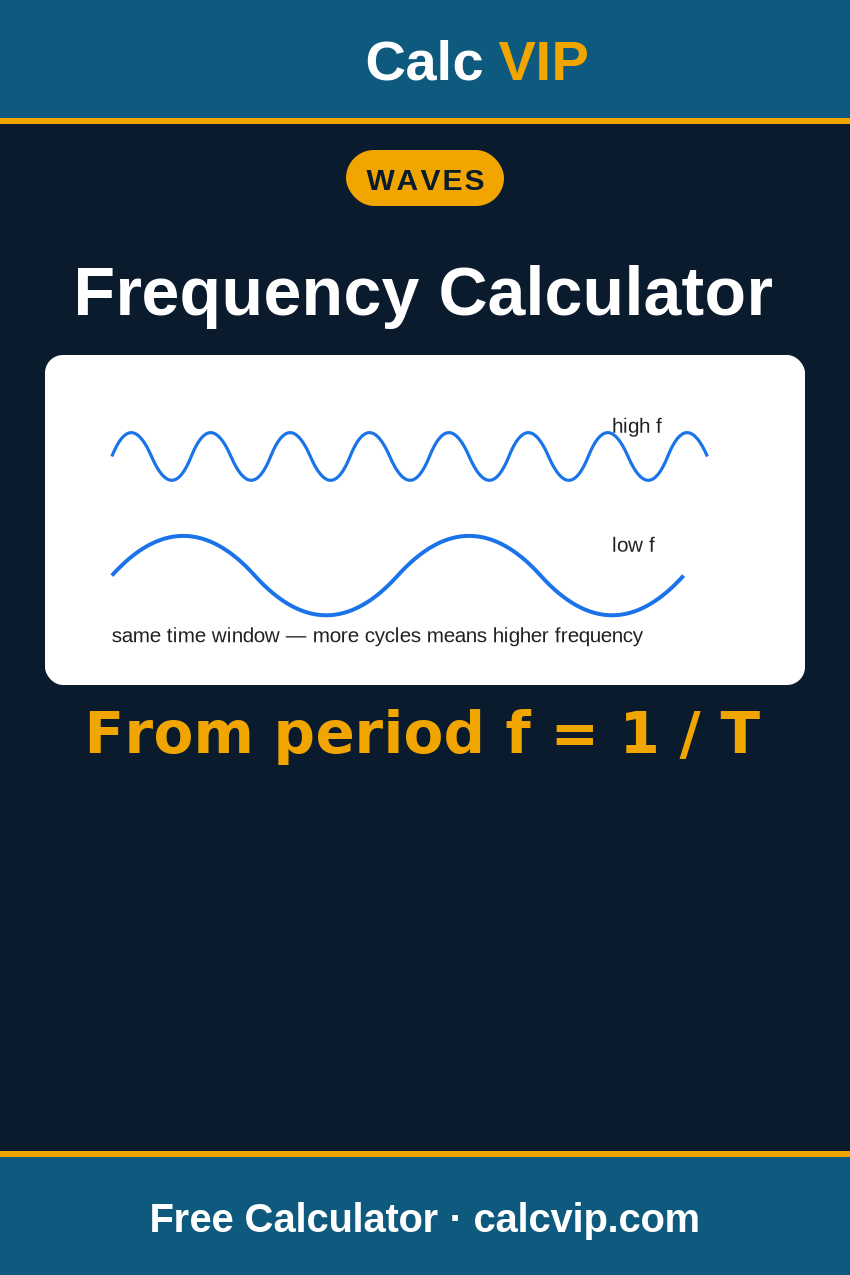
Every oscillation has a partner quantity called the period: the time taken for a single cycle. The two are mirror images of each other — a fast oscillation has a high frequency and a short period, a slow one a low frequency and a long period — and each is the reciprocal of the other. Your heartbeat is a convenient example: at 75 beats per minute, one beat takes 60 ÷ 75 = 0.8 seconds (the period), and the frequency is 1 ÷ 0.8 = 1.25 Hz. Whenever you know one of the pair, the other is a single division away.
For travelling waves there is a second route to frequency. A wave's speed, frequency and wavelength are locked together by the wave equation, v = f × λ, so if you know how fast the wave travels and how long each wave is, the frequency follows at once. This is how radio engineers think: a station's wavelength on the dial and its frequency describe the same wave from two sides. This calculator offers both methods — period and wave — because in practice you rarely know all three quantities, and either pair is enough.
Formula
From period f = 1 / T • From wave speed f = v / λ • f in hertz (Hz), T in seconds (s), v in m/s, λ in metres (m)
Both formulas rearrange into every form you might need. From f = 1/T, the period is T = 1 / f — a 440 Hz tuning fork completes one vibration in 1 ÷ 440 = 0.00227 s, about 2.27 milliseconds. From f = v/λ, the wavelength is λ = v / f and the speed is v = f × λ: an FM station at 100 MHz broadcasts waves of 300,000,000 ÷ 100,000,000 = 3 m. Notice the seesaw built into these relations: with speed fixed, doubling the frequency halves both the period and the wavelength. High-frequency waves are always short and quick; low-frequency waves are long and slow.
| Symbol | Meaning | Units |
|---|---|---|
| f | frequency — cycles completed per second | hertz (Hz); also kHz, MHz, GHz |
| T | period — time for one complete cycle | seconds (s) |
| v | wave speed in the medium | m/s |
| λ | wavelength — length of one complete cycle | metres (m) |
The prefixes matter: 1 kHz = 1,000 Hz, 1 MHz = 1,000,000 Hz and 1 GHz = 1,000,000,000 Hz. Most frequency errors in practice are not physics errors at all — they are prefix errors, out by a factor of a thousand.
Frequency, period and wavelength — how they fit together
Students often muddle the three wave quantities, so here is the picture to keep. The period T is a time: how long one full cycle takes, measured with a stopwatch at a fixed place. The wavelength λ is a distance: how long one full cycle is, measured with a ruler on a frozen snapshot of the wave. The frequency f is a rate: how many cycles stream past you each second. Imagine standing by a conveyor belt of identical waves rolling past at speed v. In one second, a length v of wave passes you; each wave occupies λ of that length; so the number passing — the frequency — is v ÷ λ. That single picture derives the whole wave formula and shows why period and wavelength, though both called "one cycle", live in different units and must never be swapped.
Music gives the friendliest feel for frequency ratios. Doubling a frequency raises a note by exactly one octave: the A above middle C is standardised at 440 Hz, the A below it at 220 Hz, the A above at 880 Hz. The twelve semitones of a scale divide that doubling into equal ratio steps of about 1.0595 each, so every note on a piano is a fixed multiple of its neighbours. This is why frequency — not wavelength or period — is printed on tuning apps and why orchestras tune to a single reference note: match the frequency and you match the pitch, whatever the instrument.
How to use
- Pick a method: use the period if you know the time for one complete wave or oscillation, or use wave speed and wavelength for a travelling wave.
- Enter the value(s) asked for.
- Click "Calculate Frequency" to get the frequency in hertz (Hz).
- Watch your units: the period must be in seconds (so 20 milliseconds is 0.02 s) and the wavelength in metres, or the answer will be out by a factor of a thousand.
Worked examples
Example 1 — from the period. A wave has a period of 0.02 s.
f = 1 / T = 1 ÷ 0.02 = 50 Hz
This is exactly the situation with mains electricity in much of the world: the current changes direction in a cycle lasting 0.02 s, repeated 50 times every second.
Example 2 — from wave speed and wavelength. A sound wave travels at 340 m/s with a wavelength of 2 m.
f = v / λ = 340 ÷ 2 = 170 Hz — a low musical note, around the bottom of a typical singing voice.
Example 3 — a heartbeat. A resting heart beats 75 times a minute, so its period is 60 ÷ 75 = 0.8 s and f = 1 ÷ 0.8 = 1.25 Hz. During hard exercise at 150 beats per minute the period halves to 0.4 s and the frequency doubles to 2.5 Hz — the reciprocal relationship in action.
Example 4 — checking a radio station. An FM station broadcasts at 100 MHz (100,000,000 Hz) and its waves travel at the speed of light, 300,000,000 m/s. Turning the wave formula around, λ = v / f = 300,000,000 ÷ 100,000,000 = 3 m. That is why FM aerials are around a metre or so long — a useful aerial is a decent fraction of a wavelength.
Example 5 — a mosquito's wings. A mosquito beats its wings about 600 times per second — a frequency of 600 Hz, which is why its whine is a high, needling note. Its period is T = 1 ÷ 600 = 0.00167 s, about 1.67 milliseconds per beat. A larger insect such as a bumblebee, at roughly 200 Hz, sounds correspondingly deeper: pitch is frequency, and the ear reads it instantly.
It is worth pausing on the range covered by the examples on this page: a heart manages about one cycle per second, a power grid fifty, a mosquito six hundred, a bat's call tens of thousands, and a Wi-Fi radio billions — yet the single relation f = 1/T, backed by f = v/λ, describes every one of them without modification.
Frequency in real life
Hearing. The human ear responds to roughly 20 Hz to 20,000 Hz. The lowest piano note is 27.5 Hz, the highest about 4,186 Hz, and a soprano's top notes sit near 1,000 Hz. Frequencies are the reason a bass drum feels slow and heavy while a whistle feels piercing.
Electricity. Mains power alternates at 50 Hz in most of the world and 60 Hz in the Americas — a hum you can sometimes hear from transformers and old fluorescent lights.
Radio and Wi-Fi. Radio waves span kilohertz to gigahertz: AM radio near 1 MHz, FM near 100 MHz, Wi-Fi at 2.4 and 5 GHz. Each service is allocated its own frequency band so signals do not overlap.
Medicine. Ultrasound scanners use 2–15 MHz — far above hearing — because high frequencies have short wavelengths, and short wavelengths resolve fine detail, just as a fine brush paints finer lines.
Computers. A processor rated at 3 GHz is performing three billion clock cycles every second. Each cycle is a step in its calculations, so — all else equal — a higher clock frequency means a faster machine, which is why gigahertz figures feature so prominently in computer advertising.
Tuning and instruments. Orchestras tune to A = 440 Hz before a concert, guitar strings span 82 Hz (low E) to 660 Hz and beyond, and a piano's 88 keys cover 27.5 Hz to 4,186 Hz — nearly the whole useful range of musical hearing in a single instrument.
Quick reference: familiar frequencies
| Thing | Frequency | Period |
|---|---|---|
| resting heartbeat (75 bpm) | 1.25 Hz | 0.8 s |
| lowest piano note | 27.5 Hz | 0.036 s |
| mains electricity (most of the world) | 50 Hz | 0.02 s |
| middle C | 261.6 Hz | 0.0038 s |
| concert A | 440 Hz | 0.00227 s |
| top of human hearing | 20,000 Hz | 0.00005 s |
| medical ultrasound | 2–15 MHz | under a microsecond |
| Wi-Fi | 2.4 GHz | 0.42 nanoseconds |
Reading down the period column shows the reciprocal relationship at work across an enormous range: from a heartbeat you can count aloud to radio waves cycling billions of times while you read this sentence — all described by the same single quantity.
Does frequency change when a wave enters a new medium?
No — and this surprises many students. When sound passes from air into water, or light from air into glass, the wave speeds up or slows down and its wavelength stretches or shrinks to match, but the frequency stays exactly the same. The reason is bookkeeping: crests cannot pile up or vanish at the boundary. If 170 crests arrive at the surface every second, then 170 crests must leave it every second, or waves would accumulate at the join. So frequency is fixed by the source, while speed and wavelength are properties of the medium. It is also why light keeps its colour in glass: colour is frequency, and the frequency never changes.
Frequency in other units: rpm and beats per minute
Not everything that repeats is measured in hertz. Engines and turntables are rated in revolutions per minute (rpm), and heart rates in beats per minute (bpm). The conversion is always the same: divide by 60 to turn "per minute" into "per second", because a hertz is one cycle per second. A car engine idling at 900 rpm is rotating 900 ÷ 60 = 15 times per second — a frequency of 15 Hz. A vinyl record at 33 rpm turns at just 0.55 Hz, taking about 1.8 s per revolution, while a washing machine on a 1,200 rpm spin cycle rotates at 20 Hz. The hertz is simply the scientist's tidier version of the same idea: count the repetitions, divide by the seconds, and you have the frequency whatever the machine.
Resonance: when frequencies match
Every object that can vibrate has preferred frequencies of its own — its natural or resonant frequencies, set by its size, shape and material. Push a child on a swing at random moments and little happens; push in time with the swing's own frequency and small pushes build a huge motion. That is resonance, and frequency is its key: a driving force only transfers energy efficiently when its frequency matches the natural frequency of the thing being driven. Radio receivers work this way, tuning a circuit's natural frequency until it matches the station's, so that one signal is amplified out of thousands. A singer can shatter a wine glass by holding exactly the glass's resonant note until the vibrations grow beyond the glass's strength. Engineers design bridges, buildings and aircraft parts to keep their resonant frequencies safely away from the frequencies of winds, earthquakes and engines — because when the two meet, structures can shake themselves apart. Whenever a small input produces a surprisingly large response, a frequency match is almost always the reason.
Frequency is not amplitude
Two waves can share a frequency and still be utterly different, because frequency says nothing about size. Amplitude is the wave's maximum displacement — the height of a water wave, the pressure swing of a sound, the voltage swing of a signal. A whisper and a shout at the same note have the same frequency and wildly different amplitudes; a bass rumble and a mosquito's whine can carry the same energy with wildly different frequencies. Loudness, brightness and strength live in the amplitude (and grow with its square); pitch, colour and station live in the frequency. Keeping the two apart clears up a family of confusions — turning up the volume does not change the station, and a bigger wave is not a faster one.
Common mistakes
- Leaving the period in milliseconds. A period of 20 ms is 0.02 s, giving f = 50 Hz. Enter 20 instead and you get 0.05 Hz — wrong by a factor of 1000.
- Confusing frequency with wave speed. A high-frequency wave is not a fast wave. In the same medium all sound waves travel at the same speed whatever their pitch; frequency counts cycles, speed measures travel.
- Mixing up period and wavelength. Both describe "one cycle", but T is in seconds and λ is in metres. Check the units before choosing a formula.
- Forgetting the mega and giga. 100 MHz is 100,000,000 Hz. Dropping the millions is the commonest cause of absurd radio answers.
- Reading per-minute figures as hertz. A motor at 1,800 rpm is turning at 30 Hz, not 1,800 Hz. Hertz are per second — divide anything quoted per minute by 60.
FAQ
What is frequency measured in?
Frequency is measured in hertz (Hz). 1 Hz means one complete wave or oscillation every second.
What is the difference between frequency and period?
The period T is the time taken for one complete wave (in seconds); frequency is how many complete waves happen each second. They are reciprocals: f = 1/T.
What frequency can humans hear?
Most people hear sounds between about 20 Hz and 20,000 Hz. Anything below 20 Hz is called infrasound and anything above 20,000 Hz is ultrasound.
How do I measure the frequency of a pendulum?
Time ten complete swings and divide by ten to get an accurate period, then take f = 1/T. Timing many swings and sharing the total is far more accurate than trying to time a single swing.
What is the difference between frequency and amplitude?
Frequency counts how often the wave repeats; amplitude measures how big each repetition is — the height of a water wave or the loudness of a sound. A wave can be high-frequency and small, or low-frequency and huge.
Why do higher frequencies carry more detail?
Because their wavelengths are shorter, and a wave cannot resolve detail much smaller than its own wavelength. That is why ultrasound (megahertz, millimetre wavelengths) images a baby clearly, while audible sound (metre wavelengths) cannot.
Is frequency the same for everyone listening?
Almost — unless the source or listener is moving, when the Doppler effect shifts the frequency each listener hears. Stand still beside the road and you measure the true frequency; drive towards the source and you measure a higher one.
What frequency is middle C?
261.6 Hz in the standard tuning where A above it is 440 Hz. Each octave doubles the frequency, so the C below middle C is 130.8 Hz and the C above is 523.3 Hz.
Why does a recording played too fast sound squeaky?
Speeding up playback squeezes the same cycles into less time, multiplying every frequency by the speed-up factor. Voices climb in pitch — the classic chipmunk effect — because pitch is nothing but frequency as the ear reads it.
Can frequency be zero?
A frequency of zero means no repetition at all — a steady, unchanging value, like the constant voltage of a battery (called DC, direct current). It is a useful limiting case rather than a wave: with f = 0 the period is infinite and the wavelength formula no longer applies.