 Calc
Mach Angle Calculator – Mach Number & Shock Cone Angle
 Created by David Okafor · Physics Writer · Waves & Light · Last updated: November 2026
Use this free Mach Angle Calculator to find the Mach number of a fast-moving object and the angle of the shock cone (Mach cone) it trails behind it. Enter the object's speed and the speed of sound around it — for example a jet at altitude, where sound is slower than at sea level.
The Mach number is a ratio, not a speed: it compares the object with the sound it makes. That is why the same aircraft, at the same true speed, has a different Mach number at sea level and at altitude — cold high-altitude air carries sound at only about 295 m/s, so 605 m/s is a modest Mach 1.76 down low but Mach 2.05 in the stratosphere. Once the object outruns its own sound, the wavefronts it emits cannot escape forwards; they pile up along a cone trailing behind it, and the cone's half-angle μ is fixed by one clean piece of geometry: sin μ = 1/M. This calculator finds both numbers — and, just as usefully, tells you when no cone exists at all.
The geometry is worth seeing once. In one second the object travels vobject metres; in that same second the sound it emitted at the start of the second has expanded into a sphere of radius vsound metres. Draw the line from the object's present position tangent to that sphere and you have the cone's surface; the triangle's hypotenuse is the object's travel, its opposite side the sound's, and sin μ = vsound/vobject = 1/M falls out immediately. Every earlier wavefront nests inside the same cone, tangent to the same surface — the cone is the envelope of all of them, a shock front where the pressure jumps almost discontinuously.
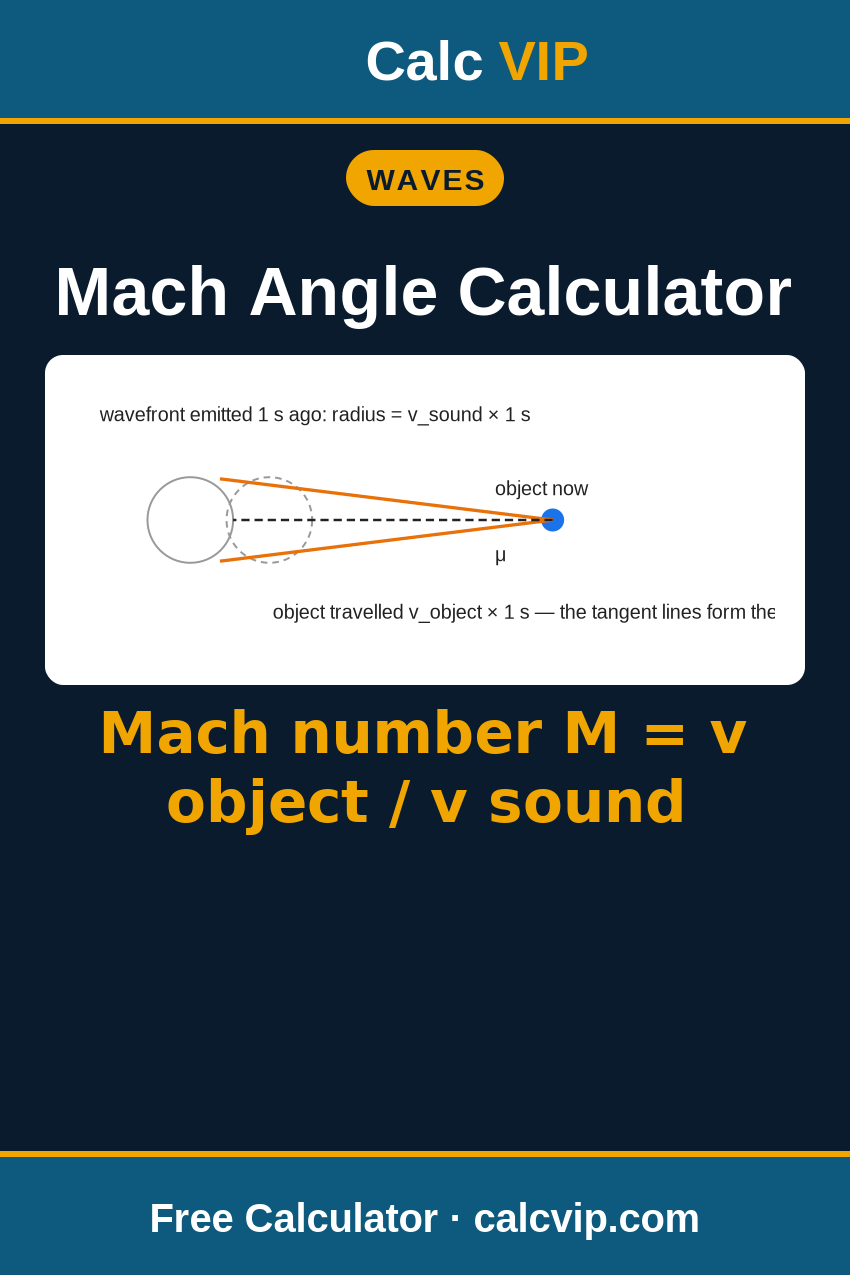
Two honest limits. The formula gives the angle of the far-field cone from a compact object; near a real aircraft the shocks cling to the nose, wings and tail at angles set by those shapes, merging into the simple cone only far behind. And M must exceed 1: below Mach 1 the calculator reports the subsonic case, where sound outruns the object in every direction and no envelope can form.
Formula
Mach number M = vobject / vsound • Mach angle μ = sin⁻¹(1 / M) — defined only for M > 1 (supersonic).
The pair of formulas runs both ways: given a measured cone angle, M = 1 / sin μ — the standard way of reading speed from a wind-tunnel photograph — and the object's speed is always vobject = M × vsound. Regime names ride along with the number: below Mach 0.8 subsonic, 0.8–1.2 transonic, 1–5 supersonic, above 5 hypersonic. The speed of sound itself is not a constant of nature: in air it is set by temperature, v ≈ 331 + 0.6 × T(°C) m/s, giving 343 m/s at 20 °C, 331 m/s at freezing, and about 295 m/s in the −57 °C stratosphere where jets cruise. Quote a Mach number and you have silently quoted the local temperature too.
| Symbol | Meaning | Units |
|---|---|---|
| M | Mach number — object speed in units of sound speed | dimensionless |
| μ | Mach angle — half-angle of the shock cone | degrees |
| vobject | speed of the object through the air | m/s |
| vsound | local speed of sound (temperature-dependent) | m/s |
The sonic boom is the cone, arriving
A supersonic aircraft does not make a boom once, when it "breaks the barrier". It drags the cone behind it continuously, and every listener on the ground hears a boom at the moment the cone's surface sweeps across their ears. Because the cone trails behind and below the aircraft, that moment comes after the jet has passed overhead — often long after. Take the worked example's jet (Mach 2, μ = 30°) at 10,000 m altitude: the cone reaches the ground along a line 10,000 / tan 30° = 17,320 m behind the point below the aircraft, so an observer hears the boom when the jet is already some 17 km past them — about 25.5 seconds after it crossed overhead at 680 m/s. Spectators who look up at the sound see empty sky; the culprit is at the horizon.
The boom's carpet on the ground is tens of kilometres wide, set by the same geometry, and its strength falls with altitude and cone angle. This is why overland supersonic flight is restricted in many countries: the cone does not dissipate politely at property lines. Modern low-boom demonstrators reshape the aircraft so the cone's pressure jump is smeared into a gentle ramp — the angle μ stays sin⁻¹(1/M), but the shock's sting is engineered out of it.
How to use
- Enter the object's speed in metres per second (divide km/h by 3.6 to convert; multiply mph by 0.447).
- Enter the local speed of sound: about 343 m/s at sea level on a mild day, but only about 295 m/s at jet cruising altitude — use the value for the air the object is actually moving through.
- Click "Calculate Mach Number & Angle" to see the Mach number and, if the object is supersonic, the half-angle of its shock cone.
- If the result is subsonic, no angle exists — the calculator says so, and the fix is a faster object or colder (slower-sound) air, not a different formula.
Worked examples
Example 1 — the reference jet. A jet flies at 680 m/s where the speed of sound is 340 m/s.
M = 680 / 340 = Mach 2.
Mach angle μ = sin⁻¹(1 / 2) = 30° — the shock cone trails behind the jet with a half-angle of 30°.
Example 2 — Concorde at altitude. Concorde cruised at about 605 m/s in air where sound travels at 295 m/s: M = 605/295 = 2.05, and μ = sin⁻¹(1/2.05) = 29.18°. Note that the same 605 m/s at sea level (343 m/s) would be only Mach 1.76 — Concorde's famous "Mach 2" was a property of the cold stratosphere as much as of the aircraft.
Example 3 — a rifle bullet. A bullet leaves the muzzle at 900 m/s on a 20 °C day (vsound = 343 m/s): M = 2.62, μ = sin⁻¹(1/2.62) = 22.40°. The crack heard by a distant observer is this cone sweeping past — it arrives from the bullet's trajectory, not from the rifle, which is why experienced listeners locate the sound along the line of flight.
Example 4 — designing from a target Mach. A fighter is to cruise at Mach 1.6 where vsound = 295 m/s. Its speed must be 1.6 × 295 = 472 m/s (1699 km/h), and its cone angle will be μ = sin⁻¹(1/1.6) = 38.68° — a wide cone, typical of modest supersonic speeds, sweeping a broad boom carpet.
Example 5 — a meteor. A meteoroid tears through the upper atmosphere at 30,000 m/s where the local sound speed is about 300 m/s: M = 100, and μ = sin⁻¹(0.01) = 0.57°. The "cone" is practically a cylinder hugging the trajectory — which is why a bright meteor's boom, when it comes, arrives as a rolling rumble from along the whole path rather than from a point.
Example 6 — the honest subsonic answer. An airliner cruises at 250 m/s at altitude (vsound = 295 m/s): M = 0.85. There is no Mach angle — the calculator correctly refuses one. The aircraft is transonic, fast enough for local shocks on its wings, but it never outruns its own sound, so no cone forms behind it.
Mach angles in real life
Wind-tunnel diagnostics. In a schlieren photograph of a model at speed, the cone angle is the speedometer: measure μ, invert to M = 1/sin μ, and you have the tunnel's Mach number without a single pressure probe. Test engineers have read speeds off cone angles since the 1940s.
Sonic boom regulation. The boom carpet's width and the delay between overflight and boom (Example: 25.5 s for the Mach 2 jet at 10 km) are computed from μ. Flight routes, altitude rules and the coming generation of quiet supersonic jets are all planned around this one angle.
Ballistics. A bullet's crack, the safe distances for observers, and the design of suppressors all involve the cone. Long-range shooters even correct for the cone's interaction with crosswinds; the bullet drags its shock system the whole way to the target.
Whip cracks and towel snaps. The tip of a cracked whip briefly exceeds the speed of sound — the crack is a miniature sonic boom, complete with a tiny Mach cone. It is likely the first supersonic device humans ever built, predating aircraft by millennia.
Cherenkov radiation — the optical twin. When a charged particle outruns light in a medium (light in water travels at c/1.33), it emits a cone of blue light at exactly this formula's angle, with 1/M replaced by c/(n·v). The eerie blue glow of reactor pools is a Mach cone made of light, and neutrino detectors the size of mountains read particle energies from its angle.
Boat wakes. A duck, a ship and a speedboat all trail a V-shaped wake whose angle in deep water is fixed at 19.47° — the Kelvin angle, sin⁻¹(1/3) — the same value this calculator gives for Mach 3. The mathematics of envelopes does not care whether the waves are sound, light or water.
Quick reference: Mach number and cone angle
| Mach M | Mach angle μ = sin⁻¹(1/M) | Regime / example |
|---|---|---|
| 1.2 | 56.44° | just supersonic — cone barely swept back |
| 1.5 | 41.81° | fighter dash speed |
| 2.0 | 30.00° | Concorde class |
| 2.5 | 23.58° | fast interceptor |
| 3.0 | 19.47° | SR-71 class; also the Kelvin wake angle |
| 4.0 | 14.48° | high supersonic |
| 5.0 | 11.54° | hypersonic threshold |
| 10 | 5.74° | re-entry vehicles |
The trend is the design problem of high-speed flight in one column: as M rises the cone collapses towards the body, so the shock system lies ever closer to the skin — heating, drag and control all sharpen with it. At the other end, just above Mach 1, the cone stands almost perpendicular, which is why the transonic regime is so draggy: the aircraft is practically carrying a wall of compressed air.
The flight regimes behind the angle — and the cloud that is not the cone
| Regime | Mach range | Cone angle μ | Character |
|---|---|---|---|
| Subsonic | M < 0.8 | no cone | sound outruns the body in every direction; the air ahead is "warned" |
| Transonic | 0.8 – 1.2 | 90° → 56° | mixed flow, shocks form on the wings; the hardest regime to fly through |
| Supersonic | 1.2 – 5 | 56° → 11.5° | the clean cone of this page; boom carpets and schlieren photographs |
| Hypersonic | M > 5 | < 11.5° | the cone lies almost along the body; heating, not noise, becomes the problem |
One popular image needs correcting while the table is in view: the white vapour cone that blooms around a jet in humid air is not the Mach cone, and it does not mark the instant of "breaking the sound barrier". It is a cloud of condensed droplets in the low-pressure air expanding over the wings and fuselage — the Prandtl–Glauert condensation — and it can appear at high subsonic speed on a damp day, with no cone and no boom at all. The true Mach cone is invisible: a surface of pressure discontinuity, detectable by the boom it delivers, by schlieren optics in a wind tunnel, or occasionally by the refraction of sunlight at a shock — never by a white halo. Photographs captioned otherwise are showing weather, not acoustics.
The cone's geometry also sets the sonic boom's footprint. A jet cruising at height h drags its cone behind it, and the cone's surface meets the ground out to a lateral distance of about h / tan(μ) = h√(M² − 1) on either side of the ground track. For a Concorde at 16 km flying Mach 2, that is 16 × √3 ≈ 27.7 km each side — a boom carpet of order 55 km wide (wider still once atmospheric refraction is counted), swept along the entire route. Everyone inside the carpet hears the boom; nobody outside it does. That single geometric fact, computed from this page's angle, is what banned supersonic flight over land and confined Concorde to ocean crossings.
Common mistakes
- Using sea-level sound speed at altitude. The Mach number depends on the local sound speed. 605 m/s is Mach 1.76 against 343 m/s but Mach 2.05 against the stratosphere's 295 m/s. Pilots think in Mach precisely because the aerodynamics follow the local value.
- Expecting an angle at Mach 0.99. There is none. sin⁻¹(1/M) has no solution for M < 1, and the calculator's refusal is the physics talking: no cone exists to measure.
- Confusing the Mach angle with the shock angle on a wing. Oblique shocks attached to wedges and wings stand at angles larger than μ and depend on the deflection. The Mach angle is the limiting case — the weakest possible shock, far from the body.
- Treating the boom as a one-time event. The cone is dragged continuously; everyone under the flight path hears their own boom as it passes. "Breaking the sound barrier" happens once per flight; booming happens for the whole supersonic leg.
- Mixing up half-angle and full angle. μ is measured from the line of flight to one side of the cone — the half-angle. The full V of the cone is 2μ (60° for the Mach 2 example). Photographs measured carelessly across both sides double the angle and halve the inferred Mach number's accuracy.
FAQ
Why is there no Mach angle below Mach 1?
A subsonic object never outruns its own sound waves, so the waves escape in all directions and never pile up into a cone. The cone only forms when the object moves faster than the waves it produces.
What happens to the cone at very high Mach numbers?
As M grows, sin μ = 1/M gets smaller, so the cone becomes narrower and hugs the object more closely. At Mach 5 the angle is only about 11.5°.
Is the Mach angle the same as the sonic boom I hear?
The boom is heard when the surface of the Mach cone sweeps past your ears. Because the cone trails behind the aircraft, you hear the boom after the jet has already passed overhead.
What is the Mach angle at exactly Mach 1?
sin⁻¹(1/1) = 90° — the "cone" is a flat wall of piled-up wavefronts moving with the object. It is the limiting case between no cone at all and the swept-back cones of faster flight, and it is why the calculator treats M = 1 as its own special answer.
Can I find the Mach number from a photograph of the cone?
Yes — that is a standard technique. Measure the half-angle μ from the flight line to the cone's edge, then M = 1/sin μ. A photograph showing 30° means Mach 2; 19.47° means Mach 3. Schlieren and shadowgraph photography exist largely to make the invisible cone visible for this measurement.
Why does the speed of sound change with altitude?
Because it depends on temperature: v ≈ 331 + 0.6 × T(°C) m/s. High-altitude air is cold, so sound is slower there, and a given true speed corresponds to a higher Mach number. Density, surprisingly, does not enter — thin air at the same temperature carries sound at the same speed.
Do shock cones exist in water?
Torpedoes and high-speed underwater projectiles can exceed the speed of sound in their cavitation bubble physics aside, sound in water travels at about 1,480 m/s, so true hydrodynamic Mach cones are rare — but the wake envelope of a boat (the Kelvin V) follows the same envelope mathematics with a fixed 19.47° angle.
What is the difference between Mach angle and Mach number?
The Mach number is the speed ratio — the cause. The Mach angle is the geometric consequence — the half-angle of the cone that ratio produces. One number answers "how fast compared with sound?", the other "where is the shock?".
How wide is the boom carpet of a jet?
It scales with altitude and angle: roughly, the cone spreading at angle μ from a jet at height h paints a carpet whose half-width is of order h/tan μ either side of the ground track — for the 10 km, Mach 2 case that is tens of kilometres in total. Real carpets are shaped further by wind and temperature gradients bending the rays.
Is there a Mach cone for light?
Not in vacuum — nothing outruns light there. In a medium, where light travels at c/n, particles faster than that emit Cherenkov radiation on a cone given by the same formula with the medium's light speed in place of sound: cos or sin forms depending on convention. It is the Mach effect wearing optical clothes, and it won its discoverers a Nobel prize.