 Calc
Open Pipe Harmonics Calculator – All Harmonics of an Open Pipe
 Created by David Okafor · Physics Writer · Waves & Light · Last updated: November 2026
Use this free Open Pipe Harmonics Calculator to list the resonant frequencies of a pipe open at both ends — like a flute or an open organ pipe. An open pipe supports every harmonic, so enter the pipe length and the speed of sound to see the first five, with their wavelengths.
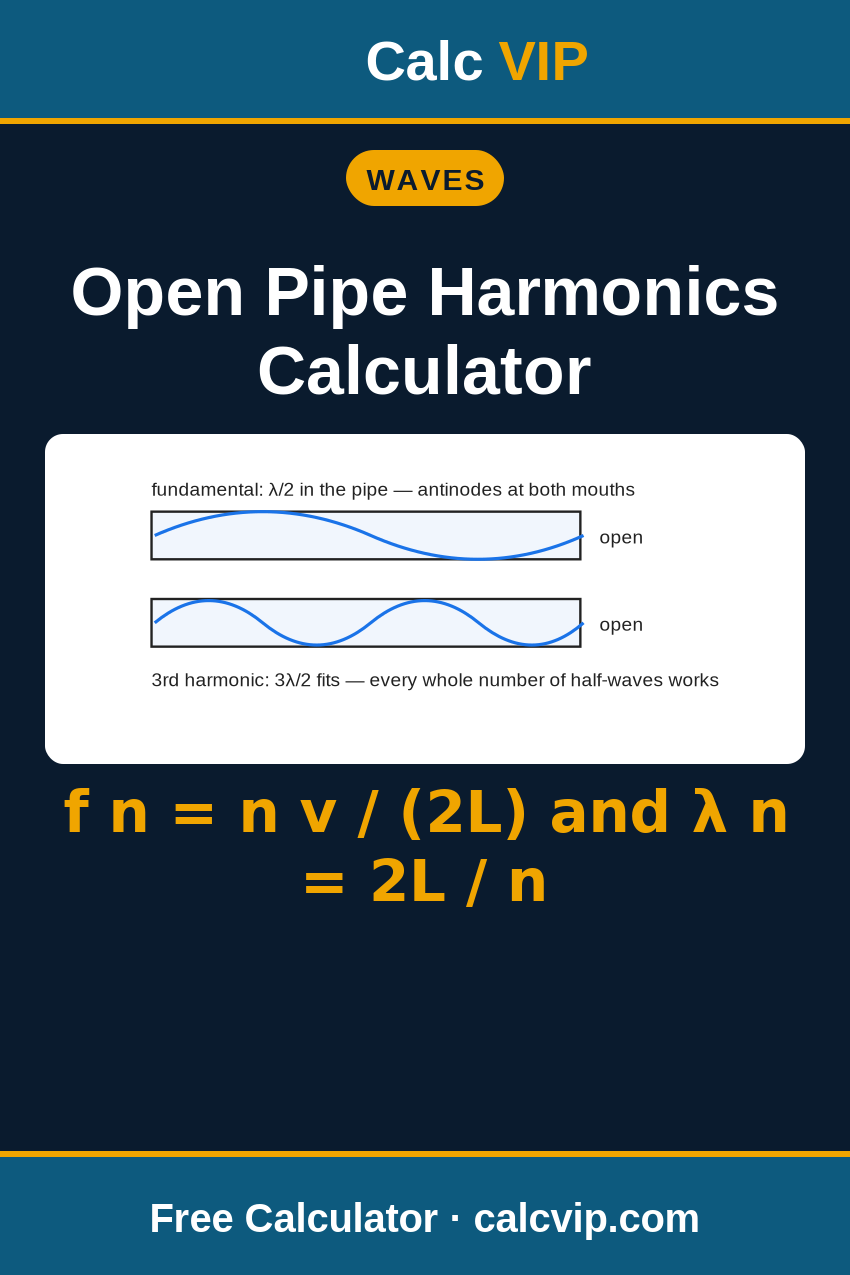
Where a closed pipe admits only odd harmonics, an open pipe is generous: both ends are displacement antinodes — air at each mouth swings freely in and out — and any standing wave with an antinode at both ends fits. Those are exactly the patterns containing a whole number of half-wavelengths: L = λ/2, λ, 3λ/2, 2λ…, giving the complete series f, 2f, 3f, 4f, 5f… The fundamental is f₁ = v/(2L), twice the closed pipe's fundamental for the same length, and the full harmonic ladder is what gives flutes and open organ pipes their bright, complete tone: every ingredient the ear expects is present.
This calculator lists the first five harmonics with their wavelengths from just two inputs, the pipe length and the speed of sound. It is the natural companion to the Closed Pipe Harmonics Calculator — run the same length through both and the difference between the two families stands out in a single glance: the open pipe starts an octave higher and fills in every rung, including the 2nd harmonic the closed pipe forbids.
Real instruments add their usual footnotes. The antinodes sit slightly beyond each open end (the end correction, about 0.6 of the radius at each end), so real pipes sound a little flat of these ideal numbers — worked through with figures in the depth section. And while a flute's body is an open pipe, its pitch is bent by embouchure and keywork in ways no formula captures; what the formula does give, exactly, is the resonance skeleton those refinements decorate.
Formula
For a pipe open at both ends, every harmonic fits: fn = n v / (2L) and λn = 2L / n, for n = 1, 2, 3, 4, 5, … The fundamental is f₁ = v / (2L).
Rearranged for builders: the length for a target fundamental is L = v / (2f₁), and the harmonic number of any frequency is n = 2Lf / v — for an open pipe it should come out a whole number at a resonance, any whole number, unlike the closed pipe's odd-only rule. The fundamental's wavelength is exactly twice the pipe: an open pipe is a half-wave resonator. A handy comparison to memorise: the open pipe of length L plays the same fundamental as a closed pipe of length L/2 — one reason flutes are longer than clarinets for the same lowest note. Units: metres, metres per second (343 m/s in air at 20 °C), hertz.
| Symbol | Meaning | Units |
|---|---|---|
| fn | frequency of the n-th harmonic (n = 1, 2, 3, …) | hertz (Hz) |
| L | length of the air column | metres (m) |
| v | speed of sound in the gas inside | m/s |
| λn | wavelength of the n-th harmonic, 2L/n | metres (m) |
Why every harmonic fits — and what that does to the sound
Count the boundary conditions. Each open end demands an antinode; a standing wave of wavelength λ has antinodes every λ/2 along its length; so the pipe resonates whenever its length is a whole number of half-wavelengths. There is no parity restriction — nothing analogous to the closed pipe's node forcing odd quarters — so the series is complete. In frequency terms the overtones stand at exact multiples of the fundamental, and a periodic tone whose spectrum is the full harmonic series is precisely what the auditory system is built to fuse into a single rich pitch: flute, open organ pipe, trumpet and the human voice all share this skeleton, differing in the strengths of the rungs rather than in which rungs exist.
The contrast with the closed pipe is the cleanest illustration in all of acoustics that timbre is boundary conditions made audible. Same air, same speed of sound, similar tubes — but cap one end and the fundamental drops an octave, the even rungs vanish, and the sound turns hollow. Uncap it and everything doubles back up and fills in. When you run this calculator and its closed-pipe companion on the same length, you are looking at the difference between a clarinet and a flute expressed as two tables of numbers.
How to use
- Enter the length of the pipe — the air column between its two open ends — in metres.
- Enter the speed of sound for the temperature: about 343 m/s at 20 °C (331 m/s at 0 °C, roughly +0.6 m/s per degree).
- Click "Show Harmonics" to see the first five harmonics with frequencies and wavelengths.
- To design for a target fundamental, use L = v/(2f₁) from the Formula section, then confirm the series here — and compare it with the closed-pipe calculator if the instrument might behave as a stopped pipe instead.
Worked examples
Example 1 — the reference pipe. An open pipe of length L = 0.85 m with v = 340 m/s:
Fundamental f₁ = 340 / (2 × 0.85) = 200 Hz, λ₁ = 2 × 0.85 = 1.70 m.
2nd: 400 Hz, λ = 0.85 m • 3rd: 600 Hz, λ = 0.57 m • 4th: 800 Hz, λ = 0.43 m • 5th: 1000 Hz, λ = 0.34 m.
Example 2 — the concert flute. A flute's effective air column for its lowest note is about L = 0.655 m. With v = 343 m/s: f₁ = 343/(2 × 0.655) = 261.83 Hz — middle C (C4 = 261.63 Hz) to within a fifth of a hertz — followed by 523.66, 785.50, 1047.33 and 1309.16 Hz. The flute's whole first octave is this pipe; its second octave is the same pipe persuaded onto the 2nd harmonic.
Example 3 — an open organ rank. An open flue pipe of L = 2.44 m (a true 8-foot pipe) gives f₁ = 343/(2 × 2.44) = 70.29 Hz, then 140.57, 210.86, 281.15 and 351.43 Hz. Compare the stopped pipe of the same length in the companion calculator: 35.14 Hz — the open pipe costs twice the metal per note at the bottom of the organ, which is why builders stop the largest pipes.
Example 4 — the PVC pipe instrument. A length of tubing L = 0.50 m, struck or blown as an open pipe at v = 343 m/s, sounds f₁ = 343 Hz with harmonics at 686, 1029, 1372 and 1715 Hz. Classroom "boomwhacker"-style instruments and pipe organs of the YouTube age are cut from L = v/(2f) for each note of the scale — this example is one F4 tube of such a set.
Example 5 — the singing tube in the laboratory. A tube open at both ends resonates for a 512 Hz fork when its length is L = v/(2f) = 343/1024 = 0.335 m — 33.5 cm. Students find the resonance by sliding a telescoping tube; the next resonance appears at twice the length (the 2nd harmonic fitting the longer tube at the same frequency), a pattern that distinguishes open tubes from closed ones in the resonance-tube experiment.
Example 6 — the pan flute's open tube. Some pan flutes and many Andean zampoña tubes are open at the far end; an open tube of L = 0.15 m sounds f₁ = 343/(2 × 0.15) = 1143.33 Hz. The stopped version of the same tube would give 571.67 Hz — the two calculators together let a builder choose the register before cutting anything.
Open pipes in real life
The flute family. Flutes, recorders, whistles and the flue pipes of organs are open pipes with an air-jet drive at one mouth. Their overblowing behaviour — the jump to the 2nd harmonic, the octave — follows directly from the complete series this calculator lists.
Open organ pipes. The ranks that give an organ its brilliance are open pipes voiced so their harmonics speak promptly. Pipe lengths follow L = v/(2f) minus the end corrections, and a rank is a physical printout of this page's table, one pipe per note.
Brass instruments, approximately. A trumpet's tubing is driven by the lips at one end, yet its resonances approximate an open pipe's full series (the bell flare and mouthpiece conspire to make it so) — which is why brass players select notes from the complete harmonic ladder, using valves to add tubing and shift the whole ladder downwards.
Didgeridoo and long tubes. A didgeridoo is a long open-ended tube whose drone is its fundamental; players exploit the higher resonances listed here as "toots" — the first toot is the 2nd or 3rd harmonic of the same tube, reached by tightening the lips and blowing harder.
Ventilation and plumbing hum. Open-ended ducts and standpipes resonate as open pipes; a duct of 3.4 m has a fundamental near 50 Hz, uncomfortably close to mains hum harmonics, and HVAC engineers detune lengths using exactly this formula to avoid a building that sings.
Chimneys and organ-pipe whistling. Wind across a chimney top can excite its open-pipe modes — the eerie moaning of a flue on a gusty night is its harmonic series being played by turbulence, at frequencies this calculator predicts from the chimney's height.
End corrections at both ends — and overblowing
Each open end of a real pipe adds its own correction of about 0.6 × radius, because the antinode forms slightly outside the tube. The Example 1 pipe with a radius of 2 cm gains 0.012 m at each end: effective length 0.874 m, and the fundamental falls from 200 Hz to 340/(2 × 0.874) = 194.51 Hz — flat by nearly half a semitone. Wide, short tubes suffer proportionally the most, which is why organ pipes are trimmed with tuning slots and why the laboratory resonance method measures differences between resonances to cancel the correction.
Overblowing is the harmonic ladder in action. Increase the air speed at a flute's embouchure and the fundamental gives way to the 2nd harmonic — the note jumps exactly an octave, because the ladder's second rung is 2f. The clarinet, missing that rung, jumps to 3f, a twelfth. Recorders, flutes and shakuhachi all exploit rung two; the third register of the flute climbs to 3f and 4f by cross-fingering that suppresses the lower rungs. Every one of those fingerings is an argument with this calculator's table, and the table always wins.
Notice what does not appear anywhere in the ladder: how the pipe is driven. A flue pipe's air jet, a recorder's fipple, a flutist's lips and a reed organ pipe's vibrating tongue are four utterly different engines, yet all four excite the same resonances at the same frequencies, because the ladder belongs to the air column and not to the motor. The engine decides which rungs sound strongly — a reed's rich buzz feeds every harmonic, a gentle flue favours the low ones — but it cannot move a rung. That separation of roles, engine versus resonator, is why a calculator that knows only L and v can say so much about instruments it has never heard.
Quick reference: fundamental frequency by pipe length (v = 343 m/s)
| Air column L | Open pipe f₁ = v/2L | 2nd harmonic | Closed pipe f₁ (same L) |
|---|---|---|---|
| 0.10 m | 1715.0 Hz | 3430.0 Hz | 857.5 Hz |
| 0.25 m | 686.0 Hz | 1372.0 Hz | 343.0 Hz |
| 0.50 m | 343.0 Hz | 686.0 Hz | 171.5 Hz |
| 0.85 m | 201.76 Hz | 403.53 Hz | 100.88 Hz |
| 1.00 m | 171.5 Hz | 343.0 Hz | 85.75 Hz |
| 2.00 m | 85.75 Hz | 171.5 Hz | 42.88 Hz |
The right-hand column is the whole open-versus-closed story in one glance: at every length the open pipe's fundamental is exactly twice the closed pipe's, and only the open pipe owns a 2nd harmonic. If you are identifying an unknown tube from a recording, compare the fundamental against the first strong overtone — 2f says open, 3f says closed.
Common mistakes
- Using the closed-pipe formula. v/(4L) is for a pipe capped at one end. For a pipe open at both ends the fundamental is v/(2L) — the 4L version predicts a note an octave too low.
- Skipping the 2nd harmonic. Students fresh from the closed pipe often list 200, 600, 1000… for this example. The open pipe's series is complete: 200, 400, 600, 800, 1000. The even rungs are the point.
- Measuring to the wrong ends. L is the air column between the two openings. On a flute that is the embouchure hole to the first open key or the foot — not the full length of the instrument's body with its head joint cork.
- Ignoring temperature. v changes about 0.6 m/s per °C; a pipe voiced at 20 °C plays roughly 3.5% sharp at 35 °C. Wind sections tune after warming up for exactly this reason — the calculator's v input is where that reality enters.
- Neglecting two end corrections. An open pipe has two open ends, each adding ≈0.6r. For wide tubes the combined correction can flatten the fundamental by several percent (200 → 194.51 Hz in the worked case) — twice the closed pipe's error at the same radius.
FAQ
Why does an open pipe have all the harmonics?
Both ends are antinodes, so any whole number of half-wavelengths fits between them. That gives every multiple of the fundamental — 2f, 3f, 4f, … — which is why flutes and open organ pipes have a bright, rich tone.
How does an open pipe compare with a closed pipe of the same length?
The open pipe's fundamental, v/(2L), is exactly twice the closed pipe's, v/(4L) — one octave higher. Compare this example (200 Hz) with a closed pipe of 0.85 m (100 Hz).
What happens when a flute player "overblows"?
Overblowing excites the 2nd harmonic instead of the fundamental, so the note jumps up exactly one octave (from f₁ to 2f₁). On a clarinet (a closed pipe) the same trick jumps to the 3rd harmonic instead.
Why is the open pipe's wavelength twice its length?
Because the fundamental fits exactly half a wave between the two antinodes: λ₁ = 2L. Each higher harmonic fits one more half-wave, so λn = 2L/n — the wavelengths shrink as the frequencies climb, keeping f × λ = v at every rung.
Is a flute's effective length the same as its body length?
Not quite. The air column starts at the embouchure hole (not the closed cork end of the head joint) and ends at the first open finger hole, plus end corrections at both. That effective length is what belongs in this calculator — for the lowest note of a concert flute it works out to about 0.655 m, as Example 2 shows.
Do conical instruments like the oboe follow this?
Surprisingly, yes. A complete cone resonates like an open pipe of the same length, with the full harmonic series — despite being driven by a reed. That is why the oboe and saxophone overblow at the octave while the cylindrical clarinet jumps a twelfth.
What if one end is only partly open?
The pipe sits between the two ideals: the partly closed end is neither a perfect node nor antinode, the fundamental lands between v/(4L) and v/(2L), and the harmonic series is neither complete nor odd-only. Cupping a hand over a tube's end and hearing the pitch sag is this effect in real time.
Can an open pipe be too short to have a fundamental in range?
The formula always returns a number, but very short wide tubes stop behaving like pipes at all — the end corrections exceed the length, and the resonance becomes a Helmholtz-like mode of the opening. As a rule of thumb the model is trustworthy when L is at least several times the diameter.
Why do organ builders call an open rank "8-foot" when the longest pipe is about 2.44 m?
Because 8 feet is 2.44 m: the name is simply the physical length of the rank's longest pipe, the one for its lowest C. The ideal formula gives 70.29 Hz for that length at v = 343 m/s (Example 3); historical pitch standards were often lower than today's, and end corrections lower the real pitch further, so a nominal 8-foot pipe served the C its builder intended.
Does the gas inside matter?
Only through v. Fill the pipe with helium (v ≈ 965 m/s) and every resonance climbs by the ratio 965/343 ≈ 2.8 — the basis of the squeaky-voice effect, which is your vocal tract's resonances shifting, not your vocal cords speeding up. The calculator accepts any v you give it.