 Calc
Pipe Length Calculator – Length of Open & Closed Pipes for a Resonant Frequency
 Created by David Okafor · Physics Writer · Waves & Light · Last updated: November 2026
Use this free Pipe Length Calculator to find how long an organ pipe, flute or tube must be to resonate at a chosen frequency — for both open pipes (open at both ends) and closed pipes (closed at one end).
Every wind instrument is a length of pipe chosen by arithmetic. This calculator runs that arithmetic forwards: give it the note you want and it returns the length of pipe — open at both ends like a flute, or closed at one end like a clarinet — whose fundamental resonance is exactly that note. The physics is standing waves in air. The air column will only sing strongly at wavelengths that fit its length with the right boundary conditions, and the fundamental — the longest fitting wave — sets the instrument's pitch through f = v/λ.
The two pipe types differ by a factor of two, and the reason is pure geometry. At an open end the air is free to move, so the standing wave must have an antinode (maximum motion) there. Open at both ends means antinode–antinode, and the shortest pattern joining them is half a wavelength: L = λ/2. At a closed end the air cannot move — a node. A pipe closed at one end must fit node-to-antinode, which is a quarter wavelength: L = λ/4. Hence the closed pipe sounds the same note as an open pipe twice its length, a fact organ builders have exploited for centuries: a stopped pipe gives you the deep note at half the cost in metal, space and money.
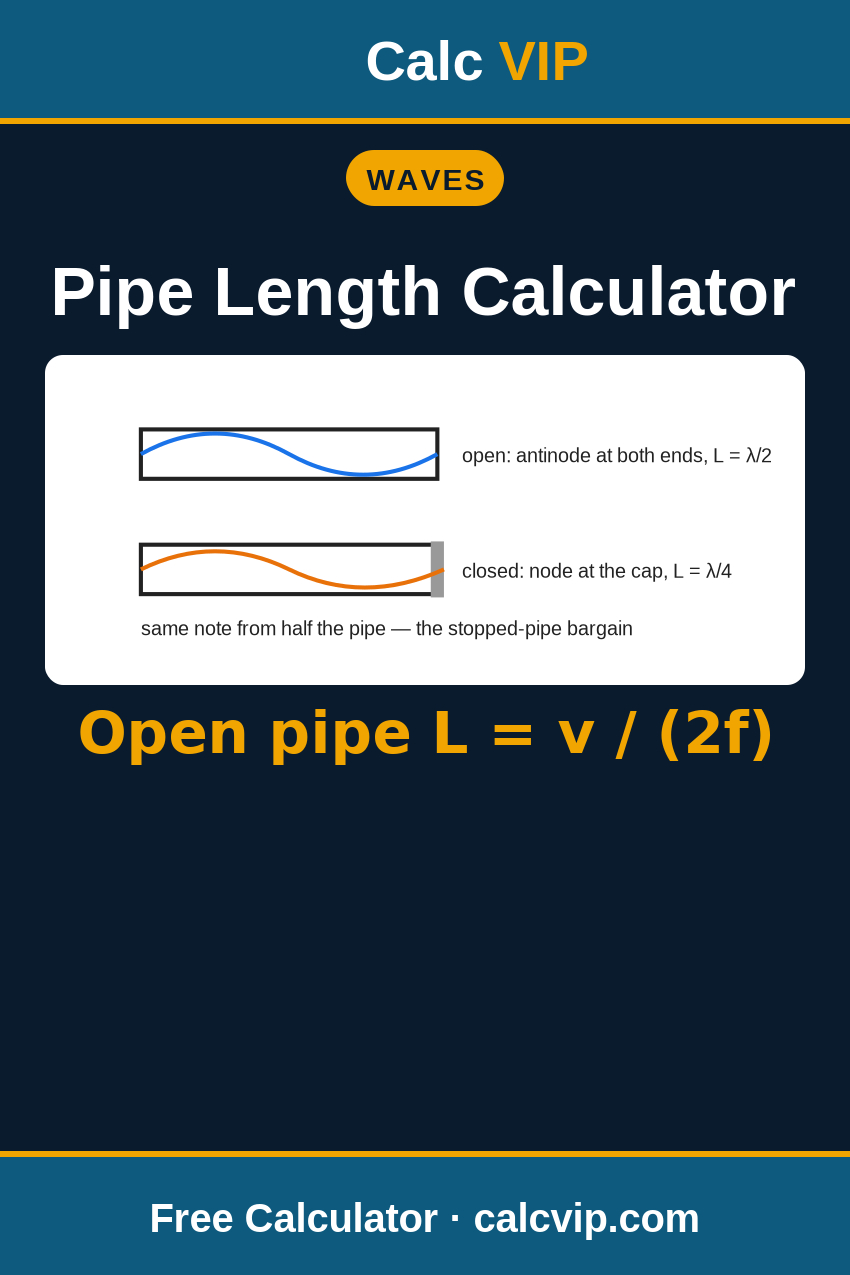
Combine the fitting rules with λ = v/f and the calculator's formulas appear: L = v/(2f) for the open pipe, L = v/(4f) for the closed. With v = 343 m/s at room temperature, a 440 Hz A needs 39 cm open or 19.5 cm closed. Everything else — the organ's towering 8-metre bass pipes, the panpipe's graduated bamboo, the recorder's modest tube — is this division performed at other frequencies. The one refinement the raw formula omits, the end correction, is covered in the depth section below: real makers cut a little short and trim by ear, because the standing wave bulges slightly beyond the pipe's physical end.
Formula
Open pipe L = v / (2f) • Closed pipe L = v / (4f) • with λ = v / f • rearranged: f = v / (2L) open, f = v / (4L) closed
Both formulas are λ = v/f wearing the fitting rule of their pipe. The open pipe's fundamental wavelength is 2L, so f = v/2L; the closed pipe's is 4L, so f = v/4L. The harmonic content differs just as cleanly: the open pipe resonates at all multiples of its fundamental (f, 2f, 3f, 4f…), because any whole number of half-wavelengths fits antinode-to-antinode; the closed pipe admits only odd multiples (f, 3f, 5f…), because node-to-antinode patterns come only in odd quarter-wavelength counts. That single difference explains two instrument families: flutes and open organ pipes, rich in all harmonics, versus clarinets and stopped pipes, hollow with odd ones. To play an octave higher, an open pipe overblows to its 2nd harmonic; a clarinet overblows to its 3rd — a twelfth — which is why clarinets need so many more keys to fill the gap.
| Symbol | Meaning | Units |
|---|---|---|
| L | length of the air column (the answer) | m |
| f | desired fundamental frequency | hertz (Hz) |
| v | speed of sound in the air inside the pipe | m/s |
| λ | wavelength of the fundamental | m |
Nodes, antinodes and the two families of wind instrument
The standing wave inside a pipe is a wave of air displacement (and, out of step with it, of pressure). The rules are simple: air at a closed end cannot move — displacement node, pressure antinode; air at an open end moves freely — displacement antinode, pressure node, because the open end is pinned to atmospheric pressure. Every pipe resonance is a jigsaw of these conditions. The fundamental is the longest wave satisfying them, and the overtones are the shorter waves that also satisfy them — all half-wave counts for the open pipe, odd quarter-wave counts for the closed. Musicians meet the consequences daily: a flute (open) and a clarinet (closed) of similar length play in different registers and blend differently with an orchestra, purely because of which rows of the harmonic table each is allowed to use.
There is a subtler consequence for the player: the instrument's pitch is not set by the pipe alone but by the pipe plus the air in it. Warm the air and v rises; with L fixed, f = v/(2L) rises with it — a flute at 30 °C plays about 447 Hz where it played 440 Hz at 20 °C (worked through as Example 6 below). Players "blow an instrument into tune" as it warms in their hands, and organ tuners specify the temperature at which the organ is voiced, because an organ tuned on a cold morning will be sharp by the afternoon service. The calculator's speed input is where that whole world of practical tuning enters: change v and every length rescales in proportion.
How to use
- Choose the pipe type: "Open at both ends" for flutes, recorders and open organ pipes; "Closed at one end" for clarinet-style tubes, stopped organ pipes and panpipes.
- Enter the frequency of the note you want, in hertz.
- Enter the speed of sound — 343 m/s for air at 20 °C; raise it towards 349 m/s for a warm hall (30 °C) if you are designing for real playing conditions.
- Click "Calculate Length" to get the fundamental length in metres and centimetres, with the wavelength shown for reference. For a physical build, cut slightly long and trim — see the end-correction section below.
Worked examples
Example 1 — concert A. How long must a pipe be to play 440 Hz with v = 343 m/s?
Open pipe: L = 343 / (2 × 440) = 0.39 m.
Closed pipe: L = 343 / (4 × 440) = 0.19 m.
A closed pipe needs only half the length of an open one for the same note.
Example 2 — the organ's depths. Lengths for 65.4 Hz (C2, near the bottom of the piano):
Open: L = 343 / (2 × 65.4) = 2.62 m. Closed: L = 343 / (4 × 65.4) = 1.31 m.
Now the stopped-pipe bargain is worth metres of tin and a great deal of money — which is why the biggest organ pipes are so often stopped.
Example 3 — a flute's top register. An open pipe for 523 Hz (C5):
L = 343 / (2 × 523) = 0.33 m. A real flute's tube is longer than this because the player stops it down with keys and the embouchure end behaves unusually — but the sounding length for this note, from embouchure hole to the first open key, is close to these 33 cm.
Example 4 — the limit of hearing. Pipes for 20 Hz, the lowest audible frequency:
Open: L = 343 / 40 = 8.58 m. Closed: L = 343 / 80 = 4.29 m.
Only the grandest organs attempt it — the famous 32-foot stops (about 9.75 m of pipe) exist precisely because physics demands this scale, and even then you feel the note as much as hear it.
Example 5 — a panpipe tube. A closed bamboo tube for 392 Hz (G4):
L = 343 / (4 × 392) = 0.22 m (21.9 cm). Panpipes, bottle organs and ocarina-like instruments are all closed-pipe calculators made solid — each tube's length is its note.
Example 6 — the warm-hall effect. On a 30 °C day (v = 349 m/s), what open length gives 440 Hz, and what does yesterday's pipe play?
L = 349 / 880 = 0.40 m. The pipe cut to 0.39 m at 20 °C now plays f = 349 / (2 × 0.39) = 447 Hz — sharp by 7 Hz, about a sixth of a semitone, purely from the weather inside the hall.
Pipe lengths in real life
Organ building. An organ rank is this calculator rendered in metal and wood: each octave doubles the lengths, each semitone multiplies by about 0.944. Builders still lay out ranks with the same divisions, then voice and trim each pipe by ear against the end correction.
Wind instrument design. The clarinet's cylindrical closed pipe explains its register key behaviour — overblowing jumps a twelfth (to 3f), so the instrument needs extra keys to bridge to the next register, where the flute, overblowing an octave (to 2f), needs fewer.
Panpipes, whistles and bottles. Blowing across a bottle is a closed-pipe experiment: the note falls as you drink because the air column lengthens... and rises as you add water, shortening the column. The pitch tracks L = v/4f exactly.
Exhaust and intake tuning. Engine designers treat exhaust pipes as organ pipes: a pressure wave reflected from the open end returns after a time set by the pipe length, and lengths are chosen so the returning wave helps scavenge the next exhaust stroke at the target rpm.
Architectural acoustics. Ventilation ducts, lift shafts and long corridors are accidental pipes with resonances in the infrasound and low-audio range. A duct's length predicts its hum frequency with this formula — and the fix (change the length, or add a side branch) uses it too.
Didgeridoo and natural trumpets. A 1.5 m didgeridoo, effectively a closed-ish pipe, drones near f = 343/(4 × 1.5) ≈ 57 Hz — the deep pulse its players decorate with vocal and lip effects, all anchored by one division.
The end correction: why real pipes are cut shorter
The standing wave does not stop dead at the pipe's rim. The air just outside an open end is dragged into the oscillation, so the antinode — the effective end of the air column — sits a little beyond the physical end, by about 0.6 × the pipe's radius (equivalently 0.3 × its diameter) for each open end. The pipe therefore behaves as if it were longer than it is: an open pipe of radius 2 cm gains about 1.2 cm at each end, 2.4 cm in all — on a 39 cm pipe, a 6% error, worth more than a semitone. Makers handle it empirically: the formula gives the effective length, so the physical pipe is cut shorter by the correction, then trimmed during voicing until the note speaks true. Wide pipes need bigger corrections than narrow ones, one reason organ pipes of the same note but different scales (diameters) are not interchangeable. The calculator gives the clean physics; the end correction is the craft knowledge that turns physics into an instrument.
Quick reference: pipe lengths for common notes (v = 343 m/s)
| Note | Frequency | Open pipe L | Closed pipe L |
|---|---|---|---|
| C4 (middle C) | 261.6 Hz | 0.66 m | 0.33 m |
| D4 | 293.7 Hz | 0.58 m | 0.29 m |
| E4 | 329.6 Hz | 0.52 m | 0.26 m |
| G4 | 392 Hz | 0.44 m | 0.22 m |
| A4 | 440 Hz | 0.39 m | 0.19 m |
| C5 | 523.3 Hz | 0.33 m | 0.16 m |
Two patterns to carry away: the closed column is always the open column halved, and an octave up (double f) halves both — the entire geography of wind instruments in one small table.
Scaling a rank: the geometry of a whole instrument
One pipe is a division; an instrument is the division repeated with a rule. Equal temperament divides the octave into twelve semitones with a frequency ratio of 21/12 ≈ 1.0595 per step, so lengths shrink by the reciprocal, ×0.9439, per semitone — and halve exactly at the octave. An open rank built from the C2 pipe of Example 2 (2.62 m) climbs through C3 at 1.31 m and C4 at 0.66 m to a C6 pipe of just 343/(2 × 1,046.5) = 0.16 m — a 16-fold range of lengths on one keyboard, which is why organ cases are pyramids and piano strings fan out across the frame. Makers add one more refinement: the diameter usually shrinks more slowly than the length (roughly halving every two octaves rather than every one), keeping the small pipes relatively wider and their tone fuller — a scaling compromise between the formula's clean geometry and the ear's preferences, worked out over centuries of building.
Common mistakes
- Using the open formula for a closed pipe (or vice versa). The factor is 2 versus 4 in the denominator — swapping them puts the note an octave out. Check the instrument: one capped end means divide by 4f.
- Forgetting the end correction on a real build. The formula returns the effective air-column length. A pipe cut to exactly that physical length will play flat, by up to a semitone for wide pipes.
- Ignoring temperature. Lengths scale with v, and v moves 0.6 m/s per °C. Designing at 343 m/s for an instrument that will play in a 30 °C hall builds in a sharpness of about a sixth of a semitone.
- Expecting even harmonics from a closed pipe. They are forbidden by the boundary conditions. If your design needs a strong 2nd harmonic at low length, you need an open pipe or a conical bore, not a stopped cylinder.
- Measuring a flute's full tube and expecting the formula to match. The sounding length runs from the embouchure hole to the first open tone hole, not the whole instrument. The formula governs the vibrating column, wherever the player's fingers define it.
FAQ
Why is a closed pipe half as long?
A closed end must be a node and the open end an antinode, so only a quarter of a wavelength fits in the pipe (L = λ/4). An open pipe fits half a wavelength (L = λ/2).
Can a closed pipe play even harmonics?
No. A closed pipe only resonates at odd multiples of its fundamental (f, 3f, 5f…), which is why a clarinet sounds "hollower" than a flute.
Is the real pipe exactly this length?
Slightly shorter in practice — the air just outside the open end also vibrates (the "end correction", about 0.6 × the pipe radius per open end). Makers trim the pipe a little to compensate.
What length of open pipe plays middle C?
Middle C is 261.6 Hz, so L = 343 / (2 × 261.6) = 0.66 m open, or 0.33 m closed. A recorder's sounding length for its lowest notes is in exactly this territory.
Why does covering one end of a tube drop the note an octave?
Because the fitting rule changes from λ = 2L to λ = 4L: the same physical tube now hosts a wavelength twice as long, and f = v/λ halves. It is the quickest classroom demonstration of the two formulas.
Does the pipe's diameter affect the pitch?
Only slightly, through the end correction (about 0.6 × radius per open end): wider pipes behave as if a little longer, so they play a touch flatter for the same cut length. Diameter mostly affects tone and loudness, not pitch.
How long is the longest organ pipe?
The largest 32-foot stops have pipes around 9.75 m long for notes near 16–20 Hz — at and below the edge of hearing, felt in the chest as much as heard. Many are stopped pipes, halving the physical length the formula would otherwise demand.
Can a pipe be too short for its note?
A pipe always resonates at the frequency its length dictates; "too short" just means it plays a higher note than intended. There is no slack in the relation — length and fundamental are locked by f = v/(2L) or v/(4L).
Why do brass instruments not follow these lengths directly?
Brass bores are mostly conical and end in a flaring bell, which changes the boundary conditions and the end correction; their effective lengths blend open-pipe behaviour with corrections. The cylindrical formulas here are exact for cylindrical pipes — flutes, clarinets, organ pipes, tubes.
What happens to the note if I blow harder?
Up to a point, nothing — the pipe selects its resonance. Blow much harder and the pipe jumps to its next allowed resonance: the octave (2f) for an open pipe, the twelfth (3f) for a closed one. That jump, "overblowing", is a feature musicians use deliberately.