 Calc
Pipe Resonance Calculator – Open & Closed Pipe Resonant Frequencies
 Created by David Okafor · Physics Writer · Waves & Light · Last updated: November 2026
Use this free Pipe Resonance Calculator to find the resonant frequencies of an air column in a pipe. Choose an open pipe (both ends open, like a flute) or a closed pipe (one end closed, like a clarinet), then enter the pipe length and the resonance number to get the frequency and wavelength of that resonance.
Blow across the top of a bottle, speak into a cardboard tube, or listen to the wind in a drainpipe, and the air answers with a definite musical pitch. That pitch is not an accident of the blowing — it is chosen by the pipe. The air column inside can only vibrate strongly at certain frequencies, its resonances, because the sound waves reflecting back and forth inside must fit the pipe's length the way a standing wave must fit a string. Every wind instrument, from a pan pipe to a cathedral organ, is an exercise in choosing a length so that the fitting rule lands on the note you want.
The crucial detail is what happens at the ends. At an open end the air is free to rush in and out, so the opening is a displacement antinode — the air there swings with maximum amplitude. At a closed end the air is trapped against a solid cap, so it must be a node — no motion at all. Those two boundary conditions, applied to the requirement that the wave fit the pipe, generate two quite different musical families. An open pipe fits half a wavelength in its fundamental and supports every harmonic. A closed pipe fits only a quarter wavelength, sounds an octave lower for the same length, and supports only the odd harmonics.
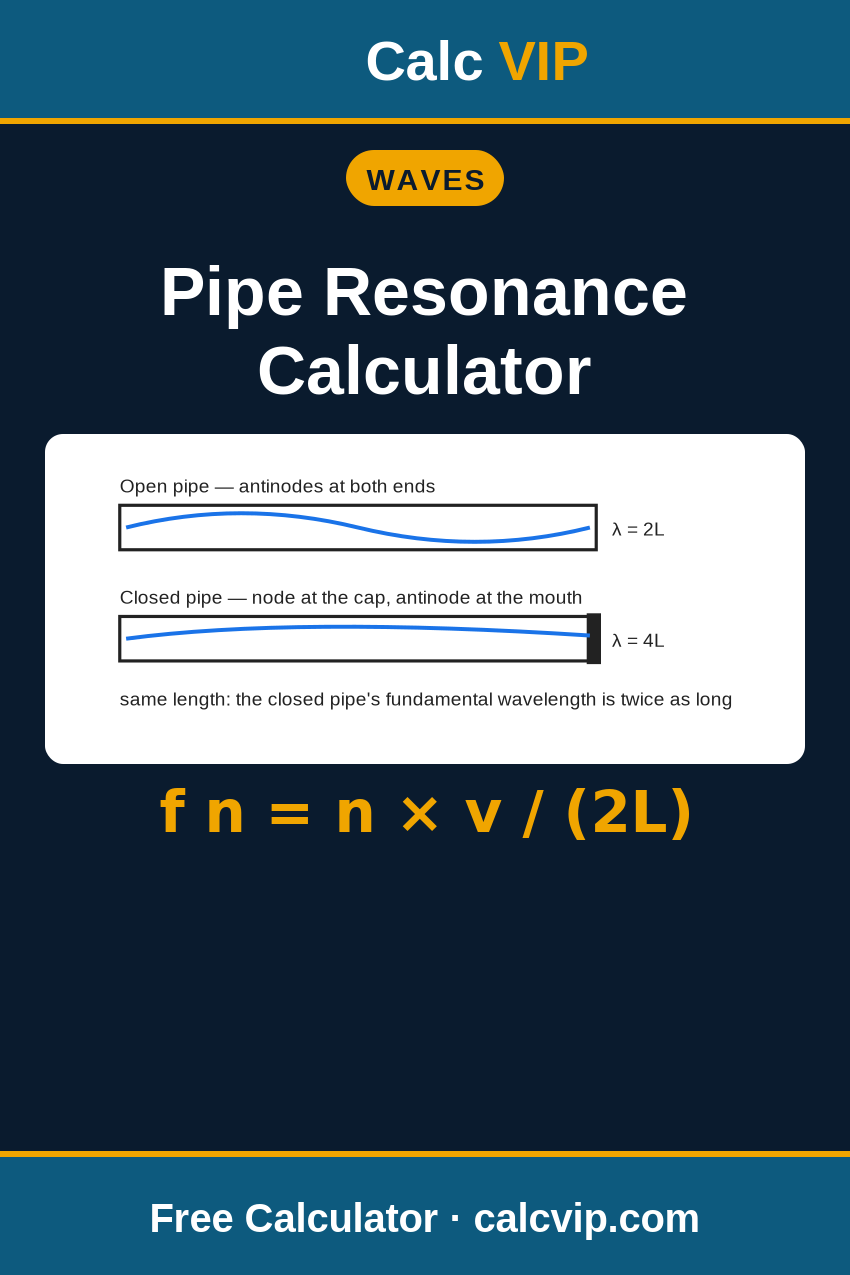
That single difference — all harmonics versus odd ones only — is why a flute and a clarinet, two tubes of similar size, sound so unlike each other, and why a clarinettist "overblows" not to the octave but to the twelfth. This calculator applies both rules: pick the pipe type, enter the length and which resonance you want, and it returns the frequency and wavelength, using the speed of sound you specify.
Formula
Open pipe: fn = n × v / (2L) — all harmonics (n = 1, 2, 3, ...)
Closed pipe: fn = (2n − 1) × v / (4L) — only odd harmonics (1st, 3rd, 5th, ...)
Read the formulas as fitting rules. In an open pipe the fundamental fits half a wavelength in the tube, λ1 = 2L, and each higher resonance adds another half-wavelength, so the frequencies climb as simple multiples of v/(2L) — exactly like a string. In a closed pipe the fundamental fits a quarter wavelength, λ1 = 4L, and the patterns that can satisfy "node at the cap, antinode at the mouth" are λ = 4L, 4L/3, 4L/5…, giving frequencies that are the odd multiples (2n − 1) of v/(4L). Note what the n in the closed-pipe formula counts: resonances in order, not harmonic numbers. The second resonance of a closed pipe (n = 2 in this calculator) is its 3rd harmonic. Rearranged for instrument makers, the length for a target fundamental is L = v/(2f) open and L = v/(4f) closed.
| Symbol | Meaning | Units |
|---|---|---|
| fn | frequency of the nth resonance | hertz (Hz) |
| n | resonance number — 1 = fundamental, 2 = next above, … | — |
| v | speed of sound in the air inside the pipe | m/s |
| L | length of the air column | m |
| λ | wavelength of the resonance | m |
Nodes, antinodes and the two families
It helps to be precise about which wave we are drawing. Sound in a pipe can be described by the air's displacement (how far molecules swing back and forth along the tube) or by its pressure. The two descriptions are a quarter-cycle out of step: where displacement has a node, pressure has an antinode, and vice versa. The boundary conditions are simplest in the displacement picture used here and in the calculator. A closed end forbids motion, so displacement has a node there (and pressure swings most wildly — the cap feels the full force of each compression). An open end connects to the room, whose pressure barely changes, so pressure has a node there and displacement an antinode: the air at the mouth sloshes freely in and out.
With those rules, the two families build themselves. Open–open: antinodes at both ends, so the simplest pattern is half a wavelength with a node in the middle, and adding half-wavelengths generates every integer multiple — a complete harmonic series, like a string's. Closed–open: a node at one end and an antinode at the other are a quarter-wavelength apart, so the fundamental is λ = 4L; the next pattern that still ends node-to-antinode fits three quarter-wavelengths, then five — only odd multiples survive. The missing even harmonics are not a subtlety: they are exactly the frequencies that give a flute its bright, complete sound, and their absence is the clarinet's hollow, woody colour.
How to use
- Select the pipe type: open at both ends, or closed at one end.
- Enter the speed of sound in air (343 m/s at about 20 °C is pre-filled; lower it for cold air, raise it for warm).
- Enter the length of the air column in metres.
- Enter the resonance number: 1 for the fundamental, 2 for the next resonance above it, and so on. For a closed pipe, remember resonance 2 is the 3rd harmonic.
- Click "Calculate Resonant Frequency" to get the frequency and wavelength of that resonance.
Worked examples
Example 1 — open versus closed, same pipe. A pipe is 0.85 m long and the speed of sound is 343 m/s. Open, its fundamental is f1 = 343 / (2 × 0.85) = 343 / 1.7 = 201.76 Hz, with wavelength λ = 2L = 1.7 m. The same pipe closed at one end has a fundamental of 343 / (4 × 0.85) = 100.88 Hz — exactly one octave lower — with wavelength λ = 4L = 3.4 m.
Example 2 — climbing the open pipe. The third resonance of that open pipe (n = 3) is f3 = 3 × 343 / 1.7 = 605.29 Hz, with wavelength λ = 2 × 0.85 / 3 = 0.57 m. Each step up the open pipe's ladder adds one more 201.76 Hz.
Example 3 — the closed pipe's second resonance. For the closed version, n = 2 means the multiplier (2n − 1) = 3, so f = 3 × 343 / (4 × 0.85) = 302.65 Hz. There is no resonance at 2 × 100.88 = 201.76 Hz — that frequency belongs to the open pipe's family, not this one.
Example 4 — designing an organ pipe. An organ builder wants the note C2, 65.41 Hz. An open pipe needs L = 343 / (2 × 65.41) = 2.62 m. A stopped (closed) pipe reaches the same note in half the height: L = 343 / (4 × 65.41) = 1.31 m. That is why church organs use stopped pipes for the deepest ranks — the ceiling is only so high.
Example 5 — a flute's lowest note. A flute is an open pipe whose effective air column for its lowest note is about 0.66 m. Its fundamental is f1 = 343 / (2 × 0.66) = 259.85 Hz — close to middle C (261.6 Hz), exactly where a flute's range begins.
Example 6 — why the clarinet overblows a twelfth. A clarinet's air column is about 0.6 m and closed at the reed end, so its fundamental is f1 = 343 / (4 × 0.6) = 142.92 Hz. Blow harder and the note does not jump to 2f1 — that resonance does not exist — but to 3f1 = 428.75 Hz, a musical twelfth up, the clarinet's famous register break.
Pipe resonance in real life
Flutes, recorders and whistles are open pipes: the player changes L with finger holes, and overblowing reaches the 2nd harmonic, one octave up, because the complete series is available.
Clarinets and stopped organ pipes are closed pipes: odd harmonics only, a fundamental an octave below an open pipe of the same length, and a register jump of a twelfth instead of an octave.
Pan pipes and bottle blowing. Each pan-pipe tube is closed at the bottom, so its length follows L = v/(4f). Blowing across a bottle is a cousin of the same physics — the air in the neck resonates against the springy air volume inside.
The trombone slide is a variable-length open pipe: extending the slide lengthens L and lowers every resonance together, giving the player seven positions instead of valves.
Your own ear canal is a closed pipe about 2.5 cm long. Its fundamental resonance is 343 / (4 × 0.025) = 3,430 Hz — and human hearing is indeed most sensitive around 3–4 kHz. Evolution tuned the canal to amplify exactly the band where speech consonants live.
Wind over chimneys and drains. A steady wind across a pipe mouth excites its resonances the way a flautist's air jet does, which is why tall chimneys moan at a steady pitch on windy nights and why drainpipes "sing" at one note.
End correction: why real pipes sound slightly flat
The ideal formulas assume the antinode sits exactly in the plane of the open end. In reality the air just outside the mouth is dragged into the oscillation, so the antinode floats a little beyond the pipe — the column behaves as if it were longer by roughly 0.6 × the pipe's radius for each open end. For the 0.85 m pipe of Example 1 with a 2 cm radius, the effective length becomes 0.85 + 0.012 = 0.862 m and the open fundamental falls from 201.76 Hz to 343 / (2 × 0.862) = 198.96 Hz — about a quarter of a semitone flat, easily enough for an organ tuner to care about. Wide pipes need bigger corrections than narrow ones, which is one reason real instrument dimensions never match the ideal formula exactly.
Quick reference: a half-metre pipe, v = 343 m/s
| Pipe (L = 0.5 m) | 1st resonance | 2nd resonance | 3rd resonance |
|---|---|---|---|
| Open (both ends) | 343 Hz | 686 Hz | 1,029 Hz |
| Closed (one end) | 171.5 Hz | 514.5 Hz | 857.5 Hz |
Read across the closed row and the odd-harmonic rule is visible in the numbers: 171.5, then 3 × 171.5 = 514.5, then 5 × 171.5 = 857.5. The open row is simply 343 × 1, 2, 3 — the same ladder as a string's.
Measuring the speed of sound with a pipe
The closed pipe has a second career as a measuring instrument. In the classic resonance-tube experiment, a vertical tube dips into water so its air column can be lengthened or shortened, and a tuning fork is held over the mouth. As the column shortens, it booms at particular lengths: the first when L = λ/4, the next when L = 3λ/4. The trick is to use both: subtracting the two lengths gives λ/2 exactly, and the unknown end correction — which shifts both resonances equally — cancels out of the difference. With a 512 Hz fork resonating at 0.16 m and again at 0.49 m, the difference is 0.33 m, so λ = 0.66 m and v = fλ = 512 × 0.66 = 337.9 m/s — the speed of sound in that room on that day, measured with a jar of water. It is one of the oldest precision experiments in acoustics, and it works because the fitting rule in this calculator is exact.
Common mistakes
- Using 2L for a closed pipe. A closed pipe's fundamental fits a quarter wavelength, λ = 4L. Using 2L doubles the answer and puts the note an octave too high.
- Expecting even harmonics from a closed pipe. They cannot exist — the node/antinode boundary conditions forbid them. If your closed-pipe calculation produces 2f1 as a resonance, the formula went wrong.
- Reading n as the harmonic number for closed pipes. In this calculator n counts resonances: n = 2 for a closed pipe is the 3rd harmonic, n = 3 is the 5th. Confusing the two understates the frequency badly.
- Forgetting the speed of sound changes with temperature. The formulas take v as an input for a reason: on a cold day v falls and every resonance of a wind instrument falls with it, which is why orchestras tune after the hall warms up.
- Ignoring end correction in design work. Real pipes behave about 0.6 radii longer per open end. For school problems the ideal formula is expected; for a pipe someone must play in tune, the correction decides the final cut.
FAQ
Why does a closed pipe sound lower than an open pipe of the same length?
In a closed pipe the fundamental wavelength is 4L (only a quarter of the wave fits in the pipe), while in an open pipe it is 2L. Double the wavelength means half the frequency — one octave lower.
Why are there no even harmonics in a closed pipe?
The closed end must be a node and the open end an antinode. Only odd multiples of the fundamental (1, 3, 5, ...) can satisfy both conditions at once, which is why a clarinet sounds "hollow" compared with a flute.
What is end correction?
The antinode at an open end actually sits slightly outside the pipe, making the effective length a little longer than the physical length (roughly L + 0.6 × radius per open end). This calculator uses the simple ideal-pipe formulas taught in most courses.
What does "resonance" mean for a pipe?
It means the driving sound matches a standing-wave pattern that fits the pipe, so reflections reinforce instead of cancelling and the vibration builds up large. Blow white noise (a breath) at a pipe and only its resonant frequencies survive loudly — the pipe selects its own notes from the noise.
How long must a pipe be to play a specific note?
Turn the formulas around: L = v/(2f) for an open pipe and L = v/(4f) for a closed one. Middle C (261.63 Hz) needs an open pipe of 343 / 523.26 ≈ 0.66 m, or a closed pipe of about 0.33 m — before end correction, which adds a little to both.
Does the pipe's diameter affect its pitch?
Only slightly, through the end correction: a wider pipe's antinode floats further out (0.6 × radius per open end), making it behave longer and sound flatter. The ideal formulas themselves contain no diameter term at all.
Why do wind instruments go sharp as they warm up?
The player's breath and the room warm the air inside the pipe, the speed of sound rises (about 0.6 m/s per °C), and since f is proportional to v with L fixed, every resonance rises. String players have the opposite problem — their instruments drift flat as strings warm and slacken.
What happens when you overblow a pipe?
The fundamental gives way to the next resonance. On an open pipe (flute, recorder) that is the 2nd harmonic — an octave up. On a closed pipe (clarinet) the next resonance is the 3rd harmonic — a twelfth up — which is why the clarinet's fingering system needs extra keys to fill the gap.
Is a conical pipe, like an oboe or saxophone, open or closed?
Surprisingly, open. A cone stopped at its narrow end behaves acoustically like an open pipe of the same length, supporting the full harmonic series — which is why the oboe overblows at the octave despite being capped by a reed, unlike the cylindrical clarinet.
Can a pipe resonate if I just shout into it?
Yes — your voice contains a spread of frequencies, and the pipe reinforces whichever ones match its resonances, so a shout into a long tube comes back coloured by the tube's fundamental and harmonics. It is the same effect that makes singing in a tiled stairwell sound so flattering.