 Calc
Resonance Tube Calculator – First Three Resonance Lengths of a Closed Tube
 Created by David Okafor · Physics Writer · Waves & Light · Last updated: November 2026
Use this free Resonance Tube Calculator to find the first three air-column lengths at which a tube closed at one end resonates for a given tuning-fork frequency — the classic school experiment for measuring the speed of sound.
The resonance tube is one of the oldest precision instruments in acoustics: a vertical tube, water at the bottom, a tuning fork at the top. Lower the water level slowly and at certain air-column lengths the fork's note suddenly booms out, reinforced by the column below. Those lengths are not arbitrary — they are the odd quarter-wavelengths of the fork's note, λ/4, 3λ/4, 5λ/4, and this calculator predicts all three from the fork's frequency and the speed of sound. Measure any two of them in the lab and you can run the physics backwards to measure the speed of sound itself — which is why this experiment has survived in school laboratories for over a century.
The setup is a pipe closed at one end, with the water surface as the closed end. The boundary conditions are the familiar pair: the water surface is a displacement node (the air there cannot move into the water), and the open top is an antinode. The shortest column satisfying them holds exactly a quarter of a wavelength. Lengthen the column by half a wavelength and the conditions are met again — another half-wave slips in — giving 3λ/4, then 5λ/4. The resonances are spaced by exactly λ/2, a regularity the calculator's table makes visible and the experiment exploits: the spacing between neighbouring resonances is the cleanest measurement of λ available, because a systematic error (the end correction) shifts every length by the same amount and cancels in the difference.
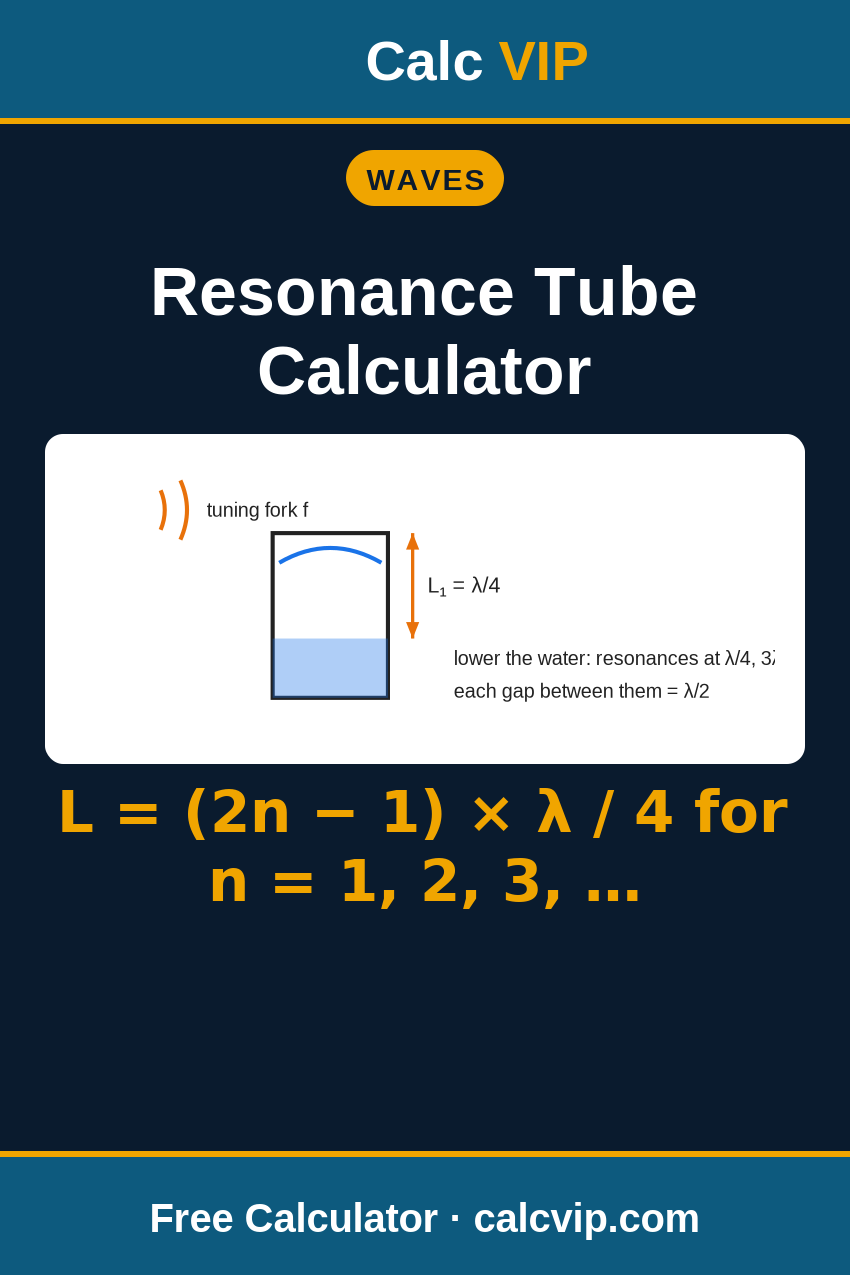
What the calculator gives you is the ideal geometry: λ from v/f, then the three lengths. What the laboratory adds is texture — the loudness swelling as you approach each length, the slight shortening of the first resonance by the end correction, the way a warm room stretches every length by raising v. Knowing the predicted values before you touch the apparatus turns a fishing expedition into a measurement: you lower the water expecting resonance near 16.7 cm, 50.2 cm and 83.7 cm for a 512 Hz fork, and the departures of the real values from the predicted ones become data — about temperature, about end correction, about the speed of sound in your room on your day.
Formula
A tube closed at one end resonates when its length is an odd multiple of a quarter wavelength:
L = (2n − 1) × λ / 4 for n = 1, 2, 3, … • λ = v / f • neighbouring resonances differ by λ/2 • measuring sound speed: v = 2f × (L₂ − L₁)
The (2n − 1) is the odd numbers in disguise — 1, 3, 5 — counting the quarter-wavelengths that fit between a node and an antinode. The first resonance is the fundamental of the closed tube; the higher ones are its odd overtones (3f and 5f patterns living in a longer column at the same driving frequency — note the fork supplies the frequency; the column lengths are what change). The spacing rule is the experimentalist's treasure: L₂ − L₁ = λ/2 exactly, so λ = 2(L₂ − L₁) and v = fλ = 2f(L₂ − L₁), with the end correction — the same additive offset on both lengths — wiped out by the subtraction. If only one resonance is reachable, L₁ + c = λ/4 with c ≈ 0.3 × the tube's diameter gives a rougher route to the same λ.
| Symbol | Meaning | Units |
|---|---|---|
| L₁, L₂, L₃ | first, second, third resonance lengths | m (or cm) |
| n | resonance number — 1, 2, 3… | — |
| f | frequency of the tuning fork | hertz (Hz) |
| v | speed of sound in the tube's air | m/s |
| λ | wavelength of the fork's note, v/f | m |
Why the sound suddenly booms
Resonance is energy bookkeeping. The fork delivers small pushes of energy to the air at the tube's mouth, at its own frequency. If the column is the wrong length, the wave reflected from the water returns out of step with the fork's pushes, and the energy sloshes in and out without accumulating — the fork sounds no louder than it would in open air. At a resonant length, the reflected wave returns exactly in step: each new push lands on air already moving the right way, energy piles up cycle after cycle, and the column's oscillation grows until losses balance the input. The boom you hear is that accumulated energy radiating back out of the mouth. The sharpness of the swelling is itself information: a narrow, sudden resonance means low losses (a high-Q system); a broad, gentle one means the energy leaks quickly.
This is also why the experiment demands a pure fork rather than a loudspeaker playing a chord, and why the fork must be held with its prongs' vibration plane aligned to drive the column efficiently. And it explains the direction of travel: you lower the water slowly through each resonance, because approaching from either side the swelling is symmetric but the exact peak is easiest to bracket by passing it and coming back. Generations of students have found the same three lengths the calculator predicts — 16.7, 50.2, 83.7 cm for the 512 Hz fork — and the small, stubborn shortfall of the first length below λ/4 is often a student's first encounter with a systematic error and the trick of differencing it away.
How to use
- Enter the frequency stamped on your tuning fork, in hertz.
- Enter the speed of sound for your room — 343 m/s at 20 °C; adjust by 0.6 m/s per degree if the room is notably warmer or colder.
- Click "Find Resonance Lengths" to see λ and the first three resonant air-column lengths in metres and centimetres.
- In the lab, lower the water level slowly and mark where the sound peaks; compare with the predictions, then use v = 2f(L₂ − L₁) on your measured lengths to find the speed of sound for yourself.
Worked examples
Example 1 — the classic 512 Hz fork. A 512 Hz fork is used with v = 343 m/s, so λ = 343 / 512 = 0.67 m.
L₁ = λ/4 = 16.75 cm, L₂ = 3λ/4 = 50.24 cm, L₃ = 5λ/4 = 83.74 cm.
Check: L₂ − L₁ = 33.49 cm = λ/2, as expected.
Example 2 — a 440 Hz fork. λ = 343 / 440 = 0.7795 m.
L₁ = 19.49 cm, L₂ = 58.47 cm, L₃ = 97.44 cm. The third resonance just fits inside a metre tube — with a 512 Hz fork it fits comfortably; with lower forks it escapes, as Example 6 shows.
Example 3 — a 256 Hz fork. λ = 343 / 256 = 1.3398 m.
L₁ = 33.50 cm, L₂ = 100.49 cm, L₃ = 167.48 cm. Only the first resonance fits a standard metre tube; the experiment with this fork is a one-resonance measurement unless a taller apparatus is used.
Example 4 — a 1,024 Hz fork. λ = 343 / 1,024 = 0.3350 m.
L₁ = 8.37 cm, L₂ = 25.12 cm, L₃ = 41.87 cm — and the pattern continues: L₄ = 7λ/4 = 58.62 cm, L₅ = 9λ/4 = 75.37 cm, L₆ = 11λ/4 = 92.11 cm. High forks give many resonances per metre, which is why they make the most precise sound-speed measurements.
Example 5 — measuring the speed of sound. In the lab, a 512 Hz fork gives measured resonances at L₁ = 17.0 cm and L₂ = 51.0 cm (both lengthened a touch by the end correction).
λ = 2 × (L₂ − L₁) = 2 × 0.34 = 0.68 m.
v = fλ = 512 × 0.68 = 348 m/s — a warm room (about 28 °C by the 0.6-per-degree rule), recovered from two ruler readings.
Example 6 — a 384 Hz fork in a metre tube. λ = 343 / 384 = 0.8932 m.
L₁ = 22.33 cm, L₂ = 66.99 cm, L₃ = 111.65 cm. The third resonance lies beyond the tube's metre, so only two resonances are observable — still enough for the difference method, which needs just a neighbouring pair.
Resonance tubes in real life
Measuring the speed of sound. The headline application, taught worldwide: two resonance lengths and a fork of known frequency yield v to within a percent, with apparatus costing almost nothing. The same difference trick cancels the end correction — a first lesson in experimental design.
Kundt's tube and material testing. A cousin apparatus fills a horizontal tube with dust, which heaps at the nodes of a standing wave; the heap spacing is λ/2 in whatever gas or rod is being tested, giving sound speeds in materials from helium to steel.
Wind instruments, again. A clarinet is a resonance tube the player shortens and lengthens with tone holes; each fingering selects the column length whose resonances support the reed's frequency — the calculator's table is the instrument's fingering chart in embryo.
Helmholtz resonators and bass traps. Bottles, ocarina chambers and studio bass traps are volume resonators governed by the same node-antinode bookkeeping; the resonance tube is their one-dimensional ancestor, and its odd-quarter-wave rule guides their design.
Industrial level and thickness sensing. Resonant air columns in pipes and tanks shift their resonance lengths as liquid levels move; monitoring which length resonates turns this school experiment into a contactless level gauge.
Calibrating microphones and rooms. Known resonances at known lengths provide reference tones and pressures for testing microphones, and small-scale tube measurements predict how ducts and corridors in buildings will hum — the lengths at which they will boom are in this table.
The end correction, and why the difference method defeats it
The antinode at the tube's open mouth does not sit exactly at the rim: the air just above the mouth joins the oscillation, so the column behaves as if it were longer by a correction c ≈ 0.3 × the tube's diameter (about 0.9 cm for a 3 cm tube). Every measured resonance is therefore a little shorter than the ideal length the calculator prints: resonance is found at Lmeasured = Lideal − c, because the effective column already includes the invisible extra c above the rim — the water surface needs to supply only the remainder. Using L₁ alone to find λ bakes that error in whole. But c is the same at every resonance, so subtracting two measured lengths removes it exactly: the measured difference (L₂,meas − L₁,meas) equals the ideal difference λ/2 with no trace of c. This is a general experimental strategy — measure a difference to kill a constant offset — and the resonance tube is where many scientists first meet it. The calculator's ideal lengths, your measured lengths, and the small constant gap between them tell the whole story together.
Quick reference: resonance lengths for common forks (v = 343 m/s)
| Fork frequency | λ | L₁ = λ/4 | L₂ = 3λ/4 | L₃ = 5λ/4 |
|---|---|---|---|---|
| 256 Hz | 1.34 m | 33.50 cm | 100.49 cm | 167.48 cm |
| 320 Hz | 1.07 m | 26.80 cm | 80.39 cm | 133.98 cm |
| 384 Hz | 0.89 m | 22.33 cm | 66.99 cm | 111.65 cm |
| 440 Hz | 0.78 m | 19.49 cm | 58.47 cm | 97.44 cm |
| 512 Hz | 0.67 m | 16.75 cm | 50.24 cm | 83.74 cm |
| 1,024 Hz | 0.33 m | 8.37 cm | 25.12 cm | 41.87 cm |
Choose a fork to fit your tube: for a metre of travel you want L₂ within reach for the difference method, which points to forks of 384 Hz and above; lower forks still give a first resonance and a single-length estimate.
Running the experiment on a warm day
Temperature reaches into this experiment through v, and the calculator makes the effect concrete. In a room at 30 °C the speed of sound is 349 m/s, so a 440 Hz fork has λ = 349/440 = 0.7932 m and resonances at L₁ = 19.83 cm, L₂ = 59.49 cm and L₃ = 99.15 cm — each about 1.7% longer than the 20 °C values in the quick-reference table. A class that measures these lengths and compares them with a 343 m/s prediction will "discover" a discrepancy of a third of a centimetre at L₁ and over a centimetre at L₂; a class that first measures the room temperature and feeds 349 m/s to the calculator watches the discrepancy vanish. That is the experiment's second lesson, after the end correction: most "errors" in a careful measurement are physics you have not included yet.
Common mistakes
- Expecting a resonance at λ/2. A closed tube has no λ/2 resonance — the node-antinode condition admits only odd quarter-wavelengths. If you find a "resonance" at λ/2, you are hearing something else, probably a harmonic of the source.
- Using L₁ alone for the speed of sound. L₁ carries the full end-correction error. Always difference two neighbouring resonances: v = 2f(L₂ − L₁) is the formula the experiment was designed around.
- Lowering the water too fast. The resonance peaks are sharp — a centimetre or two wide in loudness. Rush past and you will overshoot the peak and misread the length by more than the end correction you were trying to defeat.
- Forgetting the room's temperature. v changes 0.6 m/s per °C, and the lengths scale with v. Comparing your lengths against predictions computed at 343 m/s in a 28 °C room manufactures a fake discrepancy of about 1.5%.
- Holding the fork wrongly. The prongs vibrate in their own plane; held with that plane wrongly oriented to the tube axis, the fork drives the column weakly and the resonances seem faint or missing. Strike the fork on something soft, too — a hard strike adds clang tones that muddy the peak.
FAQ
Why do only odd multiples of λ/4 resonate?
The closed end must be a node and the open end an antinode. Fitting a node at one end and an antinode at the other only works for lengths of λ/4, 3λ/4, 5λ/4 and so on.
How does this experiment measure the speed of sound?
Measure two neighbouring resonance lengths. Their difference is λ/2, so λ = 2 × (L₂ − L₁), and then v = fλ using the fork's known frequency.
Why is the measured L₁ slightly less than λ/4?
The antinode sits a little above the tube's mouth (the end correction, about 0.3 × the tube diameter). Using the difference L₂ − L₁ cancels this error out.
What if my tube is open at both ends?
Then the resonances come at λ/2, λ, 3λ/2… — every half-wavelength — because both ends are antinodes. The odd-quarter rule belongs to the closed tube; the calculator on the pipe-length page covers the open case.
How accurate is this experiment?
With care — slow water movement, repeated bracketing of each peak, two resonances differenced — the speed of sound comes out within about 1% of the accepted value, remarkable for a fork, a tube and a ruler.
Why is the second resonance not exactly three times the first in my measurements?
Because of the end correction: measured lengths are L = (ideal) − c, so L₂/L₁ = (3λ/4 − c)/(λ/4 − c) ≠ 3. The difference L₂ − L₁ is exact even when the ratio is not — another reason the difference method rules.
Can I use a phone app instead of a tuning fork?
Yes — a tone generator at a known frequency works well, and lets you choose frequencies that fit your tube. Keep the phone's speaker close to the mouth and the volume modest; the physics is unchanged.
What fork frequency suits a 50 cm tube?
You need at least L₂ inside 50 cm: 3λ/4 ≤ 0.5 m means λ ≤ 0.667 m, so f ≥ 343/0.667 ≈ 515 Hz. A 512 Hz fork is borderline (L₂ = 50.24 cm); 600 Hz and above is comfortable.
Does the tube's diameter matter?
To the ideal lengths, no. To the measurements, yes — the end correction scales with diameter (≈0.3 × d), so a wider tube shows a bigger shortfall at L₁. The difference method removes it at any diameter.
Why does the fork go quiet again after each boom?
Past the resonant length, the reflected wave returns out of step with the fork's pushes and the column stops accumulating energy. Resonance is a precise meeting of timings; a centimetre of extra water breaks the appointment.