 Calc
Synodic Period Calculator – Time Between Oppositions of Two Planets
 Created by Yuki Tanaka · Physics Editor · Modern Physics · Last updated: November 2026
Use this free Synodic Period Calculator to find how often two planets line up with the Sun as seen from one of them — the time between oppositions or conjunctions. This is why Mars, for example, is best seen only every 26 months.
The synodic period is the period you actually experience. Nobody on Earth watches Mars complete an orbit against the stars in 1.881 years and calls that its cycle; what we watch is Mars returning to opposition — the configuration where Earth passes between Mars and the Sun, Mars rides high all night and blazes at its brightest — and that happens every 780 days, not every 687. The sidereal period belongs to the planet; the synodic period belongs to the relationship between two planets, and it is longer or shorter than either sidereal period because the observing platform is itself in motion. Every calendar of planetary visibility, every launch window, every cycle of phases is synodic.
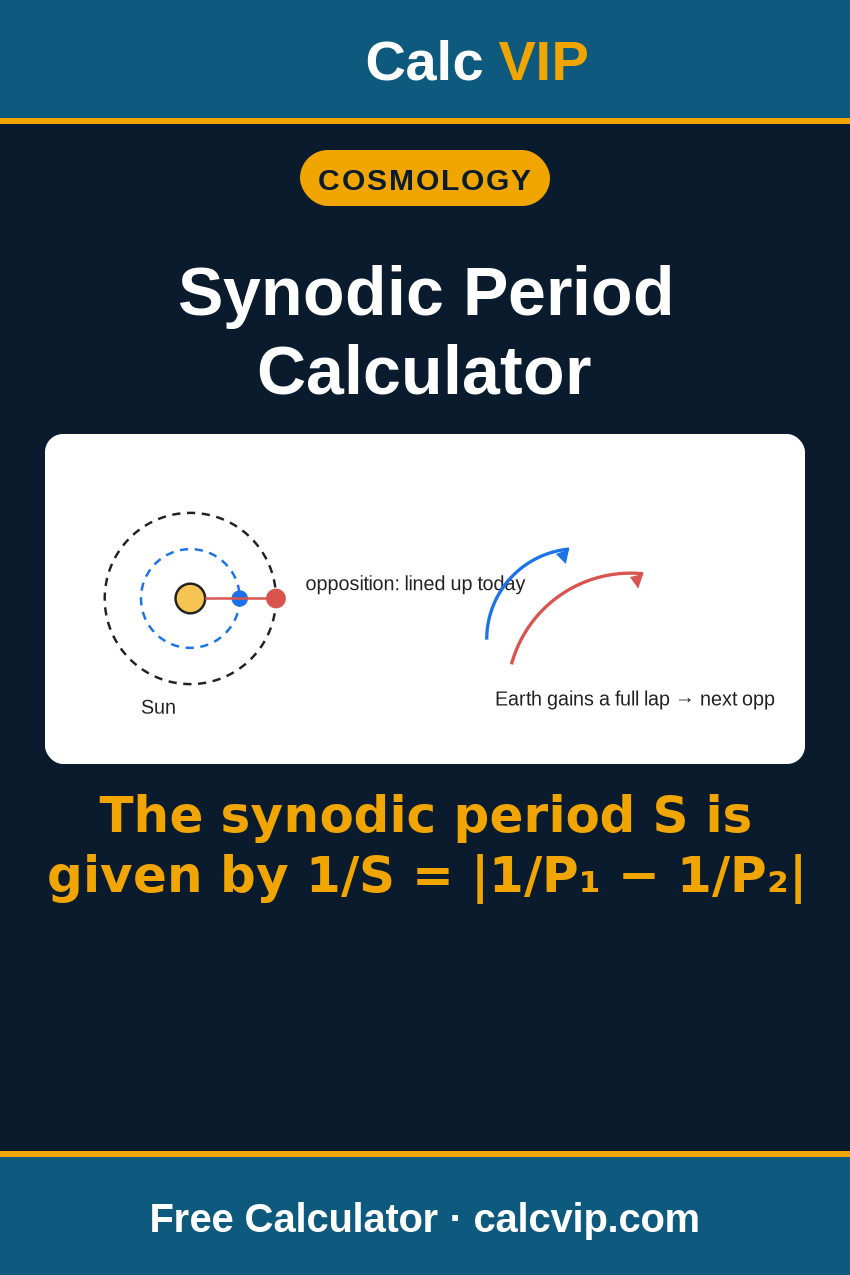
The mathematics is the mathematics of laps on a running track. If one runner completes a lap in P1 and a slower one in P2, the faster gains a full lap at a rate of (1/P1 − 1/P2) laps per unit time — the difference of frequencies. The time to gain exactly one lap, which is the time between line-ups, is the reciprocal of that difference: 1/S = |1/P1 − 1/P2|. The absolute value is the formula's quiet wisdom: it does not care which planet is faster. For an outer planet watched from Earth, Earth is the faster runner and S exceeds Earth's year modestly; for an inner planet like Venus, Venus is faster, and the same formula returns the 584-day cycle of its appearances as evening and morning star.
The Moon offers the homeliest example, so familiar it hides in plain sight. The Moon orbits in 27.3 days against the stars, but the phases repeat every 29.5 days. The difference is exactly this calculator at work: while the Moon completes one orbit, Earth has moved about a twelfth of the way around the Sun, so the Moon needs two extra days to regain the same alignment with the sunlight. Every calendar that tries to reconcile months with years — including the lunar and lunisolar calendars still in use — is negotiating with that 29.5-day synodic month.
Formula
The synodic period S is given by 1/S = |1/P₁ − 1/P₂|, where P₁ and P₂ are the two orbital (sidereal) periods. The faster planet gains a full lap on the slower one every S years. Equivalently, S = (P₁ × P₂) / |P₂ − P₁| — the product over the difference — which shows the two limiting behaviours at a glance: planets with very different periods line up on roughly the faster one's schedule, while planets with nearly equal periods (P₂ − P₁ small) take an age to realign, because the lap is gained so slowly. Periods may be entered in any unit — years here, days for moons — provided both use the same one; S comes out in that unit.
| Symbol | Meaning | Units |
|---|---|---|
| S | synodic period — time between successive line-ups | years (also shown in days) |
| P₁, P₂ | sidereal (true orbital) periods of the two planets | years |
| 1/P | orbital frequency — laps per year; synodic rate is the difference | per year |
Oppositions, conjunctions and the retrograde loop
For an outer planet, the synodic cycle has a dramatic centrepiece. As Earth catches up and passes the slower planet, the geometry of the line-up — opposition — places the planet opposite the Sun in our sky: rising at sunset, visible all night, nearest and brightest. And for a few weeks around opposition, the planet appears to reverse course against the stars, tracing the famous retrograde loop that ancient astronomers strained to explain with epicycles. Retrograde is pure synodic geometry: we overtake the planet on the inside track, and our own motion projects a temporary backwards sweep onto it, exactly as a slower car seems to drift backwards as you pass it on a motorway. The loop's recurrence interval is S — which is why Mars's retrogrades arrive every 26 months, Jupiter's every 13.
Inner planets run the same cycle in a different costume. Mercury and Venus never reach opposition; instead they alternate between evening and morning visibility, passing between Earth and Sun (inferior conjunction) and behind the Sun (superior conjunction) once per synodic period. Venus's 584-day cycle divides into about 263 days as evening star, a brief disappearance, 263 days as morning star, and a longer absence behind the Sun — a rhythm so regular that the Maya built a calendar table on it, and so striking that Venus's two apparitions were long mistaken for two different stars, the evening Hesperus and the morning Phosphorus.
How to use
- Pick the two planets — or choose "Custom period…" and type any period in years.
- Click "Calculate Synodic Period".
- You get the time between line-ups in years and in days.
- For moons or satellites, use the custom fields with periods in days (for example the Moon's 27.32 days against a planet's year in days) — the formula is unit-agnostic as long as both periods match.
Worked examples
Example 1 — Earth and Mars. Earth (P₁ = 1 year) and Mars (P₂ = 1.881 years):
1/S = |1/1 − 1/1.881| = 0.4684 → S = 2.14 years = 779.84 days
So Mars comes to opposition roughly every 780 days — about every 26 months — which is why Mars missions launch in windows about 26 months apart.
Example 2 — Earth and Jupiter. 1/S = |1 − 1/11.86| = 0.9157 → S = 1.09 years = 398.88 days. Jupiter's oppositions march through the calendar about a month later each year — this year in one constellation's season, next year a month on — completing the zodiac in about twelve years, as its sidereal period promises.
Example 3 — Earth and Venus. 1/S = |1/0.615 − 1| = 0.6260 → S = 1.60 years = 583.45 days. In that cycle Venus appears as the brilliant evening star, vanishes into the Sun's glare, re-emerges as the morning star, and hides again — the rhythm behind its ancient double identity.
Example 4 — Earth and Mercury. 1/S = |1/0.241 − 1| = 3.149 → S = 0.318 years = 115.98 days. Mercury's swift orbit makes its synodic cycle barely four months: three or four apparitions a year, each only a few weeks long, which is why so many people have never knowingly seen the innermost planet.
Example 5 — the Moon's phases. Feed the calculator the Moon's sidereal period in years, 27.32 days = 0.0748 yr, against Earth's 1 yr:
1/S = |1/0.0748 − 1| = 12.37 → S = 0.0809 yr = 29.53 days — the synodic month, the interval from full moon to full moon, recovered from the orbital period by the same formula that schedules Mars launches.
Example 6 — Earth and Saturn. 1/S = |1 − 1/29.45| = 0.9660 → S = 1.035 years = 378.09 days. Saturn is so slow that Earth laps it almost annually; its oppositions creep forward only about two weeks per year, and the changing tilt of its rings through the cycle is the main spectacle.
Synodic periods in real life
Mission launch windows. A spacecraft can only depart for another planet when the geometry lines up — at a specific point in the synodic cycle. Mars windows recur every 779.84 days; miss one and the next is 26 months away, a fact that has dictated the schedule of every Mars mission ever flown.
Planning observations. Opposition is when an outer planet is closest, largest and up all night. Amateur and professional observing programmes are built around synodic calendars: this calculator's output is the timetable.
Calendars and festivals. The synodic month (29.53 days) is the Moon's phase cycle, and twelve of them make 354 days — eleven short of the solar year. Purely lunar calendars drift through the seasons for exactly this reason; lunisolar calendars insert leap months to repair the mismatch.
Predicting transits and eclipses. Transits of Venus occur in pairs eight years apart, then not for over a century — a pattern hidden in the near-commensurability of Earth's year and Venus's synodic cycle (five synodic cycles ≈ eight years, to within two days).
Exoplanet follow-up. For planets around other stars the same arithmetic schedules observations: a transiting planet's visibility from a moving Earth, and the spacing of its transits as seen from a future space telescope, are synodic problems.
Communications with deep-space probes. Solar conjunctions — when a spacecraft passes behind the Sun as seen from Earth — recur on the synodic cycle of Earth and the target planet, and mission teams plan radio silence around them.
Near-resonances: when synodic cycles almost repeat
Some pairs of periods are nearly commensurate — small whole numbers of one almost equal small whole numbers of the other — and then the synodic pattern nearly repeats after a few cycles, producing astronomy's famous long rhythms. Five Venus synodic periods total 2,916.8 days; eight Earth years total 2,922 days — close enough that Venus traces almost the same pentagram of apparitions every eight years, and its transits come in eight-year pairs. The Saros cycle of eclipses (223 synodic months ≈ 239 anomalistic months ≈ 242 draconic months) is the same phenomenon in the Earth–Moon–Sun system. These near-misses are coincidences of the current epoch, not laws — periods drift over geological time — but while they last they give the sky a memory, and ancient astronomers, who had nothing but patience and records, found them.
Synodic periods beyond the planets
The formula belongs to any two cycles racing at different rates. A satellite in low Earth orbit (period ~92 minutes) laps the rotating Earth beneath it, so its ground track repeats on a synodic-like schedule that mission designers tune for reconnaissance revisit times. The Jupiter–Io–Europa system hosts a genuine three-body resonance in which the moons' periods are locked 1:2:4, and their conjunctions recur at the same longitude forever. Even a lighthouse and a ship's roll, or two pendulum clocks on a shared wall drifting into synchrony, obey the arithmetic of beat frequencies — 1/S = |1/P₁ − 1/P₂| is the beat formula, and the synodic period is simply the beat of the solar system's clocks, heard over years instead of seconds. One caution when applying the idea: synodic periods always describe two motions around a common centre. Pairings that do not share one — the Moon "versus" the Sun as seen from Earth, say — reduce to the phase-cycle case of Example 5 rather than a new instance of the formula.
Why Mars oppositions vary: the 764-to-811-day spread
The formula gives the mean synodic period, but Mars refuses to keep it exactly. Both orbits are ellipses, and Mars's is markedly eccentric (0.093, against Earth's 0.017), so the planets' angular speeds vary around their orbits and the geometry of each catch-up differs. Individual intervals between Mars oppositions range from about 764 days (when the line-up happens with Mars near perihelion, moving fast) to about 811 days (near aphelion). The same eccentricity makes perihelic oppositions — 2003's was the closest in roughly 60,000 years, at 55.8 million km — dramatically better observing events than aphelic ones. Jupiter's intervals vary less, Saturn's less still: the more circular the orbits, the more metronomic the synodic beat. When you plan around this calculator's output, allow the spread; when you teach with it, the spread is the doorway to Kepler's second law.
A second-order effect completes the picture: the planets' orbits are slowly precessing and their periods are, for practical purposes, constant, so the synodic pattern is stable over human timescales. The calendar of oppositions computed today will serve observers for centuries, drifting only through the slow accumulation of the small variations above — which is more than can be said for most clocks.
Quick reference: synodic periods from Earth
| Planet | Sidereal period (yr) | Synodic period (days) |
|---|---|---|
| Mercury | 0.241 | 115.98 |
| Venus | 0.615 | 583.45 |
| Mars | 1.881 | 779.84 |
| Jupiter | 11.86 | 398.88 |
| Saturn | 29.45 | 378.09 |
| Uranus | 84.02 | 369.65 |
| Neptune | 164.8 | 367.48 |
The outer-planet pattern is the formula's signature: as P₂ grows, 1/P₂ shrinks towards zero and S settles towards Earth's own year — the most distant planets are lapped almost annually, so their oppositions arrive like slow birthdays.
Common mistakes
- Using the synodic period as the orbital period. Mars's year is 687 days; its opposition cycle is 780. Quoting one for the other corrupts everything downstream — launch windows, observing plans, exam answers.
- Mixing units between the two periods. One period in years and the other in days silently wrecks the reciprocals. Convert both to the same unit first; the answer inherits that unit.
- Forgetting the absolute value. Without it, an inner planet paired with an outer one returns a negative period. The sign only records which planet is faster; the cycle length is its magnitude.
- Expecting exact repetition. Real orbits are elliptical and slightly perturbed, so individual intervals between oppositions vary by weeks around the mean S (Mars's range is roughly 764–811 days). S is the average rhythm, not a metronome.
- Pairing a planet with itself. Equal periods make the denominator zero — correctly: two bodies on identical orbits never gain a lap. The calculator flags this rather than dividing by zero.
FAQ
What is the difference between sidereal and synodic periods?
The sidereal period is the true orbital period measured against the stars. The synodic period is measured relative to the Sun as seen from the other planet, and it is what decides oppositions and phases.
What is Earth's synodic period with Jupiter?
1/S = |1 − 1/11.86| gives S ≈ 1.09 years ≈ 399 days, so Jupiter is at opposition about every 13 months.
Why does the Moon's phase cycle (29.5 days) differ from its orbit (27.3 days)?
Same idea: the Moon's synodic period relative to the moving Earth–Sun line is longer than its sidereal orbital period.
Why is Mars's synodic period longer than both planets' years?
Because Earth gains on Mars slowly: their frequencies differ by less than either frequency alone (1 − 0.53 = 0.47 laps per year), and a slow gain rate means a long wait for a full lap — 2.14 years.
What happens at a "great opposition" of Mars?
Mars's elliptical orbit means some oppositions occur near its perihelion, bringing it unusually close (about 56 million km against a typical 78 million). These perihelic oppositions recur roughly every 15–17 years — the synodic cycle beating against the orbit's own orientation.
Do moons have synodic periods too?
Yes — the phase cycle of any moon as seen from its planet is a synodic period. Our Moon's is the famous one; Jupiter's moons show phases on cycles of days by the same arithmetic.
Can the synodic period be shorter than both sidereal periods?
Shorter than the slower body's period, easily — Earth and Neptune line up every 367 days against Neptune's 165 years. But never shorter than the faster body's period: a full lap cannot be gained in less time than the faster runner takes to complete one lap, so S always exceeds min(P₁, P₂).
How did ancient astronomers find synodic periods?
By record-keeping across generations: Babylonian tablets track Venus's apparitions and Mars's retrogrades over centuries, and the periods emerge from the repetitions. Synodic periods are observable from one planet's surface, which is why they were known millennia before the sidereal periods were.
What is a synodic day on another planet?
The same idea applied to rotation: the solar day (noon to noon) is the synodic period of a planet's spin relative to the Sun. Mars's sol, 24 h 39 m, is its spin period (24 h 37 m) corrected synodically for its orbital motion.
Why do launch windows to Jupiter come every 13 months?
Because Earth–Jupiter geometry repeats on the 399-day synodic cycle. Missions like Juno and JUICE departed in such windows; miss one and the planets will not realign for over a year.