 Calc
Launch Speed Calculator – Find Launch Speed from Range & Angle
 Created by Sarah Mitchell · Physics Editor · Motion & Measurement · Last updated: November 2026
Use this free Launch Speed Solver Calculator to work backwards from a projectile's range: if you know how far it landed and the angle it was launched at, this finds the launch speed needed. It also shows the flight time and maximum height that go with that launch.
Most projectile problems run forwards: given a launch, predict the flight. This calculator runs the film backwards. You have watched something land — a ball, a shell, a jet of water — and measured where it came down and the angle it left at; from those two facts it reconstructs the one you could not measure directly: how fast it was launched. Inverse problems like this are how much of real physics is done, from artillery tables to the ejection speeds of volcanic bombs, because landings are easy to observe and launches are not.
The mathematics is a single rearrangement. Range obeys R = u² sin 2θ ÷ g, so the launch speed is u = √(Rg ÷ sin 2θ). Everything interesting hides in that sin 2θ: it peaks at θ = 45°, where a given range demands the least launch speed, and it falls away symmetrically, so complementary angles — 30° and 60°, 15° and 75° — demand identical speeds for identical ranges, one flight skimming low and quick, the other lobbing high and slow. The calculator reports the flight time and maximum height alongside the speed, because those are what separate the two otherwise-equal solutions.
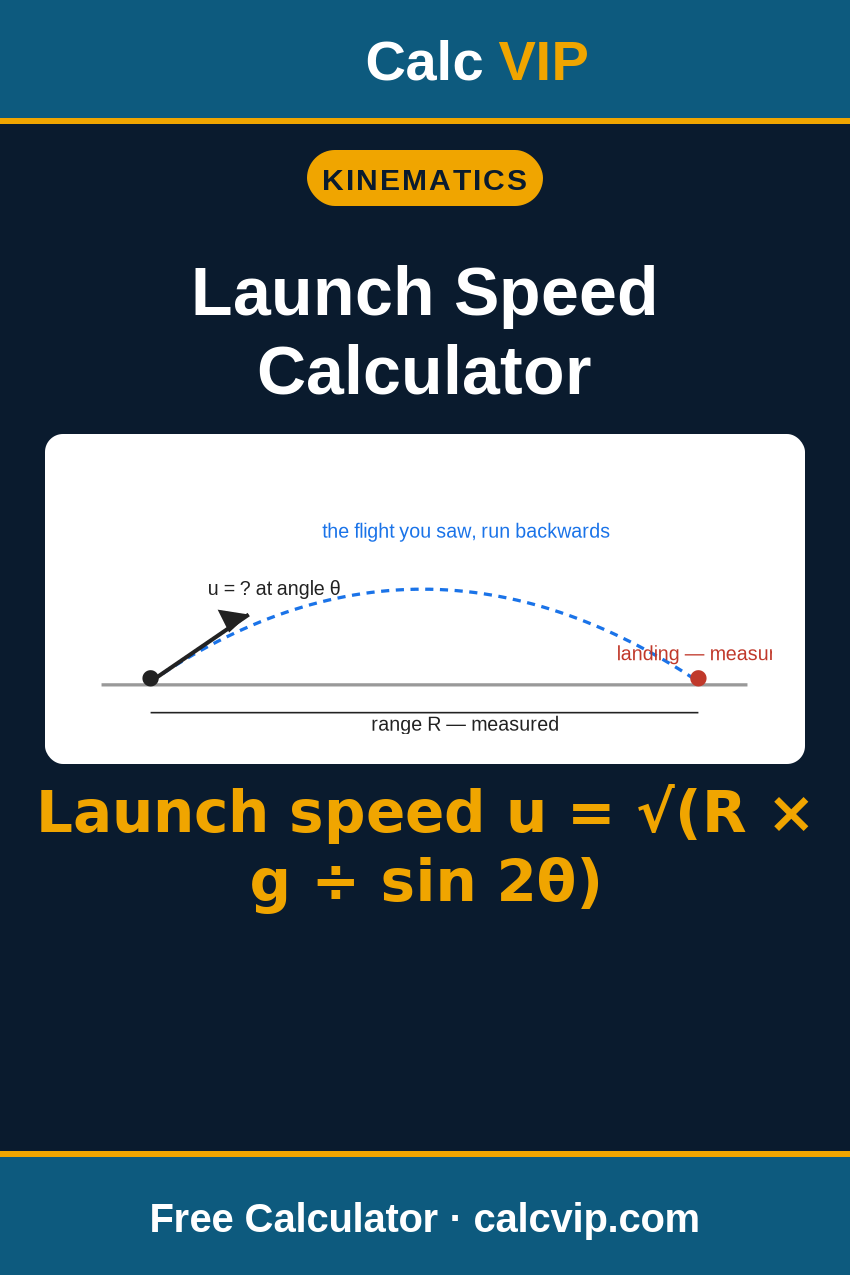
One assumption deserves to be stated before the numbers: launch and landing happen at the same height, and air resistance is ignored. Within those rails the reconstruction is exact. Outside them — a landing in a valley, a feather-light projectile in wind — the answer is a benchmark rather than a measurement, and the FAQ below explains which way reality bends it.
Formula
Launch speed u = √(R × g ÷ sin 2θ) • Flight time T = 2u sin θ ÷ g • Maximum height H = u² sin²θ ÷ (2g)
The solver's formula is the range equation R = u² sin 2θ ÷ g turned inside out: multiply both sides by g, divide by sin 2θ, take the square root. The two companion results then follow from the launch speed in the usual way — flight time is twice the vertical component divided by g (up-time and down-time are equal on level ground), and maximum height is the vertical component's energy height, (u sin θ)² ÷ (2g). One useful identity hides in the 45° case: there sin 2θ = 1, so u = √(Rg) and H = R ÷ 4 exactly — a projectile at 45° peaks at a quarter of its range, a check worth running mentally on any answer this page gives.
| Symbol | Meaning | Units |
|---|---|---|
| R | range — horizontal distance to the landing point | m |
| θ | launch angle above the horizontal | degrees |
| u | launch speed — the quantity solved for | m/s |
| T | total flight time | s |
| H | maximum height of the flight | m |
| g | gravitational acceleration (9.81 on Earth) | m/s² |
Two flights for every range: the complementary-angle pair
Because sin 2θ is symmetric about 45°, almost every (range, speed) pair corresponds to two possible flights. Given a range of 45 m, the solver finds u = 22.58 m/s whether the angle was 30° or 60° — but the flights could hardly differ more: the 30° launch is airborne for 2.3 s and peaks at 6.5 m, while the 60° launch hangs for 3.99 s and peaks at 19.49 m. Same speed, same range, utterly different journeys. Artillery officers have exploited the pair for centuries: the flat trajectory arrives quickly and is hard to shelter from; the lobbed one drops over walls and hills into courtyards. Mortars exist to be the second solution, howitzers to offer both.
The pair collapses into one at exactly 45°, where sin 2θ reaches its maximum of 1 and the required launch speed is minimised: umin = √(Rg). Any other angle demands more speed for the same range — the "speed factor" 1 ÷ √sin 2θ in the quick-reference table quantifies the tax: a mere 1.07 at 30° or 60°, but 1.41 at 15° or 75°, and unbounded as the angle approaches 0° or 90°, where the range shrinks to nothing however hard you launch.
How to use
- Enter the measured range R in metres — the horizontal distance from launch to landing, with both at the same height.
- Enter the launch angle θ in degrees. If you know the range and the flight time but not the angle, see the FAQ — the angle can be recovered from those instead.
- Adjust g if you are off Earth (Moon 1.62, Mars 3.71 m/s²).
- Click "Solve for Launch Speed" to get the launch speed in m/s and km/h, plus the flight time and maximum height of the reconstructed flight.
- Sanity-check with the 45° identity where relevant: at 45°, H should be exactly R ÷ 4.
Worked examples
Example 1 — the reference shot. A projectile launched at θ = 45° lands R = 80 m away. Launch speed u = √(80 × 9.81 ÷ sin 90°) = √784.8 = 28.01 m/s (100.85 km/h). Its flight time is T = 2 × 28.01 × sin 45° ÷ 9.81 = 4.04 s, and its maximum height is H = 784.8 × 0.5 ÷ 19.62 = 20 m — exactly R ÷ 4, as the 45° identity promises.
Example 2 — the flat solution. A range of 45 m at θ = 30°: u = √(45 × 9.81 ÷ sin 60°) = √(441.45 ÷ 0.866) = √509.7 = 22.58 m/s. Flight time T = 2 × 22.58 × 0.5 ÷ 9.81 = 2.3 s; maximum height H = 509.7 × 0.25 ÷ 19.62 = 6.5 m. A skimming flight, there and gone.
Example 3 — its high twin. The same 45 m at θ = 60° demands the same speed — sin 120° = sin 60°, so u = 22.58 m/s again — but now T = 2 × 22.58 × sin 60° ÷ 9.81 = 3.99 s and H = 509.7 × 0.75 ÷ 19.62 = 19.49 m. The calculator gives you both twins' vital statistics; only observation can tell you which one flew.
Example 4 — a golf drive. A drive carries 220 m at an optimal 45° (ignoring the aerodynamic lift real golf exploits): u = √(220 × 9.81) = √2158.2 = 46.46 m/s = 167.24 km/h, airborne for 6.7 s and peaking at 55 m. Real tour ball speeds are higher still, because drag taxes the flight and the launch angle is lower — the ideal figure is the floor beneath the real one.
Example 5 — the same shot on the Moon. With g = 1.62, an 80 m range at 45° needs only u = √(80 × 1.62) = √129.6 = 11.38 m/s, yet the flight lasts 9.94 s and still peaks at 20 m — the peak depends on u² ÷ g, and both shrank together. Lunar golf, as Alan Shepard demonstrated in 1971, is a game of patience.
Example 6 — a fire hose. A water jet lands 30 m from the nozzle at 45°: u = √(30 × 9.81) = √294.3 = 17.16 m/s, flight time 2.47 s, peak height 7.5 m. Firefighters invert this constantly: the reach of a branch is a launch-speed measurement written in water, and pump pressure is chosen to buy exactly the u the building demands.
Launch-speed solving in real life
Artillery and ballistics. Firing tables are this solver industrialised: for each gun, charge and angle, the range is measured on proving grounds and the muzzle velocity inferred. The modern chronograph measures u directly, but the tables were built — and are still checked — by range reconstruction.
Sports science. A javelin's or shot's release speed is routinely estimated from its measured carry and release angle when radar is unavailable. The method ranks athletes' techniques honestly, because it prices the angle's tax exactly.
Volcanology. Bombs found at measured distances from a vent, with ejection angles estimated from impact marks, give eruption velocities through this formula — the numbers that set exclusion zones around active craters.
Forensic reconstruction. Where an object landed after being thrown or projected — debris from an explosion or a collision — is evidence: the range and a plausible angle bound the launch speed, and with it the energy of the event that threw it.
Irrigation and fountain design. Sprinkler spacing is launch-speed engineering: the head's pressure sets u, the nozzle angle is fixed, and the range formula decides how far apart the heads can stand while their patterns still overlap.
Games and simulation. Every physics engine that lets a player lob a grenade on an arc solves this problem in reverse for its aim assist — choosing u for a chosen R and θ, sixty times a second. The formula on this page is, quite literally, a game mechanic.
The square-root economy of range
Range is bought at a square root's exchange rate: u = √(Rg ÷ sin 2θ) means doubling the range costs only √2 ≈ 1.41 times the speed, and quadrupling it costs exactly double. The quick-reference table shows the going rate at 45° — 10 m costs 9.9 m/s, 40 m costs 19.81, 90 m costs 29.71. This generosity is why projectile weapons and throwing sports scale so dramatically with modest speed gains, and also why they saturate: each further doubling of range demands the same multiplicative speed increase while the energy — proportional to u² — doubles every time the range does. Kinetic energy, not speed, is the true currency, and range is priced linearly in it: R = u² sin 2θ ÷ g says the range is the energy per unit mass, spent at an angle's efficiency.
The second witness: recovering the angle from the peak height
Range alone cannot fix both unknowns, but range plus maximum height can — and the key is a small identity worth memorising: for level flight, tan θ = 4H ÷ R. Divide the height formula by the range formula and the launch speed cancels entirely, leaving the angle standing alone. Check it against the worked examples: Example 1 has H = 20 m and R = 80 m, so tan θ = 80 ÷ 80 = 1 and θ = 45°, as launched. Example 2 has H = 6.5 m and R = 45 m: tan θ = 26 ÷ 45 = 0.578, and arctan of that is 30° — the flat twin recovered from two tape-measure facts. Once θ is known, this calculator returns u immediately. The identity also works as an audit: if a reported angle, range and peak height fail tan θ = 4H ÷ R, at least one of the three measurements is wrong — a consistency check built into the geometry, free of charge, that coaches and range officers use to catch bad data before it becomes bad conclusions.
Quick reference: launch speed for range at 45°, and the angle tax
| Range at 45° | Launch speed needed | Angle | Speed factor vs 45° |
|---|---|---|---|
| 10 m | 9.9 m/s | 15° / 75° | 1.41 |
| 20 m | 14.01 m/s | 20° / 70° | 1.25 |
| 40 m | 19.81 m/s | 30° / 60° | 1.07 |
| 60 m | 24.26 m/s | 40° / 50° | 1.01 |
| 80 m | 28.01 m/s | 45° | 1.00 |
| 100 m | 31.32 m/s | — | — |
To use the right-hand columns: find the 45° speed for your range, then multiply by the factor for your actual angle. A 60 m range at 30° needs 24.26 × 1.07 ≈ 25.96 m/s — the tax for leaving the optimal angle is often surprisingly small, which is why real launchers choose angles for other reasons (clearing obstacles, dropping steeply) almost for free, whenever the target allows it.
Common mistakes
- Using sin θ instead of sin 2θ. The range formula carries sin 2θ — the double angle. Substituting sin θ understates the divisor at most angles and inflates the solved speed, sometimes grossly.
- Degrees versus radians. sin 2θ must be evaluated with θ in the mode your calculator expects. Feeding 45 radians into the sine produces a meaningless factor and a launch speed from another universe.
- Assuming the landing is level when it is not. A projectile landing below its launch flies farther for the same speed, so the solver — assuming level ground — will overestimate the launch speed needed. Downhill ranges flatter the launcher.
- Expecting 45° to be optimal in air. Drag punishes the high, long flight, so real optimal angles sit below 45° — around 40° for many shells, near 30–35° for a shot put's release from height. The 45° rule is the vacuum benchmark this page computes.
- Forgetting that range alone cannot fix both u and θ. One range measurement is one equation: it determines u only once θ is supplied (or T or H). Two unknowns demand two observations — which is why the calculator asks for the angle.
FAQ
Where does the formula come from?
The range formula is R = u² sin 2θ ÷ g. Rearranging it to make u the subject gives u = √(Rg ÷ sin 2θ).
Why do two different angles give the same range?
Angles that add to 90° (like 30° and 60°) have the same sin 2θ value, so they produce the same range at the same speed — one flies low and fast, the other high and slow.
Does this work if the projectile lands lower than the launch point?
Not exactly — this solver assumes launch and landing at the same height. For a landing below the launch (e.g. off a cliff), the range is longer for the same speed.
Can I find the angle if I know the range and flight time instead?
Yes. The vertical motion gives sin θ = gT ÷ (2u) once u is known, and combining with the range: from T and R, the horizontal component is u cos θ = R ÷ T, and the vertical component is u sin θ = gT ÷ 2 — so θ = arctan(gT ÷ 2 ÷ (R ÷ T)) and u follows from either component. Two observations, two unknowns.
What launch speed does a human throw reach?
A strong baseball throw leaves the hand near 40 m/s; at 45° in vacuum that is a range of u² ÷ g ≈ 163 m — far beyond any real throw's carry, because drag and a lower release angle tax the flight heavily. The gap between the vacuum figure and reality is a fair measure of air resistance's importance at such speeds.
Why does the same range at 30° and 60° need the same speed but different times?
Because range depends on the product of the components (through sin 2θ = 2 sin θ cos θ), and swapping the components leaves the product unchanged. The flight time, though, is set by the vertical component alone — bigger at 60°, hence the longer hang.
How does air resistance change the solved speed?
Drag steals range, so a real projectile that landed at R must have been launched faster than this solver reports. The vacuum answer is a lower bound on the true launch speed — the faster and lighter the projectile, the larger the correction.
What if the projectile was launched from a height?
Then the range is longer for the same speed and angle, and this level-ground solver overestimates u. The correct treatment solves the full trajectory equation with the launch height included — the structure is the same, with one more term under the square root.
Is there a minimum range below which the solver fails?
No — the mathematics works for any positive range and any angle strictly between 0° and 90°. What fails near the extremes is practicality: at 5° the required speed is enormous (factor ≈ 2.4 over the 45° figure) and drag dominates everything.
How accurate is measuring range with a tape for this purpose?
Since u depends on √R, a 4% error in range becomes only a 2% error in speed — the square root forgives. Angle errors are less kind near the extremes: at 15°, a 1° error in θ moves sin 2θ by about 6%, and the solved speed by about 3%.