 Calc
Sound Distance Calculator – Inverse Square Law Intensity & dB
 Created by David Okafor · Physics Writer · Waves & Light · Last updated: November 2026
Use this free Sound Distance Calculator to find how much quieter a sound gets as you move away from its source, using the inverse square law. Enter the known intensity or sound level at one distance, then the new distance, and get the intensity and level there.
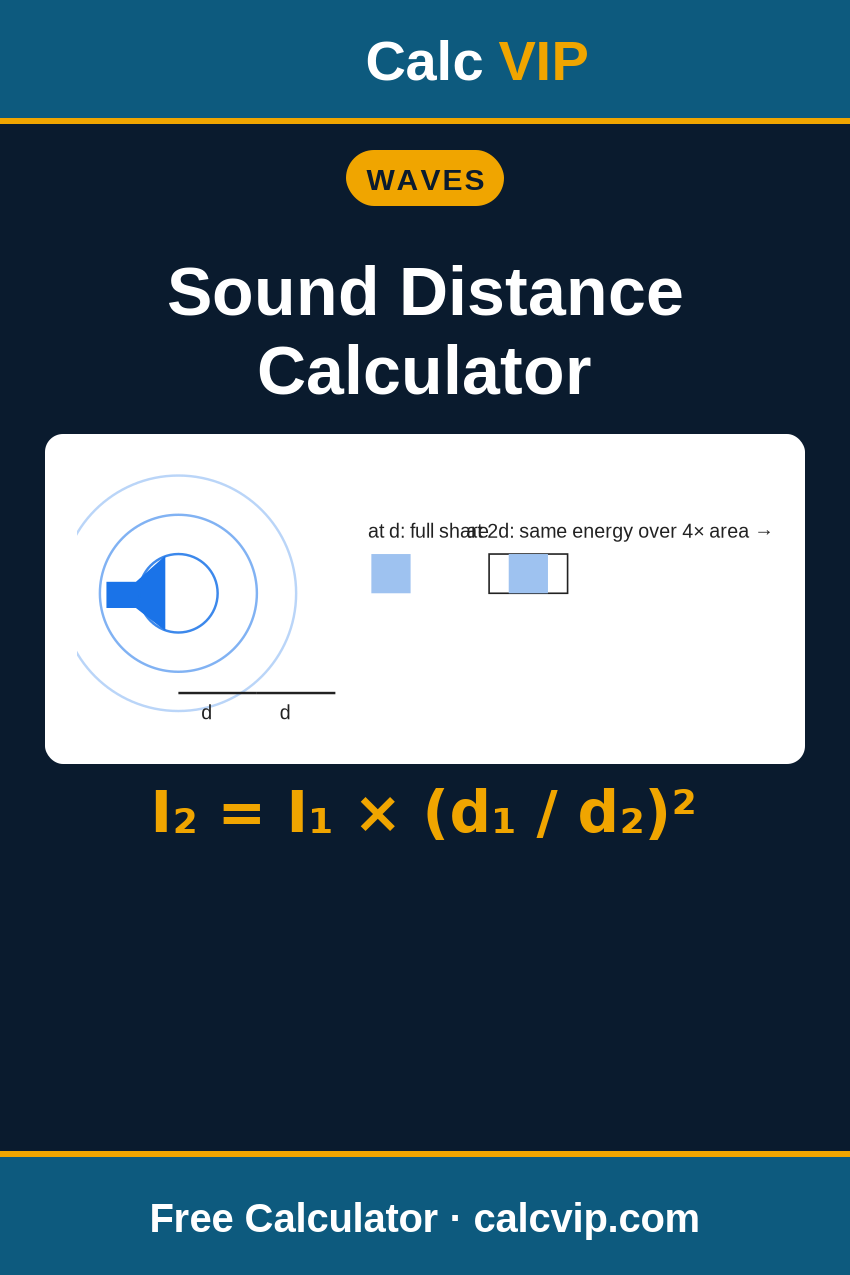
Step away from a loudspeaker and the sound does not fade gently — it collapses. Double your distance and the level drops by 6 decibels; double it again and another 6 go. The reason is geometry, not absorption: a source radiating into open air paints its energy over the surface of an expanding sphere, and the sphere's area grows with the square of its radius. The same fixed power spread over four times the area delivers a quarter of the intensity, and over a hundred times the area, a hundredth. This thinning-out is the inverse square law, and it governs not just sound but light, gravity and radiation — anything that spreads from a point into space.
Because decibels are logarithmic, the law has a beautifully simple working form: every doubling of distance costs the same 6.02 dB, and every tenfold increase in distance costs exactly 20 dB. Concert engineers chain doublings in their heads (1 m → 2 → 4 → 8 → 16 m is four doublings, about 24 dB gone), safety officers use the law to set distances from machinery, and neighbours learn it involuntarily when a party moves to the far end of a garden. This calculator does the full job properly: give it an intensity or a decibel level at one distance, and a second distance, and it returns both the intensity and the level at the new position.
One warning belongs at the front: the law describes a lone source in open space — the "free field". Real rooms bounce sound back from walls and ceilings, and real ground reflects it too, so indoors and near surfaces the level falls more slowly than the law predicts. The calculator's answers are the honest outdoor benchmark; the depth section below explains how reality bends them.
Formula
Inverse square law: I₂ = I₁ × (d₁ / d₂)² • Level change: L₂ = L₁ − 20 × log₁₀(d₂ / d₁)
Intensity I is in watts per square metre (W/m²); the reference intensity for decibels is I₀ = 10⁻¹² W/m².
The two formulas are one law in two dialects. The intensity form shows the physics: the ratio of distances, squared. The level form shows the practice: because a level is 10 × log₁₀(I/I₀), substituting the squared ratio turns the exponent into the factor 20 in front of the logarithm — the origin of the famous "20 log" rule and of the 6 dB per doubling (20 × log₁₀ 2 = 6.02). Moving closer runs the same equations backwards with the sign flipped: halving the distance adds 6.02 dB and quadruples the intensity. If you are given a level and need the intensity, invert the definition: I = I₀ × 10(L/10). The calculator moves freely between the two dialects, accepting either an intensity or a level as its starting point.
| Symbol | Meaning | Units |
|---|---|---|
| I₁, I₂ | sound intensity at distances 1 and 2 | W/m² |
| L₁, L₂ | sound level at distances 1 and 2 | decibels (dB) |
| d₁, d₂ | the two distances from the source | m |
| I₀ | reference intensity — the threshold of hearing | 10⁻¹² W/m² |
Why the square? Spheres, and where the law breaks
Picture the source as a light bulb radiating sound instead of light. At distance d the energy passes through a sphere of area 4πd²; at 2d the sphere's area is 4π(2d)² = four times larger, so each square metre receives a quarter of the power. Nothing is absorbed or lost — the energy is all still there, just spread thinner. That is why the law is called geometric attenuation, and why it is so relentless: it is not friction wearing the sound down, it is arithmetic. It is also why the same 1/d² appears in Newton's gravity and in the brightness of stars: the universe spreads everything from a point over spheres.
The assumptions hidden inside the picture matter as much as the law. The source must be small compared with the distances (a point source) and you must be far enough away that its size and directionality stop mattering — the "far field". A long motorway is not a point but a line, and its noise falls by only 3 dB per doubling, because a line spreads energy over a cylinder, not a sphere. Indoors, reflections refill the sound field: beyond the "critical distance" from a source, the reverberant level stays almost constant no matter where you stand, which is why a classroom's back row hears the teacher far better than the inverse square law alone would allow. And outdoors over long distances the air itself begins to absorb sound — high frequencies first — adding a slow extra fade on top of the geometry.
How to use
- Enter what you know at the first distance: either the intensity in W/m², or the sound level in decibels (dB). If you fill in both, the intensity is used.
- Enter distance 1 (where the known value was measured) and distance 2 (where you want the new value), both in metres.
- Click "Calculate Level at Distance 2" to get the intensity and sound level at the new distance.
- For a quick mental check, count the doublings between the two distances: each one is worth about 6 dB, and each tenfold step is worth 20 dB.
Worked examples
Example 1 — four metres from a speaker. A speaker measures 60 dB (intensity 10⁻⁶ W/m²) at 1 m. What is the level at 4 m?
I₂ = 10⁻⁶ × (1/4)² = 10⁻⁶ / 16 = 6.25 × 10⁻⁸ W/m²
L₂ = 60 − 20 × log₁₀(4) = 60 − 12.04 = 47.96 dB.
Example 2 — the lawnmower at the fence. A mower is 90 dB at 1 m. At the neighbour's fence, 10 m away, the level is L₂ = 90 − 20 × log₁₀(10) = 90 − 20 = 70 dB — still as loud as a vacuum cleaner, because a single tenfold step only buys 20 dB. Its intensity has fallen from 10⁻³ W/m² to 10⁻⁵ W/m², a hundredfold drop that the ear reports as merely "quieter".
Example 3 — the back of the concert field. A festival PA measures 100 dB at 2 m. At a barrier 32 m back, the distance ratio is 16, so L₂ = 100 − 20 × log₁₀(16) = 100 − 24.08 = 75.92 dB. Four doublings, four lots of 6 dB — which is why big fields need delay towers to top the level back up.
Example 4 — moving closer to a whisper. A whisper is 30 dB at 1 m. Lean in to 0.25 m and the law runs in reverse: L₂ = 30 − 20 × log₁₀(0.25) = 30 + 12.04 = 42.04 dB. Two halvings of distance, two gains of 6 dB — a whisper in the ear really is dramatically louder than a whisper across a desk.
Example 5 — the doubling chain. A machine is 80 dB at 1 m. Then: at 2 m, 80 − 6.02 = 73.98 dB; at 4 m, 67.96 dB; at 8 m, 61.94 dB; at 16 m, 55.92 dB. Four doublings cost 24 dB in total, and the intensity at 16 m is 1/256 of the value at 1 m — the square law quietly compounding.
Example 6 — how far until the siren is conversation-quiet? A siren is 120 dB at 1 m; you want the distance where it falls to 60 dB. The needed drop is 60 dB, and since 20 × log₁₀(d₂/d₁) = 60 gives log₁₀(d₂) = 3, the answer is d₂ = 1,000 m — a full kilometre. Decibel problems that look enormous often collapse into clean powers of ten.
Sound and distance in real life
Hearing-safety distances. Regulations quote machinery noise at a reference distance and let employers work out safe zones with this law: a tool at 100 dB at 1 m reaches the 85 dB action level at about 5.6 m — the calculation behind painted lines on factory floors.
Home cinema and hi-fi. Speaker sensitivity is specified at 1 m; your sofa at 3–4 m sits 10–12 dB below that figure, which is why amplifier power requirements climb so fast for large rooms.
Noise complaints and planning. Environmental assessments predict a venue's or road's level at the nearest home with the inverse square law (plus corrections), and licensing decisions turn on the result.
Alarm design. A fire alarm must reach a set level at the furthest bedhead; designers start from the sounder's 1 m rating and subtract 6 dB per doubling along the corridor, adding sounders where the arithmetic runs out.
Wildlife recording. A recordist who halves the distance to a singing bird gains 6 dB of bird against the background noise — the cheapest signal-to-noise improvement in field recording is simply getting closer, law permitting.
Stadium and festival PA. Delay towers exist because of Example 3: beyond a few tens of metres the main system's level has fallen too far, so timed satellite speakers restart the distance clock for the back of the crowd.
There is a useful way to hold the indoor picture together. Close to a source, the direct sound — the part that obeys this page's law — dominates what you hear. Further away, the reflected, reverberant sound, which is roughly the same level everywhere in the room, takes over. The crossover is called the critical distance, and it explains a familiar experience: in a lively hall a conversation is easy at arm's length and hopeless across the room, not because the far voice is weak in absolute terms but because it is buried under the room's own recycled sound. Recording engineers place microphones inside the critical distance for clarity; architects push it outward with absorbent surfaces. The calculator's law still prices the direct sound exactly — it is the other ingredient, the room's contribution, that must be estimated separately.
Quick reference: what a distance change does to the level
| Distance multiplied by | Level change | Intensity multiplied by |
|---|---|---|
| × 2 | −6.02 dB | 0.25 |
| × 3 | −9.54 dB | 0.111 |
| × 4 | −12.04 dB | 0.0625 |
| × 5 | −13.98 dB | 0.04 |
| × 10 | −20 dB | 0.01 |
| × 100 | −40 dB | 0.0001 |
| ÷ 2 (moving closer) | +6.02 dB | 4 |
The intensity column is the sobering one: step ten times further away and your ear receives one hundredth of the power, yet reports the sound as only 20 dB — roughly "a quarter as loud" — down. Human hearing compresses enormous physical ratios into modest sensations, which is exactly why the decibel scale was invented.
Ground, wind and barriers: how the real world edits the law
Outdoor sound rarely travels through empty space, and three everyday effects bend the calculator's clean predictions. First, the ground: sound reaching a listener arrives by a direct path and by a path reflected off the ground, and the two can reinforce or partially cancel depending on frequency and geometry — one reason levels over soft, absorptive ground (grass, snow, ploughed earth) fall faster than the law predicts, while sound over water or concrete can carry slightly further. Second, wind and temperature gradients refract sound: downwind, or on a still night with warm air aloft, rays bend back towards the ground and distant sources sound startlingly clear; upwind, they bend away and a shadow zone forms. None of this breaks the inverse square law — it still governs the spreading along each bent path — but it explains why the same source at the same distance can differ by 10 dB between a windy afternoon and a calm evening.
Third, barriers. A wall or fence between source and listener forces sound to diffract over the top, and the detour costs energy: a well-placed noise barrier typically buys 5–15 dB of extra reduction on top of distance losses, with the biggest wins when the barrier breaks the line of sight close to the source or the listener. Environmental engineers combine all three corrections — geometric spreading from this page, ground and air absorption, barrier diffraction — to predict a new road's noise at a bedroom window to within a few decibels. The inverse square term is always the largest single entry in that budget, which is why doubling a setback distance remains the cheapest noise control ever devised.
Common mistakes
- Using 10 × log for a distance ratio. The 10 belongs to intensity and power ratios; distance enters squared, so its level formula carries 20. Using 10 halves every drop — you would predict 3 dB per doubling instead of 6.
- Thinking intensity halves when distance doubles. It quarters. The area grows as the square, so doubling the distance divides intensity by four; halving happens at about 1.41× the distance.
- Applying the law indoors without correction. In a room, reflections add a reverberant field that does not fall with distance. Predictions from the bare law will understate levels at the back of halls and classrooms badly.
- Treating decibels as linear. A drop from 100 dB to 50 dB is not "half the sound" — it is a hundred-thousandfold fall in intensity, perceived as roughly a thirty-second of the loudness. Always convert through the formulas, never by proportion.
- Measuring too close to the source. Within a distance comparable to the source's own size, the point-source assumption fails and the law overstates the fall. Start your reference measurement at least a few source-widths away.
FAQ
Why is it called the inverse square law?
The sound energy spreads out over the surface of an expanding sphere, whose area grows with the square of the distance. Double the distance and the same energy covers four times the area, so the intensity falls to one quarter.
How many decibels do I lose when I double the distance?
About 6 dB, every time the distance doubles (in open air, away from walls and the ground). Moving from 1 m to 8 m costs about 18 dB.
Does this work indoors?
Only approximately. Indoors, reflections from walls, ceiling and floor add sound back, so the level falls more slowly with distance than the inverse square law predicts.
How far away do I need to be to drop the level by 20 dB?
Ten times your starting distance, since 20 × log₁₀(10) = 20. From a reference point at 1 m, that is 10 m; from 3 m, it is 30 m. The rule "twenty decibels per tenfold distance" is the fastest form of this whole page.
Why 6 dB per doubling for distance but 3 dB for doubling power?
They are different doublings. Doubling a source's power doubles its intensity everywhere: 10 × log₁₀(2) = 3.01 dB. Doubling your distance quarters the intensity: 10 × log₁₀(1/4) = −6.02 dB. The two rules coexist because intensity depends on the square of distance but only linearly on power.
Does the same law govern light and gravity?
Yes — anything radiating or reaching outward from a point into three-dimensional space thins over spheres of area 4πd². Starlight, radio signals, X-rays and gravitational pull all obey inverse square laws; sound intensity is simply the version you can hear.
What if there are two identical speakers?
Two equal sources radiating together double the total power, adding 3.01 dB at any given distance — noticeably louder, but not the dramatic change people expect from "twice the speakers". Four speakers add 6 dB. This is why venue systems scale up in multiples, not singles.
Why does traffic noise fall more slowly than the law predicts?
A road is a line source, not a point: its sound spreads over the surface of an expanding cylinder, whose area grows only in proportion to distance. The result is about 3 dB per doubling of distance instead of 6 — one reason motorways remain audible so far away.
Can I use the calculator for underwater sound or light?
The geometry is identical — enter distances and a starting intensity or level and the ratios hold. What changes between media are the reference values (underwater acoustics uses a different reference pressure) and extra absorption, so treat cross-media absolute levels with care while trusting the distance ratios.
At what distance does the law start working?
Once you are a few times further away than the source's largest dimension — the far field. For a person speaking, that is well under a metre; for a large PA stack or a machine hall, several metres. Inside that zone levels vary with position in complicated ways the simple law cannot capture.