 Calc
Impact Velocity Calculator – Fall Speed on Any Planet
 Created by Priya Sharma · Physics Editor · Energy & Gravity · Last updated: November 2026
Use this free Impact Velocity Calculator to find how fast an object is moving after falling from a height on any planet. The planet's surface gravity is worked out from its mass and radius first, then the fall speed follows.
Drop something, and gravity turns height into speed at a rate that surprises almost everyone the first time they compute it. A fall of just 100 metres on Earth — the height of a 30-storey building — ends at 44 metres per second, about 160 km/h, faster than most motorway traffic. The same drop on the Moon ends at a comparatively gentle 18 m/s, while on Jupiter it ends at a lethal 72 m/s. The only thing that changes between those worlds is the strength of surface gravity, and this calculator builds the answer from the planet itself: give it a mass and radius, and it first derives the surface gravity g = GM/R², then applies the fall formula.
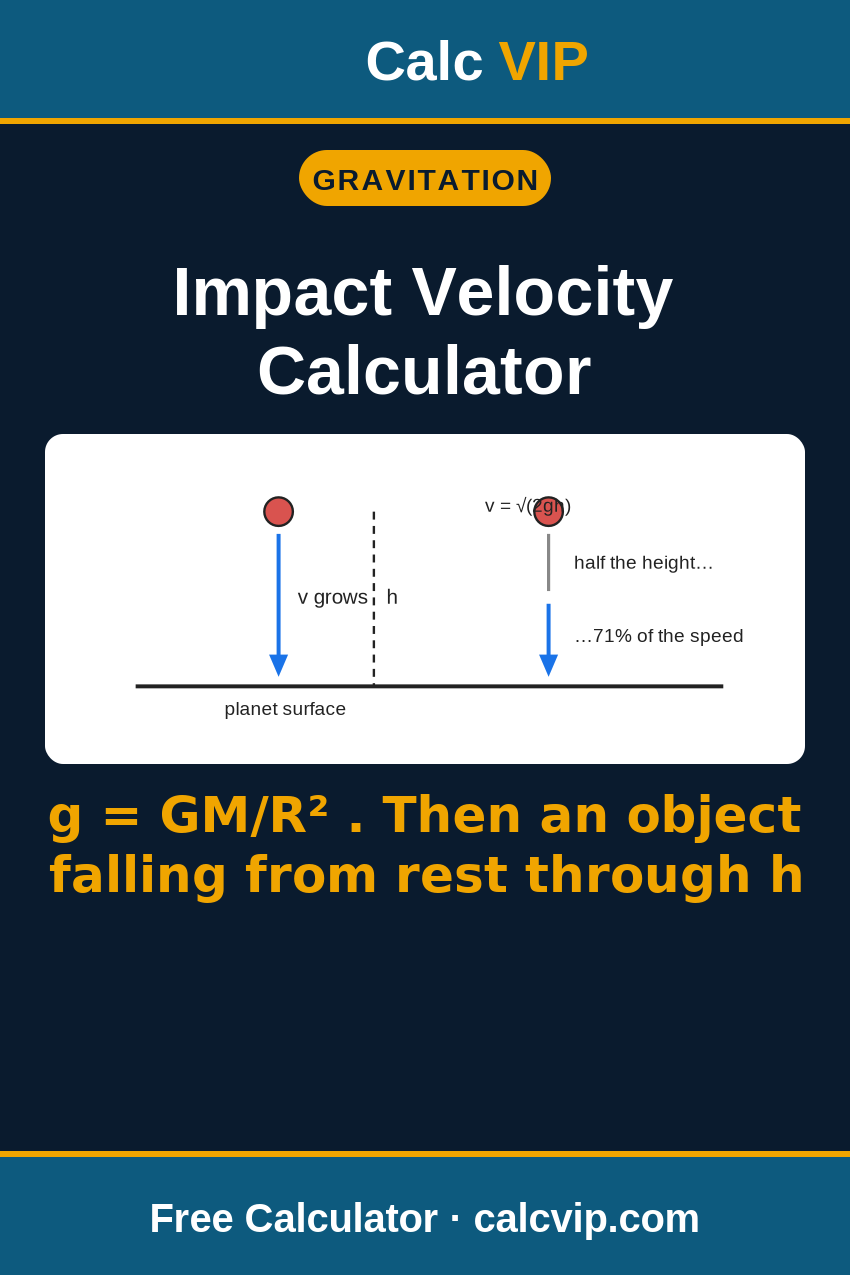
The fall formula itself is one of the most satisfying in elementary physics, because it comes from energy rather than from tracking the motion second by second. An object at height h stores gravitational potential energy mgh; arriving at the ground, all of it has become kinetic energy ½mv². Setting the two equal, the mass cancels — which is the algebra's way of stating Galileo's great discovery that, air aside, everything falls together. What remains, v = √(2gh), says the impact speed grows only with the square root of the height: quadruple the drop and you merely double the speed.
Use the presets to tour the solar system's gravity, or invent a world of your own with any mass and radius. The calculator reports the surface gravity it derived and the impact speed in both m/s and km/h. One honest warning, which the depth sections below explore: the formula assumes no air resistance, so treat its Earth answers for long falls as ceilings that real, drag-limited falls never quite reach.
Formula
First the surface gravity: g = GM/R². Then an object falling from rest through height h (with no air resistance) reaches v = √(2gh) • v in m/s, g in m/s², h in metres, G = 6.674 × 10⁻¹¹ N·m²/kg².
The two formulas rearrange to cover the neighbouring questions. Given an impact speed and a planet, the drop height was h = v²/(2g) — the formula accident investigators effectively run backwards. Given a fall time instead of a height, constant acceleration gives v = gt and h = ½gt², so the impact speed can equally be written v = √(2gh) with h eliminated. And given a target impact speed on a world of known radius, the gravity — hence the mass — the world must have is M = v²R²/(2Gh). Notice what is absent from every version: the falling object's own mass. It cancels in the energy balance mgh = ½mv², and it would cancel in the force balance too, because a heavier object is both pulled harder and harder to accelerate, in exactly the same proportion.
| Symbol | Meaning | Units |
|---|---|---|
| v | impact velocity after falling height h | m/s (calculator also gives km/h) |
| g | surface gravity, GM/R² | m/s² |
| h | drop height | m |
| M, R | planet mass and radius | kg, km (calculator input) |
| t | fall time, √(2h/g) | s |
Why everything falls together — and when it doesn't
The cancellation of mass in v = √(2gh) is one of the deepest facts in physics wearing a simple disguise. It works because the mass that gravity pulls on (gravitational mass) and the mass that resists acceleration (inertial mass) are the same quantity — an equivalence Einstein elevated into the foundation of general relativity. Its most famous demonstration was performed on live television from the Moon: in 1971 Apollo 15 commander David Scott dropped a geological hammer and a falcon feather together, and in the Moon's airless gravity they struck the dust at the same instant, exactly as this formula insists. On Earth the experiment fails in public because air refuses to cooperate: drag depends on shape and speed but not on the energy bookkeeping, and it grows with v² until, for light or bulky objects, it balances gravity entirely.
That balancing point is terminal velocity, and it marks the honest boundary of this calculator. A skydiver in a belly-down posture reaches about 55 m/s, at which point the formula's implied drop height is only about 154 m — every metre fallen beyond that adds nothing. A raindrop reaches its terminal velocity of roughly 9 m/s within its first few metres of fall, which is why rain from kilometres up arrives as a sting rather than a bullet. Dense, compact objects — a steel ball, a meteorite, a hammer on the Moon — stay close to the formula for any realistic height. The rule of use is simple: the denser and smaller the object compared with the air it pushes aside, and the thinner the atmosphere, the more truthfully √(2gh) describes the landing.
How to use
- Pick a planet preset — Earth, Moon, Mars or Jupiter — to fill in its mass and radius, or choose Custom and enter any mass in kilograms and radius in kilometres.
- Enter the drop height h in metres, measured from where the object is released to where it lands.
- Click "Calculate Impact Velocity" to get the derived surface gravity g and the impact speed in m/s and km/h.
- Sanity-check the gravity first: if the printed g is not the world you intended (9.82 for Earth, 1.62 for the Moon, 3.73 for Mars), a mass or radius has been mistyped — the impact speed inherits any such error.
- For falls on Earth through air, read the result as an upper bound: real objects, especially light or flat ones, land slower because of drag, as the section above explains.
Worked examples
Example 1 — a 100 m drop on Earth. Drop an object from h = 100 m on Earth (M = 5.972 × 10²⁴ kg, R = 6,371 km):
g = GM/R² ≈ 9.82 m/s²
v = √(2 × 9.82 × 100) = √1964 ≈ 44.32 m/s ≈ 159.54 km/h.
On the Moon the same drop gives only about 18.03 m/s, because lunar gravity is just 1.62 m/s².
Example 2 — the same 100 m on the Moon. M = 7.348 × 10²² kg, R = 1,737.4 km, h = 100 m.
g = GM/R² ≈ 1.62 m/s²; v = √(2 × 1.62 × 100) ≈ 18.03 m/s ≈ 64.89 km/h.
The fall also takes its time: t = √(2h/g) ≈ 11.1 seconds, against 4.5 seconds on Earth — the stately, floating quality of Apollo footage is this arithmetic made visible.
Example 3 — a 100 m drop on Mars. M = 6.417 × 10²³ kg, R = 3,389.5 km, h = 100 m.
g ≈ 3.73 m/s²; v = √(2 × 3.73 × 100) ≈ 27.30 m/s ≈ 98.30 km/h.
Mars's thin air offers almost no braking, so unlike on Earth this figure is close to the truth for real objects — one reason landing heavy hardware on Mars is famously hard: nothing slows the descent for free.
Example 4 — a 100 m drop on Jupiter. M = 1.898 × 10²⁷ kg, R = 69,911 km (mean radius), h = 100 m.
g = GM/R² ≈ 25.92 m/s²; v = √(2 × 25.92 × 100) ≈ 72.00 m/s ≈ 259.19 km/h.
There is no surface to land on — Jupiter is gas all the way down — but the number still governs how fast infalling comets and spacecraft plunge into the cloud tops before the atmosphere takes over.
Example 5 — falling off a roof on Earth. h = 10 m, a two-storey house.
v = √(2 × 9.82 × 10) ≈ 14.01 m/s ≈ 50.45 km/h.
This is the speed of a car in city traffic, reached in just 1.43 seconds — a useful calibration for why even "short" falls onto hard ground are so dangerous, and why fall-arrest equipment is designed around arresting this much speed within a metre or so.
Example 6 — an invented world. M = 1 × 10²⁴ kg, R = 5,000 km, h = 50 m.
g = GM/R² ≈ 2.67 m/s²; v = √(2 × 2.67 × 50) ≈ 16.34 m/s ≈ 58.83 km/h.
A world with a sixth of Earth's mass in a smaller ball pulls a little harder than the Moon; a 50 m cliff there is roughly as dangerous as a 14 m cliff at home, by the h = v²/2g rearrangement.
Impact velocity in real life
Meteorites arrive at least this fast. An asteroid falling to Earth gains speed from Earth's gravity on top of whatever speed it brought from space. Even one starting from rest relative to Earth would strike at escape velocity — 11.2 km/s, which is this formula with h effectively infinite — and real impactors arrive at 12–70 km/s, which is why a modest rock can release the energy of a nuclear arsenal.
Crash and safety engineering. Vehicle crash standards are set in exactly these terms: a 50 km/h barrier test reproduces the impact of a fall of about 10 m, and crumple zones, airbags and fall-arrest harnesses are all devices for stretching the stopping distance once √(2gh) has fixed the arrival speed.
Hailstones and terminal velocity. A large hailstone's damage is set by its terminal velocity, around 40 m/s for the biggest stones — near the vacuum-formula speed for a fall of only 80 m, because drag caps it there. The formula explains the cap's neighbourhood; aerodynamics explains the cap.
Planetary landers budget for it. Every Mars lander must kill the speed gravity keeps adding during descent, with heat shield, parachute and rockets in sequence. On the airless Moon there is no parachute option at all: the entire arrival speed, built by lunar gravity from orbit, must be cancelled by rocket thrust — the arithmetic of this page with the sign reversed.
Cliff divers and stunt falls. A diver leaving a 27 m platform — the competitive high-diving height — enters the water at √(2 × 9.82 × 27) ≈ 23 m/s, about 83 km/h, which is why the water must be aerated to soften the entry and why the margin for a bad landing is so thin.
Volcanic bombs and falling debris. Blocks thrown a kilometre into the air by an eruption return at up to 140 m/s in vacuum terms; drag trims the smaller fragments, but the large blocks that threaten volcanologists land close to the formula's figure — one reason exclusion zones are drawn in kilometres, not metres.
The energy view: why the square root rules everything
Read the formula as an energy statement and several puzzles dissolve at once. The kinetic energy at impact, per kilogram, is simply gh — for the 100 m Earth drop, 982 joules per kilogram. Doubling the height doubles the energy but multiplies the speed only by √2 ≈ 1.41, because energy grows with v². This is why the middle of a fall is deceptively slow: an object dropped from 100 m passes the halfway height, 50 m, already travelling at 31.3 m/s — 71% of its final speed — and gains the remaining 29% in the last half of the distance. It is also why braking distances in cars quadruple when speed doubles, and why meteorite energy estimates, not speeds, are the numbers that matter: the energy is what the ground has to absorb.
Quick reference: a 100 m fall across the solar system
| Body | Surface gravity g | Impact speed from 100 m | Fall time |
|---|---|---|---|
| Moon | 1.62 m/s² | 18.03 m/s (64.89 km/h) | 11.1 s |
| Mercury | 3.70 m/s² | 27.21 m/s (97.96 km/h) | 7.35 s |
| Mars | 3.73 m/s² | 27.30 m/s (98.30 km/h) | 7.32 s |
| Venus | 8.87 m/s² | 42.12 m/s (151.62 km/h) | 4.75 s |
| Earth | 9.82 m/s² | 44.32 m/s (159.54 km/h) | 4.51 s |
| Jupiter | 25.92 m/s² | 72.00 m/s (259.19 km/h) | 2.78 s |
Mercury and Mars make an instructive pair: nearly identical surface gravities from utterly different planets — Mercury small and dense, Mars larger and fluffier — because g cares only about the combination M/R². Venus, meanwhile, nearly matches Earth despite its crushing atmosphere being irrelevant to the vacuum arithmetic; its thick air would in practice slow real falls far below the listed figure.
Common mistakes
- Trusting the formula through thick air. √(2gh) is the no-drag answer. For falls of more than a few tens of metres on Earth, light or flat objects land much slower; even dense ones drift below the figure on kilometre falls. Treat Earth results for large h as ceilings.
- Doubling the height and expecting double the speed. Speed grows with √h. Four times the height gives twice the speed; a hundred times the height gives only ten times the speed.
- Entering the radius in metres, or the height in kilometres. The calculator wants radius in km and height in m, exactly as labelled. A radius typed in metres inflates g a millionfold and produces absurd speeds — check the printed g against the known value for your planet.
- Assuming a heavier object lands faster. In vacuum it does not — mass cancels. If a heavy and a light object land differently in an experiment, the difference is air resistance, not gravity.
- Using surface gravity for very tall falls. g weakens with altitude as 1/r². For drops comparable to the planet's radius — a fall from a high orbit — the constant-g formula fails and the energy must be computed with the full potential, GM(1/R − 1/(R+h)). For building-height drops the difference is invisible.
FAQ
Why doesn't the falling object's mass matter?
Mass appears on both sides of the energy equation (mgh = ½mv²) and cancels out. In a vacuum, a hammer and a feather dropped together hit the ground at the same speed — as Apollo 15 famously demonstrated on the Moon.
When is this formula not accurate?
When air resistance matters. On Earth, light or large objects reach a terminal velocity and stop accelerating, so the real impact speed is lower than √(2gh).
What impact speed does a 1 km fall give on Earth?
v = √(2 × 9.82 × 1000) ≈ 140.14 m/s ≈ 504 km/h — ignoring air resistance, which in reality would slow the fall a lot.
How long does a fall take?
From rest under constant gravity, t = √(2h/g). The 100 m Earth drop takes about 4.5 seconds; the same drop on the Moon takes about 11.1 seconds. The average speed during the fall is exactly half the impact speed, which is a handy cross-check: 100 m at an average of 22.16 m/s takes 4.51 s.
Does the formula work if the object is thrown downward?
Yes, with one extra term: v² = v₀² + 2gh, where v₀ is the throwing speed. A ball thrown down at 10 m/s from 100 m on Earth lands at √(100 + 1964) ≈ 45.4 m/s — the throw adds surprisingly little once gravity has had a long fall to work with, because speeds add in quadrature, not directly.
What is terminal velocity, in one sentence?
It is the speed at which air resistance, growing with v², exactly balances gravity, so acceleration stops — about 55 m/s for a spread-eagled skydiver, 9 m/s for a raindrop, and effectively infinite for a hammer on the airless Moon.
How fast would something hit Earth falling from very far away?
At most, starting from rest at infinity, it arrives at escape velocity: 11.2 km/s. That is the ceiling gravity alone can impose, and it equals the speed needed to leave — the symmetry between falling in and climbing out that the energy formula guarantees.
Why do cats survive falls that injure people?
Mostly terminal velocity and proportions: a cat's low mass relative to its surface area gives it a terminal velocity around 27 m/s, reached after roughly 20 m of fall, and a body built to absorb that landing. The formula still applies — the cat simply stops accelerating early, at a survivable speed.
Would a fall on an asteroid be dangerous?
Barely, and slowly. On a body with g of a few thousandths of a m/s², a 100 m fall ends at walking pace but takes minutes, and escape velocity may be only a few m/s — jump too enthusiastically and the bigger risk is not landing at all.
Is the impact speed the same as the speed a moment before landing?
Yes — "impact velocity" is precisely the velocity at the instant of contact, before any crumpling, bouncing or splashing begins. What happens after contact depends on how quickly that speed is brought to zero, which is the whole science of cushioning.